DSA Campaigns Are Being Killed by Google. Here’s What to Do Before September 2026.
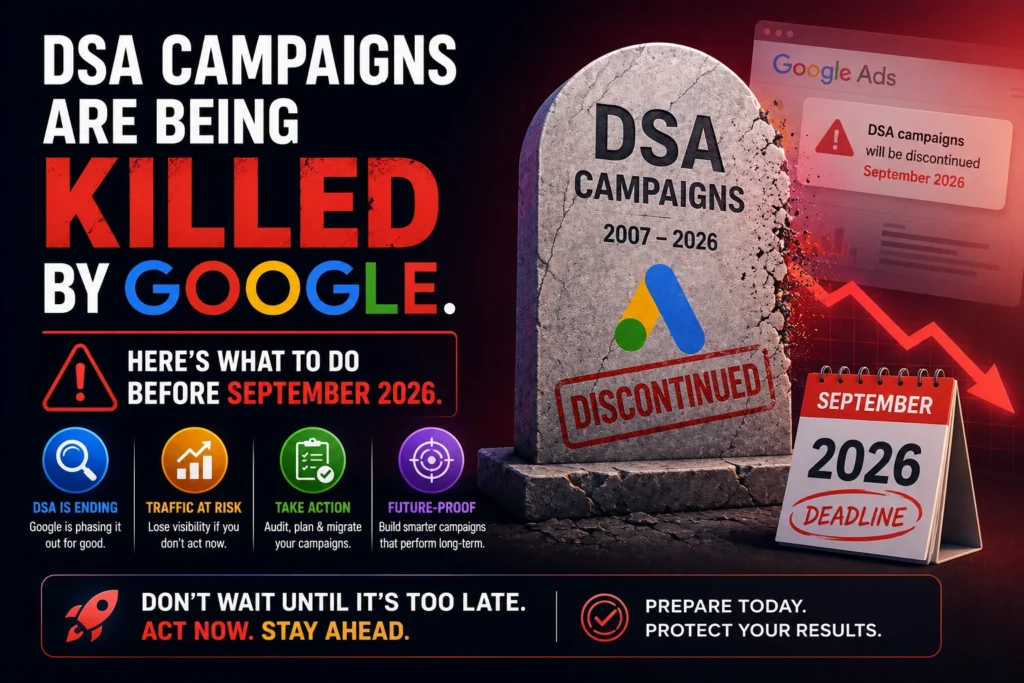

Dynamic Search Ads DSA deprecation is no longer a rumour on an industry forum – it is a confirmed, dated, mandatory transition with a hard deadline of September 2026. On April 15, Google officially announced that DSA campaigns, along with Automatically Created Assets (ACA) and campaign-level broad match settings, will be automatically upgraded to AI Max for Search beginning this September. No opt-out exists. No extension has been offered. If you are still running DSA campaigns and you haven’t started your migration, the clock is ticking.
In this article16 sections
This is the most significant structural change to Google’s search advertising platform since Smart Shopping was retired in favour of Performance Max in 2022. And just like that transition, brands that migrate on their own terms will have significantly more control over how their campaigns are configured than those who wait for Google to do it for them.
At Search Savvy, we have been tracking this announcement since it dropped and working through its implications for clients across India and internationally. This post gives you every confirmed fact, the complete migration timeline, what AI Max actually is, and the step-by-step action plan to protect your paid search performance between now and September.
What Is Dynamic Search Ads DSA Deprecation and When Does It Happen?#
Dynamic Search Ads DSA deprecation refers to Google’s confirmed retirement of DSA as a standalone campaign format. Google announced on April 15, 2026 – through Brandon Ervin, Director of Product Management at Google Ads – that all eligible campaigns using DSA, Automatically Created Assets, and campaign-level broad match settings will be forcibly migrated to AI Max for Search starting September 2026.
The timeline has two distinct phases:
Phase 1 – Now through August 2026 (Voluntary migration window): Voluntary upgrade tools began rolling out the week of April 15. During this phase, you can migrate on your own terms – preserving your existing settings, reviewing default configurations before activating, and running AI Max alongside your DSA campaigns to build a performance baseline.
Phase 2 – September 2026 (Automatic migration): Any remaining eligible DSA campaigns will be force-migrated. From September onward, you will not be able to create new DSA campaigns via Google Ads, Google Ads Editor, or the Google Ads API. There is no formal opt-out mechanism.
This migration window is shorter than most advertisers realise. The Smart Shopping to Performance Max transition in 2022 ran approximately nine months. The DSA to AI Max window is April to September – just 5.5 months, roughly 40% less runway. For agencies managing multiple client accounts, the compressed timeline is a serious operational consideration.
Why Is Google Retiring Dynamic Search Ads in 2026?#
Dynamic Search Ads DSA deprecation follows the same pattern Google has applied consistently to every legacy campaign format since Universal App Campaigns in 2015 and Performance Max in 2020: retire formats that require more manual input in favour of systems that hand more decisions to AI.
The stated rationale from Google is straightforward and, to its credit, largely honest. Brandon Ervin told MediaPost: “When we talk about the new era of search, we’re really talking about how people’s search habits have become much more complex and difficult to predict.”
DSA was built for a search environment where advertisers could still expand coverage primarily through website content and landing page relationships. That model filled keyword gaps effectively – but it was fundamentally limited by a relatively straightforward interpretation of site content and URL targeting.
The search landscape in 2026 looks very different:
- Queries are longer, more specific, more conversational, and more context-dependent than when DSA became a core campaign type
- Users are increasingly searching via AI tools like Gemini, ChatGPT, and Perplexity, using natural language that doesn’t map to traditional keyword structures
- Broad match keywords alone cannot capture the full range of intent signals available to AI-powered systems
- Some agencies have already reduced DSA reliance voluntarily, with client ad spend on DSA reported as “nearly nonexistent” ahead of the forced migration
The unsentimental reality: DSA was never going to survive the AI advertising transition. The question was always when – and April 2026 is when.
What Is AI Max and How Is It Different From DSA?#
Dynamic Search Ads DSA deprecation would be far more alarming if its replacement were purely a black box. AI Max is more controllable than many advertisers initially feared – though it does require a different strategic mindset.
AI Max for Search is not just a new name for DSA. It is a broader search automation layer built around three core capabilities that DSA either lacked entirely or handled more narrowly:
1. Smart Search Term Matching#
Instead of matching user queries primarily to your website content and URL targeting rules, AI Max uses real-time intent signals, session context, and behavioural data to identify when your ad should serve. This means AI Max can match your campaigns to queries that your DSA setup – or your keyword list – would never have reached, based on a richer understanding of what the user is actually trying to accomplish.
2. Dynamic Text Customisation#
AI Max generates and customises headlines and descriptions in real time for each individual query, using content from your existing ads, landing pages, and campaign assets. The ad copy is composed dynamically at auction time to match the specific user query – rather than pulling from a fixed set of DSA templates.
3. Final URL Expansion#
This is AI Max’s most powerful – and most potentially disruptive – feature. The AI can send users to any relevant page on your entire website when it predicts a different landing page will perform better than your provided URL. If your site structure and landing page quality are strong, this can be a significant performance advantage. If they are not, it creates the risk of users being sent to irrelevant pages with high bounce rates.
Performance claims from Google: AI Max for Search campaigns see an average of 7% more conversions or conversion value at a similar CPA/ROAS when using the full feature suite compared to using search term matching alone. Independent benchmarks show wider variance – SMEC reported +13% revenue with +16% CPA, Brainlabs reported a 40% success rate across tested accounts, while a Monks case study found 99% of AI Max terms drove zero conversions in one account. Results depend heavily on account structure, asset quality, and migration configuration.
Key controls advertisers retain: Despite the AI-first orientation, AI Max preserves meaningful advertiser control:
- Brand inclusions/exclusions – specify which brands your ads can and cannot appear alongside
- Location intent settings – granular geographic targeting
- URL inclusions/exclusions – restrict or permit which pages AI Max can send traffic to
- Text guidelines – up to 25 term exclusions and 40 messaging restrictions to protect brand safety
- AI Brief – a newer feature for structured guidance on messaging, matching, and audience targeting
The framing that matters: you are no longer defining exact targeting rules. You are guiding a system using inputs – assets, brand constraints, and creative guidelines. The quality and diversity of your inputs directly determine performance quality. Weak assets will scale poor results faster than DSA ever could.
What Are the Biggest Risks of Waiting for the Automatic Migration?#
Dynamic Search Ads DSA deprecation will happen whether you plan for it or not. The risks of waiting for September’s automatic migration are material and well-documented from previous forced Google Ads transitions.
Risk 1: Loss of configuration control When Google forces migration, it applies default settings – including Final URL Expansion enabled by default. If you have pages on your website you do not want to serve as ad destinations (outdated pages, thin content pages, checkout pages, error pages), a forced migration may immediately start sending paid traffic to them. Voluntary migration lets you configure URL exclusions before the first impression.
Risk 2: Learning period disruption AI Max needs time to learn your account’s performance patterns. Migrating now gives you several months of learning data before September – meaning the system arrives at its most capable state before the forced deadline, not after. A forced September migration starts the learning period in the same month, creating a potential performance dip at the worst possible time.
Risk 3: Disrupted campaign architecture Forced migrations often flatten strategic nuances – negative keyword lists, URL segmentation, audience layers – that took months to build into your DSA campaigns. Migrating voluntarily, with the 1-click upgrade tool that Google has provided, allows all historical data and settings to port across within the same ad groups.
Risk 4: Asset quality defaults AI Max generates ad copy from your landing pages and existing assets. If your assets are thin, inconsistent, or misaligned with your targeting goals before migration, AI Max will scale those weaknesses. Early migration gives you time to audit and improve your asset library before it becomes the input for automated creative generation at scale.
How Should You Migrate from DSA to AI Max Before September 2026?#
At Search Savvy, the migration framework we recommend for clients is built around one principle: migrate voluntarily, configure conservatively, and expand gradually. Here is the step-by-step plan:
Step 1: Audit Your Current DSA Campaign Structure (Do This Week)#
Before touching any settings, document your current DSA setup completely:
- Export a full list of your DSA targets (URL targets, page feed targets, or all webpages settings)
- Note your current negative keyword lists – these must be reviewed and carried across
- Document your current URL exclusions – any pages you explicitly blocked from DSA must be reconfigured as AI Max URL exclusions
- Download historical performance data (at minimum 90 days) as a benchmark baseline
- Identify your top-performing ad groups – these need individual attention during migration, not bulk processing
Step 2: Clean Up Your Landing Pages and Site Structure (Weeks 1–3)#
AI Max uses your website content to inform targeting and creative generation – just as DSA did, but more aggressively. Gaps in landing page coverage, outdated content, or poor site structure will reduce relevance and increase wasted spend.
- Identify and remove or noindex thin, outdated, or irrelevant pages that you do not want serving as AI Max landing destinations
- Ensure your highest-value conversion pages have clear, specific, product or service-relevant content that AI Max can read accurately
- Verify your site’s XML sitemap is current and submitted in Google Search Console – AI Max’s URL crawling references it
Step 3: Build and Review Your Asset Library (Weeks 2–4)#
AI Max generates dynamic ad creative from your existing assets. The quality of what you give it determines the quality of what it produces.
- Audit all existing RSA headlines and descriptions – remove generic, underperforming copy
- Add at least 8–10 strong headlines and 4–5 descriptions per ad group that reflect specific, high-intent user needs
- Create a list of text guidelines: up to 25 terms to exclude and up to 40 messaging restrictions (competitor brand names, claims you can’t make, product names you don’t want associated)
- Configure brand inclusions and exclusions before activating migration
Step 4: Use Google’s 1-Click Upgrade Tool Conservatively (Weeks 3–5)#
Google’s voluntary upgrade tool converts existing dynamic ad groups to standard ad groups with AI Max features enabled. When using it:
- Start with your lowest-risk, best-performing DSA campaign – not your highest-spend campaign
- Disable Final URL Expansion initially – activate it manually after reviewing where AI Max wants to send traffic first
- Run the migrated campaign parallel to your remaining DSA campaigns for 4–6 weeks to measure genuine incremental performance
- Review query reports weekly during the first month after migration – AI Max will surface queries your DSA campaigns never reached
Step 5: Review, Expand, and Complete Migration (June–August 2026)#
Based on your initial migration performance:
- Gradually activate Final URL Expansion if initial results are positive and landing page coverage is clean
- Expand migration to remaining DSA campaigns one at a time, not in bulk
- Complete voluntary migration of all DSA campaigns before the end of August – giving Google’s systems two to three weeks to stabilise before the September forced-migration window
What About Performance Max – Should DSA Advertisers Consider That Instead?#
Dynamic Search Ads DSA deprecation has prompted some advertisers to ask whether Performance Max is a better migration destination than AI Max. The answer depends on your campaign objectives and existing account structure.
Key differences:
- AI Max is Search-only – it does not automatically run ads on YouTube, Display, Shopping, or Discover. If your goal is search-intent coverage, AI Max is the more targeted and controllable option.
- Performance Max spans the full Google ecosystem – search, YouTube, Display, Shopping, Gmail, Maps. It is more powerful for full-funnel campaigns but significantly more complex to manage and audit.
- For advertisers currently running DSA as a search coverage expansion tool, AI Max is the most direct functional replacement and the migration path Google has specifically designed.
For brands running both DSA and Performance Max, both campaigns can coexist – when a query is eligible for both, the one with the higher Ad Rank serves. Your existing keyword campaigns continue to run separately and are not affected by the DSA deprecation.
FAQ: Dynamic Search Ads DSA Deprecation in 2026#
Q1: When exactly are Dynamic Search Ads being deprecated?
Google confirmed on April 15, 2026, that DSA campaigns will be automatically migrated to AI Max for Search beginning September 2026. From September onward, no new DSA campaigns can be created via Google Ads, Google Ads Editor, or the Google Ads API. The voluntary migration window – where you retain full control over configuration – is open now through August 2026.
Q2: What happens to my DSA campaigns if I don’t migrate before September?
If you take no action, Google will automatically upgrade your remaining eligible DSA campaigns to AI Max in September. All three AI Max features – search term matching, text customisation, and Final URL Expansion – will be enabled by default. Your legacy URL controls will be preserved, but any settings not explicitly carried over may be lost, and the system will begin sending traffic to AI Max’s chosen landing pages immediately without your prior review.
Q3: Is AI Max better or worse than DSA for paid search performance?
The honest answer is: it depends, and it varies by account. Google reports an average of 7% more conversions or conversion value at similar CPA/ROAS using AI Max’s full feature set. Independent tests show significant variance – from +13% revenue (SMEC) to cases where 99% of AI Max terms drove zero conversions (Monks). Accounts with clean site structure, strong asset libraries, and well-configured brand and URL controls tend to perform well. Accounts with thin landing pages or poorly curated assets tend to struggle.
Q4: Can I turn off Final URL Expansion in AI Max?
Yes – and Search Savvy strongly recommends doing so initially. Final URL Expansion is one of AI Max’s highest-risk default settings, because it allows Google’s AI to send traffic to any page on your website it deems relevant. When migrating voluntarily, you can restrict URL expansion to your provided feed only – giving you visibility into where AI Max wants to send traffic before you expand its scope. Starting with restricted URL settings and expanding gradually after reviewing performance is the recommended approach.
Q5: Does DSA deprecation affect my standard keyword campaigns?
No – your existing standard keyword campaigns are not affected by the DSA deprecation. They continue to run normally. AI Max operates alongside standard keyword campaigns; when both are eligible for the same query, Ad Rank determines which serves. The deprecation applies specifically to DSA campaign types, ACA settings, and campaign-level broad match settings.
Q6: Is there a performance difference between voluntary migration and waiting for the automatic upgrade?
Voluntary migration is significantly better for performance control. It allows you to port historical data, configure URL exclusions and brand controls before the first AI Max impression, and run parallel campaigns to build a clean performance baseline before removing your DSA campaigns. Automatic migration applies default settings, starts the AI learning period in September rather than now, and risks sending traffic to landing pages you would have excluded had you migrated on your own terms.
The Bottom Line#
Dynamic Search Ads DSA deprecation is the clearest signal yet that Google’s advertising platform is completing its transition to an AI-first, automation-led model. DSA was an excellent tool for its era – and it is being replaced by something genuinely more capable. But “more capable” does not mean “less risky if you ignore it.”
The brands that will navigate this transition most successfully are the ones that treat the next three months as a deliberate strategy window – auditing their site structure, building stronger asset libraries, migrating campaigns in controlled stages, and using the learning period to build data before September arrives.
Those that wait will face forced migration with default settings, a learning period in the middle of their peak season, and no benchmark data to evaluate whether performance has improved or degraded. That is not a risk worth taking when the voluntary window is already open.If you need help planning your DSA to AI Max migration, structuring your asset library, or assessing the impact on your overall paid search strategy, reach out to the Search Savvy team. There are roughly three months of runway left – and every week of voluntary migration is worth more than the equivalent week after September’s automatic upgrade.