What Is Zero-Click Search and How to Win Traffic Despite It?

Most business owners still measure SEO success by counting clicks. In 2026, that single metric misses most of what is actually happening on the search results page – because the majority of searches never send anyone to a website at all.
In this article7 sections
Zero-click search now accounts for 68% of all U.S. Google searches, up from 60% in 2024 and just 50% in 2019, according to SparkToro’s June 2026 study. When an AI Overview appears, that rate climbs even higher – to roughly 83%, meaning eight out of ten users now get their answer directly on the results page and never click through at all, per Click Vision’s 2026 zero-click statistics report.
At Search Savvy, this shift is exactly why we no longer measure a client’s SEO success purely by traffic. This guide breaks down exactly what zero-click search is, what the current 2026 data actually shows, and a practical framework for building visibility – and revenue – despite it.
What Is Zero-Click Search, Exactly?#
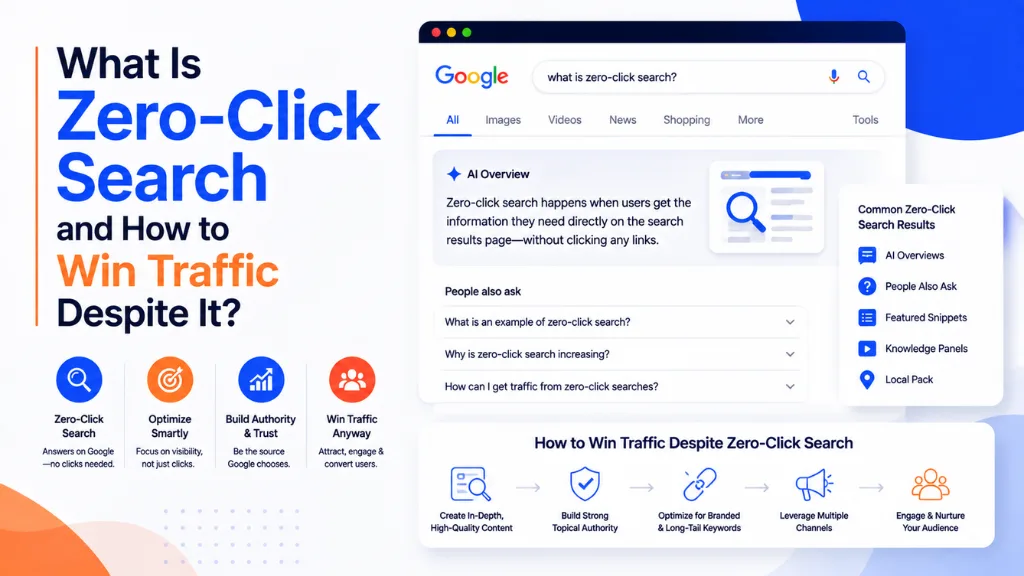
Zero-click search is any query where the person finds their answer without clicking through to a website at all – the answer sits directly on the results page itself, whether in a featured snippet, knowledge panel, local pack, or AI-generated overview.
The information the person wanted gets delivered before they ever leave the search results page, according to Arfadia’s 2026 sourced zero-click statistics. This is not a fringe SEO concern anymore – it is the defining structural shift in how search engines deliver value to users in 2026, and it changes what “ranking well” actually means for a business.
Zero-click search is not a brand-new phenomenon either, which is worth understanding. The trend predates generative AI entirely and has been accelerating steadily since featured snippets and knowledge panels first matured, according to DigitalApplied’s 2026 complete data guide. What changed in 2024 and 2025 was the scale and sophistication of these on-SERP answers, particularly once AI-generated summaries began pulling from multiple sources at once.
People Also Ask: Is zero-click search a new trend caused by AI Overviews? Short Answer: No. Zero-click search has been growing steadily since 2016, well before generative AI search existed. AI Overviews significantly accelerated the trend, but they did not create it – featured snippets and knowledge panels were already driving it years earlier.
How Much of Search Traffic Does Zero-Click Search Actually Affect?#
Zero-click search affects a much larger share of queries than most business owners realise, and the effect varies significantly depending on device, query type, and whether an AI Overview appears.
Mobile searches see roughly 77% zero-click rates, compared to 46.5–56% on desktop, according to Strategyc’s 2026 zero-click data breakdown and Searchlab’s 2026 statistics report. Query type matters just as much: informational searches see roughly 74% zero-click rates, while transactional searches – the ones where someone actually intends to buy – sit far lower, around 31%, per Strategyc’s analysis.
AI Overviews specifically have a measurable, direct effect on click-through behaviour. AI Overviews reduce organic click-through rate by an average of 18–28%, and Google AI Overviews now appear on roughly 25.8–43% of all Google searches, depending on the dataset referenced, according to OptimizeGEO’s 2026 report and DigitalApplied’s 2026 strategy guide.
People Also Ask: Do all types of searches end without a click at the same rate? Short Answer: No. Informational searches see roughly 74% zero-click rates, while transactional searches – where someone intends to make a purchase – sit around 31%. Mobile searches are also significantly more zero-click than desktop searches.
Why Doesn’t Zero-Click Search Mean SEO Is No Longer Worth Doing?#
Zero-click search changes what SEO is for, not whether it matters – the businesses treating on-SERP visibility as a threat are missing the actual opportunity sitting in front of them.
Marketers who treat AI Overviews, snippets, and local packs as distribution layers rather than threats are already gaining visibility other businesses are losing, according to Click Vision’s 2026 analysis. A brand can genuinely dominate a conversation and build recognition even without earning the click – the comparison many analysts now use is a billboard: nobody measures a billboard’s ROI in clicks, and zero-click visibility increasingly works the same way, per Similarweb’s 2026 zero-click marketing analysis.
The traffic that does survive AI Overview exposure also tends to convert better, not worse. The clicks that do come through after an AI Overview appears convert 23% better, because those users have already read a summary and are specifically seeking deeper information – making them higher-intent visitors by the time they click, according to DigitalApplied’s 2026 data.
People Also Ask: Does zero-click search mean SEO traffic quality is getting worse? Short Answer: No, generally the opposite for surviving clicks. While overall click volume drops, users who click through after seeing an AI Overview tend to convert roughly 23% better, since they arrive already informed and specifically seeking deeper detail.
How Should You Measure Success in a Zero-Click Search Environment?#
Zero-click search requires a genuinely different measurement framework, because traditional metrics like raw organic clicks and website sessions no longer tell the full story of how a brand is actually performing in search.
Brand impressions increasingly replace clicks as the primary visibility metric – when users get an answer directly on the results page, the brands they see in featured snippets, knowledge panels, and AI citations still gain awareness even without a site visit, according to DigitalApplied’s 2026 strategy guide. Winning in this environment means optimising for answer inclusion, entity clarity, and structured credibility – not chasing keyword rankings as the only success metric, per Click Vision’s 2026 report.
Practical metrics to start tracking alongside traditional traffic:
- Branded search volume growth – a strong signal that zero-click exposure is building genuine awareness
- AI citation frequency – how often your brand appears as a cited source in AI Overviews
- Featured snippet and rich result ownership – track which SERP features your content wins
- Schema markup validation – ensures your content is technically eligible for rich results and citations
- Correlation between impressions and downstream conversions, not just click-through rate alone
People Also Ask: What metric should replace clicks as the primary SEO success measure? Short Answer: No single metric fully replaces clicks, but branded search growth combined with AI citation frequency gives a more complete picture. If impressions grow while branded search stays flat, your content may be visible but not compelling enough to drive follow-up interest.
What Strategies Actually Win Visibility Despite Zero-Click Search?#
Zero-click search rewards a fundamentally different content approach – one built around earning placement inside the SERP itself, rather than only competing for the traditional organic listing beneath it.
According to Search Savvy’s insights from adapting client SEO strategies to this shift, the businesses seeing the strongest results are treating featured snippets, knowledge panels, and AI citations as genuine placements worth optimising for directly, not consolation prizes for missing the top organic spot.
Practical strategies that consistently improve zero-click visibility:
- Optimise directly for featured snippets – structure content to answer specific questions in clear, extractable formats
- Implement structured data and schema markup – sites using proper schema see measurably higher visibility across SERP features
- Focus on long-tail keywords with genuine click intent – these queries are more likely to still drive a click even in a zero-click-heavy environment
- Invest in brand-building content that increases branded search volume, since brand recognition compounds even when individual searches do not convert to clicks
- Diversify revenue paths beyond organic click volume – direct channels, email, and community-building reduce dependency on a declining click share
At Search Savvy, we recommend auditing which of your target queries already trigger AI Overviews or featured snippets before investing further content effort – that tells you exactly where visibility optimisation, not click optimisation, deserves the priority.
Why Does Structured Data Matter More in a Zero-Click Search World?#
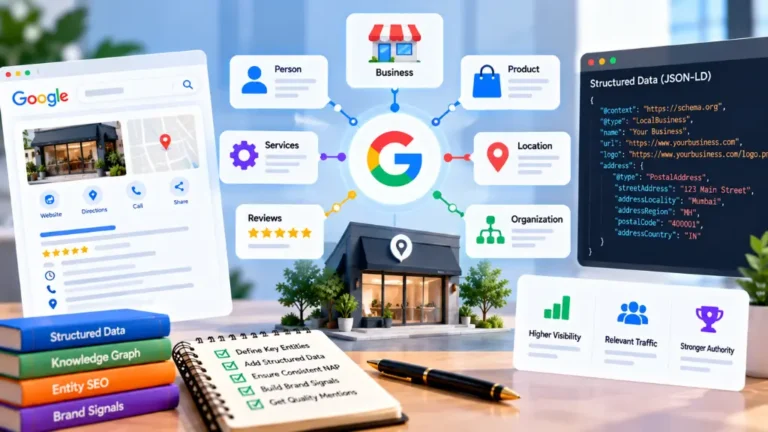
Zero-click search has made structured data genuinely essential infrastructure, rather than a technical nice-to-have most businesses could reasonably skip.
Proper schema markup increases eligibility for rich results and AI citations, and sites using structured data consistently see measurably higher visibility across SERP features compared to sites without it, according to DigitalApplied’s 2026 survival guide. Without clean schema, even genuinely strong content may never surface in the specific SERP formats – featured snippets, knowledge panels, FAQ blocks – where zero-click visibility actually lives.
According to Search Savvy’s insights from technical SEO audits, schema markup is one of the most commonly overlooked fixes we find, precisely because it produces no visible on-page change – its entire value shows up in how search engines interpret and surface the content elsewhere.
People Also Ask: Is schema markup necessary to appear in featured snippets and AI citations? Short Answer: Not strictly required, but it significantly improves your odds. Structured data helps search engines and AI systems interpret your content’s meaning and structure more reliably, directly improving eligibility for rich results and citations.
FAQ: Zero-Click Search#
Q1: What percentage of Google searches end without a click in 2026? A: Roughly 68% of U.S. Google searches ended without a click as of mid-2026, according to SparkToro’s data, up from 60% in 2024 and 50% in 2019. When an AI Overview appears, that rate rises to approximately 83%.
Q2: Should I stop investing in SEO because of zero-click search? A: No. SEO still matters, but the goal shifts toward earning visibility inside SERP features – featured snippets, knowledge panels, AI citations – rather than solely chasing traditional organic clicks. Brand visibility on the results page has real marketing value even without a click.
Q3: Does zero-click search affect every industry equally? A: No. Informational, content-driven businesses tend to be hit hardest, since informational queries see roughly 74% zero-click rates. Transactional and local businesses generally retain more click-through traffic, since users searching to buy still tend to visit a website.
Q4: How can I tell if zero-click search is affecting my specific website? A: Compare impressions to clicks in Google Search Console over time. If impressions are stable or growing while clicks decline for the same queries, zero-click features like AI Overviews or featured snippets are likely absorbing that traffic.
Q5: Do AI Overviews send any traffic back to the sources they cite? A: Very little. Roughly 1% of AI Overview views lead to a click on a cited source, according to 2026 Pew Research data. This makes citation valuable primarily for brand visibility and authority, rather than as a reliable direct traffic source.
Q6: What is the single most important shift businesses need to make for zero-click search? A: Measuring visibility and brand impressions alongside clicks, not instead of them. Businesses that continue judging SEO success purely by traffic volume will consistently undervalue the real marketing impact of AI citations, featured snippets, and knowledge panel placements.
Want to know how visible your brand actually is across zero-click search features? Visit Search Savvy to speak with an SEO expert who can audit your search visibility beyond just traditional traffic.