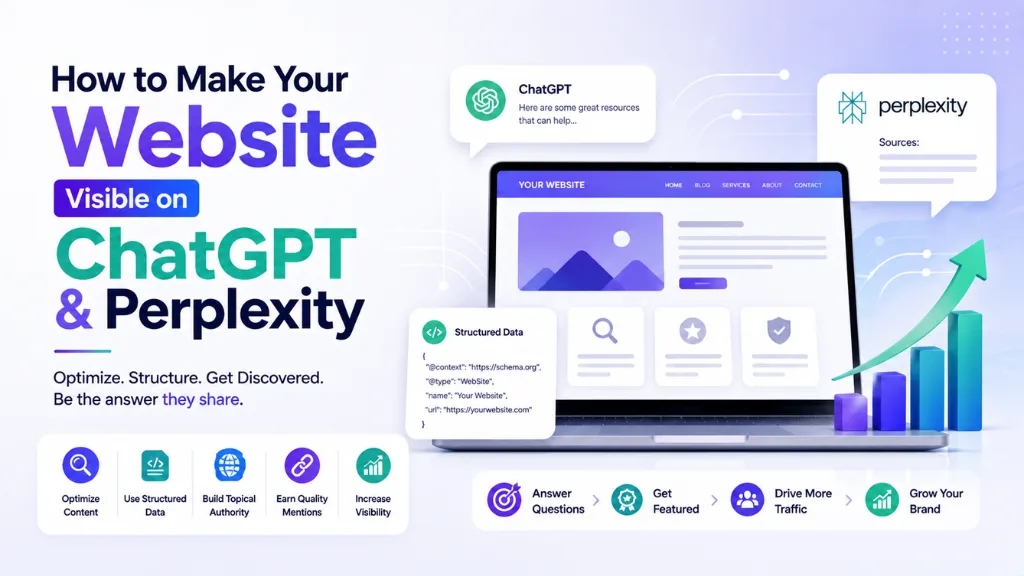
How to Make Your Website Visible on ChatGPT and Perplexity

Somewhere right now, a potential customer is asking ChatGPT or Perplexity a question squarely in your industry – and getting your competitor’s name in the answer, not yours. This is not a rare edge case anymore. It is happening millions of times a day in 2026.
In this article7 sections
Website visible on ChatGPT and Perplexity is no longer a nice-to-have consideration – AI search engines now handle an estimated 12–18% of English-language informational queries as of early 2026, up from under 2% just a year earlier, according to AI Magicx’s 2026 Generative Engine Optimization guide. ChatGPT alone now serves over 800 million weekly active users, and Perplexity handles roughly 780 million monthly queries, per Heeya’s 2026 GEO guide.
At Search Savvy, Generative Engine Optimization has become its own dedicated workstream for clients, distinct from traditional SEO. This guide breaks down exactly what makes a website visible on ChatGPT and Perplexity in 2026, with the specific technical and content changes that actually move the needle.
Why Does Website Visible on ChatGPT and Perplexity Matter So Much in 2026?#
Website visible on ChatGPT and Perplexity matters because these platforms are increasingly where people ask questions they used to type into Google – and being cited in that answer now carries real business value, even without a click.
Users often act on AI-cited information directly – buying the product they were quoted as recommending, signing up for the tool referenced in the answer, or simply internalizing the fact pattern the content established, according to AI Magicx’s 2026 GEO playbook. Being cited by these systems is described as being as valuable as ranking on Google itself for content-driven businesses in 2026.
A new measurement framework has emerged to capture this value. “Share of Model” measures how often a brand is mentioned or recommended by an AI model for a given set of prompts relative to its competitors, effectively replacing “Share of Voice” as the metric that matters, according to Yotpo’s 2026 ChatGPT SEO guide.
People Also Ask: Is being cited by ChatGPT actually valuable if it doesn’t send a click? Short Answer: Yes. Users frequently act on AI-cited recommendations directly – purchasing a product or signing up for a tool mentioned in the answer – without ever visiting the source website. Citation builds brand recognition and influences decisions even without traffic.
How Do ChatGPT and Perplexity Actually Find Your Website?#
Website visible on ChatGPT and Perplexity depends first on a purely technical requirement most businesses overlook entirely: whether your site is indexed by the right underlying search system in the first place.
ChatGPT’s Search feature often relies on Bing’s index to retrieve live, real-time information, which means being indexable by Bing is critical for ChatGPT visibility – not just Google, according to Yotpo’s 2026 GEO guide. Bing’s index also powers Copilot and a meaningful portion of Perplexity’s retrieval, so a quick way to check your foundational visibility is running a site:yourdomain.com search directly on Bing, per ClaudeFast’s 2026 GEO guide.
Perplexity, by contrast, primarily relies on real-time web retrieval rather than a static training snapshot. This makes it the fastest platform to see initial optimisation results on, since it re-crawls and re-evaluates content continuously rather than relying on periodic model training, according to ShareUHack’s 2026 GEO guide.
- Check your Bing indexing status first, since it underpins both ChatGPT and Copilot visibility
- Avoid blocking GPTBot unless you have a specific, deliberate reason – blocking it removes you from the model’s long-term memory of your products and pricing
- Confirm your robots.txt allows AI crawlers – GPTBot crawls roughly 8 times more frequently than Googlebot, according to Cloudflare’s 2025 report cited in the same ShareUHack guide, meaning technical fixes take effect faster than content changes alone
People Also Ask: Do I need to be indexed by Bing to appear in ChatGPT answers? Short Answer: Largely, yes. ChatGPT’s Search feature frequently uses Bing’s index for real-time information retrieval. If your site is not indexed by Bing, you may be effectively invisible to ChatGPT regardless of how well you rank on Google.
How Should You Structure Content to Get Cited by AI Search Engines?#
Website visible on ChatGPT and Perplexity depends heavily on how content is written, not just whether it exists – these systems specifically favour objective, fact-dense, encyclopedic writing over persuasive or opinion-heavy copy.
ChatGPT is trained to sound like an encyclopedia, so removing subjective phrases like “I think,” “we believe,” and “in our opinion” measurably increases citation likelihood, since these phrases raise the model’s internal uncertainty, or “perplexity,” about a claim, according to Yotpo’s 2026 guide. Objective, declarative sentences lower that uncertainty and increase the likelihood your text gets selected for the final generated answer.
Keyword stuffing specifically backfires in this environment. Princeton’s GEO research found that traditional keyword stuffing actually hurt performance in generative contexts, since AI engines penalise content that reads as written for algorithms rather than for humans, according to Geoptie’s 2026 AI search optimization guide.
Practical content structure principles:
- Write objective, declarative statements rather than hedged or opinion-framed sentences
- Turn real customer questions into structured Q&A content – FAQ entries and Q&A pages built from actual user intent, according to Heeya’s 2026 GEO guide
- Avoid AI-detectable keyword stuffing – write naturally, as if explaining to a person
- Keep content genuinely fresh and updated – Perplexity heavily weights recency in its real-time retrieval process
People Also Ask: Does writing in an opinion-heavy tone hurt AI citation chances? Short Answer: Yes, to a meaningful degree. Subjective phrasing like “I think” or “we believe” raises a model’s internal uncertainty about a claim. Objective, fact-based, declarative sentences are more likely to be selected and cited by ChatGPT specifically.
Why Does Reddit and Community Presence Matter So Much for Perplexity?#
Website visible on ChatGPT and Perplexity depends partly on factors entirely outside your own website – third-party platforms play an outsized role in what these engines choose to cite, particularly Perplexity.
Reddit accounts for roughly 46.5–46.7% of Perplexity’s total citations, making it by a wide margin the platform’s most-cited source category, according to Heeya’s 2026 GEO guide and Geoptie’s 2026 analysis. For ChatGPT, Reddit still matters – accounting for roughly 21% of its third-party citations – alongside YouTube at 18.8%, though ChatGPT also favours recognised, established brands and entities more heavily than Perplexity does.
This means optimisation cannot stop at your own domain. You must optimise the broader “consensus” – treating platforms like Reddit, G2, and Capterra not just as review sites, but as external training data the AI reads to verify claims made on your own website, according to Yotpo’s 2026 guide.
- Participate genuinely in Reddit discussions within your niche, citing your expertise where relevant
- Monitor G2, Capterra, and industry-specific review platforms to ensure your value proposition is accurately discussed there
- Publish on Perplexity Pages where relevant, since this creates a direct citation path within Perplexity’s own ecosystem, according to AI Magicx’s 2026 guide
People Also Ask: Why does Reddit matter so much for Perplexity citations specifically? Short Answer: Reddit accounts for nearly half of all Perplexity citations – roughly 46.5%. Genuine, expert-level participation in relevant Reddit discussions is one of the highest-leverage ways to influence how Perplexity perceives and cites your brand.
How Do ChatGPT, Perplexity, and Google AI Differ in What They Cite?#
Website visible on ChatGPT and Perplexity requires recognising that each platform weighs different signals – a strategy tuned for one will not automatically transfer perfectly to another.
Google AI Overviews show the strongest correlation with traditional Google rankings, meaning a top-10 organic position makes you a genuine citation candidate there. Perplexity does real-time web retrieval and heavily weights freshness, showing only about 25% source overlap between queries – meaning newer, fresher content has a genuine chance against established competitors, according to Geoptie’s 2026 guide. ChatGPT, by contrast, favours recognised brands and authoritative entities more heavily, relying on Bing’s index for real-time answers and broader training data for general knowledge.
- Google AI Overview – strongly tied to traditional organic ranking; E-E-A-T signals and video content help
- Perplexity – real-time retrieval; favours fresh, recently updated content; Reddit-heavy citation pattern
- ChatGPT – favours established brands and entities; relies on Bing indexing for real-time answers; encyclopedic tone performs best
People Also Ask: Should I use the same content strategy for ChatGPT and Perplexity? Short Answer: Not entirely. Perplexity heavily favours fresh, recently updated content through real-time retrieval, while ChatGPT leans toward established, authoritative brands and relies more on Bing indexing. Both benefit from clear structure, but the emphasis differs.
How Should You Track Whether Your Website Is Actually Getting Cited?#
Website visible on ChatGPT and Perplexity is measurable, and tracking citation performance directly is the only reliable way to know whether your GEO efforts are actually working.
A practical, low-cost tracking approach: pick three keywords you most want to be cited for, and search each weekly across ChatGPT, Perplexity, and Google AI Overview, logging the date, platform, keyword, and whether – and where – you were cited, according to ShareUHack’s 2026 GEO guide. This manual process takes roughly five minutes a week and provides a genuine, if narrow, signal of progress.
According to Search Savvy’s insights from running GEO audits for clients, results timelines differ meaningfully by platform. Perplexity’s real-time retrieval means initial results can appear within two to four weeks, while ChatGPT – relying more on Bing’s index and broader training data – typically takes six to twelve weeks to reflect meaningful change, per the same ShareUHack analysis.
At Search Savvy, we recommend starting with Perplexity as a validation platform precisely because of its shorter feedback cycle – if a specific content change moves the needle there quickly, it is a strong early signal the same change is worth applying more broadly.
FAQ: Making Your Website Visible on ChatGPT and Perplexity#
Q1: How long does it take to start getting cited by ChatGPT and Perplexity? A: Perplexity can show initial results within two to four weeks due to its real-time retrieval model. ChatGPT typically takes six to twelve weeks, since it relies more heavily on Bing’s index and broader training data updates.
Q2: Should I block AI crawlers like GPTBot to protect my content? A: Generally, no, unless you have a specific reason like protecting proprietary IP. For most e-commerce and SaaS brands, blocking GPTBot removes you from the model’s long-term memory of your products and pricing, reducing your chances of being recommended.
Q3: Does traditional SEO still matter if I want to be visible on ChatGPT and Perplexity? A: Yes. GEO is a parallel optimisation layer, not a replacement for SEO. Pages that already rank well organically are generally more likely to be cited by AI search engines too, since strong E-E-A-T signals and authority benefit both systems.
Q4: Is there a free way to check my current AI search visibility? A: Yes. Tools like HubSpot’s AEO Grader can score your brand’s visibility across ChatGPT, Perplexity, and Gemini for free. Manual weekly tracking of a few target keywords is also a practical, no-cost starting point.
Q5: Does content freshness matter equally across all AI search platforms? A: No. Perplexity heavily weights freshness due to its real-time retrieval model, giving newer content a genuine chance to be cited. ChatGPT relies more on established authority and broader indexed data, making freshness somewhat less decisive there.
Q6: What is the biggest mistake businesses make when trying to get cited by AI search engines? A: Writing content that reads as keyword-stuffed or written specifically for algorithms rather than people. Research shows this approach actively hurts citation performance in generative search contexts, unlike traditional SEO where keyword optimisation has historically helped more.
Want to know how visible your website actually is on ChatGPT and Perplexity right now? Visit Search Savvy to speak with an expert who can audit your current AI search visibility and build a plan to improve it.