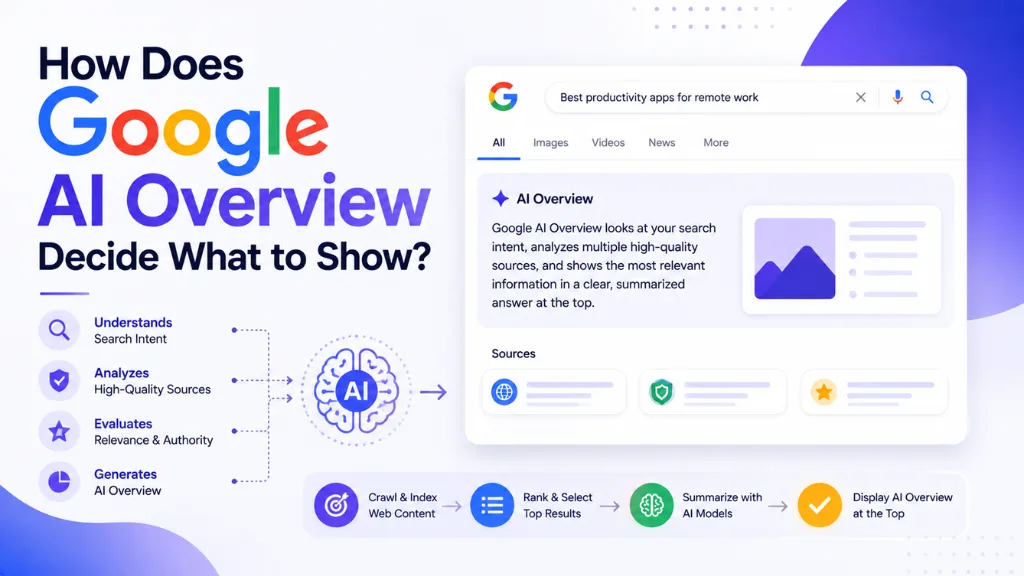
How Does Google AI Overview Decide What to Show?

Ranking first on Google used to mean something simple: your link, the top spot, the click. In 2026, a growing share of searches never scroll past the AI-generated summary sitting above the traditional results – and that summary is choosing its own winners, using its own rules.
In this article8 sections
Google AI Overview does not simply repeat the top 10 organic results in paragraph form. It runs content through a multi-stage filtering pipeline that progressively narrows 200–500 candidate documents down to just 5–15 cited sources, according to ZipTie’s 2026 reverse-engineering study of AI Overview source selection. Understanding that pipeline – not just guessing at it – is what separates sites that earn citations from sites that quietly disappear from this new layer of search entirely.
At Search Savvy, we treat AI Overview visibility as its own discipline now, distinct from traditional ranking work. This guide breaks down exactly how Google AI Overview decides what to show, using the clearest 2026 data available, and what that means for how you should structure content going forward.
Why Doesn’t Google AI Overview Just Show the Top-Ranking Page?#
Google AI Overview draws from a far wider pool of pages than traditional top-10 rankings, because it is evaluating content on genuinely different criteria than classic search ranking ever did.
Only 4.5% of AI Overview URLs directly match the page ranking in the number one organic position, according to Stackmatix’s 2026 AI Overview algorithm analysis. Even more strikingly, 47% of all AI Overview citations come from pages ranking below position five, and the correlation between organic rank and AI Overview citation sits at a moderate 0.347, per ZipTie’s 2026 study. AI Overview is not simply amplifying the top three organic results – it is drawing from a considerably wider pool and judging content on its own terms.
Google AI Overview still overlaps meaningfully with traditional rankings, just not as tightly as most site owners assume. There is an 86% domain overlap between AI Overviews and traditional search results overall, according to Semrush data cited in Stackmatix’s analysis, meaning sites that rank well organically remain far more likely to appear in AI Overview citations than sites that do not rank at all – ranking well is necessary, just no longer sufficient on its own.
People Also Ask: Does ranking number one on Google guarantee an AI Overview citation? Short Answer: No. Only 4.5% of AI Overview citations directly match the page ranking in position one organically. Nearly half of all AI Overview citations come from pages ranking below position five, meaning AI Overview evaluates content on separate criteria beyond rank alone.
How Does Google AI Overview Actually Select Its Sources?#
Google AI Overview moves candidate pages through a sequential filtering process, narrowing a broad initial pool down to the small handful of sources that ultimately appear as citations.
The process moves through semantic retrieval first, then an E-E-A-T authority filter that functions essentially as a binary pass/fail gate, before Gemini extracts and evaluates specific passages for inclusion, according to ZipTie’s 2026 breakdown of the pipeline. Pages that clear the authority gate are not automatically cited – they still need to contribute a passage the model judges clear, unique, and directly useful to the specific query.
The model then stitches extracted passages into one coherent answer and attaches citations to the sources it actually leaned on. Pages that contribute a clear, unique, trustworthy passage get cited; pages that merely echo what others already said, or that hedge and ramble, get folded into the summary without attribution at all, according to DevCommX’s 2026 AI Overview ranking guide.
People Also Ask: What happens to pages that get used but not cited in an AI Overview? Short Answer: Their information may still be reflected in the summary’s content, but without a clickable citation. This typically happens to pages that echo widely available information rather than contributing something distinct, clear, or genuinely differentiated.
What Content Format Does Google AI Overview Prefer to Extract?#
Google AI Overview strongly favours content structured as short, self-contained passages that can be lifted and used without needing surrounding context to make sense.
AI Overview prioritises passages that fully answer a query within 134–167 word self-contained units, according to Wellows’ 2026 research analysing 15,847 AI Overview results across 63 industries. Content scoring above 8.5 out of 10 on self-contained answer completeness is 4.2 times more likely to appear in AI Overviews, per the same study.
Multimodal content integration has become a significant factor too. Pages combining text, images, video, and structured data together show a 156% higher selection rate compared to text-only content, according to the same Wellows 2026 research – making this one of the strongest new ranking shifts identified in recent analysis.
Practical formatting principles that support extractability:
- Answer the question directly in the first one to two sentences of a section, before elaborating
- Write in short, declarative statements rather than long, hedged, or narrative sentences
- Structure content in self-contained 130–170 word passages that make sense without surrounding context
- Combine text with images, video, or structured data where genuinely relevant to the topic
People Also Ask: Why does Google AI Overview prefer short, self-contained passages? Short Answer: Because the model extracts and stitches together specific passages to build its summary. A passage that fully answers a question in 130–170 words without needing surrounding context is far easier for the model to lift cleanly and cite accurately.
Does E-E-A-T Still Matter for Google AI Overview Citations?#
Google AI Overview treats E-E-A-T – Experience, Expertise, Authoritativeness, and Trust – as a mandatory filtering gate rather than just one input among many, particularly for sensitive or high-stakes topics.
96% of AI Overview citations come from sources demonstrating strong E-E-A-T signals, according to Wellows’ 2026 research. This requirement becomes especially strict for YMYL topics – those involving health, finance, or safety – where the model applies noticeably tighter trust filtering before considering a passage for citation, per Content Decoded’s 2026 explainer.
Entity density plays a closely related role. Pages featuring 15 or more recognised Knowledge Graph entities per 1,000 words show a 4.8 times higher selection probability, according to the same Wellows research. This reflects how the underlying model reasons about content – through entities and their relationships, not just keyword matches.
People Also Ask: Do small or newer websites ever get cited in Google AI Overview? Short Answer: Yes. Because backlinks and domain authority are no longer the deciding factor, smaller or newer domains that produce genuinely clear, well-structured, and differentiated content can and do get cited alongside – and sometimes instead of – larger, established sites.
Why Does Original Data and Information Gain Matter So Much?#
Google AI Overview gives a disproportionate advantage to content that introduces genuinely new information, since redundant content adds nothing the model does not already have from another source.
Content introducing new insights, data, or perspectives has a disproportionate advantage in citation selection, because it reduces redundancy in the model’s final answer, according to Content Decoded’s 2026 explainer. Original surveys, proprietary datasets, internal benchmarks, and first-party studies get cited specifically because no other source can provide that same information, per Megrisoft’s 2026 citation ranking factors guide.
Information density within content matters at a granular level too. Aim for two to three quantified data points per 300-word block, since density beats length as a citation signal, according to the same Megrisoft analysis, which references Google’s own patent language around “information density” and “specificity signals” as explicit selection factors.
People Also Ask: Does publishing original research actually improve AI Overview citation chances? Short Answer: Yes, significantly. Original surveys, proprietary data, and first-party studies are cited because no other source can provide that same information – making original research one of the strongest, most defensible ways to earn consistent AI Overview citations.
What Technical Factors Influence Google AI Overview Eligibility?#
Google AI Overview citation depends on more than content quality alone – a handful of technical factors determine whether your best content is even reachable and reliably crawled in the first place.
Page speed and crawlability directly affect eligibility, since slow or poorly optimised sites may not be crawled frequently enough for AI systems to surface fresh insights, according to Content Decoded’s 2026 breakdown. Mobile usability matters too, given how much search interaction now happens on mobile devices. These factors influence eligibility and consistency rather than driving direct selection on their own – they are gatekeepers, not the deciding factor.
According to Search Savvy’s insights from auditing client sites for AI search visibility, technical health issues are often the invisible reason strong content never gets a fair chance at citation – the content itself may be excellent, but if crawling is inconsistent, Google’s systems simply may not have current, indexed versions to work from.
People Also Ask: Can a technically weak website still earn AI Overview citations? Short Answer: Rarely, and inconsistently. Technical factors like crawlability and page speed do not directly drive selection, but they gate whether AI systems can reliably access and index your content in the first place – weak technical health undermines even strong content’s citation chances.
How Should You Actually Optimise for Google AI Overview in 2026?#
Google AI Overview optimisation requires a different mindset than traditional SEO – the goal shifts from ranking a page to becoming the clearest, most citable source on a specific, narrow question.
According to Search Savvy’s insights from working across client industries in 2026, the practical difference comes down to precision over scale: you do not need to be the biggest site in your space, but you do need to be the clearest on the specific questions your audience actually asks.
A practical AI Overview optimisation checklist:
- Structure content in self-contained, 130–170 word passages that answer one specific question directly
- Include original data or first-hand experience wherever genuinely possible
- Add 15+ relevant, recognisable entities per 1,000 words to strengthen topical grounding
- Combine text with images, video, or structured data rather than relying on text alone
- Strengthen E-E-A-T signals – named authors, credentials, and transparent sourcing
- Fix technical crawlability and page speed issues so content is consistently indexed
At Search Savvy, we recommend treating AI Overview visibility as an ongoing measurement, not a one-time optimisation project – Google continues refining this system, and citation patterns shift as it does.
FAQ: Google AI Overview#
Q1: How many sources does Google AI Overview typically cite for one query? A: Roughly 5 to 15 cited sources, narrowed down from an initial candidate pool of 200 to 500 documents through Google’s multi-stage filtering process, according to 2026 research.
Q2: Is there a way to directly submit content to Google AI Overview? A: No. There is no submission process. Google selects sources automatically based on trust, content quality, structure, and relevance to the specific query, rather than through any manual inclusion request.
Q3: Does Google AI Overview replace traditional organic rankings entirely? A: No. Traditional rankings and AI Overview citations operate as related but distinct systems, with roughly 86% domain overlap. Strong organic rankings still help, but do not guarantee citation, since AI Overview applies additional, separate selection criteria.
Q4: Why do some well-known, high-authority sites not appear in AI Overview citations? A: Because AI Overview prioritises clarity, extractability, and information gain over sheer domain authority. A large, authoritative site that offers generic, non-differentiated content on a specific question can be passed over in favour of a smaller site with a clearer answer.
Q5: Does content length affect AI Overview citation chances? A: Not directly in a positive sense. AI Overview favours self-contained passages of roughly 130 to 170 words that fully answer a specific question, rather than very long content – information density and clarity matter more than overall length.
Q6: How often does Google change how AI Overview selects sources? A: Google has not published an official formula, and available evidence suggests the system continues evolving. Google’s January 2026 algorithm update, for example, produced measurable shifts in AI Overview citation patterns alongside traditional organic rankings.
Want to know whether your content is positioned to earn AI Overview citations? Visit Search Savvy to speak with an SEO expert who can audit your site for both traditional and AI search visibility.