What Is Quality Score in Google Ads and How to Improve It?

Two advertisers can bid the exact same amount on the exact same keyword and pay wildly different prices per click. The difference almost always comes down to one number sitting quietly in the Google Ads dashboard that most beginners never check.
In this article8 sections
Quality Score in Google Ads is a 1-to-10 diagnostic metric that rates the relevance and quality of your keywords, ads, and landing pages – and it directly controls both your cost per click and whether your ads show at all, according to Groas’s 2026 Quality Score guide. Ignore it, and you are effectively paying a penalty on every single click.
At Search Savvy, Quality Score is one of the first things we audit when we take over a Google Ads account, because it explains far more about wasted spend than most advertisers realise. This guide breaks down exactly what Quality Score measures, why it matters in 2026, and the practical steps that actually move it.
What Is Quality Score in Google Ads?#
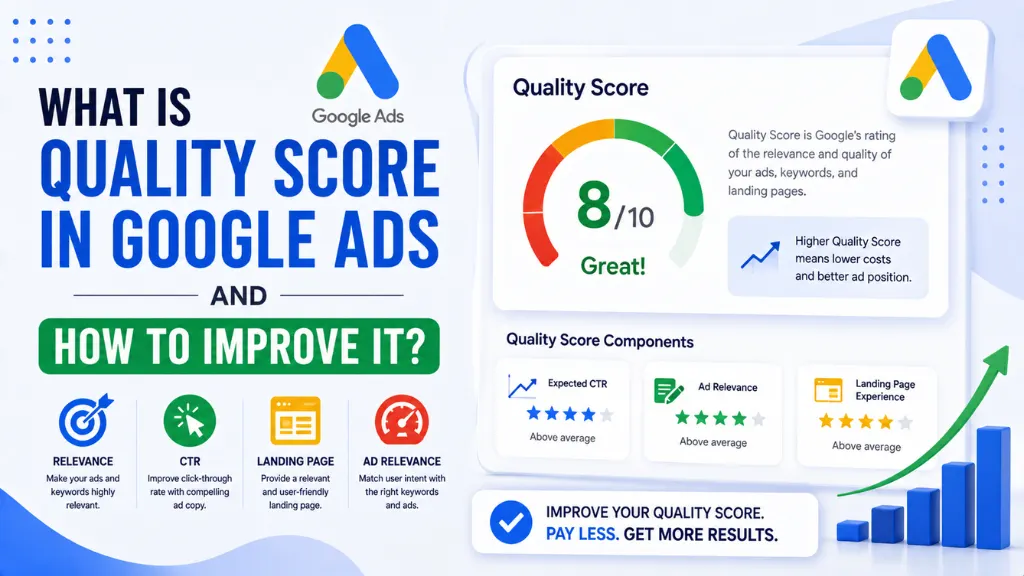
Quality Score in Google Ads is a keyword-level score, rated from 1 to 10, that Google assigns based on how relevant and useful your ad, keyword, and landing page combination is likely to be for the person searching.
The score is built from three components: expected click-through rate, ad relevance, and landing page experience. Adalysis’s research estimates their relative weight at roughly 39% for expected CTR, 39% for landing page experience, and 22% for ad relevance, according to Lionel Z’s 2026 Quality Score breakdown. That means landing page experience carries nearly twice the influence most advertisers assume it does – it is not just a conversion tool, it is a direct scoring input.
Quality Score in Google Ads is best understood as a diagnostic, not a target to chase for its own sake. Google has confirmed it functions as a lagging indicator of the real-time quality signals actually used at auction, per the same analysis. The visible 1–10 score tells you where a problem exists, even though it is not the literal number plugged into the auction.
People Also Ask: What does Quality Score actually measure in Google Ads? Short Answer: Quality Score measures three things: how likely users are to click your ad (expected CTR), how closely your ad copy matches the keyword and search intent (ad relevance), and how relevant and useful your landing page is once someone clicks (landing page experience).
Why Does Quality Score in Google Ads Matter So Much for Your Costs?#
Quality Score in Google Ads matters because it directly determines how much you pay per click – two advertisers bidding identically can end up with dramatically different costs based on this score alone.
Ads rated “Above average” on both landing page experience and ad relevance for non-branded keywords see CPCs roughly 36% below average, according to Lionel Z’s 2026 analysis. That is not a marginal saving – it is often the difference between a campaign that is profitable and one that quietly bleeds budget month after month.
Quality Score in Google Ads also affects whether your ads appear at all, not just how much they cost. A low score can prevent an ad from being competitive even at a high bid, because Google weighs relevance alongside bid amount when ranking ads. The average Quality Score across a large sample of accounts sits at just 5–6, meaning a score of 7 already puts you ahead of most advertisers, per the same Lionel Z research.
People Also Ask: How much can Quality Score actually save on ad spend? Short Answer: Ads with “Above average” ratings on landing page experience and ad relevance see cost-per-click roughly 36% lower than average, according to 2026 industry analysis. Over a sustained campaign, this compounds into significant budget savings.
How Does Expected Click-Through Rate Work in Quality Score?#
Quality Score in Google Ads relies heavily on expected click-through rate, which measures how likely someone is to click your ad when it appears for a specific keyword – regardless of your ad’s actual position or extensions.
Expected CTR’s value is calculated independently of your ad’s position or the assets attached to it, and it is relative to the keyword itself, according to Store Growers’ 2026 Quality Score guide. This is why raw CTR numbers can be misleading: a 2% CTR might rate “above average” for one keyword, while a 6% CTR rates “below average” for a more competitive one.
To improve expected CTR, focus on tighter alignment between what people search for and what your ad promises:
- Include the exact keyword or a close variant in at least one headline, which increases visual relevance and often triggers bolded text in the search result
- Write ad copy around the searcher’s problem, not just your product name or brand
- Test multiple responsive search ad headlines so Google can identify which combinations earn the strongest click-through performance
People Also Ask: Does ad position affect Expected CTR in Quality Score? Short Answer: No. Google calculates Expected CTR independently of your ad’s position, extensions, or other visibility factors – it measures the intrinsic likelihood that your specific ad-keyword combination will earn a click.
How Does Ad Relevance Affect Quality Score in Google Ads?#
Quality Score in Google Ads also depends on ad relevance, which measures how tightly your ad copy matches the intent behind the specific search term that triggered it – not just the keyword you technically bid on.
Ad relevance carries a smaller estimated weight than the other two components, at roughly 22%, but it remains the fastest component to improve, according to Groas’s 2026 breakdown. Restructuring ad groups and writing tighter responsive search ads can move scores within one to two weeks once Google accumulates enough impression data.
The most common ad relevance mistake is running one broad ad group covering many loosely related keywords. A tightly themed ad group – where every keyword shares a common intent – lets your ad copy speak directly to that intent, rather than trying to cover too much ground at once.
People Also Ask: How quickly can ad relevance improve Quality Score? Short Answer: Ad relevance changes, such as restructuring ad groups or rewriting responsive search ads, can move Quality Score within one to two weeks once Google gathers sufficient impression data – faster than landing page experience improvements typically take.
Why Is Landing Page Experience the Most Underinvested Quality Score Factor?#
Quality Score in Google Ads is shaped heavily by landing page experience, yet it is consistently the component advertisers spend the least time fixing – largely because it feels like a conversion-rate problem rather than a paid search problem.
Landing page experience carries almost the same weight as expected CTR, yet it is the most underinvested area, partly because fixing it takes more effort than rewriting a headline, according to Lionel Z’s 2026 research. If your ad promises “same-day delivery” and the landing page says “ships in 3–5 business days,” both Google’s crawlers and the actual user notice that mismatch immediately.
Page speed matters more than most advertisers assume. A one-second delay in mobile page load time can reduce mobile conversions by up to 20%, according to GrowLeads’ 2026 landing page playbook. Since Google’s Landing Pages report specifically evaluates mobile-friendliness, slow-loading pages quietly damage Quality Score alongside conversion rate.
Practical ways to strengthen landing page experience:
- Match your headline, offer, and CTA directly to what the ad promised – this single fix is often the highest-leverage lever available
- Optimise for mobile load speed – aim for sub-two-second load times wherever possible
- Remove disruptive interstitials and ensure the core offer is visible without excessive scrolling
- Make the page content-rich and specific, not generic, since a thin page limits what Google’s systems can match against user intent
People Also Ask: Why does landing page experience matter more than most advertisers think? Short Answer: Landing page experience carries nearly the same weight as expected CTR in the Quality Score formula – roughly 39% each – yet it is the component most advertisers neglect, because improving it feels like a conversion-rate task rather than a paid search task.
How Does Quality Score Connect to Google’s AI-Driven Search Features in 2026?#
Quality Score in Google Ads has taken on new significance in 2026 because landing page quality now influences more than cost per click – it can determine whether your ads are eligible for Google’s newest AI-powered placements at all.
AI Max-eligible campaigns can appear inside Google’s AI Overviews, the AI-generated summaries at the top of search results, while standard exact and phrase match campaigns cannot, according to Foundry CRO’s 2026 landing page and Quality Score guide. A thin or generic landing page limits what Google’s AI can match against user intent – landing page content is no longer just a conversion tool, it is now an ad matching signal.
According to Search Savvy’s insights from managing accounts through this shift, brands that treated landing pages as an afterthought are now losing visibility in Google’s AI-powered surfaces, not just paying a few extra rupees per click.
How Should You Approach Improving Quality Score Practically?#
Quality Score in Google Ads should be treated as a diagnostic tool that tells you exactly where your account is breaking down – not a number to chase for its own sake.
Use the score to identify which of the three components is underperforming at the keyword level, then address the root cause specifically, rather than making broad account-wide changes and hoping something helps, according to Omologist’s 2026 best-practice guide. Review the Expected CTR, Ad Relevance, and Landing Page Experience columns individually before deciding what to fix.
At Search Savvy, we recommend this simple diagnostic sequence for any underperforming keyword:
- Check which component is rated “below average” in the Quality Score breakdown
- If Expected CTR is low – rewrite headlines to include the keyword and address searcher intent directly
- If Ad Relevance is low – split the ad group into more tightly themed keyword clusters
- If Landing Page Experience is low – audit message match, mobile speed, and page content depth
- Wait for reassessment – allow one to two weeks for ad-level changes, longer for landing page recrawls
At Search Savvy, our experience shows that fixing landing page experience typically produces the largest, most durable Quality Score gains – even though it is the component most advertisers fix last.
FAQ: Quality Score in Google Ads#
Q1: What is considered a good Quality Score in Google Ads? A: A score of 7 or above is generally considered good, and puts you ahead of most advertisers, since the average Quality Score across large account samples sits at just 5–6. A score of 10 is rare and usually not worth chasing at the expense of other priorities.
Q2: Does Quality Score directly determine my auction cost? A: Not directly – Google has confirmed Quality Score is a lagging diagnostic indicator, not a literal auction input. However, it correlates strongly with the real-time quality signals that do determine your cost per click, so treating it as a proxy is reasonable.
Q3: How often does Google update Quality Score? A: Quality Score updates continuously as Google gathers new impression and click data, but individual components update at different speeds – Expected CTR needs accumulated click data, while landing page experience depends on Google’s own recrawl schedule.
Q4: Can a new campaign have a high Quality Score immediately? A: Rarely. New keywords often show “unrated” until enough data accumulates. Expect Quality Score to stabilise over the first few weeks as Google gathers sufficient impressions and clicks to assess each component reliably.
Q5: Does Quality Score apply to Performance Max campaigns? A: No, not in the traditional keyword-level sense. Quality Score applies specifically to Search campaigns. Performance Max relies on different quality and relevance signals, though strong landing pages and creative assets remain important for both campaign types.
Q6: Which Quality Score component should I fix first? A: Whichever component is rated “below average” in your account’s breakdown for a specific keyword. If more than one is low, landing page experience is usually the highest-leverage fix, even though it takes more effort than rewriting ad copy.
Want a Quality Score audit for your Google Ads account? Visit Search Savvy to speak with a paid media expert who can identify exactly where your account is losing money on avoidable clicks.