

Here is the content economics problem most bloggers discover too late: a post that took a week to research and write stops generating traffic within six weeks of publication, and the only solution anyone offers is to produce more content next week.
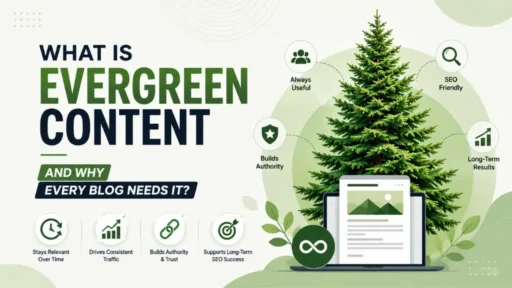
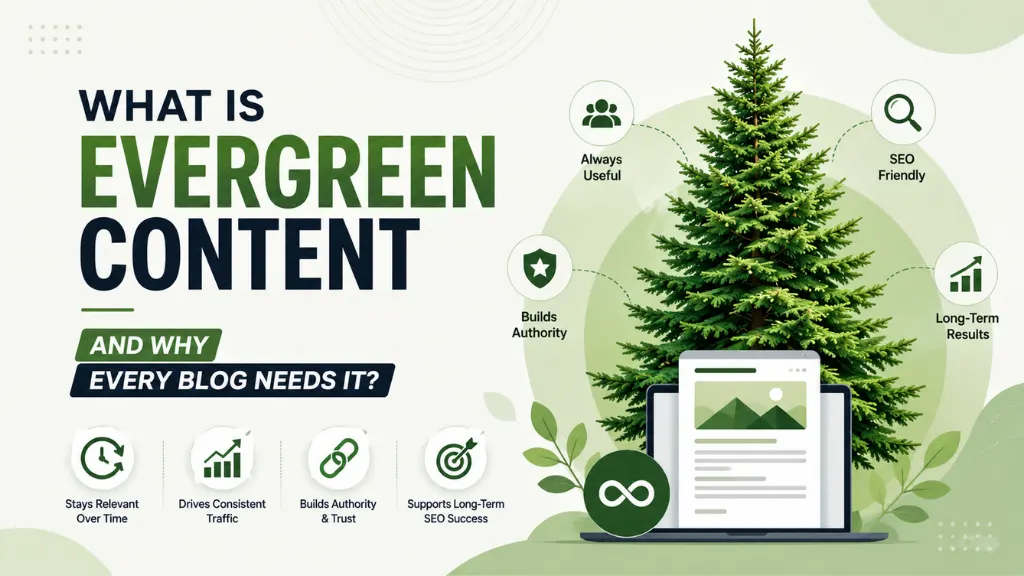
Evergreen content is the alternative model. It is content that remains relevant, useful, and searchable months and years after its publish date – because it is built around questions that people have permanently, not trends that fade with the news cycle.
Evergreen content accounts for a disproportionate share of organic traffic on every mature content site, and the data explains why. Evergreen content reduces marketing costs by 62% compared to content strategies dependent on constant new production, because the same asset continues generating traffic without needing to be replaced. The SEO equivalent of compound interest, it keeps earning returns long after the initial investment is made.
Evergreen content also benefits from a fundamental truth about how search works: search queries about human fundamentals – how to do something, what something means, why something matters – do not change much from year to year. The search volume for “how to write a blog post” is as stable in 2026 as it was in 2020. The opportunity is always there; it just requires content built to claim it permanently rather than capturing it once and moving on.
At Search Savvy, evergreen content forms the backbone of every content strategy we build, because it is the part of a content library that compounds rather than depreciates. This guide explains what it is, why it matters more than ever in 2026, and how to create it effectively.
What Is Evergreen Content?
Evergreen content is written material that remains relevant and useful to readers over a long period – typically months to years – because it addresses topics with stable, ongoing search demand rather than current events or short-lived trends.
Evergreen content takes its name from the trees that retain their leaves throughout the year rather than shedding them seasonally. In content terms, this means the piece stays “green” – alive and valuable – regardless of what time of year it is or what is currently happening in the news cycle.
Evergreen content does not mean static content. It means content built on a timeless topic that requires only periodic, light maintenance to stay accurate – updating a statistic, refreshing an example, or adding a new section – rather than being replaced entirely when it becomes outdated.
People Also Ask: What is the difference between evergreen and trending content? Short Answer: Evergreen content answers questions that remain relevant indefinitely – “how to write an email subject line” or “what is a canonical tag.” Trending content responds to current events, recent product launches, or seasonal spikes – “Google’s May 2026 core update results” or “Instagram’s new feature explained.” Both have value, but evergreen content generates traffic continuously while trending content typically peaks and declines within weeks.
What Are the Best Examples of Evergreen Content?
Evergreen content consistently performs best when it covers fundamental, permanent informational needs – the questions beginners always ask, the processes professionals always need, and the definitions that never stop being searched.
Strong evergreen content formats include:
- Comprehensive guides – “The Beginner’s Guide to SEO,” “How to Start a Blog from Scratch,” “What Is Digital Marketing?” – topics searched at every skill level, indefinitely
- How-to tutorials – step-by-step processes for tasks people need to perform repeatedly: “How to Write a Meta Description,” “How to Set Up Google Search Console”
- Definition posts – clear explanations of concepts that new audiences always need: “What Is a Canonical Tag?”, “What Is Bounce Rate?”
- Comparison articles – evergreen comparisons of established tools or approaches: “SEO vs PPC: What’s the Difference?”, “On-Page vs Off-Page SEO”
- FAQ and pillar pages – comprehensive resources covering every angle of a subject that becomes a go-to reference for an entire topic area
- Checklists and templates – resources people return to repeatedly and share with others who face the same task
Evergreen content that does not work well: news posts, trend analyses, product- specific reviews for items that get discontinued, and anything with a year in the title that is not updated annually (for example, “Best AI Tools of 2024” that is still live in 2026 unchanged).
Why Is Evergreen Content Important in 2026?
Evergreen content matters more in 2026 for several reasons that compound on each other.
Compound SEO returns: Evergreen content builds authority continuously. A well-structured guide published in 2024 still ranks in 2026, earns backlinks from new sources every month, and accumulates engagement signals that strengthen its position with each algorithm update. Trending content cannot do this – its authority starts declining the moment the trend passes.
Backlink attraction: Evergreen content earns links at a disproportionate rate because publishers, writers, and researchers naturally link to the authoritative, comprehensive resource on a subject rather than a time-sensitive news piece. A definitive guide on a topic earns links for years; a news post earns links for days.
AI citation eligibility: Evergreen content that covers topics comprehensively and is structured with clear question-based headings is disproportionately cited in Google AI Overviews, ChatGPT, and Perplexity. AI search systems prefer stable, well-structured resources that definitively answer questions – which is precisely what evergreen content is designed to be.
Cost efficiency: Evergreen content reduces marketing costs by 62% compared to content strategies dependent on constant new production. One 2,500-word evergreen guide can drive more cumulative traffic over 24 months than 24 monthly trend-focused posts, at the same or lower production cost.
People Also Ask: How long does evergreen content stay relevant? Short Answer: Well-maintained evergreen content stays relevant indefinitely. HubSpot’s guide to SEO, first published in 2020, remains one of their top- performing pieces of content in 2026. Moz’s Beginner’s Guide to SEO, first published in 2011, is still one of their most visited pages after multiple refreshes. The key is periodic maintenance – updating statistics, refreshing examples, and adding new sections as the topic evolves – not a full rewrite.
How Do You Create Evergreen Content That Ranks and Lasts?
Evergreen content creation follows a specific process that differs from how most content teams approach a typical blog post. The goal is not to write something useful today; it is to write the definitive resource on a topic that remains the best available answer for years.
Step 1: Choose the Right Topic
Evergreen content starts with selecting a topic that has stable, ongoing search demand – not a topic that is merely popular right now. Use keyword research tools to check historical search volume patterns and confirm the query has been consistently searched over at least 12 months with no sharp seasonal spikes or declines.
The right evergreen topic addresses one of three things: a fundamental concept people in your field always need to understand, a process they always need to complete, or a question beginners always arrive with. If the topic is genuinely only relevant for the next six months, it is not evergreen.
Step 2: Target Intent, Not Keywords
Evergreen content performs best when it matches what Google calls “informational intent” – a user who wants to learn or understand something rather than buy something immediately. Target the full range of questions a person arriving at this topic might have, not just the single head keyword that first comes to mind.
Use tools like Google’s “People Also Ask” boxes, AlsoAsked.com, and the autocomplete in Google Search Console to identify the full cluster of related questions your evergreen piece should answer.
Step 3: Write for Completeness, Not Length
Evergreen content is not defined by word count – it is defined by completeness. A genuinely evergreen piece leaves the reader with no remaining questions about the core topic. If they need to search again to find the follow-up to what you wrote, the piece is not yet evergreen.
For most informational topics in competitive categories, completeness typically requires 1,500 to 3,000 words. But the right test is not a word count target – it is whether every meaningful question about the topic has been answered clearly within the piece.
Step 4: Avoid Built-In Obsolescence
Evergreen content must be written without features that cause it to become outdated before the topic itself does:
- Avoid writing the year in the body of the piece unless you plan to update it annually (keep years in titles and meta tags, where they can be refreshed quickly)
- Avoid referencing specific tool prices, platform feature names, or software versions that change frequently
- Avoid case studies or examples where the outcome is entirely specific to a moment in time
- Write principles rather than prescriptions – “how to evaluate a backlink opportunity” ages better than “what a backlink should cost in 2025”
Step 5: Structure for Search and AI Extractability
Evergreen content in 2026 needs to be structured for two audiences simultaneously: the human reader and the AI system deciding whether to cite it. Use question-based H2 and H3 headings that mirror exactly how searches are phrased, include a FAQ section with direct, concise answers, implement FAQ schema markup, and open each major section with a clear, direct answer before elaborating with depth.
People Also Ask: How do you pick evergreen content topics for a blog? Short Answer: Look for topics with stable, year-round search volume that address ongoing informational needs rather than current trends. Keyword research tools that display historical volume over 12 to 24 months help confirm whether a topic maintains consistent demand. Good signals: consistent monthly search volume, the topic appears in multiple industries’ FAQ lists, and the top-ranking pages for the query are several years old and still ranking well.
How Do You Maintain Evergreen Content Once Published?
Evergreen content requires periodic maintenance to sustain its ranking performance – not constant rewrites, but targeted updates that signal to both Google and readers that the piece reflects current accuracy.
A practical maintenance schedule for evergreen content:
- Quarterly – Check for broken links, outdated statistics, and any factual claims that have been superseded by newer information
- Annually – Review the full structure, add new sections covering angles that have emerged since the original publication, and update any statistics to current-year data
- When rankings dip – A decline in traffic for a previously strong evergreen piece is often a signal that a competitor has published more comprehensive content on the same topic, requiring either a significant content refresh or a structural expansion
When making substantial updates, ensure the CMS reflects a current “Last Updated” date prominently. Users are more likely to click on current content in search results, and search engines interpret active maintenance as a positive freshness signal.
A useful test before updating: check the top five ranking pages for your target keyword and compare their structure, depth, and recency to your existing piece. If they consistently go deeper or cover angles you missed, the update plan is clear.
What Is the Ideal Ratio of Evergreen to Trending Content?
Evergreen content should form the foundation of any blog’s content library – typically making up 70 to 80% of total published content. Trending and time- sensitive content fills the remaining 20 to 30%, serving specific purposes that evergreen content cannot: capturing spikes of search interest around current events, demonstrating real-time industry awareness, and maintaining brand topicality.
The two formats are not competitors. They work as a complementary system: trending content captures short-term attention and can drive new audiences to a site for the first time, while evergreen content captures those readers with deeper resources that continue generating value long after the trending piece has been forgotten.
According to Search Savvy’s insights from building content strategies for Indian SMB, D2C, and professional services clients, the content libraries that compound the fastest are those that front-load evergreen development in the first six to twelve months – building ten to fifteen high-quality evergreen pillar pieces before shifting to trend-responsive content at a higher frequency.
How Does Evergreen Content Perform in AI Search and AI Overviews?
Evergreen content is disproportionately favoured by AI search surfaces in 2026, and the reasons are structural rather than coincidental.
AI Overviews, ChatGPT, and Perplexity all need sources they can trust to provide stable, reliable answers to queries they process continuously. A well-structured, comprehensive, frequently updated evergreen guide provides exactly that – a trusted, stable reference that AI systems can quote, paraphrase, and cite with confidence across many related queries over an extended period.
Evergreen content also maps naturally to the question-based format that AI systems work from. When Gemini or ChatGPT processes a query, it looks for content that clearly answers the specific question asked. An evergreen how-to guide with question-based H2 headings and a direct FAQ section satisfies this format in exactly the way AI systems are built to parse.
Evergreen content published on a site with clear topical authority – where the overall content library consistently covers a specific subject area – is significantly more likely to be cited in AI Overviews than isolated, stand-alone articles on the same topic.
Conclusion: Evergreen Content Is the Compounding Asset Every Blog Needs
Evergreen content is not the most exciting part of a content strategy to talk about. It is not reactive, it does not chase trending topics, and it often takes longer to rank than a timely piece riding a current wave. But it is the part of a content library that keeps working when everything else needs to be replaced.
Search Savvy prioritises evergreen content in every content strategy we build because the brands with the most stable, compounding organic traffic are consistently the ones with the deepest library of genuinely comprehensive, well-maintained evergreen resources – not the ones publishing the most content the most frequently.
FAQ: Evergreen Content – Your Questions Answered
Q1: Is evergreen content the same as pillar content? They overlap but are not identical. Evergreen content is defined by its timelessness – it remains relevant indefinitely. Pillar content is defined by its structural role – it is the comprehensive hub that links to cluster articles on related subtopics. Most pillar pages are designed to be evergreen, but short-form evergreen content (a clear definition post or a simple how-to guide) is not necessarily a pillar page.
Q2: Can a blog post with a specific year in the title be evergreen? Yes, if updated annually. “Best SEO Tools in 2026” can be evergreen if the URL stays stable (without the year), the year in the title is updated each January, and the content itself is substantially refreshed with each update. The URL should never include the year, since changing the URL annually creates redirect issues and resets ranking signals.
Q3: How long does it take for evergreen content to rank? Evergreen content in competitive categories typically takes three to six months to reach page-one positions, with rankings continuing to improve over six to twelve months as the piece earns backlinks and engagement. Unlike trending content, which peaks quickly and fades, evergreen content tends to rank higher over time as authority accumulates.
Q4: Should evergreen content use seasonal keywords? It depends on the intent. A piece on “summer holiday planning tips” has seasonal demand but can be genuinely evergreen if published with a URL that does not include the year, updated each spring with current information, and structured to address the perennial planning process rather than any specific summer’s travel landscape.
Q5: How do I know if a topic is truly evergreen? Check the historical search volume in a keyword research tool over the past 24 months. If the monthly search volume is consistent with no sharp spikes and declines tied to news events or seasonality, the topic has evergreen characteristics. Additionally, check whether the top-ranking pages for the query are more than 12 months old and still ranking well – that is the clearest market signal that Google treats the topic as stable.
Q6: What is the biggest mistake in creating evergreen content? Making it too shallow to be the definitive resource on the topic. The most common failure mode is producing a 600-word overview of a topic that competing 2,500-word comprehensive guides already cover exhaustively. Evergreen content must aim to be the best available answer to its core query, not merely a decent answer – because “merely decent” earns no backlinks, earns no citations, and loses rankings to more comprehensive competitors within months.
Producing blog content that stops generating traffic within weeks of publication? Visit Search Savvy for a content strategy audit that identifies your best evergreen content opportunities and maps a publishing plan built to compound traffic over time rather than reset it every month.