

Here is the fear that has circulated in every content team for the last three years: if Google finds out we used AI to write this, we’ll be penalised.
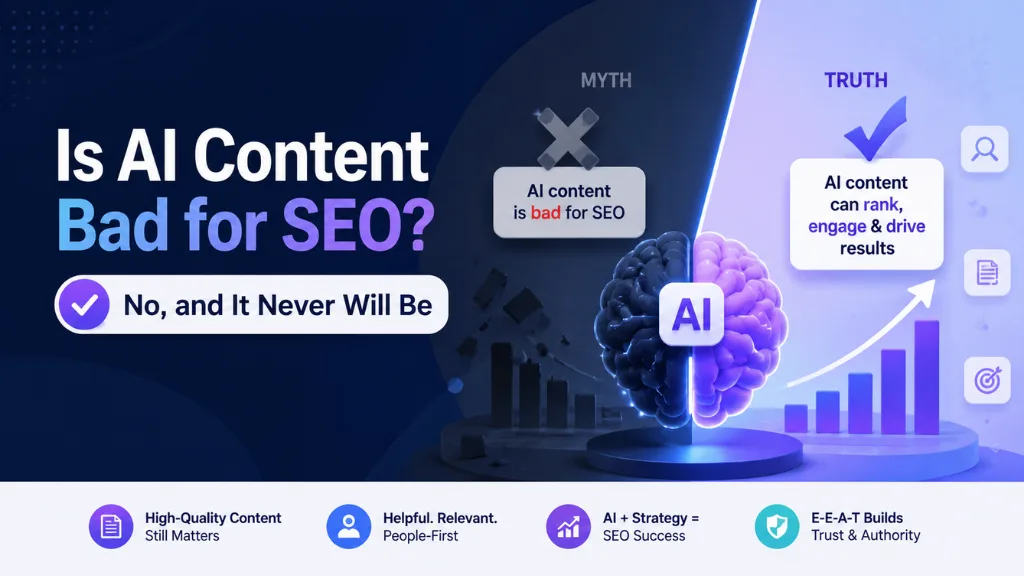
AI content bad for SEO is the assumption driving that fear, and in 2026 it remains almost entirely unsupported by evidence. Google’s policy has been consistent since February 2023 and was reaffirmed through every core update since – including March 2026 and May 2026. The search engine does not rank or penalise content based on whether a human or a machine wrote the first draft. What it evaluates is whether the content is helpful, accurate, and built for users.
AI content bad for SEO is a myth built on a real phenomenon that gets misdiagnosed. Content that underperforms after being written with AI is almost always underperforming for the same reason it would have underperformed if a human had written it – it is thin, generic, and adds nothing new to what already ranks. The production tool is not the problem. The quality is.
AI content bad for SEO is also increasingly impossible for Google to enforce as a blanket policy even if it wanted to. Ahrefs studied 600,000 pages and found that 81.9% of top-ranking pages included some form of AI assistance. Penalising AI content would mean deindexing most of the modern web – including Google’s own AI Overview outputs, which are themselves AI-generated.
At Search Savvy, we use AI writing tools in content workflows every day. The quality of the editorial layer on top of those drafts – not the AI tool itself – is what determines whether the content ranks, earns backlinks, and gets cited by AI systems. This article explains exactly why, with the data to back it.
What Is Google’s Official Position on AI-Generated Content?
AI content bad for SEO has never been Google’s stated position, and misrepresenting Google’s guidance is part of what keeps this myth alive.
Google’s February 2023 guidance on AI-generated content from its Search Central Blog states the position directly and clearly, and nothing in the two years since has changed it:
“Using automation – including AI – to generate content with the primary purpose of manipulating ranking in search results is a violation of our spam policies. That said, it’s important to recognise that not all use of automation, including AI generation, is spam.”
The same guidance continues: “Our focus is on the quality of content rather than how content is produced.”
Google’s John Mueller reinforced this in multiple public statements: “I wouldn’t think about it as AI or not, but about the value that the site adds to the web.”
The March 2026 Core Update and Search Quality Rater Guidelines confirm the same framework: Google’s human evaluators are instructed to assess content based on helpfulness, accuracy, and user satisfaction. They do not assess whether a machine was involved in writing it.
People Also Ask: Does Google penalise websites for using AI to write content? Short Answer: No. Google does not penalise content based on the production method. What Google penalises is content produced primarily to manipulate search rankings with little genuine value – whether that content was written by AI, a content mill, or a human with no editorial oversight. Google’s own guidance confirms that appropriate use of AI in content creation is not against its guidelines.
What Does the Data Actually Say About AI Content and SEO Rankings?
AI content bad for SEO is also unsupported by every significant study conducted on actual ranking performance, across 2024, 2025, and into 2026.
The Ahrefs 600,000-page study is the most comprehensive: only 13.5% of the top 20 ranking pages for 100,000 randomly selected keywords were classified as “pure human” content. 81.9% included some form of AI assistance, and 4.6% were fully AI-generated. There was a correlation of just 0.011 between AI content percentage and ranking position – a number so close to zero it is statistically meaningless.
A Rankability analysis of 487 top-ranking results for competitive commercial keywords found that content reading as human-written continued to dominate top positions – but the methodology measures output quality, not production method. The takeaway is that high-quality content still ranks, and high-quality AI-assisted content ranks as well as high-quality human-written content when both produce the same output.
A Flying Cat Marketing survey tracking 67% of respondents across four groups – ranging from no AI use to more than 50% AI-generated content – found that regardless of AI usage level, the majority of respondents reported an increase in organic traffic over six months. AI usage alone showed no statistical link to performance in either direction.
As of mid-2025, over 16% of Google’s top search results contain AI-generated content, ranking solely because they meet Google’s quality standards.
AI content bad for SEO, by every data set available, is simply not the pattern that emerges from studying actual SERP performance.
People Also Ask: Has anyone ever been penalised specifically for using AI to write content? Short Answer: Not for AI use itself. Sites penalised for AI-related content violations were penalised for scaled content abuse – publishing large volumes of thin, unedited, low-value AI content primarily to capture search traffic. The penalty trigger was the absence of quality and the manipulation intent, not the presence of AI. Google’s SpamBrain targets behavioural patterns of low-value mass production, not AI authorship.
So Why Does Some AI Content Underperform?
AI content bad for SEO is a misdiagnosis of a real problem. The real problem is not AI content – it is thin content, regardless of who or what produced it.
AI content underperforms for the same reasons any content underperforms:
- It adds nothing new – AI drafts trained on existing web content naturally produce content that sounds like a paraphrase of what already ranks. Without original data, first-hand examples, or unique insight, there is no reason for Google or a reader to choose it over an existing result
- It lacks E-E-A-T signals – Experience, Expertise, Authoritativeness, and Trustworthiness require demonstrable human knowledge. A pure AI draft with no author attribution, no credentials, and no verifiable expertise fails these signals regardless of length
- It contains hallucinated facts – AI models confidently produce inaccurate statistics, invented citations, and wrong dates. Unverified AI content contains factual errors that undermine trust signals and user satisfaction
- It is produced at scale without editorial oversight – “Scaled content abuse” is Google’s specific spam category for sites publishing large volumes of thin pages without genuine value, irrespective of the writing method. It is the volume combined with the absence of quality that triggers penalties, not the AI tools
- It is generic to the point of irrelevance – A 2025 audit of 500,000 AI-generated pages found approximately 31% showed thin-content signals – not because they were AI-written, but because they were produced without the specificity and depth Google rewards
AI content bad for SEO is, more accurately, AI content without human editorial oversight bad for SEO. The distinction matters enormously for how you structure a content workflow.
People Also Ask: Why does AI-generated content sometimes rank poorly even when it seems well-written? Short Answer: Fluency is not the same as quality. AI content can be grammatically perfect and structurally sound while containing nothing that a reader could not get from any of the other hundred pages targeting the same keyword. Google’s systems in 2026 are specifically tuned to detect topical depth and genuine information value – not just correct language patterns. Content that passes a readability check but fails an expertise check is what underperforms.
What Is the Right Way to Use AI for SEO Content?
AI content bad for SEO is the wrong question. The right question is: what does AI handle well, and what does it require human input to get right?
AI tools handle the parts of content production that are most time-consuming and least dependent on unique expertise:
- First drafts and outlines – structure, section ordering, and covering the obvious angles of a topic
- Research aggregation – summarising what other sources say about a topic, as a starting point for adding original layer on top
- SEO formatting – heading hierarchies, FAQ sections, meta descriptions, and schema suggestions
- Editing and rewriting – improving clarity and flow on human-drafted content
Humans must supply the parts that determine whether content outranks competitors:
- Original data and case studies – specific examples, real metrics, and brand-specific results that AI cannot generate
- First-hand experience – the “E” in E-E-A-T that Google’s quality systems specifically reward
- Fact-checking – every statistic, citation, and named entity verified against a primary source before publication
- Editorial voice – the perspective, position, and brand-specific angle that makes content distinctive rather than generic
The AI-assisted, human-refined model is what every successful content workflow looks like in 2026. Pure AI-generated content without editorial oversight underperforms human-written content by 23% in organic rankings after 12 months. AI-assisted content with genuine human editing matches or outperforms purely human-written content in both quality and efficiency.
Why Will AI Content Never Be Bad for SEO?
AI content bad for SEO as a structural concern – one that could be built into Google’s ranking systems as a permanent penalty – is something that will never happen, and the reasons are structural rather than optimistic.
First, Google uses AI extensively in its own products. AI Overviews, which appear on 48 to 58% of all SERPs globally in 2026, are themselves AI-generated – Gemini synthesising answers from multiple sources and presenting them in Google’s own words. Penalising AI content would require Google to penalise its own primary product evolution.
Second, 81.9% of top-ranking pages already include AI assistance. Penalising AI content would mean deindexing the majority of the modern web – including the research institutions, news organisations, and enterprise brands Google specifically wants to surface.
Third, Google’s detection systems evaluate quality signals – engagement metrics, E-E-A-T, originality, and intent satisfaction – not production method signals. There is no confirmed evidence that Google uses AI detection as a ranking mechanism, and its policies explicitly redirect away from that framing toward quality as the only test that matters.
According to Search Savvy’s insights from managing AI-assisted content across Indian and international client sites through two major 2026 core updates, the only content that lost rankings was content that was thin and generic regardless of how it was produced – and the content that recovered was the content that added original depth, updated facts, and genuine editorial perspective on top of the AI draft.
How Should Indian Brands Approach AI Content for SEO?
AI content bad for SEO concerns are particularly relevant to Indian brands and agencies that have adopted AI tools at scale for content production and are navigating both the efficiency gains and the quality risks simultaneously.
Indian content teams using AI effectively are treating it as a research and drafting accelerator, not a publishing pipeline. The highest-performing approach pairs AI drafts with India-specific data, regional examples, local regulatory context, and the kind of brand-specific case study detail that no AI model can generate from training data alone.
At Search Savvy, we recommend Indian brands start every AI-assisted content piece by asking one question before it goes live: “Does this contain anything a reader could not find on any other page targeting this keyword?” If the honest answer is no, the piece needs more human editorial input before publication – regardless of how fluent and well-formatted the AI draft is.
Conclusion: The Tool Was Never the Test
AI content bad for SEO was always the wrong framing. Google’s test has never been how content was produced. It has always been whether content is helpful, accurate, and built for users – and that test applies identically to AI-assisted and human-written content.
Search Savvy uses AI tools in content production, recommends them to clients, and has seen no penalty for doing so – because the work focuses on what AI cannot do, which is supplying original insight, verified facts, and genuine editorial judgment on top of whatever the tool produces as a starting point.
FAQ: Is AI Content Bad for SEO? – Your Questions Answered
Q1: Will Google ever penalise AI content as a direct policy? This is structurally unlikely. Google uses AI in AI Overviews, ranking systems, and its own content. Over 81% of top-ranking pages already include AI assistance. Penalising AI content would require deindexing most of the modern web, including Google’s own major products. Google’s policy focus has always been on content quality and user intent – which apply equally to human and AI-generated content and always will.
Q2: What specifically does get penalised when AI content is involved? Scaled content abuse – publishing large volumes of thin, low-value pages primarily to capture search traffic, with little or no human editorial oversight. This was penalised before AI tools existed (when it was done with content farms and article spinners) and continues to be penalised now. The abuse pattern is the trigger, not the tool.
Q3: Does Google have an AI content detector in its algorithm? There is no confirmed evidence that Google uses AI detection scoring as a ranking signal. Google’s own guidelines do not reference detection as a mechanism, and Google representatives including John Mueller have consistently redirected the conversation to quality rather than production method. Google’s SpamBrain targets behavioural and quality signals, not AI authorship.
Q4: How much human editing does AI content need to rank well? Enough to add what AI cannot generate: original data or examples, verified statistics, first-hand experience, and a clear editorial perspective that distinguishes the piece from everything else targeting the same keyword. There is no percentage threshold – the test is whether the published piece contains genuine value that a competing AI draft without human input would not have.
Q5: Can fully AI-generated content rank on Google? Yes – 4.6% of top-ranking pages in Ahrefs’ 600,000-page study were classified as fully AI-generated, and as of mid-2025, over 16% of Google’s top results contain AI-generated content. The ranking performance of fully AI-generated content varies widely based on topic complexity and competition level; for competitive informational queries, fully AI-generated content without human input consistently underperforms AI-assisted, human-edited content.
Q6: Does AI content affect eligibility for Google AI Overview citations? Not directly. AI Overviews cite sources based on topical authority, structured content, and E-E-A-T signals – the same factors that determine traditional rankings. AI-assisted content that demonstrates genuine expertise and is clearly structured for direct answer extraction performs as well as human-written content for AI Overview eligibility. The signal is content quality, not content authorship.
Using AI tools for content production and wondering whether your editorial workflow is doing enough to protect quality and rankings through 2026’s core updates? Visit Search Savvy for a content quality audit that evaluates your AI-assisted pieces against E-E-A-T standards and AI Overview citation eligibility.