Vertical Video Production Systems: Scaling Short-Form Output Without Sacrificing Quality
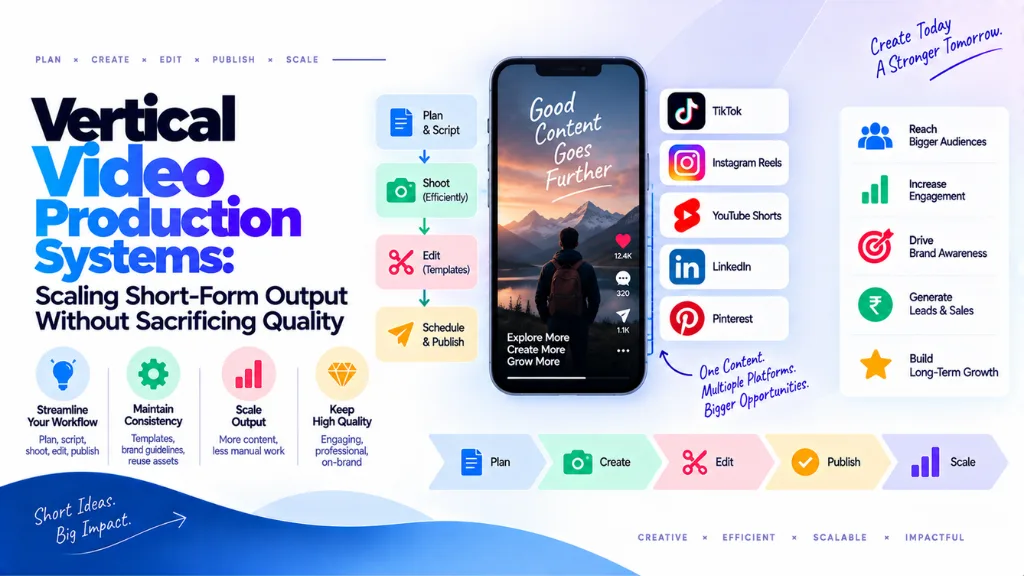

Vertical video budgets keep growing faster than the capacity to actually produce the content those budgets are meant to fund. A brand posting across three platforms, running a handful of creative refreshes per quarter, and covering even a modest number of locations quickly generates an asset count that traditional, one-video-at-a-time production workflows were never built to support. Vertical video production systems are the structured people, process, and tooling frameworks that let a team scale output to match demand without either burning out the team or letting quality erode as volume climbs.
In this article11 sections
This has become the actual gating constraint on short-form performance in 2026 – not creative ideas, and not media budget, but raw production capacity. This article breaks down what a genuine production system looks like, why ad-hoc workflows break down predictably at scale, and the specific practices that let volume and quality coexist.
What Is a Vertical Video Production System?#
A vertical video production system is a repeatable operating model – covering ownership, workflow phases, and tooling – that turns short-form video output into a predictable, scalable process rather than a series of individually planned projects. In a one-off setup, a single marketer often ends up acting as strategist, scriptwriter, editor, reviewer, and publisher simultaneously, which can work for a handful of videos but collapses once volume needs to increase without a proportional increase in headcount.
The native aspect ratio matters more than it might seem. Platforms like TikTok and Instagram Reels reward genuinely native vertical content with two to three times higher organic reach compared to horizontal footage cropped into a vertical frame on the same account, because cropped footage loses quality and creates dead zones at the edges that measurably reduce watch time. A system built around shooting vertical from the start, rather than reformatting afterward, captures that reach advantage structurally rather than hoping it works out in post-production.
Why Ad-Hoc Production Breaks at Scale#
The mechanism behind why unstructured production collapses under volume has a name in cognitive science: context-switching cost. Research consistently puts the productivity penalty at roughly 23 minutes of lost focus per task switch. A single creator who plans, records, edits, captions, and schedules within one session is packing five distinct context switches into a single sitting, and that overhead compounds directly with every additional video the same person tries to produce in the same undivided workflow.
This is precisely why unclear ownership is usually where a scaling attempt actually breaks, more often than a lack of creative ideas or editing skill. A one-off setup can absorb the context-switching cost of one person wearing every hat for a handful of projects; it cannot absorb that same cost multiplied across the asset volume a real short-form strategy now requires.
The Three Pillars: People, Process, Platform#
A genuine production system rests on three interdependent pillars, and skipping any one of them typically re-creates the bottleneck the system was meant to solve.
| Pillar | What It Covers | Common Failure Mode Without It |
| People | Clear ownership of each production phase – strategy, scripting, filming, editing, publishing | One person absorbing every role, hitting a context-switching ceiling that caps total output |
| Process | Defined, repeatable workflow phases run in batches rather than sequentially per video | Producing one video at a time, re-paying planning and setup overhead on every single piece |
| Platform | Tooling that supports the volume – AI clipping and reframing tools, brand kits, scheduling systems | Manual editing and formatting for every clip, making volume increases linear in cost rather than more efficient |
Brand guardrails belong at the front of this system, built into scripting and shot-list templates, rather than functioning as a review meeting bolted onto the end of the process. Checking brand compliance after a batch is already filmed and edited either forces expensive rework or lets inconsistencies slip through under deadline pressure – building the guardrail into the process phase avoids both outcomes.
Batch Production: The Core Workflow Shift#
The single highest-leverage change most teams can make is separating production into distinct phases and running each phase across an entire batch, rather than completing every phase for one video before starting the next. Blocking a single day to plan, film, edit, and schedule four to six videos consistently outproduces the equivalent time spent producing one video per day, because it eliminates the repeated context switches and setup overhead that dominate a sequential, one-at-a-time workflow.
AI-assisted clipping tools have made this shift more dramatic for teams working from existing long-form source material – a podcast, webinar, or interview. A single 20-minute recording session can reasonably become eight to twelve publishable vertical clips once run through a tool that identifies high-engagement moments, applies captions, and reframes for vertical delivery, without a team member reviewing the full source footage in real time. This doesn’t replace human editorial judgment entirely, but it compresses the most time-consuming part of the traditional workflow – scanning long-form footage for usable moments – into a fraction of the time it used to take.
How Much Content Should a Single Batch Session Produce?#
There’s no fixed number, but a useful anchor is to size the batch against your actual sustainable posting cadence rather than maximizing raw output. If a session produces eighteen clips and the target cadence is two posts per day, that batch represents nine days of scheduled content – a buffer worth planning deliberately rather than dumping the entire batch immediately just because it’s ready.
Quality Guardrails That Don’t Slow Down Volume#
Scaling output doesn’t have to mean diluting quality, provided a handful of specific practices are built into the batching process itself rather than treated as separate, optional polish:
- Shoot vertical natively, every time. Reformatting horizontal footage after the fact costs quality and produces the dead-zone framing problem covered earlier – building vertical capture into the shot-list template avoids this entirely.
- Protect hook discipline in the first 1.5 to 2 seconds. Short-form video’s survival window is brief enough that this deserves explicit attention in scripting, not an afterthought discovered during editing.
- Script message variants, not just visual variety. Writing three versions of the same core message – one leading with a statistic, one with a question, one with a story – targets different viewer psychology from a single planning session.
- Apply brand kit consistency automatically. Fonts, colors, and caption styles applied through a template rather than manually per video keep a large batch visually consistent without adding review overhead to every clip.
- Export clean, native files per platform. A visible watermark or cross-platform artifact signals recycled content to both viewers and platform originality-detection systems, undermining the reach benefit native vertical format was meant to capture.
Search Savvy’s reels and short-form video production services build these guardrails directly into the batch workflow itself, rather than relying on a separate quality-control pass after editing is already complete.
Pacing Output Against Platform Algorithms#
Producing volume efficiently only pays off if it’s released at a pace platforms actually reward. Consistency matters more than raw frequency: posting three times a week, every week, consistently outperforms posting daily for two weeks and then going quiet, because platform algorithms track posting cadence and reduce distribution once an account’s pattern becomes inconsistent. TikTok specifically applies what’s internally described as a 90-day trust signal for new or reactivated accounts – reduced distribution during that window is a normal ramp-up period, not a signal that the content strategy itself needs to change.
A sustainable cadence for most short-form platforms in 2026 sits around one to three clips per day. Posting seven clips from a single productive batch session in one day doesn’t produce seven times the reach – platforms actively suppress rapid same-account posting, and audiences have a real tolerance limit for how much of one creator or brand they want in a single day’s feed. Mapping batch output against this cadence, rather than publishing everything as soon as it’s ready, is what turns an efficient production session into a sustainable content pipeline.
A Practical Framework for Building a Production System#
- Assign clear ownership per phase, even if the same team covers multiple phases initially – the goal is separating the phases conceptually so batching becomes possible.
- Build brand guardrails into scripting templates, not into a post-production review step.
- Shift to phase-based batch production, blocking dedicated time for planning, filming, editing, and scheduling as separate sessions.
- Adopt AI-assisted clipping for long-form source material, compressing the highest-friction part of the traditional workflow into a fraction of the previous time.
- Size each batch against your sustainable posting cadence, not your maximum production capacity, and build in a buffer of scheduled days.
- Track distribution against cadence changes, expecting a normal ramp-up period on new or reactivated accounts rather than mistaking it for a content quality problem.
Search Savvy’s content calendar and creative production services build exactly this phase-based system for clients scaling short-form output, pairing batch production with a pacing strategy that matches what each platform’s algorithm actually rewards.
Common Mistakes in Scaling Vertical Video Production#
- Shooting horizontal and cropping to vertical. This consistently loses quality and reach compared to native vertical capture, regardless of how strong the content is.
- Letting one person own every production phase indefinitely. This caps total output at whatever a single person’s context-switching capacity allows, regardless of available budget.
- Publishing an entire batch immediately. This triggers algorithmic suppression for rapid same-account posting and exceeds audience tolerance, wasting a productive session’s output.
- Treating brand guardrails as a final review step. Catching inconsistencies after a batch is filmed and edited forces expensive rework a front-loaded process avoids.
- Mistaking normal algorithmic ramp-up for a content problem. Reduced distribution during a trust-building window is expected and doesn’t call for an immediate strategy pivot.
The Bottom Line#
Vertical video production systems solve a capacity problem, not a creativity problem – the brands scaling successfully in 2026 are the ones that stopped trying to produce their way through rising demand with an unstructured, one-video-at-a-time approach and started orchestrating people, process, and tooling as a deliberate system. Batch production, native vertical capture, front-loaded brand guardrails, and cadence-aware publishing together let output scale without the quality erosion that ad-hoc scaling almost always produces.
The practical next step is auditing your current production workflow for where context-switching is quietly capping your output, before assuming more budget alone will solve a capacity constraint that’s actually structural. Search Savvy’s short-form video workflows and creative production planning build this kind of scalable system from the ground up, so volume and quality grow together rather than trading off against each other.
Frequently Asked Questions#
What is a vertical video production system? It’s a repeatable operating model covering people, process, and tooling that turns short-form video output into a scalable, predictable workflow, rather than a series of individually planned videos each requiring the same overhead from scratch.
Why does shooting horizontal and cropping to vertical hurt performance? Cropped horizontal footage loses quality and creates dead zones at the frame edges that reduce watch time, and platforms reward genuinely native vertical content with two to three times higher organic reach compared to the same content shot horizontally and reformatted.
What is batch production, and why does it scale better than making videos one at a time? Batch production separates the workflow into distinct phases – planning, filming, editing, scheduling – and runs each phase across an entire batch of videos at once, avoiding the repeated context-switching cost that dominates a sequential, one-video-at-a-time workflow.
How many clips can a single recording session realistically produce? Using AI-assisted clipping tools, a single 20-minute long-form recording session can reasonably yield eight to twelve publishable vertical clips, though the right number to actually schedule depends on matching that output against a sustainable posting cadence rather than publishing everything at once.
How often should a brand post short-form video content? A sustainable cadence for most platforms in 2026 is roughly one to three clips per day. Consistency matters more than raw frequency – posting several times a week every week outperforms posting daily for a short burst and then going quiet.
Why does a new social media account see reduced reach even with strong content? Platforms like TikTok apply a trust-building window, sometimes described internally as a 90-day period, to new or reactivated accounts, during which distribution is reduced regardless of content quality. This is a normal ramp-up period, not a signal to change strategy.