Short-Form Video Algorithm Decoding: Retention Curves, Replays and Shares as Ranking Signals
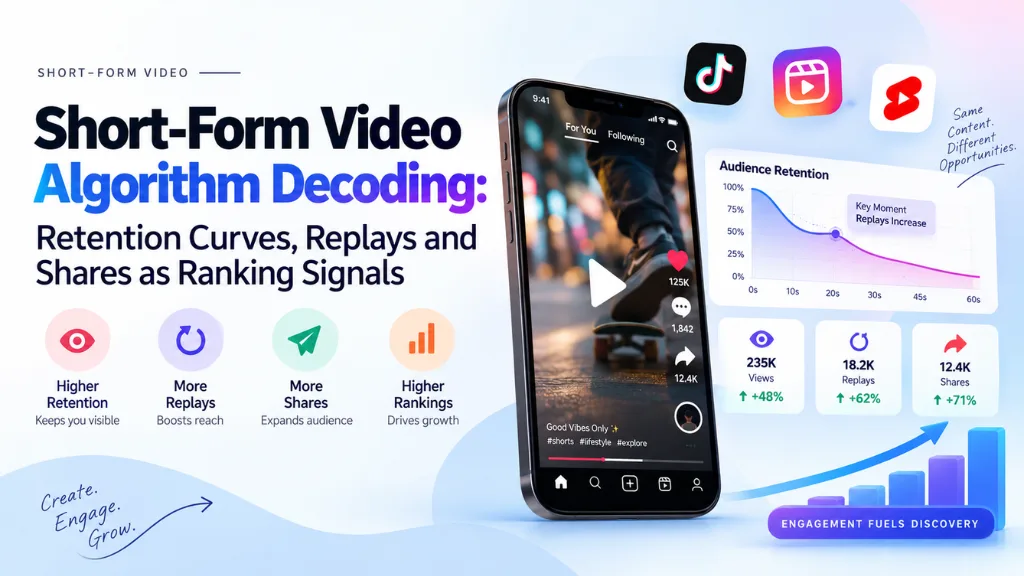

A video with thousands of likes can still get buried, while a video with a fraction of that engagement reaches millions – and the difference usually isn’t luck. Across TikTok, Instagram Reels, and YouTube Shorts, short-form video algorithms have converged on a consistent signal hierarchy in 2026: how long and how completely someone watches matters more than whether they liked it, whether they watched it more than once matters more than whether they finished it, and whether they sent it to someone privately matters more than almost anything else.
In this article10 sections
This guide decodes what’s actually driving distribution on each platform – retention curves, replays, and shares specifically – including where platforms have publicly confirmed their own priorities and where the picture is still genuinely contested.
The Shift Away from Likes: What Platforms Have Actually Confirmed#
Instagram’s own head, Adam Mosseri, confirmed in January 2025 that watch time is the top signal for Reels distribution, and that how long people watch matters more than likes or shares for determining how widely a Reel gets pushed. Multiple industry reports throughout 2025 and 2026 have consistently cited three priority signals specifically named in connection with Instagram’s Reels ranking: watch time (particularly the percentage of the video actually watched), likes per reach, and sends per reach – meaning a Reel sent privately via direct message to a niche audience.
It’s worth being precise about what this actually is: Meta has described the general categories of signals it uses, but it has not published an exact table of numerical weights, and much of the specific framing repeated across 2026 industry content is attributed commentary rather than an official, itemised algorithm specification. The consistent theme across independent reporting, however, is unambiguous – engagement quality, not raw like counts, is what determines distribution now.
Retention Curves: Why How People Watch Matters More Than Whether They Finish#
A retention curve tracks what percentage of viewers are still watching at every point in a video, and platforms use its shape – not just the final completion percentage – to judge content quality. Total watch time frequently matters more than completion rate alone: a 30-second video watched completely by 60% of viewers can outperform a 15-second video watched completely by 40% of viewers, because the algorithm is ultimately measuring accumulated attention, not simply whether a viewer reached the final frame.
Two specific points on the curve carry outsized weight:
- The hook, or intro retention – the percentage of viewers still watching past the first one-and-a-half to three seconds. Strong-performing creators are commonly cited as achieving intro retention above roughly 70%, through an opening visual, a surprising statement, or immediate value delivery rather than a slow build-up.
- Mid-video drop-off, which Instagram’s own Reels system documentation has specifically named as “short-watch avoidance” – consistent early abandonment doesn’t just hurt that one video’s distribution, it accumulates as a negative signal at the account level over time, making every subsequent post harder to distribute.
Practically, this means reviewing a retention curve graph in each platform’s creator analytics and identifying exactly where viewers drop off is more actionable than watching completion rate as a single number. A sharp drop at the eight-second mark points to a specific pacing or content problem at that moment, in a way an overall 45% completion rate alone doesn’t reveal.
Replays: The Highest-Confidence Positive Signal#
A viewer choosing to watch a video again is treated as a stronger positive signal than simply finishing it once, because a replay represents unprompted, repeated interest rather than passive completion. TikTok in particular treats rewatch behaviour as one of its highest-confidence quality signals, on the reasoning that a viewer who returns to the beginning of a video has effectively voted twice for the same content without being asked to.
This is why loop-friendly editing – structuring a video with no hard, definitive ending, so the final frame flows naturally back into the opening – has become a deliberate tactic rather than a stylistic accident. A video edited to loop seamlessly measurably increases the odds a viewer watches it through a second or third time, directly feeding the replay signal platforms weight so heavily.
Shares and Sends: Why They Outweigh Likes#
Sending a video privately to another person – via direct message, WhatsApp, or another messaging platform – is treated as a stronger signal than a public like, because it represents an explicit, personal recommendation rather than a low-effort tap. A like says “I noticed this.” A private send says “I thought of you specifically when I saw this,” which carries meaningfully more social weight and predictive value about genuine content quality.
Saves function as a related but distinct signal: rather than sending content to someone else, a save signals a personal intent to return to it later – bookmarking a recipe, a tutorial, or a piece of information for future reference. Instagram in particular is reported to weight saves more heavily than TikTok does, with a Reel saved by a small percentage of viewers frequently earning a larger distribution boost than a much higher volume of likes on the same content.
Content that consistently earns strong shares and saves tends to share a specific quality: it addresses a narrow, specific situation – a mistake to avoid, a comparison, a genuinely useful piece of information – rather than something broadly relatable but forgettable. People rarely feel compelled to send or save content that’s too generic to justify the effort.
Platform-by-Platform Differences#
Despite the shared emphasis on watch time, replays, and shares, the three major platforms score content differently at a structural level.
| Platform | Primary Scoring Unit | Distinguishing Behaviour |
| TikTok | The individual video | A single strong video from a brand-new account can reach millions; account history matters far less than the video’s own performance signals |
| Instagram Reels | The account | Reach scales with an account’s follower engagement history; an account whose followers consistently engage gets more reach on each new post than one whose followers scroll past |
| YouTube Shorts | Viewer satisfaction and platform retention | Prioritises whether a viewer stays within the Shorts feed afterward, watching additional videos in sequence, over any single video’s isolated performance |
This distinction has real strategic implications. A brand starting fresh on TikTok has a genuinely fair shot at reaching a large audience with one strong video, regardless of follower count. The same brand starting fresh on Instagram Reels is working against an account-level engagement history that hasn’t been established yet, meaning early content needs to specifically earn strong engagement from existing followers before the algorithm extends much additional reach to new viewers.
Does Posting Frequency Actually Matter? A Contradiction Worth Flagging Directly#
Some 2026 sources claim daily posting dramatically increases reach compared to weekly posting, “even if content quality is identical.” This specific claim is worth treating with real skepticism – it appears prominently in content published by companies selling automated daily-posting tools, which have an obvious commercial interest in convincing creators that frequency itself is the lever to pull.
More detailed, platform-specific reporting says something meaningfully different: total follower count and posting frequency alone have no direct effect on reach, and an account posting once a week with strong send rates and retention will outperform one posting daily with weak engagement signals. This is consistent with everything else in this guide – if watch time, replays, and shares are the actual inputs the algorithm evaluates, then posting more often without improving those underlying signals doesn’t change the fundamental scoring, it just produces more instances of the same weak signal.
The more defensible conclusion: consistency helps in the sense that more attempts create more opportunities to produce a genuinely strong-performing video, but frequency is not itself a ranking factor the way retention, replays, and shares demonstrably are.
A Practical Optimisation Sequence#
Given the signal hierarchy covered above, a logical order for building and refining short-form content runs: hook (the first one-and-a-half to three seconds) → pacing across the full retention curve → a loop mechanic to encourage replay → a specific, shareable hook that gives someone a clear reason to send it → a caption written to encourage saves. Many creators optimise in the reverse order – polishing captions and hashtags first while treating the opening seconds as an afterthought – which is backwards relative to how the algorithm actually evaluates content, since a weak hook means most viewers never see anything past it regardless of how well-crafted the rest of the video is.
Common Mistakes in Short-Form Video Optimisation#
- Treating likes as the primary success metric. A high like count with weak retention or a low send rate is a far weaker signal than platforms are reported to actually weight, and content approved purely because it “got a lot of likes” can plateau quickly despite that surface-level engagement.
- Using visibly watermarked, repurposed content. Instagram’s own leadership confirmed in February 2026 that content carrying a visible TikTok watermark or other third-party platform branding receives reduced recommendation reach.
- Building toward a hard ending. A definitive, non-looping conclusion forecloses the replay behaviour platforms weight so heavily; a seamless loop keeps that door open.
- Assuming one algorithm governs every platform identically. TikTok’s video-level scoring, Instagram’s account-level engagement history, and YouTube Shorts’ emphasis on keeping viewers inside its own feed each call for a genuinely different strategic approach, not one universal playbook.
- Equating posting frequency with signal quality. Publishing more often without improving retention, replay, or share performance doesn’t meaningfully change distribution – it just produces more content carrying the same weak signal.
- Optimising captions and hashtags before the hook and pacing. Since a weak opening loses most viewers before anything else about the video matters, this is generally the wrong place to start.
Frequently Asked Questions#
What’s the single most important ranking signal for short-form video in 2026? There isn’t one universal answer across all platforms, but watch time and retention consistently rank at or near the top for TikTok, Instagram Reels, and YouTube Shorts alike, with replays and private shares serving as the strongest secondary signals of genuine content quality.
Do likes matter at all anymore? They still factor in, but multiple platforms and industry reports place them below watch time, replays, and shares in actual weighting. A video with strong retention and a low like count generally outperforms one with the reverse.
Why are private shares (sends) weighted more heavily than public likes? A private send represents an explicit, personal recommendation to a specific person, which carries stronger predictive value about genuine content quality than a low-effort public like. Platforms treat this as a much stronger signal of “this content is worth someone else’s time” than a like conveys.
Does posting more frequently improve algorithm performance? Not on its own. More detailed platform-specific reporting indicates that posting frequency and follower count alone have no direct effect on reach – an account posting less often but with strong retention and share signals tends to outperform one posting daily with weak engagement.
Is the TikTok algorithm different from Instagram’s Reels algorithm? Yes, structurally. TikTok scores primarily at the individual video level, giving new accounts a genuine chance to reach a large audience with one strong video. Instagram Reels weighs account-level follower engagement history more heavily, meaning reach scales more gradually with an account’s established engagement quality.
What should creators optimise first: the hook or the caption? The hook. Since a weak opening loses most viewers within the first few seconds, everything downstream – pacing, replay potential, caption-driven saves – depends on enough viewers staying past that initial moment to matter at all.
The Bottom Line#
Short-form video algorithms in 2026 converge on a consistent hierarchy, even as TikTok, Instagram Reels, and YouTube Shorts differ in exactly how they score content: watch time and retention curve shape matter more than raw completion, replays are treated as the strongest available proof of genuine quality, and private shares consistently outweigh public likes as a distribution signal. Build content around that hierarchy – a strong hook, deliberate pacing, a loop mechanic, and a specific, shareable reason to send it – rather than chasing likes or posting frequency for their own sake. Search Savvy’s Reels and short-form video production services and analytics and performance reporting services build content and measurement strategy around exactly these retention and share-based signals.