Cross-Platform Attribution Modelling: Measuring True Social Media ROI in a Cookie-Less World
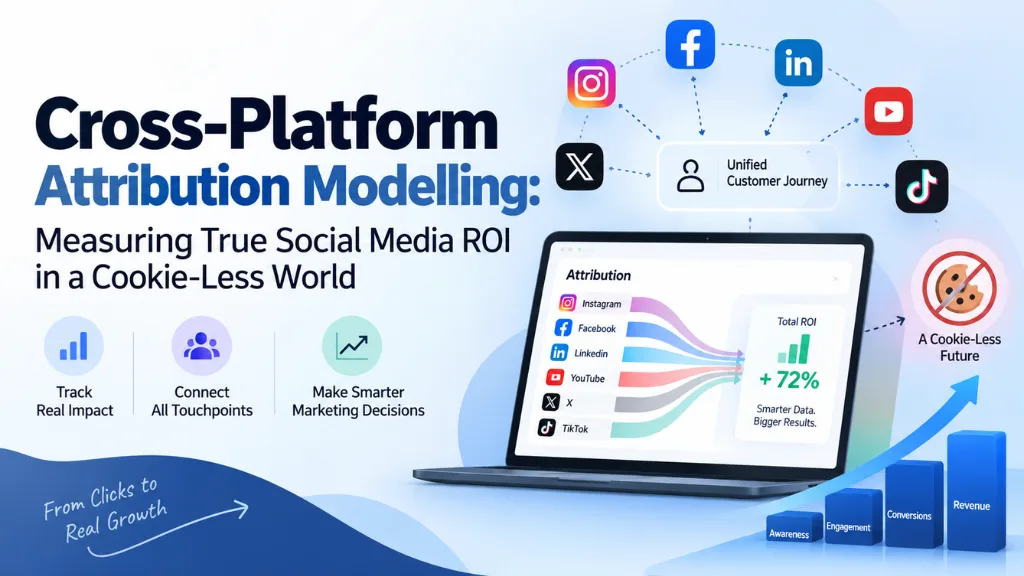

Open Meta Ads Manager, Google Ads, and your CRM side by side, and you’ll likely see three different numbers claiming to explain the same batch of conversions – Meta says 100, Google says 80, and your CRM shows 90 actual customers. This isn’t a tracking mistake. It’s the honest state of cross-platform attribution modelling in 2026, and before fixing it, one widely repeated premise needs correcting directly: third-party cookies didn’t actually disappear the way most of this conversation assumes.
In this article10 sections
This guide starts with what genuinely happened to cookies in 2026, why cross-platform social media attribution remains broken regardless of that outcome, and the practical stack – server-side tracking, deduplication, and incrementality testing – that gets a business closer to the truth than any single platform’s self-reported numbers ever will.
Correcting the Premise: What Actually Happened to Third-Party Cookies#
Most attribution content published in 2026 still opens with “third-party cookies are going away.” They aren’t, at least not in Chrome. Google officially reversed its Chrome cookie deprecation plan on April 22, 2025, and retired ten Privacy Sandbox APIs – including Topics, Protected Audience, and Attribution Reporting – on October 17, 2025, citing low adoption. Third-party cookies remain enabled by default in Chrome as of 2026, with users given the option to disable them in settings rather than facing removal.
This doesn’t mean the measurement environment is stable, though. Safari, Firefox, and Brave have continued blocking third-party cookies by default throughout this entire period – accounting for roughly 17–20% of global browser traffic that’s been effectively cookieless regardless of anything Chrome decided. And separately from any browser’s cookie policy, the ePrivacy Directive in the EU and equivalent laws elsewhere have required consent for non-essential cookies since long before Google proposed deprecating anything, meaning a large share of traffic behaves as functionally cookieless for compliance reasons even where the browser itself would technically allow tracking.
The practical upshot: the real driver of social media measurement signal loss in 2026 isn’t Chrome’s cookie policy – it’s Apple’s App Tracking Transparency framework, Safari’s tracking prevention, ad blockers, and the fact that major platforms don’t share user identifiers with each other. A patchwork of partial, inconsistent signal loss across browsers and devices, rather than one clean, uniform shift, is arguably a harder problem to plan around than the fully cookieless future many teams originally built their 2023–2024 measurement roadmaps to expect.
Why Cross-Platform Attribution Is Still Broken, Cookies Aside#
Even a business with perfect first-party data and full user consent still runs into a structural limitation: Meta, Google, TikTok, and LinkedIn each measure and report attribution within their own walled garden, using their own methodology, without sharing identifiers across platforms. Each platform’s in-platform reporting is inherently biased toward crediting its own channel – Meta’s attribution system will tend to claim credit for a conversion that Google Ads also claims credit for, because neither has visibility into what happened on the other platform.
This is why adding up the conversions each platform separately reports routinely produces a total well above what a business’s CRM or actual revenue data confirms. It’s not fraud or a technical bug on any single platform’s part – it’s the mathematically expected outcome of several independent, self-interested measurement systems each claiming credit for touchpoints they can partially observe, with no shared source of truth between them.
The Real Sources of Social Media Measurement Signal Loss#
| Source | What It Does |
| Apple’s App Tracking Transparency (ATT) | Requires explicit opt-in for cross-app tracking on iOS; most users decline, cutting platforms’ visibility into a significant share of mobile conversion activity |
| Safari Intelligent Tracking Prevention | Blocks third-party cookies and limits tracking script behavior by default, independent of Chrome’s policy |
| Ad blockers | Block tracking pixels and scripts entirely for a meaningful share of desktop and mobile users |
| Tracking parameter stripping | Apple strips known tracking parameters (such as fbclid) from links shared in Mail, Messages, and private browsing |
| Walled garden non-sharing | Platforms don’t exchange user identifiers or conversion data with each other, regardless of consent or cookie status |
Server-Side Tracking: The Foundational Fix#
Server-side tracking, delivered through each platform’s Conversions API (Meta, TikTok, Google) or equivalent Events API, sends conversion data directly from your server to the platform, rather than relying solely on a browser-based pixel that ad blockers and privacy settings can silently block. This is the single highest-leverage technical fix available for most of the signal loss described above, since it recovers visibility into conversions the browser-based pixel alone would simply miss.
Two implementation details matter more than the setup itself:
- Run server-side tracking alongside the browser pixel, not as a replacement for it, and deduplicate the two using a shared event ID for each conversion. Without deduplication, the same purchase gets counted once by the pixel and again by the server-side event, inflating reported conversions and misleading the platform’s own ad-optimisation algorithm in the process – a failure mode that’s arguably worse than the missing data it was meant to fix.
- Passing clean, hashed first-party identifiers – email, phone number – alongside the standard event data improves what platforms call Event Match Quality, which practitioners commonly report translating into better campaign optimisation and reporting accuracy, though these specific performance figures tend to be vendor-reported rather than independently audited, and worth treating as directional rather than a guaranteed outcome for any specific account.
Deterministic vs. Probabilistic Matching#
Two broad approaches now coexist in cross-platform measurement. Deterministic matching uses hashed, first-party identifiers collected directly at the point of conversion – an email address or phone number a customer actually provided – as the join key connecting a conversion back to an ad interaction. This is now considered the most durable and accurate form of cross-channel measurement available, precisely because it doesn’t depend on a third-party cookie or a browser’s willingness to allow tracking at all.
Probabilistic matching infers a likely connection between a device or session and a conversion using statistical modelling rather than a confirmed identifier – the fallback approach for the growing share of traffic where no first-party identifier was ever captured. It’s genuinely useful for filling measurement gaps, but it’s inherently a modelled estimate rather than a confirmed match, and should be treated with appropriately more caution in high-stakes budget decisions than deterministic data.
Layering Incrementality Testing on Top of Platform-Reported Numbers#
Server-side tracking improves data completeness, but it doesn’t answer the deeper question every marketer actually cares about: did this ad spend cause additional conversions, or would many of those customers have converted anyway? Improving signal quality raises the accuracy ceiling for every downstream measurement method – attribution, media mix modeling, and incrementality testing alike – but it doesn’t make any of them inherently more causal on its own.
Incrementality testing, run through each platform’s own holdout tools – Meta’s Conversion Lift, Google’s Geo Experiments, LinkedIn’s Conversion Lift feature – deliberately withholds ads from a control group and compares outcomes against a group that saw them, isolating genuine causal lift from correlation. This has become the most trusted measurement approach among senior marketing decision-makers: a January 2026 survey conducted by Haus and reported by eMarketer found 60% of respondents trust independent incrementality testing most, compared to 40% for media mix modeling and 37% for in-platform reporting alone – a meaningful vote of confidence away from taking any single platform’s self-reported numbers at face value.
Running a full incrementality test on every campaign isn’t practical for most businesses, but rotating tests across major channels on a quarterly basis provides a periodic reality check against platform-reported figures without requiring constant testing infrastructure.
A Practical Measurement Stack by Spend Tier#
| Spend Level | Recommended Stack |
| Smaller budgets | Server-side tracking (Conversions/Events API) as the foundation, plus GA4’s data-driven attribution for cross-channel signal – sufficient for most decisions at this scale |
| Mid-size budgets | Add quarterly incrementality testing and consider a lightweight multi-touch attribution tool if average customer journeys run longer than roughly five days and a CRM identity graph is available |
| Enterprise budgets | Full media mix modeling alongside rotating incrementality tests and dedicated data infrastructure, reflecting both the higher stakes and the greater feasibility of more sophisticated measurement at this scale |
Offline conversion import – feeding phone or in-store conversions back into ad platforms – is also worth prioritising for businesses with a meaningful non-digital conversion channel, since this step alone frequently recovers a substantial share of otherwise unreported conversions for B2B and local service businesses specifically.
Common Mistakes in Cross-Platform Attribution#
- Trusting each platform’s self-reported ROAS at face value. Every platform’s in-platform attribution is structurally biased toward crediting its own channel, which is precisely why the sum of platform-reported conversions routinely exceeds actual confirmed customers.
- Deploying server-side tracking without deduplication. Running CAPI alongside a browser pixel without a shared event ID to prevent double-counting inflates reported conversions and actively misleads the platform’s own optimisation algorithm.
- Treating server-side tracking as a causation fix. It restores missing signal and raises the accuracy ceiling for every downstream measurement method, but it doesn’t make platform-reported numbers any more causally reliable on its own – that’s specifically what incrementality testing is for.
- Assuming Chrome’s cookie reversal solved the measurement problem. The bigger, ongoing drivers of signal loss – iOS App Tracking Transparency, Safari’s tracking prevention, ad blockers, and walled garden non-sharing – were never dependent on Chrome’s specific cookie policy in the first place.
- Ignoring consent requirements because cookies remain technically available. GDPR, the ePrivacy Directive, and equivalent regional laws require consent for non-essential tracking regardless of what any browser allows by default.
- Over-investing in enterprise-grade measurement infrastructure too early. A smaller business is generally better served by solid server-side tracking and GA4’s data-driven attribution than by a costly multi-touch attribution platform or full media mix modeling study it doesn’t yet have the spend or data volume to justify.
Frequently Asked Questions#
Did third-party cookies actually go away in 2026? Not in Chrome specifically – Google reversed its deprecation plan in April 2025 and retired the Privacy Sandbox APIs that were meant to replace cookies in October 2025, leaving third-party cookies enabled by default. Safari, Firefox, and Brave have continued blocking them by default throughout this period, so a meaningful share of traffic remains effectively cookieless regardless of Chrome’s decision.
If cookies didn’t disappear, why is social media attribution still so unreliable? Because the bigger drivers of signal loss were never primarily about browser cookies – Apple’s App Tracking Transparency framework, Safari’s independent tracking prevention, ad blockers, and the fact that platforms like Meta, Google, and TikTok don’t share identifiers with each other all continue to fragment measurement regardless of what any single browser does with cookies.
What is the Conversions API, and why does it matter? The Conversions API (and equivalent Events API implementations) lets a business send conversion data directly from its server to an ad platform, recovering visibility into conversions that a browser-based pixel alone would miss due to ad blockers, tracking prevention, or privacy settings. It should run alongside, not instead of, the existing browser pixel, with deduplication to prevent double-counting.
Is media mix modeling a replacement for platform-level attribution? Not exactly a replacement – it’s a complementary approach. Media mix modeling estimates channel contribution using aggregated, historical data rather than individual-level tracking, making it more privacy-resilient, but it typically operates at a slower cadence and coarser granularity than platform-level or incrementality-based measurement.
How often should a business run incrementality tests? Most mature measurement programs rotate incrementality tests across channels on a quarterly basis, using them as a periodic reality check against platform-reported numbers rather than running constant testing across every campaign, which isn’t practical for most budgets.
Do small businesses need to worry about all of this, or is it only relevant at enterprise scale? The foundational fix – server-side tracking alongside GA4’s data-driven attribution – is worthwhile even for smaller businesses, since it’s relatively low-cost and directly recovers otherwise lost conversion signal. Full media mix modeling and enterprise multi-touch attribution platforms are generally only justified once spend and data volume reach a scale that makes their cost and complexity worthwhile.
The Bottom Line#
Cross-platform attribution in 2026 isn’t broken because cookies disappeared – they didn’t, at least not from Chrome. It’s broken because walled gardens don’t share data with each other, because iOS and non-Chrome browsers already block a meaningful share of tracking regardless of Chrome’s policy, and because every platform’s in-platform reporting is structurally biased toward crediting itself. Server-side tracking with proper deduplication restores lost signal, deterministic matching using first-party identifiers is the most durable foundation available, and incrementality testing – now the most trusted measurement method among senior marketers – is what actually separates causal impact from platforms simply claiming credit for what would have happened anyway. Search Savvy’s performance marketing services and analytics and performance reporting services build exactly this kind of server-side, incrementality-informed measurement stack, and the performance marketing glossary is a useful reference for the terminology covered throughout this guide.