SGE vs Traditional SEO: How Google’s AI Is Changing Rankings
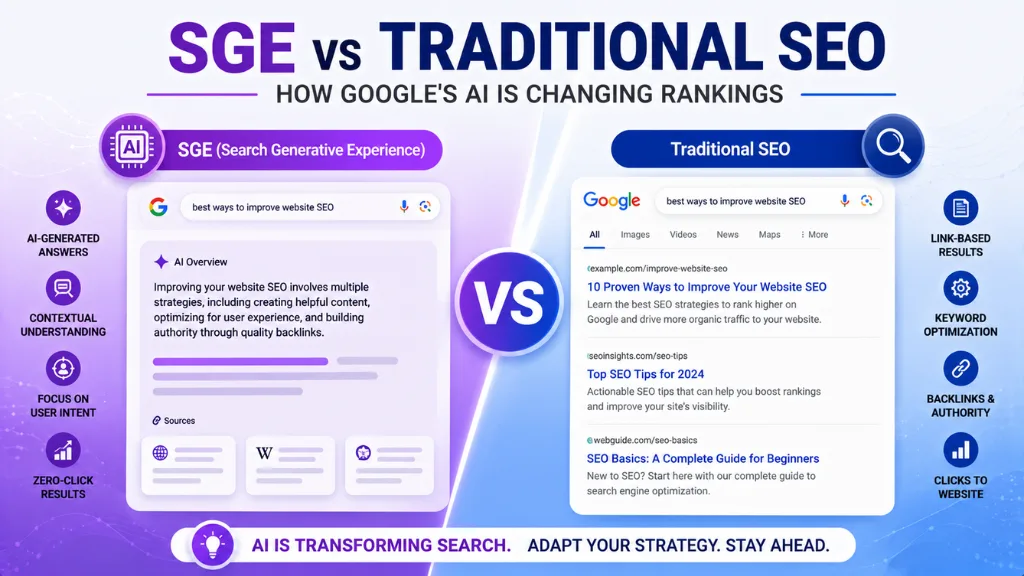

Here is the SEO reality most site owners discovered in 2025 and are still adjusting to in 2026: you can hold your number-one ranking and still lose half your traffic.
In this article14 sections
SGE vs Traditional SEO is not just an academic comparison anymore. It is the practical challenge every website producing informational content now faces, every day, in every search category. Google’s Search Generative Experience – first tested in 2023 as SGE, renamed AI Overviews in 2024, and now expanded into a full AI Mode tab in 2026 – has fundamentally changed the relationship between ranking in search and receiving traffic from it.
SGE vs Traditional SEO reflects two different search eras. In the traditional model, ranking in position one reliably delivered clicks. In the AI search model of 2026, a Pew Research Center study tracking 68,000 real search queries found that when an AI Overview appeared, users clicked on organic results only 8% of the time – compared to 15% without one. That is a 46.7% relative decline in clicks, even when rankings are unchanged.
SGE vs Traditional SEO is a distinction every SEO needs to understand to build a strategy that holds in 2026 – because the old “rank and click” model no longer describes how most informational search actually works.
At Search Savvy, we have been tracking the AI Overview impact across client sites since the initial rollout, and the data is clear: traditional ranking still matters, but it is no longer sufficient on its own. This guide explains exactly what changed and what to do about it.
What Is SGE and How Did It Evolve Into AI Overviews and AI Mode?#
SGE vs Traditional SEO begins with understanding what SGE actually was – and what it has become. Google’s Search Generative Experience was introduced as an experimental feature in Google’s Search Labs in May 2023, giving opted-in users an AI-generated summary above traditional results for eligible queries.
SGE became AI Overviews in May 2024, when Google rolled the feature out to all US users without requiring an experimental opt-in. By early 2026, AI Overviews are live in over 200 countries and 40 languages, appearing at the top of the search results page and synthesising answers from multiple sources before a user ever sees a blue link.
In 2026, Google added a second, more aggressive AI surface: AI Mode. Unlike AI Overviews, which appear inline above standard results, AI Mode is a dedicated tab – similar to Images or Shopping – where the entire interface is conversational. AI Mode links to an average of 12.6 sources per response, compared to 13.3 for AI Overviews, but the two surfaces share only 10.7% of cited URLs, meaning they pull from significantly different pools of content.
People Also Ask: What is the difference between SGE, AI Overviews, and AI Mode? Short Answer: SGE (Search Generative Experience) was the experimental 2023 precursor to what became AI Overviews in 2024 – AI-generated summaries appearing above traditional search results. AI Mode, introduced in 2026, is a separate conversational search tab powered by Gemini, where the entire interface is AI-driven and users can ask follow-up questions. Both can pull from the same content but show limited overlap in which URLs they actually cite.
How Does SGE vs Traditional SEO Affect Traffic and Click-Through Rates?#
SGE vs Traditional SEO produces its most visible impact in click-through rates, and the 2026 data across multiple independent studies is consistent in its direction even when it varies in magnitude.
Informational queries – “what is,” “how to,” and “why does” style searches – are the most heavily affected. These are precisely the query types that most content blogs, educational sites, and resource hubs depend on for organic traffic.
Key 2026 data points on the SGE vs Traditional SEO traffic impact:
- 60% of searches in traditional search engines now end without a click due to AI summaries, according to Bain research
- CTR dropped from 15% to 8% when an AI Overview was present in Pew Research’s tracking study of 68,000 real searches – a 46.7% relative decline
- Only 1% of searches lead to users clicking a link directly within an AI Overview (Pew Research Center)
- CTR drops for informational queries range from 34% to 58% across multiple independent analyses
- In a worst-case documented scenario, DMG Media reported desktop CTR dropping from 25.23% to 2.79% – an 89% reduction – when AI Overviews appeared for their content
- Users end their search session 26% of the time when an AI Overview is shown, compared to 16% without one
SGE vs Traditional SEO, however, is not uniformly bad for all traffic types. AI-referral visitors – those who click through from an AI Overview citation – are measurably more engaged: Similarweb data from June 2026 shows they view nearly twice as many pages and spend twice as long on site compared to standard organic visitors. Fewer clicks, but higher-intent clicks.
People Also Ask: Does ranking #1 on Google still matter with AI Overviews? Short Answer: Yes, but it is no longer sufficient on its own. 76.1% of URLs cited in AI Overviews also rank in the top 10 organic results, meaning traditional ranking is still the strongest predictor of AI citation eligibility. But ranking first now requires a parallel strategy for AI citation visibility, since the top position no longer automatically delivers the clicks it once did for informational queries.
What Queries Are Most Affected by SGE vs Traditional SEO?#
SGE vs Traditional SEO does not affect every query type equally. The impact is heavily concentrated in specific categories, and understanding this determines where to prioritise adaptation.
Highest impact – expect 34 to 58% CTR declines:
- Informational queries: “What is X,” “How does Y work,” “Why does Z happen”
- Definition and explainer content
- Educational how-to guides
Moderate impact:
- Commercial investigation queries where AI Overviews compare options
- Generic product or service category queries
Lower impact – less disrupted:
- Navigational queries (searching for a specific brand or website)
- Transactional queries with clear purchase intent
- Local and near-me searches
- Long-tail, highly specific queries where AI may cite lower-ranking pages
SGE vs Traditional SEO has created an important implication for content strategy: the informational content that once served as the primary top-of-funnel traffic driver now generates fewer clicks – but may still generate AI citations that build brand visibility at scale. Adapting means treating citation as a visibility metric alongside direct traffic.
Why Does SGE vs Traditional SEO Matter More in 2026?#
SGE vs Traditional SEO matters more in 2026 because AI search surfaces have moved from experimental to default. Google AI Mode is now the default experience for millions of users in the United States, with a broader global rollout underway. AI Overviews appear in over 200 countries after May 2025’s expansion. This is not a future concern – it is the current baseline.
SGE vs Traditional SEO has also introduced a new visibility currency: source citation. Ranking on page one still matters, because 76.1% of AI Overview citations come from sites already in the top 10 organic results. But being cited is now a separate, measurable goal that requires different optimisation beyond simply improving organic rank position.
SGE vs Traditional SEO volatility also makes AI visibility harder to track than traditional rankings. AI Overview placements change significantly over time – one Authoritas report found that 70% of cited pages changed over a two- to three-month period, and these changes were not consistently linked to organic ranking movements. AI Mode is even more volatile, with only 9.2% of its results overlapping when the same query is run three times in the same session.
How Do You Optimise for Both SGE and Traditional SEO?#
SGE vs Traditional SEO is not an either-or choice. The underlying signals that generate traditional rankings – content quality, topical authority, structured data, and E-E-A-T – are the same signals that determine AI Overview citation eligibility. The strategic difference is in how content is structured and presented, not in the fundamentals beneath it.
Structure Content for AI Extractability#
SGE vs Traditional SEO optimisation starts with making content “extractable” – structured so that Google’s Gemini-powered system can identify a clear, direct answer to a query within the page. The answer-first format places a direct, concise answer of 40 to 60 words at the opening of each major H2 section, before elaborating with depth and examples.
This structure serves traditional SEO by satisfying search intent clearly. It serves AI Overviews by giving the model a clean, quotable answer block that can be extracted without misrepresentation.
Use Structured Data#
SGE vs Traditional SEO both benefit from structured data, but AI surfaces depend on it more heavily for content classification. Priority schema types in 2026 include FAQ and HowTo markup – both of which directly map to the question-and- answer format AI Overviews are built to surface.
Build Genuine Topical Authority#
SGE vs Traditional SEO citation selection heavily favours topically authoritative sites. Google’s AI Overviews prefer E-E-A-T signals – Experience, Expertise, Authoritativeness, Trustworthiness – that are demonstrated through comprehensive topic coverage, transparent author credentials, and entity verification in Google’s Knowledge Graph.
Sites that build topical clusters, not just isolated blog posts, consistently outperform in both traditional and AI search.
Create Original, Information-Rich Content#
SGE vs Traditional SEO both penalise “me-too” content. AI models are specifically trained to ignore content that simply rephrases what already exists. To be cited, content needs original data, a unique perspective, or first-hand experience that AI cannot synthesise from existing sources – because that is exactly the kind of content the AI cannot itself generate and must cite a source for.
Pursue Entity Authority Beyond Your Own Site#
SGE vs Traditional SEO citation patterns in 2026 reveal an uncomfortable truth: Google’s AI Overviews frequently cite platforms like YouTube, Reddit, LinkedIn, and Wikipedia alongside or ahead of independent websites. YouTube and Reddit combined account for 78.2% of social media AI citations. For independent site owners, this means building brand mentions and entity presence on trusted external platforms is now part of AI search optimisation, not just link building.
People Also Ask: Does content need to rank in the top 10 to appear in AI Overviews? Short Answer: Mostly yes. 76.1% of URLs cited in AI Overviews also rank in the top 10 organic results. However, AI Mode operates differently – it can cite lower-ranking or even non-ranking pages if they are contextually highly relevant and well-structured. Traditional ranking remains the primary gateway to AI Overview eligibility, but AI Mode introduces a secondary citation channel that rewards content clarity and topical specificity over raw ranking position.
What Does This Mean for Measuring SEO Success?#
SGE vs Traditional SEO requires a different measurement framework in 2026. Traditional SEO measurement – rank position, organic clicks, and session count – captures only part of the picture in an environment where AI Overviews intercept a large portion of informational query traffic.
Measurement should now include:
- AI Overview citation rate – tracked using tools like Semrush’s Visibility Overview, SE Ranking’s AI tracking, or specialised AI visibility platforms
- Branded search volume growth – a proxy for the brand recognition generated by AI citation, even when clicks do not follow
- Conversion rate and engagement quality from organic traffic – since the volume-to-intent ratio of organic traffic has shifted, fewer but more engaged sessions may represent equal or greater value
- AI Mode citation appearances – separately tracked from AI Overview citations, since the two surfaces draw from significantly different source pools
According to Search Savvy’s insights from monitoring AI visibility alongside traditional rankings for client sites throughout 2026, the brands adapting most successfully are those treating AI citation as a parallel KPI to organic rank – tracking it monthly and optimising specifically for it rather than assuming organic ranking automatically produces AI visibility.
How Should Indian Websites Adapt to SGE vs Traditional SEO?#
SGE vs Traditional SEO affects Indian websites through a combination of global and local dynamics. AI Overviews are now live in India following the 2025 global expansion, meaning Indian-market informational queries face the same CTR reduction pressures as US queries.
SGE vs Traditional SEO for Indian brands means the same adaptation strategies apply – answer-first content structures, structured data, topical authority – but with the added priority of mobile-first execution. Indian search traffic is predominantly mobile, and AI Overview display behaviour differs between mobile and desktop in ways that affect which content gets cited.
At Search Savvy, we recommend Indian businesses audit their top-performing informational pages first – the “what is,” “how to,” and “best of” style content that previously drove the most top-of-funnel traffic – and restructure them with answer-first formatting, FAQ schema, and original India- specific data that gives AI systems a reason to cite the page rather than aggregate from generic global sources.
Conclusion: Rank to Be Cited, Not Just to Be Clicked#
SGE vs Traditional SEO is not a comparison between old and new – it is the description of a search landscape that now requires both. Traditional ranking remains the gateway to AI Overview citation. But ranking alone, without the structural signals that make content extractable, is no longer enough to guarantee visibility.
Search Savvy builds every content and SEO strategy in 2026 around dual-surface visibility – optimising for traditional rankings while simultaneously structuring content for AI citation, because the brands that hold consistent visibility through this transition are the ones doing both.
FAQ: SGE vs Traditional SEO – Your Questions Answered#
Q1: What does SGE stand for, and is it still relevant in 2026? SGE stands for Search Generative Experience – Google’s experimental AI search feature introduced in 2023. It was renamed AI Overviews in 2024 and expanded globally. In 2026, SGE as a product name is no longer used, but the technology it introduced – AI-generated summaries above organic results – is now the default search experience for hundreds of millions of users worldwide.
Q2: Will AI Overviews eventually replace traditional organic rankings? Not fully, and not soon. Google continues to display traditional blue-link results below AI Overviews, and navigational, transactional, and local searches still rely heavily on traditional formats. However, AI Overviews are progressively absorbing a larger share of informational query visibility, and 76.1% of AI citations come from existing top-10 rankings – meaning traditional SEO remains the primary gateway to AI visibility.
Q3: How do I get my website cited in Google AI Overviews? Rank in the top 10 for your target queries, structure content with clear answer- first formatting (40 to 60 word direct answers at H2 openings), implement FAQ and HowTo schema, build genuine topical authority across a cluster of related content, and demonstrate E-E-A-T signals through transparent author credentials and entity presence in Google’s Knowledge Graph.
Q4: Is zero-click search really increasing in 2026? Yes, significantly. Bain research found 60% of searches in traditional search engines now end without a click due to AI summaries. Pew Research’s tracking study found only 8% of users clicked organic results when an AI Overview appeared. Zero-click search is increasingly the norm for informational queries, making brand citation within AI Overviews a more important visibility metric than direct click volume.
Q5: Do AI Mode and AI Overviews cite the same content? Mostly no. SE Ranking research found only 10.7% of cited URLs and 16% of domains overlap between AI Mode and AI Overviews despite both being Google products. This means citation strategies for one surface do not automatically produce citations on the other – and tracking should treat them as separate visibility channels.
Q6: Should I change my entire SEO strategy because of AI Overviews? Evolve rather than abandon. Core SEO fundamentals – content quality, topical authority, technical health, and E-E-A-T – remain the foundation for both traditional rankings and AI citation eligibility. The adaptation is additive: add structured data, answer-first formatting, and AI citation tracking as a new layer on top of existing SEO practice, not as a replacement for it.
Noticing your organic traffic declining despite holding your rankings – or unsure whether your content is structured for AI Overview citation alongside traditional search? Visit Search Savvy for an SEO audit that evaluates your dual-surface visibility across both traditional results and AI search in 2026.