How to Fact-Check AI-Generated Content Before Publishing
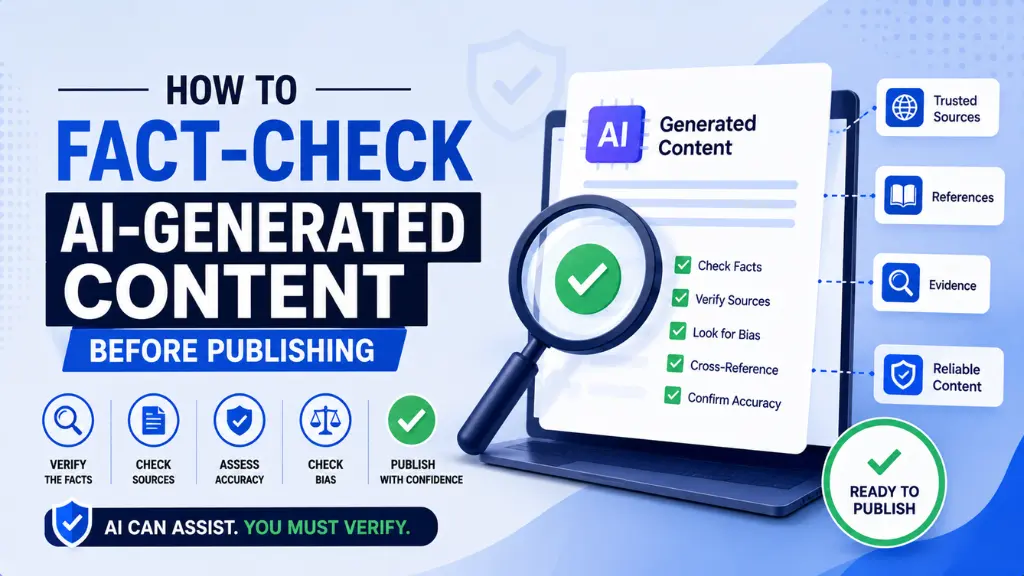

Here is the scenario that plays out more often than most content teams admit: a reader emails the day after publication asking for a link to the Harvard study cited in paragraph three. There is no Harvard study. There never was. The AI invented the title, the year, the institution, and the percentage figure – and presented all four with the same confident tone as the rest of the article.
In this article16 sections
AI-generated content has made producing first drafts faster than at any point in the history of writing. It has not made the underlying facts more reliable. A 2025 BBC and European Broadcasting Union study of 22 media organisations found that 45% of AI-generated answers contained at least one significant accuracy issue, 31% had sourcing problems including missing or incorrect attributions, and 20% contained major errors including hallucinated details.
AI-generated content in 2026 also faces a sharper quality bar than before. Google’s March and May 2026 core updates specifically targeted thin, AI-generated content without genuine editorial oversight, and the E-E-A-T signals that protect rankings depend directly on the accuracy and verifiability of what is published. A fabricated statistic does not just embarrass a brand – it can trigger a quality signal that suppresses entire content clusters in search results.
At Search Savvy, every piece of AI-assisted content we produce goes through a structured verification process before publication – not because we distrust AI tools, but because the evidence is clear that even the best models hallucinate at rates that make blind trust commercially dangerous. This guide lays out that process in full.
What Is AI-Generated Content Hallucination and Why Does It Happen?#
AI-generated content hallucination refers to outputs where the model presents confidently stated information that is factually wrong, invented, or unverifiable – not as the result of an error or system failure, but as a normal product of how large language models generate text.
AI-generated content is produced by models predicting the most probable next word or phrase based on patterns in training data – not by retrieving verified facts from a reliable database. When a model is asked about a topic where its training data is thin, outdated, or absent, it fills those gaps with plausible- sounding statements rather than admitting uncertainty. The result is confident fabrication that reads exactly like confident accuracy.
People Also Ask: Why do AI tools produce hallucinations even on confident-sounding outputs? Short Answer: Large language models are optimised to generate coherent, contextually appropriate text – not to distinguish between retrieved facts and invented ones. When the model lacks accurate information on a specific claim, it generates the most statistically probable answer based on surrounding context. This produces fabrications that sound convincing because they are structurally and stylistically consistent with accurate content.
Why Is Fact-Checking AI-Generated Content More Important in 2026?#
AI-generated content hallucination rates have not improved as consistently as the general capability of AI models. The 2026 Stanford HAI AI Index found hallucination rates ranging from 22% to 94% across 26 top models on specific benchmark tasks. OpenAI’s own system card for o3 reported a 33% hallucination rate on PersonQA queries – more than double the 16% rate of the older o1 model. O4-mini reached 48% on SimpleQA.
The counter-intuitive finding is critical: reasoning-optimised models, which perform better on many tasks, hallucinate more on certain specific queries, particularly person-specific recall and tasks involving named entities.
AI-generated content fact-checking also directly affects Google E-E-A-T signals, which Google’s 2026 core updates confirmed as a primary ranking factor. Content that contains fabricated statistics, misattributed quotes, or hallucinated company names fails the trustworthiness and accuracy criteria that Google’s quality evaluators specifically check on reviewed pages.
- 45% of AI-generated media answers contained at least one significant accuracy issue (BBC/EBU study, 2025)
- 94% of marketers planned to use AI for content creation in 2026, but only 65% said their organisation’s guidelines prioritise accuracy and fact-checking
- Hallucination rates across top AI models range from 22% to 94% depending on task type and query specificity (Stanford HAI 2026)
- Fabricated citations and statistics are among the most damaging error types because readers who check them lose trust in the entire piece
People Also Ask: Do newer, more advanced AI models hallucinate less? Short Answer: Not consistently, and sometimes the reverse is true. OpenAI’s advanced o3 reasoning model hallucinated on 33% of PersonQA queries, compared to 16% for the older o1 model. Improvements in general reasoning capability and improvements in factual reliability are different dimensions – a model can be more powerful and more prone to confident fabrication on specific task types simultaneously.
How Do You Identify the Highest-Risk Claims in AI-Generated Content?#
AI-generated content fact-checking is more efficient when applied selectively rather than treating every sentence with equal scrutiny. Not all claims carry the same risk – a general statement like “email marketing is widely used” needs no verification, while “email marketing delivers $42 for every $1 spent according to Litmus 2026” needs a source check before it goes live.
Triage your claims into three risk tiers before beginning verification:
Tier 1 – Verify every time:
- Specific statistics with percentage figures, dollar amounts, or rankings
- Named citations including study titles, publication names, and years
- Direct quotes attributed to named individuals
- Claims about specific companies, products, or people
- Legal, medical, financial, or regulatory statements
- Dates of events, policy changes, or product launches
Tier 2 – Spot-check selectively:
- General industry trends described without specific sourcing
- Platform feature descriptions that may have changed recently
- Statements about competitor products or services
Tier 3 – Accept with judgment:
- Widely known, non-controversial general statements
- Conceptual explanations of established processes
- Historical facts with broad consensus
A typical 1,500-word AI-generated blog post takes roughly 35 to 50 minutes to fact-check properly using this triage framework: 10 to 15 minutes sorting claims, 20 to 30 minutes verifying Tier 1 claims at primary source level, and 5 to 10 minutes spot-checking Tier 2 items.
What Are the Six Most Common Types of AI Hallucinations to Check For?#
AI-generated content produces hallucinations in predictable patterns, which makes systematic checking faster once you know what to look for. Six types account for almost all damaging errors:
1. Invented Statistics#
AI-generated content regularly produces round numbers presented as research findings – “productivity increases 47% after AI adoption” or “83% of marketers use email.” Round numbers are guilty until proven innocent. Real research produces messy numbers. Verify every specific percentage or dollar figure against the primary source named, not just search results about the claim.
2. Fabricated Citations#
AI-generated content frequently invents plausible-sounding study titles, journal names, and institutional affiliations. A “Harvard Business Review study from 2024” or a “McKinsey Global Institute report showing 60% growth” may not exist at all. Search the specific title in quotation marks and verify directly on the publisher’s website before citing it.
3. Misattributed Quotes#
AI-generated content assigns quotes to real, named individuals that those people never said. This is one of the most legally and reputationally dangerous hallucination types. Never publish a direct quote attributed to a named person without locating the original source – an interview, a confirmed social post, or a primary document where the quote appears verbatim.
4. Wrong Dates#
AI-generated content confuses the dates of events, product launches, regulation changes, and research publications regularly. A piece claiming a platform feature launched in 2022 may be referencing something that happened in 2024. Verify dates for anything time-sensitive against primary sources rather than trusting the model’s stated year.
5. Fictional Case Studies#
AI-generated content sometimes produces invented examples – “Company X increased revenue by 300% after implementing strategy Y” – where Company X does not exist or never ran the cited campaign. Treat every specific case study that cannot be traced to a named, findable source as fabricated until proven otherwise.
6. Broken and Fabricated URLs#
AI-generated content produces URLs that look valid but return 404 errors or lead to entirely different content. Click through every link before publishing, and verify that the linked page actually contains the claim being attributed to it.
People Also Ask: How can I tell if a statistic in AI content is fabricated? Short Answer: Search the specific number and study name in quotation marks and attempt to locate the primary source directly on the publisher’s website. Real research produces specific, messy numbers with methodology attached – round, clean percentages without a traceable primary source are a strong signal that the model invented the figure. If you cannot locate the source after a reasonable search, replace the specific claim with qualified general language rather than publishing an unverifiable number.
What Is the Five-Pass Verification Process for AI-Generated Content?#
AI-generated content fact-checking becomes faster and more reliable when structured as a systematic five-pass review rather than a single read-through. Each pass targets a different category of error:
Pass 1: Statistic Scan Read through the full draft flagging every specific number, percentage, dollar figure, or ranking claim. Do not verify yet – just identify and highlight every quantitative statement in the piece.
Pass 2: Citation Check For every named study, report, or publication, search the specific title in quotation marks and verify it exists on the primary publisher’s website. Confirm the year, author, and institution match what the AI stated.
Pass 3: Quote Verification Locate the exact source for every direct quote attributed to a named individual. A quote that cannot be traced to a primary source – interview, official statement, or published book – should be removed or converted to a paraphrase attributed to the original source.
Pass 4: Link Click-Through Click every hyperlink in the piece and confirm the destination page exists, loads correctly, and contains the content being attributed to it.
Pass 5: Named Entity Sweep Check every company name, person’s name, role title, and product name the AI has used. Confirm the person holds the role stated, the company exists, and any product features described are accurate for the current version.
This five-pass process takes 15 to 25 minutes on a typical article and catches the overwhelming majority of damaging errors before they reach publication.
What Tools Help Fact-Check AI-Generated Content?#
AI-generated content verification is accelerated by a small set of tools that complement human judgment rather than replacing it:
- Google Scholar – locating and verifying academic research citations that AI frequently misattributes
- Perplexity AI – cross-referencing specific claims with live web sources and citations that can be clicked and verified
- Winston AI – an AI fact-checker that analyses generated text for potential inaccuracies and flags high-risk claims
- Originality.ai – combination AI content detector and fact-checking tool used by content teams for editorial review
- Google Fact Check Explorer – searches existing fact-checks by claim or publisher to surface prior debunks
- A second AI model – using a different AI tool to critique the first model’s claims is a low-cost way to catch obvious errors; ask it to identify any statements it cannot verify from its training data
No tool replaces human judgment for fact-checking. Each of these accelerates the grunt work of source location and claim triaging, but the final editorial decision always requires a human reviewer who understands the context.
What Should You Do When a Claim Cannot Be Verified?#
AI-generated content regularly produces unverifiable claims where no primary source can be located after a reasonable search. The right response is not to assume the source exists somewhere – it is to replace the unverifiable claim with qualified general language.
“Many marketers report higher email engagement after segmentation” conveys the same conceptual point as an invented “87% of marketers see higher engagement” without committing to a number that does not exist. This approach also protects E-E-A-T signals directly – Google’s quality evaluators are specifically checking whether claims made on a page can be substantiated.
Named entities are where AI hallucinations become most visible and most damaging to reader trust. A fabricated statistic is embarrassing. A misattributed quote from a real person, or a claim about a company that contradicts verifiable public information, is the kind of error that readers find, share, and remember.
People Also Ask: Should I delete or replace unverifiable AI statistics rather than trying to find the source? Short Answer: Replace them with qualified, verifiable alternatives rather than deleting the surrounding content. If a specific percentage cannot be traced to a primary source, rewrite the claim using qualified general language (“industry data consistently shows…”) or locate a different, verifiable source for the same conceptual point. Publishing unverifiable specific numbers is a direct E-E-A-T risk that is not worth the marginal specificity benefit.
How Should Indian Content Teams Approach AI-Generated Content Fact-Checking?#
AI-generated content about India-specific topics carries a higher hallucination risk than general global content, because AI models have less dense, less current training data about India-specific regulations, market statistics, platform usage figures, and regional business context.
Claims about GST rates, TRAI regulations, RBI guidelines, or specific Indian platform statistics like Justdial or IndiaMART user figures are particularly prone to fabrication or outdated data being presented as current. Verify any India-specific regulatory or market claim against official government sources, ministry websites, or directly on the platform’s own published data.
According to Search Savvy’s insights from reviewing AI-assisted content for Indian SMB and D2C clients, the most frequently occurring fabrication type in India-relevant AI content is incorrect statistics about internet penetration, mobile usage, and e-commerce growth figures – all of which change rapidly and are regularly presented by AI models with outdated or invented precision.
Conclusion: Verification Is Not Optional Overhead#
AI-generated content has made it possible to draft more content, faster, across more topics than any team could have managed manually two years ago. It has not made the underlying obligation to publish accurate information any less binding.
Search Savvy treats fact-checking as a non-negotiable editorial step in every AI-assisted content workflow – not because AI tools are unreliable in general, but because the specific failure mode of confident hallucination is invisible without a structured verification process. Thirty-five minutes of fact-checking per article is not overhead; it is the difference between content that builds authority and content that quietly erodes it.
FAQ: Fact-Checking AI-Generated Content – Your Questions Answered#
Q1: How common are factual errors in AI-generated content? More common than most publishers assume. A BBC/EBU study found 45% of AI-generated media answers contained at least one significant accuracy issue. Stanford HAI’s 2026 AI Index found hallucination rates between 22% and 94% across 26 leading models depending on task type. The rate varies significantly by what is being asked – named entity recall and specific statistics are much higher risk than conceptual explanations.
Q2: How long should fact-checking AI content take? A structured five-pass verification process on a typical 1,500-word article takes 35 to 50 minutes. This includes 10 to 15 minutes triaging claims by risk level, 20 to 30 minutes verifying Tier 1 high-risk claims at primary source level, and 5 to 10 minutes spot-checking medium-risk items.
Q3: Can I use AI to fact-check other AI-generated content? As a first pass, yes. Using a different AI model to identify claims it cannot verify from its own training data catches obvious errors efficiently. However, this cannot replace human verification against primary sources – two AI models can be confidently wrong about the same fabricated fact simultaneously.
Q4: Does publishing unverified AI content hurt Google rankings? Yes, indirectly but meaningfully. Google’s E-E-A-T framework specifically evaluates trustworthiness and accuracy as ranking signals. Content containing fabricated statistics, misattributed quotes, or hallucinated citations fails the trustworthiness criteria that Google’s quality evaluators check. Google’s 2026 core updates also specifically penalised AI-generated content without genuine editorial oversight.
Q5: What should I do if I have already published AI content with errors? Correct the errors immediately and re-publish with a notation that the article has been updated. Do not delete the page or change the URL unless the content is irreparably inaccurate – corrections that improve existing content preserve any existing ranking authority. Request re-indexing through Google Search Console after making substantive corrections.
Q6: Are AI tools that search the web less prone to hallucinations? Meaningfully, but not completely. Tools using Retrieval-Augmented Generation (RAG) – including Perplexity AI and web-browsing modes in ChatGPT and Gemini – anchor their responses to retrieved documents rather than training data alone, which reduces hallucination rates on specific factual queries. However, they can still misread or misattribute sources, and all retrieved content should be verified at the primary source rather than trusted on the basis of an AI’s summary of it.
Publishing AI-assisted content and not sure whether your fact-checking process is thorough enough to protect your brand and your rankings? Visit Search Savvy for a content quality audit that evaluates your editorial workflow against the accuracy standards Google’s 2026 systems actually reward.