How to Optimize Your Blog for AI Search Engines in 2026

A growing share of searches never make it to a list of blue links anymore – they’re answered directly, with a handful of cited sources, by Google AI Overviews, ChatGPT, Perplexity, or Gemini. If your blog isn’t structured in a way these systems can extract and cite cleanly, it doesn’t matter how well the post reads to a human visitor who never arrives, because the AI-generated answer already gave them what they needed from someone else’s page. This is the exact shift Search Savvy factors into blog content briefs now, rather than treating it as a separate workstream.
In this article15 sections
This article covers what actually changes when optimizing a blog for AI search versus classic SEO, how the major AI platforms differ in what they cite, the specific structural changes that improve citation odds, and which popular “AI SEO” tactics are worth the effort and which ones aren’t.
What Does It Mean to Optimize a Blog for AI Search?#
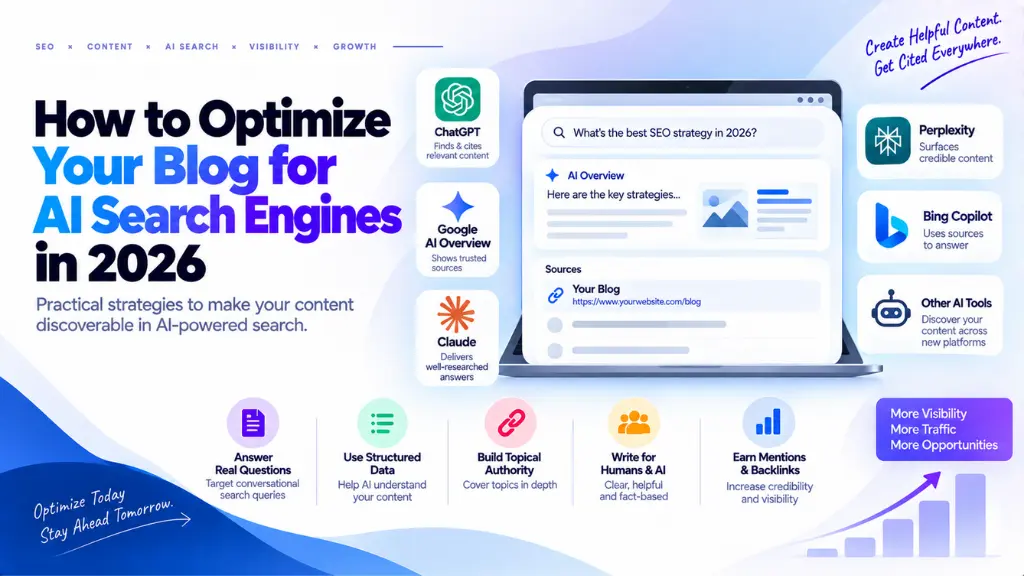
Optimizing a blog for AI search means structuring content so AI systems can find it, accurately extract its meaning, and confidently cite it when generating a direct answer to a user’s question – rather than optimizing purely to rank in a traditional list of search results. Since AI Overviews, ChatGPT, and Perplexity typically compile an answer from a small number of sources rather than surfacing ten links, the practical goal shifts from “rank on page one” to “be one of the handful of sources the system actually pulls from.”
The good news is that this doesn’t require four entirely separate optimization strategies for four different platforms. The same underlying fundamentals – answer-first writing, specific and verifiable claims, clean structural formatting, and proper schema markup – improve citation odds across Google AI Overviews, ChatGPT, Perplexity, and Gemini simultaneously, even though each platform sources content somewhat differently underneath.
How the Major AI Platforms Source Content Differently#
Do ChatGPT, Perplexity, and Google AI Overviews Cite the Same Kinds of Sources?#
No. Industry citation-tracking studies have found that these platforms draw on noticeably different types of sources, and a source frequently cited by one platform isn’t necessarily cited by another. These findings come from third-party analyses and citation-tracking firms rather than platform-disclosed data, so treat specific figures as directional rather than exact.
| Platform | Sourcing Pattern (Vendor-Reported) | Practical Implication |
| ChatGPT | Leans heavily on Wikipedia and established editorial sources (Reuters, AP, major news outlets) | Objective, declarative writing that reads like a reliable reference source tends to perform better |
| Perplexity | Weights recency heavily and draws frequently on community platforms like Reddit | Regularly updated content and genuinely current information matter more here than on other platforms |
| Google AI Overviews / Gemini | Builds substantially on Google’s existing organic index and ranking signals | A page that already ranks well in classic organic search has a real head start on Overview citation |
Because these sourcing patterns diverge, a blog post optimized purely for one platform’s preferences won’t automatically perform the same way on another. The safer strategy for most blogs is building on the shared fundamentals – clarity, structure, and citability – rather than chasing platform-specific tricks, since those fundamentals are what all these systems are ultimately trying to extract regardless of which sources they lean on most.
Structural Changes That Improve AI Citation Odds#
Write Answer-First Paragraphs#
Structure each major section so the first one to two sentences after a heading directly answer the question that heading implies, before expanding into supporting detail. This gives an AI system a clean, self-contained passage to extract and cite accurately, rather than requiring it to synthesize an answer from an unclear or answer-buried-in-context paragraph.
Use Descriptive, Question-Based Headings#
Headings phrased as the actual questions a reader would ask – “What is X,” “How does Y work,” “Is Z worth it” – map more directly onto the conversational queries people type into AI chat interfaces than generic, keyword-stuffed headers. This also improves how cleanly a system can match a specific section of your post to a specific query it’s trying to answer.
Include Specific, Verifiable Facts#
Named statistics with clear sourcing, concrete examples, and specific figures are easier for an AI system to extract with confidence than vague, generalized claims. A system generating an answer is more likely to cite a source that states something precisely than one that hedges without offering anything concrete to quote or paraphrase.
Implement Relevant Schema Markup#
Structured data – particularly Article, FAQ, and HowTo schema where applicable – gives AI systems an explicit, machine-readable declaration of a page’s content and structure, reinforcing what they infer from the prose itself. Tools like an FAQ schema generator make this a fast addition rather than a manual coding task. This doesn’t guarantee citation, but it removes ambiguity that could otherwise work against a page being confidently selected as a source.
Keep Content Current#
Perplexity in particular has been reported to favor recently published or recently updated content for time-sensitive topics, and even a modest refresh – updated examples, corrected figures, a revised publish or modified date – can meaningfully affect how current a system perceives a page to be. Beyond any single platform’s preference, content that’s actually kept accurate over time is simply a better candidate for citation regardless of which system is evaluating it.
Is llms.txt Worth Implementing?#
llms.txt is a community-proposed text file, similar in concept to robots.txt, intended to give AI crawlers a condensed, markdown-formatted summary of a site’s content. It’s frequently promoted as an essential AI-search optimization step, but the evidence for its actual impact is weak. Google’s Gary Illyes has stated on the record that Google doesn’t support llms.txt and has no plans to, and industry crawl-monitoring data has found that major AI crawlers – including GPTBot, ClaudeBot, and PerplexityBot – overwhelmingly fetch a site’s regular HTML directly rather than requesting the llms.txt file at all. Adoption studies have also found the file present on only around one in ten sites analyzed, with essentially no major AI provider having publicly committed to using it as a ranking or citation signal.
None of this means llms.txt is actively harmful, and it costs very little to implement. But it shouldn’t be treated as a priority ahead of the fundamentals that have actual, demonstrated impact: answer-first structure, schema markup, and genuinely well-organized, citable content. Treating llms.txt as a substitute for those fundamentals – rather than a low-cost, low-certainty addition – is a common and avoidable misallocation of effort.
Technical Requirements Behind the Content Work#
None of the structural writing changes above matter if AI crawlers can’t actually access the content in the first place. Most AI crawlers used by ChatGPT and similar systems don’t execute JavaScript, so content that depends on client-side rendering to appear is often invisible to them regardless of how well it’s structured once rendered. Confirming that a blog’s core content, headings, and metadata are present in the raw HTML response – not just in what a browser eventually displays after running JavaScript – is a prerequisite that belongs in any technical SEO review before content-level AI optimization work begins.
Building Topical Depth, Not Just Individual Posts#
A single well-optimized blog post can get cited occasionally, but AI systems – like classic search engines – tend to favor sources they can recognize as comprehensive and authoritative on a subject, not just a single strong page surrounded by unrelated content. Building a blog around clearly interconnected topic clusters, rather than a scattered mix of unrelated posts, reinforces the same topical signal these systems draw on when deciding which sources to trust for a given query. This is the same underlying discipline behind a well-structured content strategy and topical authority program, applied with AI citation specifically in mind rather than classic ranking alone – and it’s the area where Search Savvy typically sees the biggest gap between blogs that get cited repeatedly and blogs that get cited once and never again.
Common Mistakes#
- Treating AI search optimization as entirely separate from SEO. The two share most of their foundation – clear writing, good structure, technical crawlability – rather than requiring a parallel, disconnected strategy.
- Overinvesting in llms.txt relative to its demonstrated impact. It’s a low-cost addition, not a substitute for content quality, structure, or crawlability.
- Writing for one AI platform’s citation preferences at the expense of others. Chasing Wikipedia-style tone for ChatGPT while ignoring the recency and structural fundamentals that matter across all platforms leaves value on the table.
- Burying direct answers deep in paragraphs. Content that eventually answers a question, several sentences in, is harder for both readers and AI systems to extract cleanly than an answer-first structure.
- Ignoring JavaScript rendering issues. A blog with excellent content that isn’t present in the raw HTML response may be effectively invisible to crawlers that don’t execute JavaScript.
- Publishing isolated posts without building topical depth. A single strong article rarely earns the same trust signal as a comprehensively covered subject area.
Search Savvy folds AI search structuring into standard content marketing delivery now, since the writing habits that improve AI citation are largely the same habits that make content genuinely more useful to a human reader.
Frequently Asked Questions#
Do I need to write different content for ChatGPT versus Google AI Overviews? Not fundamentally. The shared principles – answer-first structure, specific facts, clean formatting, and schema markup – improve citation odds across platforms. Minor adjustments, like emphasizing recency for Perplexity, can help, but a wholesale separate strategy per platform isn’t necessary for most blogs.
Is llms.txt necessary for AI search visibility? No. Current evidence suggests major AI crawlers rarely fetch it and no major AI provider has confirmed using it as a citation signal. It’s a low-cost, low-priority addition rather than a meaningful optimization lever on its own.
Does my blog need to already rank well in Google to appear in AI Overviews? Often, yes, since AI Overviews and Gemini draw heavily on Google’s existing index and ranking signals. Strong classic SEO fundamentals remain relevant even when the specific goal is AI citation rather than a traditional ranking position.
How often should blog content be updated for AI search optimization? There’s no universal rule, but platforms like Perplexity have been reported to favor more recently published or updated content for time-sensitive topics, so periodically refreshing key facts, examples, and dates on evergreen posts is a reasonable practice.
Does schema markup guarantee my blog gets cited by AI systems? No. Schema markup removes ambiguity and reinforces what’s already in the content, but it doesn’t override weak or unclear writing. It works best as a complement to strong answer-first structure, not a substitute for it.
Can a small blog compete with larger, more established sites for AI citations? Yes, particularly on specific, well-covered subtopics where a smaller site’s depth and clarity can outperform a larger site’s more generic coverage of the same subject. Comprehensive coverage of a focused topic matters more than overall domain size for citation on that specific subject.
Bottom Line#
Optimizing a blog for AI search isn’t a separate discipline bolted onto traditional SEO – it’s largely the same discipline, applied with a sharper focus on structural clarity and citability. Write answer-first content, use specific and verifiable facts, implement relevant schema, keep key content current, and confirm your technical foundation actually makes that content visible to crawlers that don’t render JavaScript. Skip the low-impact trends promoted as must-haves, and put the effort instead into the fundamentals that consistently show up across every platform’s citation patterns – because that’s what these systems are actually built to reward.