How to Start Digital Marketing for Your Small Business in India
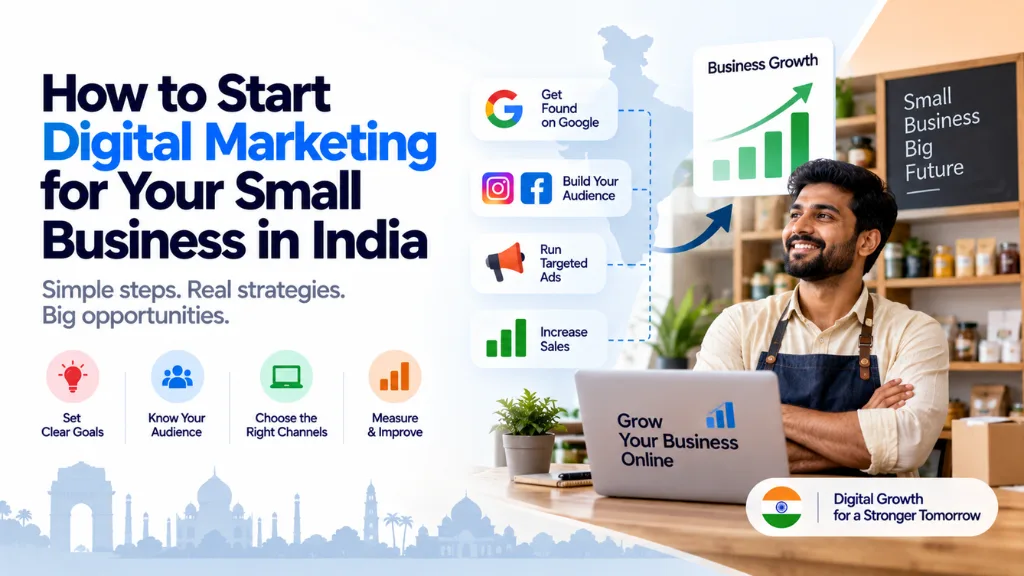

A small business in India doesn’t need a large budget to compete online – it needs the right sequence. Digital marketing for small business owners in India works differently than the Western playbook most generic guides describe: the market is mobile-first rather than desktop-first, WhatsApp-centred rather than email-centred, and heavily driven by peer recommendations and reviews rather than polished advertising alone. Getting the order right – free, high-impact steps before paid ones – matters more here than almost anywhere else.
In this article12 sections
This guide walks through exactly where to start, in the sequence that gives a small Indian business the fastest, most affordable path to being found, trusted, and chosen online.
Why Digital Marketing Works Differently for Small Businesses in India#
India’s digital landscape has a few defining characteristics worth understanding before spending a single rupee on marketing. Roughly 806 million people in India were online as of early 2025, with internet penetration around 55% of the country and still climbing, according to DataReportal’s Digital 2025 India report – meaning the addressable digital audience is enormous, but a large share of newer internet users are still coming online for the first time, often via an affordable smartphone rather than a computer.
Two other traits define the market specifically:
- WhatsApp, not email, is the primary communication channel. India has more monthly active WhatsApp users than any other country in the world, and for many small businesses it functions as the practical channel where enquiries, follow-ups, and even payments happen – not a secondary tool bolted onto a website.
- India is a referral-driven market. Research from RedSeer has found that reviews on Google, social proof on platforms like Instagram, and word-of-mouth recommendations through channels like WhatsApp groups are the leading conversion driver for a majority of Indian consumers. Trust signals matter as much as, or more than, advertising polish.
This combination means a small business doesn’t need to outspend larger competitors to be found – search engines and recommendation-driven discovery reward relevance and genuine trust signals over budget size, which is precisely why the sequence below starts with free, foundational steps rather than paid advertising.
Step 1: Claim and Optimize Your Google Business Profile#
Google Business Profile (GBP) is free, and for a local business it’s typically the single highest-impact asset available before spending anything on ads. A meaningful share of all Google searches carry local intent, and a complete, accurate, well-photographed profile puts a business directly in front of nearby customers actively searching for exactly what it offers.
To do this properly:
- Verify the business and complete every section – accurate name, address, phone number, operating hours, and the most specific applicable category.
- Add at least ten genuine, high-quality photos of the business, products, or premises.
- Post regular updates – offers, new arrivals, or short tips – since an active profile signals relevance to both customers and Google.
- Actively request and respond to customer reviews, given how heavily India’s referral-driven buying culture weighs peer validation.
Step 2: Build a Simple, Fast, Mobile-First Website#
Given how much of India’s internet usage happens on a smartphone, often on variable-quality mobile networks, a website that loads slowly or renders poorly on mobile loses customers before they ever see an offer. A small business doesn’t need an elaborate site – a clear, fast-loading, mobile-optimised site covering what the business offers, where it’s located, and how to contact it covers most of what’s actually needed at this stage.
Page speed and mobile usability aren’t a nice-to-have here; on a market where a meaningful share of customers are browsing on modest data plans and mid-range phones, a heavy, slow-loading site is a direct, measurable cost in lost enquiries.
Step 3: Set Up WhatsApp Business#
WhatsApp Business is free and, for most small businesses in India, becomes the practical channel where actual conversations, catalog browsing, and deal confirmation happen – often faster and with less friction than email or a contact form. Setting it up properly includes:
- A complete business profile with hours, address, and a product or service catalog.
- Automated greeting and away messages, so enquiries outside business hours still get an initial response.
- Quick reply templates for common questions, to keep response times fast without requiring a large team.
- A click-to-chat button added to the website and Google Business Profile, removing friction between a customer finding the business and actually reaching out.
For businesses with higher enquiry volume, the paid WhatsApp Business API adds automation, broadcast messaging, and CRM integration – worth considering once the free tier’s manual capacity is genuinely being outgrown, rather than as a starting point.
Step 4: Pick One Social Platform and Go Deep, Not Wide#
A common early mistake is spreading thin across every platform at once – Instagram, Facebook, LinkedIn, and X simultaneously – with none of them receiving enough consistent attention to actually work. A more effective approach for a resource-constrained small business is choosing the one platform where the target audience is genuinely most active – Instagram or Facebook for most consumer-facing businesses, LinkedIn for B2B services – and committing to consistent, useful content there before expanding further.
Short-form video has become a particularly strong opportunity across Indian social platforms, given how much video consumption already happens on mobile; a business willing to post honest, simple video content consistently often outperforms one investing in occasional, highly polished content less frequently.
Step 5: Invest in Local SEO Specifically#
Local SEO – optimising specifically for searches tied to a city, neighbourhood, or region – tends to deliver the fastest measurable results for a small Indian business, since it combines Google Business Profile optimisation with location-specific keyword targeting on the website itself. This means naming the specific city or area served directly in page titles, headings, and content, rather than relying on generic descriptions that could apply to a business in any location.
Step 6: Consider Paid Advertising Once the Organic Foundation Is in Place#
Once a Google Business Profile, a functional website, and an active WhatsApp and social presence are established, paid advertising through Google Ads or Meta’s ad platforms becomes a much more efficient investment – clicks and enquiries land on a foundation already built to convert them, rather than a bare or incomplete online presence. India remains one of the more affordable markets globally for digital advertising, which makes it practical to start with a genuinely small daily budget, test which audiences and offers perform, and scale spend only toward what’s actually working.
Step 7: Prepare for AI Search Visibility Early#
This is the part of the 2026 landscape most small business guides haven’t caught up to yet. India has become one of the largest markets globally for AI chat tools – reports citing OpenAI’s own leadership place India as ChatGPT’s second-largest market by weekly active users, behind only the United States. As more buyers begin research inside AI tools rather than a traditional Google search alone, being cited as a trustworthy source by these systems is becoming a genuinely important complement to ranking well in classic search results.
A small business already investing in a clear, well-structured website, genuine customer reviews, and accurate business information is largely already positioned to benefit here – the same signals that build trust with human customers and Google’s local search algorithm tend to be the ones AI systems draw on when deciding which businesses to mention in a generated answer.
Recommended Channel Sequence and Typical Cost#
| Step | Channel | Typical Cost | Typical Time to Results |
| 1 | Google Business Profile | Free | 2–4 weeks |
| 2 | Website (basic, mobile-optimised) | One-time build cost, varies by complexity | Ongoing, compounds over time |
| 3 | WhatsApp Business | Free (paid API optional at scale) | Immediate |
| 4 | One social platform, consistent posting | Free (organic) | 1–3 months |
| 5 | Local SEO | Often bundled with website/SEO work | 1–3 months |
| 6 | Paid ads (Google/Meta) | Flexible, scalable budget | Days to weeks |
| 7 | AI search visibility (GEO/AEO) | Builds on existing SEO and content foundation | Emerging, longer-term |
Common Mistakes Small Businesses in India Make#
- Spreading across every platform instead of going deep on one. Consistent activity on a single well-chosen platform outperforms occasional, thin activity across several.
- Treating WhatsApp as an afterthought rather than a primary channel. In India specifically, WhatsApp is frequently where the actual sales conversation happens, not a secondary contact option.
- Ignoring regional language content. A significant share of India’s newer internet users are more comfortable in a regional language than English, making localized content a meaningful, often underused opportunity.
- Neglecting Google reviews. Given how referral-driven Indian consumer decisions tend to be, a business with few or no reviews starts at a real disadvantage regardless of how good its advertising is.
- Jumping to paid ads before the organic foundation exists. Ad spend converts far more efficiently once a Google Business Profile, website, and WhatsApp presence are already in place to receive and convert the resulting traffic.
- Not tracking any of it consistently. Even simple tracking – which enquiries came from which channel – makes it possible to double down on what’s actually working rather than guessing.
Frequently Asked Questions#
Is WhatsApp Business really necessary, or is a website enough? For most small businesses in India, WhatsApp Business is essential rather than optional, since it’s frequently the channel customers actually prefer for enquiries, follow-ups, and even completing a purchase. A website and WhatsApp presence work best together rather than as substitutes for each other.
How much should a small business in India budget for digital marketing to start? Many of the highest-impact early steps – Google Business Profile, WhatsApp Business, and organic social posting – are free. A modest, flexible budget for paid ads becomes worthwhile once that organic foundation is in place, since India remains a comparatively affordable market for digital advertising.
Should a small business focus on Instagram, Facebook, or LinkedIn? It depends entirely on the audience. Consumer-facing businesses generally find Instagram and Facebook more effective for reach and engagement, while B2B service businesses tend to see stronger results on LinkedIn. Choosing one platform and posting consistently outperforms spreading thin across several.
Is local SEO different from regular SEO for an Indian small business? Local SEO specifically targets searches tied to a city, neighbourhood, or region, combining Google Business Profile optimisation with location-specific website content. For most small, physically-located businesses, it delivers faster, more directly relevant results than a broader national SEO strategy.
Why does AI search visibility matter for a small business already using Google? A growing share of Indian consumers now begin research inside AI chat tools rather than a traditional search engine alone, and India has become one of the largest markets globally for tools like ChatGPT. Being mentioned as a trustworthy source inside AI-generated answers is becoming an additional visibility channel alongside, not instead of, traditional search rankings.
How long does it take to see real results from digital marketing in India? It varies by channel – a well-optimised Google Business Profile can show results within a few weeks, while local SEO and social media typically take one to three months of consistent effort to build meaningful traction. Paid advertising can generate results within days, but performs best once the organic foundation is already established.
The Bottom Line#
Starting digital marketing for a small business in India works best in sequence, not all at once: a Google Business Profile and WhatsApp Business setup first, since both are free and directly match how Indian customers actually search and communicate, followed by a fast mobile-friendly website, focused local SEO, one social platform done consistently, and paid advertising once that foundation is genuinely in place. Search Savvy’s local SEO services, website design and development services, and Google Ads and PPC services support exactly this kind of foundation-first approach, and Search Savvy’s own SEO services in Mumbai reflect the same India-specific market understanding this guide is built around.