Fine-Tuning LLMs on Brand Voice: A Practical Guide for Enterprise Content Teams
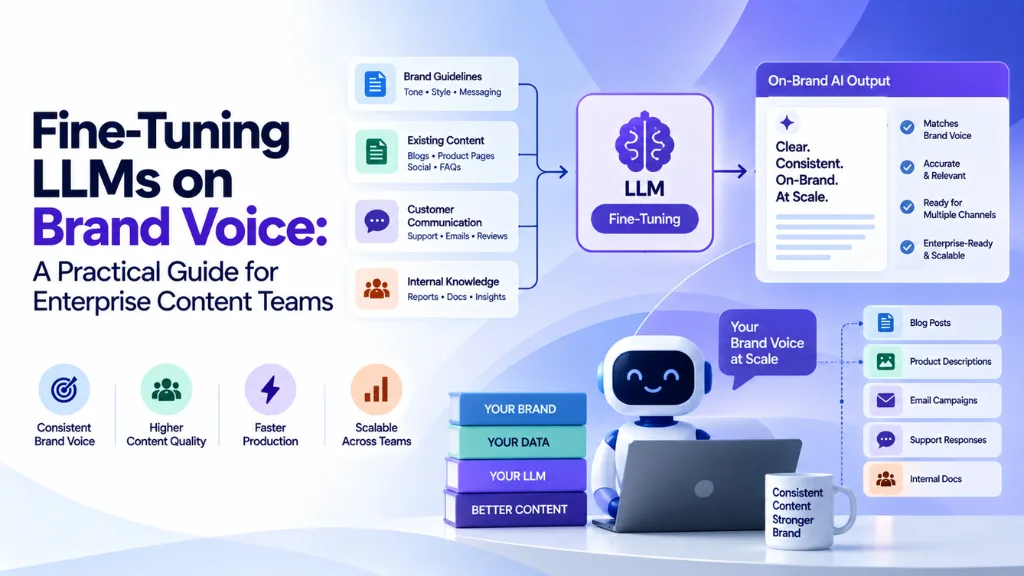

Most enterprise content teams that ask about fine-tuning an LLM on their brand voice haven’t actually exhausted the cheaper, faster option first – and the honest, direct answer is that the majority of them don’t need to fine-tune anything at all. Voice drift, generic phrasing, and inconsistent tone across a content team’s AI output are usually symptoms of thin prompting, not evidence that model weights need retraining.
In this article12 sections
This guide lays out the decision framework enterprise teams should actually follow, the specific prompting techniques that resolve most brand voice problems without touching a model’s weights, and – for the smaller set of teams that genuinely need it – how brand voice fine-tuning is done properly in 2026, including the data, evaluation, and governance work that determines whether it succeeds.
What “Fine-Tuning for Brand Voice” Actually Means#
Fine-tuning is the process of further training an existing language model on a curated dataset so it reliably reproduces a specific style, structure, or behavior – in this context, your brand’s tone, vocabulary, sentence rhythm, and editorial boundaries – without needing that instruction restated in every prompt.
It’s fundamentally a tool for form, not facts. Fine-tuning is well suited to locking in consistent voice, tone, and output structure; it’s poorly suited to injecting knowledge that changes frequently, since anything baked into model weights goes stale the moment the underlying facts update. A model fine-tuned to sound like your brand still needs current product details, pricing, or policy information supplied separately, typically through retrieval rather than the fine-tuning process itself.
The Real Decision Framework: Prompt, Then RAG, Then Fine-Tune#
The sequence most LLM teams have converged on for good reason: start with prompting, add retrieval-augmented generation (RAG) if the task needs current or proprietary information, and only fine-tune once both of those provably hit a wall. Skipping straight to fine-tuning because it “sounds like the serious option” is one of the most common and costly mistakes – it commits a team to a specific model checkpoint, a data curation and evaluation workload, and an ongoing retraining cycle, for a problem that thorough prompting often solves outright.
For brand voice specifically, this means the vast majority of content teams should spend real effort on prompt architecture and reference examples before concluding that fine-tuning is necessary.
Why Zero-Shot Prompting Is the Real Cause of Most “Fine-Tuning” Requests#
The single biggest cause of voice drift in AI-assisted content isn’t a model limitation – it’s asking a model to “write in our brand voice” without ever showing it what that voice actually sounds like. Language models default to an average, plausible-sounding conversational tone precisely because a vague instruction gives them nothing more specific to anchor to.
The fix that resolves most of this: replace zero-shot instructions with few-shot prompts built around a voice anchor library – three to five strong, representative examples of existing content per content type (blog articles, LinkedIn posts, email copy), included directly in the prompt before the new writing task. The model infers the voice from the examples far more reliably than from a description of it, and this single change typically reduces voice drift substantially compared to instruction-only prompting.
Structuring a Brand-Consistent Prompt#
A reliable brand voice prompt has four distinct parts, and how much of your voice guide actually reaches the model during generation depends heavily on getting this structure right:
- A role statement positioning the model as a writer operating within your specific brand system – not a generic assistant.
- A condensed voice guide, ideally under roughly 300 words, including two or three short example sentences in the target voice, your most important non-negotiable rules with brief rationale, and the tone profile for that specific content type. Beyond this length, models tend to deprioritize earlier instructions.
- The content brief – topic, audience, angle, and required coverage for the specific piece.
- Explicit non-negotiable rules stated at the end of the prompt, where models tend to give them the highest attention weight – banned words, required terminology, formatting constraints.
A concrete example beats an abstract instruction every time: rather than “write in a bold, innovative tone,” a usable instruction specifies who the brand is, who it’s writing for, what it should sound like relative to a concrete comparison (“like a senior engineer explaining something to a peer, not a salesperson pitching a prospect”), explicit banned phrases, and required terminology – paired with two or three sentences of actual sample copy.
When Prompting Genuinely Hits a Wall#
Fine-tuning becomes a legitimate consideration only after this prompting and retrieval work has been done seriously and specific, measurable failures persist:
- Consistent, structural drift that survives strong few-shot prompting – not occasional misses, but a reliable pattern of the model reverting to generic phrasing across a meaningful share of outputs.
- A very specific, hard-to-articulate voice that resists being captured in a written style guide, where the difference between on-brand and off-brand output is more easily shown through hundreds of examples than described in rules.
- Output volume and consistency requirements where re-including a full voice guide and several examples in every single prompt becomes operationally impractical or measurably increases latency and cost at scale.
- Format compliance failures – structured output, required sections, or JSON schemas that prompting alone breaks on a meaningful fraction of generations.
If the honest answer to “why do we want to fine-tune” is “we keep changing our mind about how we want the model to respond,” that’s a signal the target voice isn’t stable yet – prompting remains the more honest tool until the target settles.
How Brand Voice Fine-Tuning Actually Works in 2026#
For teams that clear the bar above, the technical approach has become considerably more accessible than it was a few years ago:
- LoRA and QLoRA are the default technique, not full fine-tuning. These lightweight adapter methods train a small set of additional parameters on top of a frozen base model, dramatically reducing cost and letting a team update or roll back the adapter without retraining an entire model from scratch.
- Supervised fine-tuning (SFT) works from labeled examples of on-brand output and is the standard starting point for a style and tone target. Preference-based methods like DPO or ORPO are used instead when the training data is comparative – pairs of on-brand versus off-brand responses to the same prompt – rather than single labeled examples.
- Data volume requirements have dropped significantly. Teams building on open-weight models with even a few hundred well-labeled examples of the target style can reasonably put LoRA fine-tuning in their evaluation set; it no longer requires the scale of data or infrastructure that made it an “enterprise ML team only” undertaking a couple of years ago.
- An evaluation harness must exist before training starts. Without a frozen, representative test set and a clear rubric for what “on-brand” means in practice, there’s no reliable way to tell whether a fine-tuned checkpoint actually improved on the base model or simply changed in ways that feel different.
Data Preparation: The Part That Actually Determines Success#
The training run itself is close to the easy part; data curation and evaluation design are where most of the real effort and risk sit.
- Curate genuinely representative examples of on-brand writing across the content types the model needs to produce, not a single format assumed to generalize.
- Scrub personally identifiable information before it enters any training set – names, account details, or other sensitive data should never be included unless properly masked or explicitly cleared for that use.
- Version the dataset, so that if the fine-tuned model misbehaves later, the team can trace exactly which examples it was trained on.
- Freeze a test set on day one, kept entirely separate from training data, so improvement can be measured objectively rather than judged on a handful of spot checks.
- Plan for ongoing lifecycle ownership. A fine-tuned adapter isn’t a one-time deliverable – it needs periodic retraining as brand voice evolves and as underlying base models are updated, which is a recurring cost most teams underestimate at the outset.
Prompting vs. RAG vs. Fine-Tuning for Brand Voice#
| Approach | Best For | Limitations |
| Prompt engineering with voice anchors | Most brand voice needs – tone, structure, vocabulary consistency | Requires disciplined prompt maintenance; can hit context length and latency limits at very high volume |
| RAG | Injecting current facts, product details, or policy information alongside brand voice | Doesn’t itself shape tone or style – pairs with prompting, not a substitute for it |
| Fine-tuning (LoRA/QLoRA) | Locking in a hard-to-articulate voice at scale, or fixing structural drift prompting can’t resolve | Requires curated data, an evaluation harness, and ongoing retraining as the base model or brand voice evolves |
| Fine-tuning + RAG combined | High-volume production systems needing both consistent voice and current information | The most complex and highest-maintenance option; justified mainly at real production scale |
Governance: Keeping Brand Voice Consistent After Launch#
Whichever approach a team lands on, brand voice consistency doesn’t end at deployment – it requires ongoing editorial governance:
- Tiered review, separating a non-negotiable factual-accuracy check on every piece from a tone-and-vocabulary check against the voice guide, with strategic alignment review reserved for higher-stakes content.
- A correction feedback log, tracking how often generated content requires manual tone or vocabulary correction. A content type consistently needing significant manual correction is a signal that the prompt library or fine-tuning data needs an update.
- Scheduled review cycles. A monthly check of the prompt library against real output, with a fuller quarterly update, catches the gradual quality regression that stale prompts and outdated voice examples tend to cause over time.
- Human oversight throughout, not just at the end. AI content workflows that move humans from writing to editing, and eventually to brand governance, tend to preserve quality far better than workflows that treat AI output as publish-ready by default.
Common Mistakes When Approaching Brand Voice and LLMs#
- Fine-tuning before exhausting prompting. Committing to a model checkpoint and a data curation workload before establishing that few-shot prompting genuinely can’t solve the problem wastes time and locks in unnecessary maintenance overhead.
- Describing the voice instead of showing it. A written style guide alone is a weaker signal than several concrete examples of the actual target voice included directly in the prompt.
- Treating fine-tuning as a one-time project. A fine-tuned adapter needs periodic retraining as brand voice evolves and as base models are updated – an ongoing commitment, not a single deliverable.
- Skipping the evaluation harness. Without a frozen test set and a clear rubric, it’s impossible to tell whether a fine-tuned model is actually better or just different.
- Removing human review after automating drafting. Fine-tuning and strong prompting both reduce editing time; neither reliably eliminates the need for factual and strategic review.
- Using fine-tuning to inject facts. Product details, pricing, and policies change too often to bake into model weights reliably – that information belongs in a retrieval layer, not the fine-tuning dataset.
Frequently Asked Questions#
Does every enterprise content team need to fine-tune an LLM for brand voice? No. Most brand voice consistency problems are solved through disciplined prompt engineering with a voice anchor library – several strong, representative examples included directly in the prompt – rather than through fine-tuning, which is a heavier and more maintenance-intensive commitment.
What’s the difference between RAG and fine-tuning for brand voice work? RAG supplies current, factual information at the time of generation and doesn’t itself shape tone or style. Fine-tuning shapes consistent behavior, tone, and structure but shouldn’t be used to store frequently changing facts, since anything baked into model weights goes stale as soon as the underlying information updates.
How much training data does brand voice fine-tuning require? Requirements have dropped considerably; teams with even a few hundred well-labeled examples of the target voice can reasonably evaluate LoRA fine-tuning, a much lower bar than the scale fine-tuning required a few years ago.
What is a voice anchor library? A curated set of three to five strong, representative examples of existing on-brand content per content type, used as few-shot examples in prompts so the model can infer the target voice directly rather than working from a description of it.
How often does a fine-tuned brand voice model need to be updated? There’s no universal schedule, but fine-tuned adapters need periodic retraining as brand voice evolves and as underlying base models are updated – treating this as a one-time project rather than an ongoing commitment is one of the more common planning mistakes.
Can prompting alone ever fully replace fine-tuning for brand voice? For most content teams, yes. Fine-tuning becomes genuinely justified mainly when structural drift persists despite strong few-shot prompting, when output volume makes repeating a full voice guide in every prompt impractical, or when the target voice is specific enough that examples communicate it far better than written rules can.
The Bottom Line#
Fine-tuning an LLM on brand voice is a legitimate tool, but it’s the last step in a sequence most enterprise content teams haven’t finished walking through – prompt engineering with a genuine voice anchor library resolves the majority of consistency problems teams initially bring to a fine-tuning conversation. Reserve fine-tuning for the specific, measurable cases where strong prompting has already been tried and demonstrably falls short, and go in with a real evaluation harness, clean data, and a governance plan for keeping the model current as your brand voice evolves. Search Savvy’s content strategy and topical authority services and content marketing services build voice and editorial governance directly into content production workflows, and the branding and identity glossary is a useful reference for teams formalizing their brand voice guide before feeding it into any AI workflow.