Multimodal Search Optimisation: Ranking Across Text, Image, Video and Audio Simultaneously
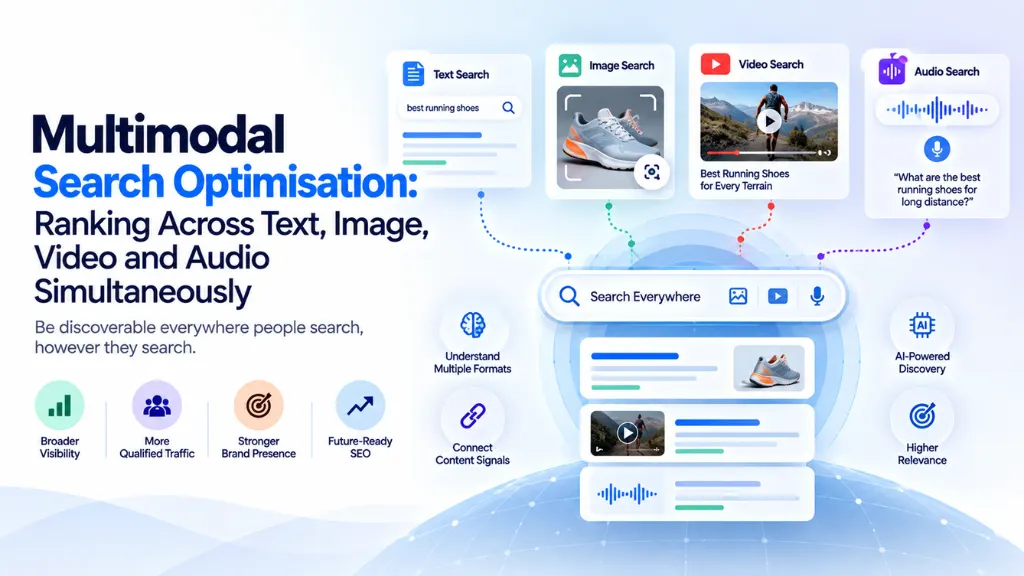

At Google’s I/O 2026 event, the company described its redesigned search box as the biggest change to that interface in over 25 years – one that now lets people search using text, images, files, video, or even open Chrome tabs, in any combination, within a single query. That redesign is the clearest signal yet that ranking for a typed keyword is no longer the whole job. Multimodal search optimisation is the practice of making a single piece of content discoverable and understandable across text, image, video, and audio simultaneously, because the systems evaluating that content – from Google Lens to Gemini to AI Overviews – now read and combine all four at once.
In this article12 sections
This guide walks through what’s driving this shift, exactly what each modality requires to be genuinely optimised rather than just present, and how to build a coordinated plan rather than treating images, video, and voice as separate afterthoughts bolted onto a text-first strategy.
What Is Multimodal Search Optimisation?#
Multimodal search optimisation is the practice of structuring content – text, images, video, and audio – so that AI-driven search systems can interpret all four formats together as a single, consistent signal about what a page is about, rather than optimising each format in isolation.
The distinction from traditional SEO is direct: classic SEO assumes a typed keyword query and a page built primarily around text. Multimodal optimisation assumes a query might arrive as a photo, a spoken question, or a video clip, and that the system answering it is drawing on your alt text, your video transcript, and your body copy at the same time to decide whether your content deserves a citation.
Why This Shift Is Happening Now#
Two forces are driving multimodal optimisation from a nice-to-have into a core requirement.
Search input itself has diversified. Google Lens now handles close to 20 billion visual searches every month, with roughly a fifth of that volume tied directly to shopping intent, and adoption skews notably toward younger users. Voice search delivers full, conversational questions rather than short typed phrases. Google’s own AI Mode accepts image uploads as a standard part of a conversational query, not a separate feature.
The models answering those queries are natively multimodal. Systems like Gemini and GPT-4o don’t process text, images, and audio through separate pipelines and stitch the results together – they process all three in a single pass, building one combined understanding of a page. Practically, that means a strong body of text paired with a generic, undescriptive image file doesn’t fully compensate for the gap; the model registers the mismatch between what your text claims and what your visual and audio assets actually communicate.
Text Is Still the Foundation – Not a Fourth Modality Among Equals#
It’s worth stating plainly: text remains the base layer. Technical SEO, keyword research, content depth, and backlinks are still what search engines and AI systems fundamentally rely on to judge whether a page deserves visibility at all. Multimodal optimisation adds image, video, and audio signals on top of that foundation – it doesn’t replace it. A page with excellent video and image optimisation but thin, poorly structured text will not outperform strong text-first content, because every other modality on this list is there to reinforce the text, not substitute for it.
Image Optimisation: Beyond Alt Text#
Image search and Google Lens both depend on machine-readable signals that go well past a single alt attribute:
- Descriptive file names. A file named red-leather-office-chair-ergonomic.jpg communicates something concrete to a crawler; IMG_4471.jpg communicates nothing, and generic alt text like “office chair” placed on an otherwise undescribed image is barely better.
- Genuinely descriptive alt text, written for the actual content and context of the image, not stuffed with keywords disconnected from what’s shown.
- Natural-language image captions. Google reads visible captions and uses them as an additional layer of context beyond the alt attribute, so a well-written caption under a key image is a distinct optimisation opportunity, not a design afterthought.
- Original photography over stock images, particularly for product pages, since Google Lens relies on visual similarity matching, and unique, well-lit original images give it something distinctive to match against rather than a stock photo used by dozens of other sites.
- Structured data using Image metadata and Product schema where applicable, giving explicit machine-readable context to accompany the pixel data itself.
Video Optimisation: Making Spoken and Visual Content Searchable#
Video content that’s properly optimised can appear in both YouTube search and Google search simultaneously – a meaningful visibility gain from a single piece of content. The core requirements:
- Full, accurate transcripts for every video, since transcripts are what allow both search engines and AI systems to index and cite spoken content the same way they would index a written article.
- VideoObject structured data, including title, description, upload date, and duration, giving search engines explicit metadata rather than relying entirely on inference.
- Video sitemaps, particularly for sites hosting a large video library, to help search engines discover and prioritise crawling video content efficiently.
- Descriptive, accurate thumbnails that reflect the actual content, since thumbnail-content mismatches undermine the trust signals search engines associate with a video over time.
- Embedding relevant videos directly into supporting content pages, not just hosting them on a video platform alone, so the surrounding text and the video reinforce each other on the same URL.
Audio and Voice Optimisation: Writing for Spoken Queries#
Voice queries behave differently from typed ones – they tend to run considerably longer and more conversational, often six to ten words framed as a full question, compared to the two or three word fragments typical of a typed search. Content built to answer these queries directly benefits from the same practices that support featured snippets and AI Overview citation:
- Question-based headings that mirror how someone would actually ask the question aloud.
- A concise, direct answer immediately following the heading, before expanding into supporting detail – the format that both voice assistants and AI answer engines tend to pull from most readily.
- Natural, conversational phrasing throughout, rather than dense, jargon-heavy sentences that read well on a page but awkwardly out loud.
One caveat worth flagging directly: Speakable structured data, designed specifically to mark sections of a page as suited for text-to-speech reading, has had an inconsistent history of support from Google, with some periods of limited rollout and some indications it no longer affects any current Search feature. Rather than relying on a single schema type whose support has shifted over time, the more durable approach is writing genuinely clear, question-and-answer structured content that works for voice assistants, AI Overviews, and human readers regardless of which specific markup Google currently processes.
Semantic Consistency: The Principle That Ties All Four Modalities Together#
The single most important cross-modality practice is consistency: using the same terminology across your video transcript, your image alt text, and your body copy, so every format reinforces the same entity and the same set of facts rather than describing the subject in three subtly different ways. If a product page’s text describes a feature one way, the video transcript describes it differently, and the image alt text omits it entirely, AI systems attempting to build a single confident understanding of the page encounter contradiction instead of reinforcement – which measurably reduces the model’s confidence in citing that page as an authoritative source.
Building a Multimodal Optimisation Plan: Step by Step#
- Audit your highest-priority pages first. Identify pages that already earn meaningful organic traffic or business value, and check whether their image, video, and audio elements are optimised at all – most sites will find these have been treated as decoration rather than discoverable assets.
- Standardise terminology across formats for each core topic or product before producing new content, so text, transcripts, and image descriptions all describe the same thing the same way.
- Add missing structured data – Image metadata, VideoObject, and relevant Product or Article schema – starting with pages that already have strong text but weak machine-readable signals around their visual and video assets.
- Produce transcripts for existing video content that doesn’t have one, since this is often the single highest-leverage gap on sites that already invest in video.
- Rewrite key headings as direct questions followed by a concise answer, aligning informational content with how voice and AI systems actually retrieve and cite information.
- Replace generic stock imagery on priority pages with original photography where feasible, particularly for product and service pages likely to be searched visually.
Modality Optimisation at a Glance#
| Modality | Primary Search Surface | Key Optimisation Actions | Relevant Structured Data |
| Text | Google Search, AI Overviews, ChatGPT, Perplexity | Clear structure, direct answers, keyword and entity relevance | Article, FAQ-style headings |
| Image | Google Images, Google Lens, Shopping | Descriptive file names, genuine alt text, natural captions, original photography | Image metadata, Product |
| Video | YouTube Search, Google Search, AI Overview video carousels | Full transcripts, accurate thumbnails, embedding on key pages | VideoObject |
| Audio/Voice | Voice assistants, AI Overviews, conversational AI Mode | Question-based headings, concise direct answers, conversational phrasing | FAQ-style content structure |
Common Mistakes in Multimodal Search Optimisation#
- Treating images and video as decoration rather than discoverable assets. Generic file names, missing transcripts, and undescriptive alt text leave an entire modality effectively invisible to search systems.
- Letting formats contradict each other. Inconsistent terminology between a video transcript, image captions, and body text undermines the single coherent entity understanding AI systems are trying to build.
- Assuming multimodal optimisation replaces text SEO. Every modality here reinforces text-based content; none of them compensates for a page with thin or poorly structured written content.
- Chasing a single schema type as a silver bullet. Structured data support for individual features changes over time – building a strategy around clear, genuinely well-structured content is more durable than betting on any one markup type remaining supported indefinitely.
- Using stock photography on product pages that depend on visual search. Generic, widely reused images give Google Lens nothing distinctive to match against a specific product.
Frequently Asked Questions#
Is multimodal search optimisation only relevant for e-commerce or visual products? No. While product-heavy sites see the clearest Google Lens benefits, video transcripts, image captions, and voice-friendly content structure benefit informational and service-based sites just as directly, since AI answer engines draw on all available formats regardless of industry.
Does adding structured data guarantee better multimodal visibility? No. Structured data reduces ambiguity and gives search systems explicit signals, which helps at the margin, but it doesn’t substitute for genuinely well-optimised underlying content – a well-tagged but thin video or a schema-marked but generic image won’t perform as well as one with real substance behind the markup.
What’s the single highest-priority action for a site just starting with multimodal optimisation? Auditing and fixing image file names, alt text, and video transcripts on already high-traffic pages tends to offer the fastest return, since these are frequently the most neglected elements on pages that otherwise have strong text content.
How is optimising for voice search different from optimising for typed search? Voice queries tend to be longer and more conversational, often framed as full questions, so content structured around question-based headings with a direct, concise answer immediately following tends to perform better for voice than dense, keyword-heavy phrasing built for typed queries.
Do I need video content to succeed at multimodal search optimisation? No single modality is mandatory for every site, but skipping video and image optimisation entirely does leave meaningful visibility on the table, particularly as Google’s own AI Mode and Lens increasingly accept and prioritise non-text input.
Is Speakable schema still worth implementing for voice search? Its support has been inconsistent, with some indications it no longer influences current Search features. Rather than relying on that specific markup, structuring content with clear, question-based headings and direct answers achieves a similar goal in a way that isn’t dependent on one schema type’s uncertain status.
The Bottom Line#
Multimodal search optimisation isn’t a separate discipline bolted onto SEO – it’s an extension of the same principle that’s always mattered, applied across formats search engines increasingly process together rather than in isolation. Keep text as the foundation, make every image and video a genuinely discoverable asset rather than decoration, and keep the terminology consistent across every format describing the same product or topic. Search Savvy’s AI search optimization (AEO/GEO) services build multimodal considerations directly into content and technical strategy, and the video schema generator and schema markup validator are practical starting points for closing the structured data gaps this article covers.