Digital Marketing vs Traditional Marketing: What’s the Difference?
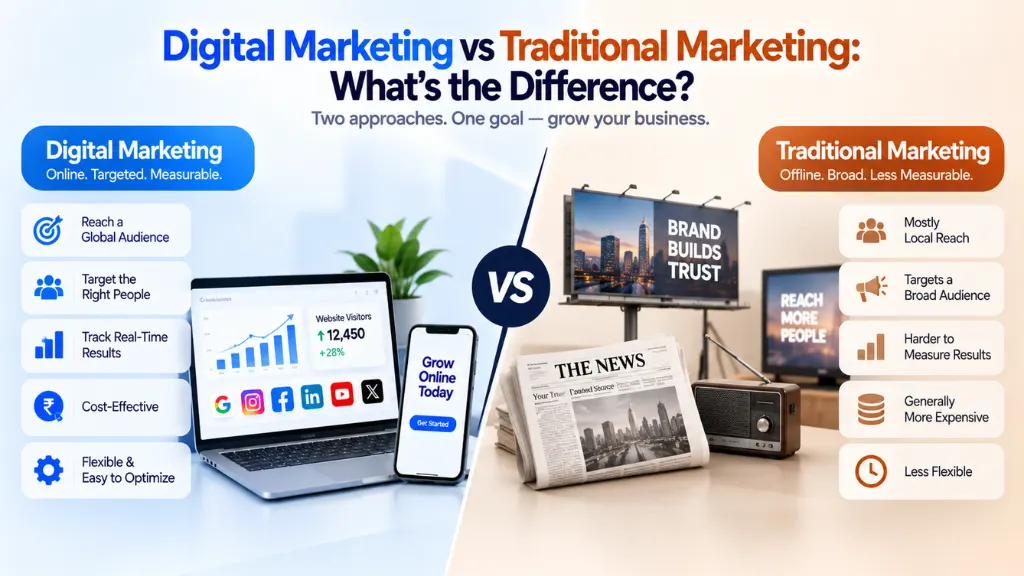

Ask which is “better,” digital marketing or traditional marketing, and the honest answer disappoints anyone hoping for a clean winner: neither one universally beats the other, and the businesses getting the best results in 2026 are mostly the ones that stopped treating this as a competition. Digital marketing vs traditional marketing comes down to a genuine trade-off – trackability, precision targeting, and real-time adjustment on one side; broad reach, memorability, and deep-rooted trust with certain audiences on the other.
In this article14 sections
This guide breaks down what actually separates the two, where each still has a real, evidence-backed advantage in 2026, and how to decide what mix makes sense for a specific business rather than picking a side on principle.
What Is Traditional Marketing?#
Traditional marketing refers to promotional methods that predate the internet and rely on offline channels to reach audiences at scale – television and radio advertising, print media like newspapers and magazines, outdoor advertising such as billboards and transit posters, direct mail, and in-person event sponsorships. These channels share a common structural trait: content is produced and placed once, then runs largely unchanged for the duration of the campaign, without the ability to adjust targeting or messaging mid-flight based on how the audience is responding.
What Is Digital Marketing?#
Digital marketing promotes products, services, or brands through online channels – search, social media, email, video, display advertising, and content marketing – where nearly every action is trackable and campaigns can be adjusted in real time. A digital campaign that underperforms can be paused, retargeted, or rewritten within hours; a print ad that underperforms has already been paid for, printed, and distributed before anyone can measure the result.
The Core Differences at a Glance#
| Factor | Traditional Marketing | Digital Marketing |
| Cost structure | Large upfront spend for production and media buying, paid regardless of performance | Flexible, scalable spend – start small, test, and scale what works |
| Targeting | Broad, typically by channel and general demographic | Precise – by behavior, interest, location, device, and more |
| Measurability | Difficult; relies on indirect methods like coupon redemption or brand recall surveys | Directly trackable – clicks, conversions, cost per acquisition, and more, often in real time |
| Adjustability | Fixed once a campaign is live | Can be paused, edited, or reallocated mid-campaign |
| Geographic reach | Limited to the channel’s coverage area – a local paper, a regional radio station | Local, national, or global simultaneously, even on a modest budget |
| Speed to launch | Weeks to months, given production and media booking lead times | Can launch in hours |
| Strongest audience | Older demographics and local, in-person trust-building | Digitally active audiences across all age groups, especially younger consumers |
Cost: Why Digital Marketing Generally Costs Less to Start#
Traditional marketing typically demands a large upfront commitment – design, printing, postage, and media placement – paid in full regardless of how the campaign actually performs. Digital marketing, by contrast, allows a business to start with a small budget, test which creative and audience combinations work, and scale spend toward whatever is actually converting rather than committing fully before any results are in.
This doesn’t mean digital marketing is cheaper indefinitely. In competitive industries and crowded ad auctions, digital costs can climb significantly, and a business with no organic presence still needs meaningful budget to compete for visibility. The real advantage isn’t a permanently lower price – it’s the ability to test cheaply before committing at scale, something traditional media generally doesn’t allow.
Targeting and Personalization#
Traditional marketing targets broadly, by channel and general audience profile – a regional radio spot reaches everyone who happens to be listening in that market, regardless of whether they’re a plausible customer. Digital marketing can target by specific behavior, interest, purchase history, device type, and precise geography, letting a business reach a narrower, more qualified audience rather than paying to reach everyone within a channel’s broad coverage area.
Measurability: The Biggest Structural Difference#
This is arguably the single most consequential distinction between the two. Digital marketing performance is directly measurable – clicks, conversions, cost per acquisition, and channel-level attribution are all available, often close to real time. Traditional marketing’s effectiveness has to be inferred indirectly, through methods like unique coupon codes, dedicated phone lines, or post-campaign brand recall surveys, none of which offer the same precision or speed as a digital analytics dashboard.
This gap matters practically: a business running a digital campaign can identify which specific ad, audience segment, or landing page is underperforming and fix it within the same campaign. A business running a billboard campaign generally has to wait until the run is complete, then infer its effectiveness after the fact, with far less certainty about what specifically drove any change in results.
Reach and Trust: Where Traditional Still Wins#
Digital marketing’s growth doesn’t mean traditional channels have become irrelevant. Certain strengths remain genuinely traditional marketing’s own:
- Older demographics still favor traditional media. Research from Pew Research Center has found that people aged 50 and older remain considerably more likely to get their news from television and print than from social media, making traditional channels a more reliable way to reach that audience specifically.
- Word of mouth remains the most trusted form of promotion of all, traditional or digital – Nielsen’s global trust research has found that roughly 92% of consumers trust recommendations from people they personally know above any form of paid advertising, a trust level neither channel type fully replicates on its own.
- Local, in-person trust-building – event sponsorships, community presence, local sports team backing – builds a kind of regional credibility that a digital ad, however well-targeted, doesn’t replicate in the same way.
- Broad awareness at scale. A well-placed television spot or major outdoor campaign can build brand familiarity across an entire market simultaneously, in a way a narrowly targeted digital campaign, by design, doesn’t attempt to do.
Speed and Adaptability#
Digital campaigns can be built, launched, tested, and adjusted within hours or days. Traditional campaigns generally require weeks or months of production and media-buying lead time before they even go live, and once live, the message and placement are fixed until the run ends. For businesses needing to react quickly to a market shift, a competitor’s move, or a real-time opportunity, this difference in adaptability is often more consequential than any cost comparison.
The Ad Spend Shift: 2026 Data#
The overall spending trend is unambiguous, even if the exact figures vary somewhat by source and methodology. Multiple 2026 industry reports converge on digital advertising now representing the clear majority of global ad spend – estimates commonly fall somewhere in the range of two-thirds to over three-quarters of total spend, with figures varying depending on whether a report measures global versus U.S.-only spend, or total marketing budgets versus paid advertising specifically. Gartner’s 2026 CMO Spend Survey found that traditional advertising has fallen to under 4% of overall marketing budgets among the CMOs surveyed, while U.S. digital ad revenue reached roughly $294.6 billion in 2025, up close to 14% year over year, according to the IAB and PwC’s joint Internet Advertising Revenue Report.
The precise percentage matters less than the direction: digital’s share of overall spend has been growing consistently for years and shows no sign of reversing, even as traditional media retains real, specific strengths for particular audiences and objectives.
Why “Vs” Is the Wrong Framing: Integrated Strategy#
Despite the spending shift, framing this as a competition where one approach replaces the other misses how most successful brands actually operate in 2026. An integrated strategy – using traditional channels for broad awareness and local trust-building, while relying on digital channels for precise targeting, measurable performance, and real-time optimization – consistently outperforms a strategy that commits entirely to one side.
A regional business running a billboard campaign alongside a targeted local search and social media presence, for instance, can use the billboard to build broad familiarity across its market while using digital channels to convert the resulting awareness into trackable leads – each channel doing what it does best, rather than competing for the same job.
Which Should Your Business Use?#
The right mix depends less on which category feels more “modern” and more on specific business factors:
- Audience age and media habits. A business targeting an older, less digitally active demographic has a stronger case for traditional channels than one targeting younger, digitally native consumers.
- Geographic scope. A hyper-local business with a single physical location may find community-based traditional tactics – sponsorships, local print, direct mail – genuinely effective in a way a global digital campaign’s broad reach doesn’t improve on.
- Budget flexibility. A business needing to test and iterate on a modest budget is generally better served starting with digital channels, given the ability to scale spend only toward what’s working.
- Measurement requirements. A business that needs to justify marketing spend with precise ROI data has a much stronger case for digital channels, given how directly their performance can be measured compared to most traditional formats.
Common Mistakes in Comparing the Two#
- Treating this as a binary choice. Most businesses benefit from some combination of both, weighted according to audience and goals, rather than committing entirely to one category.
- Assuming digital is always cheaper. In competitive industries, digital ad costs can climb considerably, and the real cost advantage is the ability to test cheaply before scaling, not a universally lower price.
- Dismissing traditional marketing as obsolete. Specific demographics and specific trust-building goals still favor traditional channels, and ignoring them entirely can mean missing an audience digital channels don’t reach as effectively.
- Underestimating the measurement gap. Businesses new to digital marketing sometimes fail to actually use the tracking data available to them, missing the core advantage digital offers over traditional channels in the first place.
- Ignoring word of mouth as a channel entirely. Since it remains the most trusted form of promotion overall, neither a traditional nor a digital strategy that ignores encouraging genuine recommendations is capturing the full picture of how people actually decide to trust a business.
Frequently Asked Questions#
Is digital marketing always better than traditional marketing? Not universally. Digital marketing offers stronger targeting, measurability, and cost flexibility, but traditional marketing retains real strengths for reaching older demographics, building broad local trust, and creating a sense of scale and authority that a narrowly targeted digital campaign doesn’t attempt to replicate.
Is traditional marketing dying out in 2026? No, though its share of overall ad spend has declined significantly and continues to shrink relative to digital. It remains a genuinely effective channel for specific audiences and goals, particularly reaching older demographics and building broad, local brand awareness.
How much of global ad spend is digital in 2026? Estimates vary by source and methodology, but multiple 2026 industry reports place digital’s share of global ad spend somewhere between roughly two-thirds and over three-quarters of the total, with the exact figure depending on whether global or regional spend, and total marketing budgets or paid advertising specifically, is being measured.
Can a small business benefit from traditional marketing, or is that only for large brands? Small businesses can benefit from targeted, local traditional tactics – community sponsorships, local print, direct mail to a defined geographic area – particularly when the goal is building trust within a specific local market rather than reaching a broad or global audience.
What’s the biggest practical difference between the two approaches? Measurability. Digital marketing performance can be tracked directly and adjusted in real time, while traditional marketing’s effectiveness generally has to be inferred indirectly, after the campaign has already run its course.
Should a new business start with digital or traditional marketing? Digital marketing is generally the more practical starting point for a new or smaller business, given the ability to test with a modest budget and scale only what performs, though the right answer still depends on the specific audience, industry, and whether local, in-person trust-building is a meaningful part of the business’s growth strategy.
The Bottom Line#
Digital marketing and traditional marketing solve different problems rather than competing for the same job – digital wins on precision targeting, measurable ROI, and the ability to test and adjust in real time, while traditional marketing still holds real advantages in broad local trust-building and reaching audiences that digital channels don’t serve as effectively. The spending shift toward digital is real and continuing, but the smartest strategy for most businesses blends both according to actual audience and goals, rather than treating this as a contest with one winner. Search Savvy’s content marketing services, performance marketing services, and Google Ads and PPC services help businesses build the measurable, digital side of an integrated marketing strategy, and the digital marketing glossary is a useful reference for the terminology covered throughout this guide.