
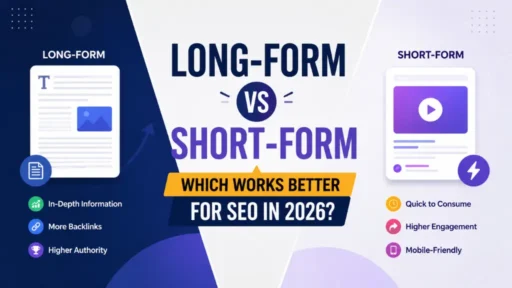
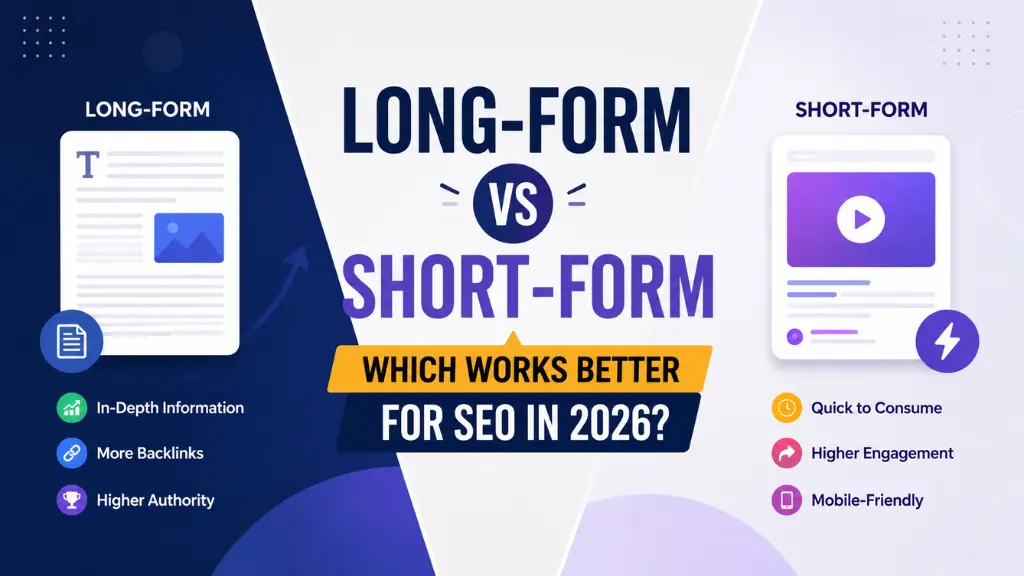

Here is the content length debate that has never quite been resolved: should you publish fewer, deeper pieces, or more frequent, tighter ones?
Long-Form vs Short-Form Content is a question most content strategies answer by accident rather than by design – defaulting to one format out of habit and wondering why results plateau. The honest answer in 2026 is more nuanced than any blanket rule, and getting it right is the difference between content that compounds into authority and content that adds noise without adding traction.
Long-Form vs Short-Form Content each serves a genuinely different purpose. They are not competing strategies for the same goal – they are complementary tools for different stages of the buyer journey, different query types, and different distribution channels. The brands outperforming competitors in 2026 are not choosing one over the other; they are deploying both with intention.
Long-Form vs Short-Form Content decisions in 2026 also carry a new dimension that did not exist two years ago: AI search visibility. Google AI Overviews now appear on 48 to 58% of all search results globally, and how content is structured – not just how long it is – determines whether it gets cited or bypassed.
At Search Savvy, content length decisions are always driven by search intent and competitive analysis rather than a fixed word count target, because the data consistently shows that the right length is whichever length fully satisfies the query better than competing pages. This guide explains what that looks like in practice.
What Is the Difference Between Long-Form and Short-Form Content?
Long-Form vs Short-Form Content is defined by word count thresholds that have shifted as average content length has increased. In 2026, the working definitions are:
- Short-form content – 300 to 800 words, designed to answer a specific, narrow query quickly
- Mid-form content – 800 to 1,500 words, covering a focused topic with moderate depth
- Long-form content – 1,500 to 5,000+ words, covering a broad topic comprehensively across multiple subtopics
Long-Form vs Short-Form Content is also defined by purpose rather than word count alone. A 300-word product description that fully satisfies purchase intent is more valuable than a 300-word blog post attempting to explain a complex SEO concept. Format should follow intent – not be imposed on it.
People Also Ask: What word count is considered long-form content in 2026? Short Answer: Long-form content in 2026 starts at approximately 1,500 words, with high-performing pillar pages and comprehensive guides commonly running to 2,500 to 5,000 words. The average blog post length has risen to 1,427 words in 2026, up from 1,236 in 2023, reflecting a continued shift toward longer content. However, no word count threshold guarantees rankings – coverage of search intent remains the primary determinant.
How Does Long-Form Content Perform for SEO in 2026?
Long-Form vs Short-Form Content data in 2026 consistently favours long-form for competitive informational queries, and the reasons are structural rather than arbitrary. Longer content tends to cover a topic more thoroughly, answer follow-up questions the reader would naturally have, and demonstrate the topical depth that Google’s E-E-A-T evaluation systems reward.
The headline data points from 2026 research make the long-form case clearly:
- The average first-page Google result contains 1,447 words
- The number-one result is typically 30% longer than the number-ten result for the same query
- Long-form content of 2,000+ words earns 77.2% more backlinks than short-form
- Posts exceeding 3,000 words receive 3.5x more backlinks and 2.4x more social shares than posts under 1,000 words
- Articles under 1,000 words average 3.47 backlinks and shares; articles of 3,000+ words average 11.07
- A 3,000-word resource is relevant to more AI queries, giving it significantly more citation opportunities in AI Overviews and LLM responses
Long-Form vs Short-Form Content also differs in long-term shelf life. A well-built pillar page of 2,500 to 4,000 words on a competitive topic can drive traffic and leads for years after publication. A 400-word blog post on the same topic is less likely to attract the backlinks and engagement that sustain rankings over multiple algorithm updates.
People Also Ask: Does longer content always rank better than shorter content? Short Answer: No – correlation, not causation. Longer content tends to rank better because it more thoroughly covers the topic and satisfies search intent, not because Google has a word count preference. A well-structured 1,200-word article can outperform a padded 4,000-word piece if the shorter article answers the query more directly. Google’s John Mueller has confirmed: “We don’t have a ranking factor that counts words on a page.”
How Does Short-Form Content Perform for SEO in 2026?
Long-Form vs Short-Form Content comparisons often undervalue short-form in SEO contexts. Short-form content has genuine and specific situations where it outperforms, particularly when the query intent is narrow and the user wants a fast, direct answer rather than comprehensive exploration.
Short-form content performs best for:
- Simple definitional queries – “What is a canonical tag?” can be fully satisfied in 400 to 600 words
- Low-competition navigational searches – where a concise, specific page can rank against minimal competition
- Product and service pages – typically perform best at 600 to 1,200 words, focused on conversion signals rather than exhaustive depth
- Local landing pages – city-specific and service-specific pages generally perform well at 600 to 1,200 words
- News and time-sensitive content – where speed to publish and freshness outweigh depth
- Top-of-funnel social content – 75% of B2B brands primarily produce short-form content for maintaining publishing cadence and social engagement
Long-Form vs Short-Form Content trade-offs at the short end: short-form content can publish faster, get indexed more quickly, and rank sooner for low-competition terms. It rarely breaks through in competitive informational categories where top results are dominated by comprehensive, well-structured articles.
What Does the 2026 Data Say About Ideal Content Length by Type?
Long-Form vs Short-Form Content decisions should start from a recommended word count range per content type, then be calibrated against the actual top-ranking pages for the specific target query.
| Content Type | Recommended Length | Notes |
| Competitive blog posts | 1,500–2,500 words | Baseline for most informational SEO |
| Pillar pages | 3,000–5,000 words | Comprehensive topical coverage |
| Product pages | 200–500 words | Conversion-focused; avoid padding |
| Category pages | 600–1,200 words | Enough context without diluting UX |
| Local landing pages | 600–1,200 words | Local relevance + conversion |
| FAQ pages | 2,000–3,500 words | Multi-question coverage |
| Short news or update posts | 300–600 words | Speed and freshness priority |
| Comparison posts | 1,500–2,500 words | Covers decision-stage queries fully |
Long-Form vs Short-Form Content calibration should always check the actual word counts of pages currently ranking in the top five positions for your target keyword. Use the average of those pages as a benchmark, then aim to match or modestly exceed it in depth and specificity – not in word count for its own sake.
People Also Ask: What is the minimum word count for a blog post to rank on Google? Short Answer: There is no confirmed Google minimum. In practice, pages under 200 to 300 words are at elevated risk of being classified as thin content under Google’s Helpful Content guidelines. For competitive informational keywords, 1,000 words is a realistic starting threshold for competitiveness, with most top-ranking positions requiring 1,500 to 2,500 words of substantive coverage.
How Does Long-Form vs Short-Form Content Affect AI Search Visibility?
Long-Form vs Short-Form Content has a clear winner for AI Overview and LLM citation eligibility: structured long-form content with short, extractable answer blocks embedded within it.
Long-Form vs Short-Form Content in the AI search context is best understood as: long-form content provides the topical authority and citation eligibility that gets a site into AI systems’ pool of trusted sources, while short, direct answer blocks within that long-form content are what actually gets extracted and surfaced in AI-generated responses.
AI Overviews specifically prefer content that demonstrates:
- Comprehensive topic coverage signalling genuine expertise
- Clear H2 and H3 heading structures that let AI systems identify which section answers which question
- Direct, concise answers of 40 to 60 words at the opening of each section before elaborating with depth
- Original data, case studies, or unique insights that AI systems cannot synthesise themselves and must cite a source for
- Structured FAQ sections that map to the question-based format AI queries naturally take
Long-Form vs Short-Form Content purely short-form pieces – 300 to 600 words – are rarely cited in AI Overviews for competitive queries, because they typically do not demonstrate enough topical depth for AI systems to treat them as authoritative sources. For AI visibility, comprehensive coverage with clear internal structure consistently outperforms brief content, even when the brief content is better written.
How Does AI Content Affect the Long-Form vs Short-Form Content Landscape?
Long-Form vs Short-Form Content strategy in 2026 must account for a specific dynamic that did not exist even two years ago: AI-generated content has flooded the SERPs with long-form content that hits word count targets without adding genuine insight.
As a result, Google’s Helpful Content systems have become more sophisticated at distinguishing genuine topical depth from padded length. Pure AI-generated content (with no human editorial oversight) underperforms human-written content by 23% in organic rankings after 12 months, according to 2026 blogging research. However, AI-assisted content – human-edited with AI drafting support – outperforms purely human-written content by 12% on productivity metrics while maintaining equivalent ranking performance.
The practical implication for Long-Form vs Short-Form Content decisions: the bar for long-form content has risen. A 2,500-word article that simply expands on what already ranks adds diminishing value. A 2,500-word article with original research, first-hand examples, and specific India-relevant or brand-specific insight that competitors cannot replicate still performs significantly better than any competing short-form content.
Long-Form vs Short-Form Content: The Hybrid Strategy That Actually Works
Long-Form vs Short-Form Content is not a binary choice – the most effective content strategies in 2026 use both formats in a deliberate sequence, often generated from the same research investment.
The content atomisation model starts with a comprehensive long-form asset (2,000 to 4,000 words), which then becomes the source material for:
- Five to seven short-form social posts extracting key statistics or insights
- One email newsletter summarising the three key takeaways
- A LinkedIn carousel presenting the step-by-step process visually
- A short-form video (60 to 90 seconds) covering the most counterintuitive finding
Long-Form vs Short-Form Content costs the most in time and research investment for the long-form anchor piece, but that investment then generates weeks of short-form content at low marginal cost – making the total cost-per-piece significantly lower than creating each format independently.
According to Search Savvy’s insights from managing content strategies across Indian and international clients in 2026, the teams compounding the fastest are those treating long-form pillar content as the SEO and authority foundation while using short-form as the distribution engine that drives new audiences back to the long-form asset.
How Should Indian Brands Approach Long-Form vs Short-Form Content?
Long-Form vs Short-Form Content for Indian brands should account for a mobile-first audience that typically consumes short-form content through Instagram, YouTube Shorts, and WhatsApp, but arrives at longer-form blog content specifically through Google search with a specific intent.
Long-Form vs Short-Form Content calibration for Indian markets benefits from understanding that AI Overviews are now active in India and affecting CTR for informational queries in exactly the same way they do in Western markets. Building long-form pillar content with strong structured data and direct answer blocks is now as strategically important for Indian content brands as it is globally.
Conclusion: Match the Format to the Intent, Then Make It the Best
Long-Form vs Short-Form Content is ultimately resolved by a simple diagnostic: what does the person searching for this query actually need to walk away satisfied? If a concise, direct 500-word answer does that, short-form wins. If covering the topic properly requires eight H2 sections, a comparison table, and a FAQ block, long-form earns the position.
Search Savvy, every content brief we produce starts with intent analysis and competitor length benchmarking before a target word count is decided – because producing the right amount of genuinely useful content consistently outperforms both padding for length and cutting for brevity.
FAQ: Long-Form vs Short-Form Content for SEO – Your Questions Answered
Q1: What length should a blog post be for SEO in 2026? For most competitive informational blog posts, 1,500 to 2,500 words is the 2026 baseline. For competitive informational keywords where top results run longer, 2,500 to 4,000 words is more appropriate. Pillar pages should reach 3,000 to 5,000 words. The best calibration method is to average the word counts of the top five currently ranking pages for your target keyword and aim to match or modestly exceed that depth.
Q2: Does Google penalise short-form content? Not explicitly, but pages under 300 words are at elevated risk of being classified as thin content under Google’s Helpful Content systems. Short-form content performs well for simple, low-competition queries and specific page types like product pages and local landing pages. For competitive informational topics, short-form consistently underperforms against more comprehensive competitors.
Q3: Which format gets more backlinks? Long-form content earns significantly more backlinks – 77.2% more than short-form on average, and posts over 3,000 words earn 3.5x more backlinks than posts under 1,000 words. The primary reason is that comprehensive resources are more likely to be cited as reference material than brief pieces that cover the same topic at a surface level.
Q4: Does short-form content have a role in SEO strategy? Yes, a meaningful one. Short-form content captures fast-answer and low-competition queries, serves as the distribution format for content across social channels, and is the starting point for the content atomisation model – where a long-form pillar becomes five to seven short-form social assets. Short-form builds reach and awareness; long-form builds authority and rankings. Together they create a pipeline neither can build alone.
Q5: What word count is best for AI Overview citations? There is no specific word count threshold for AI Overview eligibility, but comprehensive long-form content consistently earns more citations than brief pieces for competitive queries. The structural signal matters more than raw length: answer-first formatting, clear heading hierarchies, FAQ schema, and original data all improve AI citation likelihood regardless of whether a piece is 1,500 or 4,000 words.
Q6: Is AI-generated long-form content effective for SEO in 2026? Only with genuine human editorial oversight. Pure AI-generated content underperforms human-written content by 23% in organic rankings after 12 months. AI-assisted content – human-edited with AI drafting support – performs as well as purely human-written content while delivering productivity gains. The distinction between AI as a drafting tool versus AI as a publishing engine is exactly what Google’s 2026 quality systems have been specifically trained to detect.
Not sure whether your content strategy is correctly calibrated between long-form and short-form formats for your specific topic area and competitive landscape? Visit Search Savvy for a content audit that maps your existing pieces against intent, competitor length benchmarks, and AI Overview eligibility to show exactly where to invest next.