
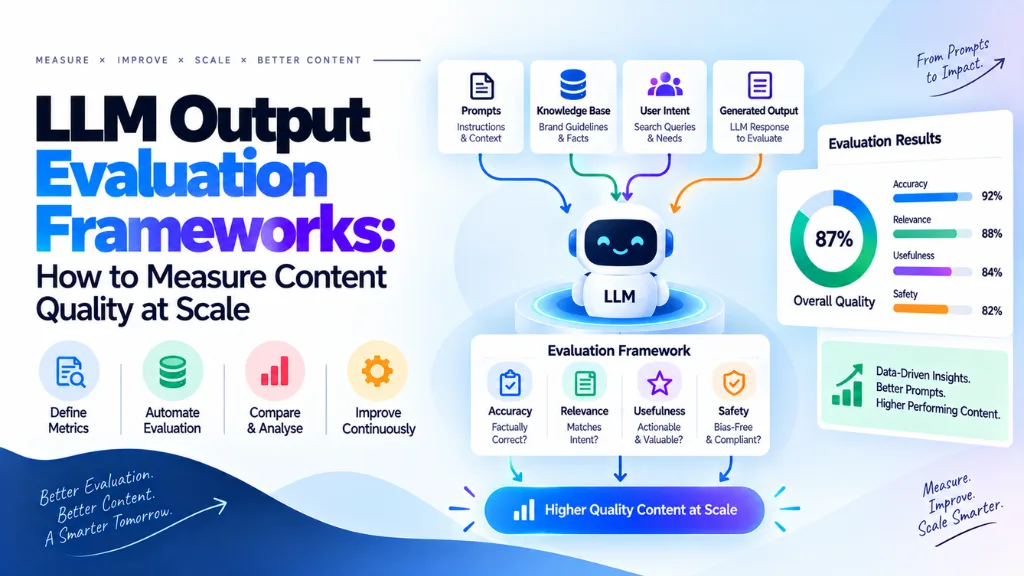

Publishing content with a large language model is easy. Knowing whether that content is actually good – accurate, original, useful to a real reader – is the hard part, and it’s the part most teams skip. LLM output evaluation is the structured process of measuring an AI-generated response against defined quality criteria, using a mix of automated metrics, model-based judges, and human review, rather than relying on a quick read-through.
This distinction has become a business problem, not just a technical one. Google’s March 2026 core update made scaled content abuse a primary enforcement target, and case studies from that update showed a sharp split: sites publishing 50 to 100 AI-assisted articles with real editing saw traffic gains of 30% to 80%, while sites publishing 1,000 or more unedited AI articles saw drops of 40% to 90%. The difference wasn’t the presence of AI. It was whether anyone had measured quality before hitting publish.
This article breaks down how LLM output evaluation frameworks actually work, what the three layers of evaluation are, and how to build a workflow that lets you scale content production without scaling risk – the same discipline Search Savvy applies when running high-volume content marketing engagements for clients.
What Is LLM Output Evaluation?
LLM output evaluation is the practice of scoring an AI model’s response against a defined set of criteria – accuracy, relevance, coherence, safety, or task-specific requirements – using repeatable methods rather than one-off spot checks. It differs from LLM observability, which tracks system-level behavior like latency and error rates, and from LLM monitoring, which watches production traffic for drift over time. Evaluation asks a narrower question: is this specific output good, according to a standard you can defend?
For content teams, that standard usually includes factual accuracy, originality, alignment with search intent, and consistency with brand voice. For engineering teams building AI products, it more often includes hallucination rate, retrieval grounding, and safety compliance. The methods overlap even when the goals differ.
Why Evaluation Matters More Once You’re Publishing at Scale
A single AI-drafted article is easy to review by eye. A production pipeline generating dozens or hundreds of pieces a month is not – and that gap is exactly where quality problems become invisible until they show up in a traffic drop or a client complaint.
Google has been consistent on this point since it first published guidance on AI-generated content in 2023: the production method isn’t the issue, and appropriate use of AI has never been against Search guidelines. What triggers Google’s scaled content abuse policy is publishing large volumes of low-value pages primarily to manipulate rankings, regardless of whether a human or a model wrote them. Thin, unoriginal, or unreviewed AI content is what gets penalized – not AI itself.
That policy reality is exactly why a formal evaluation framework matters for any team producing content at volume. Without one, “scale” and “risk” grow at the same rate.
Is AI-Generated Content Against Google’s Guidelines?
No. Google has repeatedly clarified that content is judged on helpfulness, accuracy, and originality, not on the tool used to produce it. The risk isn’t AI authorship – it’s publishing content that provides no real value to a reader, at volume, without editorial oversight.
The Three Layers of LLM Output Evaluation
Most credible evaluation frameworks in 2026 combine three distinct layers, each catching problems the others miss.
| Layer | What It Does | Strengths | Limitations |
| Automated metrics | Scores output using measurable criteria (word overlap, semantic similarity, readability) | Fast, cheap, works overnight at scale | Misses nuance, factual errors, and brand fit |
| LLM-as-a-judge | Uses a model to grade another model’s output against a rubric or checklist | Scales well, handles open-ended content, faster than human review | Prone to position bias, verbosity bias, and self-preference bias |
| Human review | Expert or editor evaluates output directly | Only method that establishes real ground truth | Slow, inconsistent between reviewers, does not scale alone |
Automated Metrics: The First Filter
Classic metrics such as BLEU, ROUGE, and BERTScore compare generated text against a reference, measuring token overlap or semantic similarity. These work well for narrowly defined tasks like translation or summarization, but they weren’t built to judge open-ended marketing or editorial content, where there’s no single “correct” reference answer. Automated metrics are best used as a fast first filter – flagging outputs that are too short, too repetitive, or structurally off – before anything reaches a human.
LLM-as-a-Judge: Scaling the Middle Layer
LLM-as-a-judge frameworks prompt a model to grade another model’s output, typically against a task-specific checklist and a Likert scale from 1 to 5. This approach scales far better than human review and handles open-ended tasks that automated metrics can’t touch, which is why it has become the workhorse layer in most 2026 evaluation stacks.
It isn’t without known failure modes, though. Research on judge reliability has identified three consistent biases:
- Position bias – in a widely cited MT-Bench study, researchers found that simply swapping the order of two candidate responses shifted a judge model’s preference by more than 10%, even when the responses were identical.
- Verbosity bias – longer outputs tend to score higher regardless of whether the extra length adds value.
- Self-preference bias – a judge model tends to favor outputs from its own model family in head-to-head comparisons.
A jury-of-judges setup – three independent models producing a majority verdict – reduces all three biases, at roughly three times the evaluation cost. Whether that trade-off is worth it depends on how expensive a bad output would be if it reached a reader unreviewed.
Human Review: The Ground Truth Layer
Human evaluation remains the only method that establishes true ground truth rather than measuring quality against a proxy. For content operations, this typically means an experienced editor checking facts, tone, and originality against a rubric, and adjudicating any content that automated or LLM-judge layers flag as borderline. This is also where E-E-A-T-relevant judgment happens – whether a piece demonstrates real expertise and a defensible point of view, something no automated metric can currently assess on its own.
Building an Evaluation Framework for Content at Scale
A workable framework doesn’t require enterprise tooling. It requires four decisions made in advance, before content starts flowing through the pipeline.
- Define your quality dimensions explicitly. For SEO and marketing content, that typically means factual accuracy, originality relative to top-ranking pages, alignment with search intent, and brand voice consistency – written down as a checklist, not left to instinct.
- Set a sampling and escalation rule. Decide what percentage of output gets full human review versus spot-checking, and define what triggers automatic escalation to a human editor (for example, any statistic, claim about pricing, or YMYL-adjacent topic).
- Use a checklist-based LLM judge for the middle layer. Generate a grading checklist per content type, have a model score drafts against it, and route low scores to human review rather than publishing on judge approval alone.
- Version and trace everything. Link every evaluation score back to the exact prompt, model version, and source material that produced it, so a quality regression can be traced to its cause instead of triggering a guess-and-check fix.
This is the same discipline Search Savvy applies internally when producing long-form content at volume: automated checks for structural requirements, followed by editorial review against a documented rubric before anything ships. Teams building this out for the first time often benefit from a structured content strategy and topical authority engagement to define what “quality” should mean for their specific site and audience before scaling production.
Common Mistakes in LLM Output Evaluation
- Relying on a single layer. Automated metrics alone miss factual errors; human review alone doesn’t scale. Frameworks need all three layers working together.
- Treating LLM-judge scores as final. Without bias controls like randomized response order or jury-of-judges setups, judge scores can reward verbosity or position over actual quality.
- Skipping traceability. If a score can’t be linked back to the prompt and model version that produced it, a quality drop becomes nearly impossible to diagnose.
- Publishing on volume targets instead of quality gates. A content calendar built around output count rather than a pass/fail quality threshold is the exact pattern Google’s scaled content abuse policy is designed to catch.
- Ignoring E-E-A-T-specific criteria. Generic coherence and fluency scores don’t capture whether content demonstrates real expertise or a defensible point of view – that judgment still requires a human layer.
The Bottom Line
LLM output evaluation isn’t an optional add-on for teams publishing AI-assisted content – it’s the mechanism that determines whether scale becomes an asset or a liability. Automated metrics, LLM-as-a-judge scoring, and human review each catch different failure modes, and a defensible framework needs all three working together, with traceability back to the exact prompt and model version behind every piece.
The practical next step is to write down your quality dimensions before your next content sprint, not after a traffic drop forces the question. If you’re scaling content production and need help defining what quality actually means for your site, Search Savvy’s website audit services and AI search optimization (AEO/GEO) services are built around exactly this kind of evaluation groundwork, so your content earns visibility instead of triggering a scaled content review.
Frequently Asked Questions
What is LLM output evaluation in simple terms? It’s the structured process of scoring an AI model’s response against defined quality criteria – such as accuracy, relevance, and coherence – using automated metrics, model-based judges, or human reviewers, rather than judging quality by a quick read-through.
What’s the difference between LLM evaluation and LLM monitoring? Evaluation measures whether a specific output meets a quality standard, typically before or during development. Monitoring watches production traffic over time for drift, errors, or degraded performance after deployment. Both matter, but they answer different questions.
Does Google penalize AI-generated content? No. Google’s guidance has consistently stated that content is judged on helpfulness, accuracy, and originality, regardless of whether it was written by a person or a model. What triggers penalties is publishing large volumes of low-value content primarily to manipulate rankings.
What is LLM-as-a-judge, and can it be trusted on its own? LLM-as-a-judge uses one model to grade another model’s output against a rubric or checklist. It scales well but has known biases – including favoring longer responses and the order in which options are presented – so it works best combined with human review for anything high-stakes.
How much human review do I actually need if I’m using automated evaluation? There’s no universal percentage, but most credible frameworks route any output touching statistics, pricing, or YMYL-adjacent topics to full human review, while sampling a smaller percentage of lower-risk content for spot checks.
Can a small team build an LLM evaluation framework without expensive tooling? Yes. A written quality checklist, a defined escalation rule for what gets human review, and a way to trace scores back to the prompt and model version used are enough to start. Dedicated platforms add automation later, but the framework itself doesn’t require them on day one.