
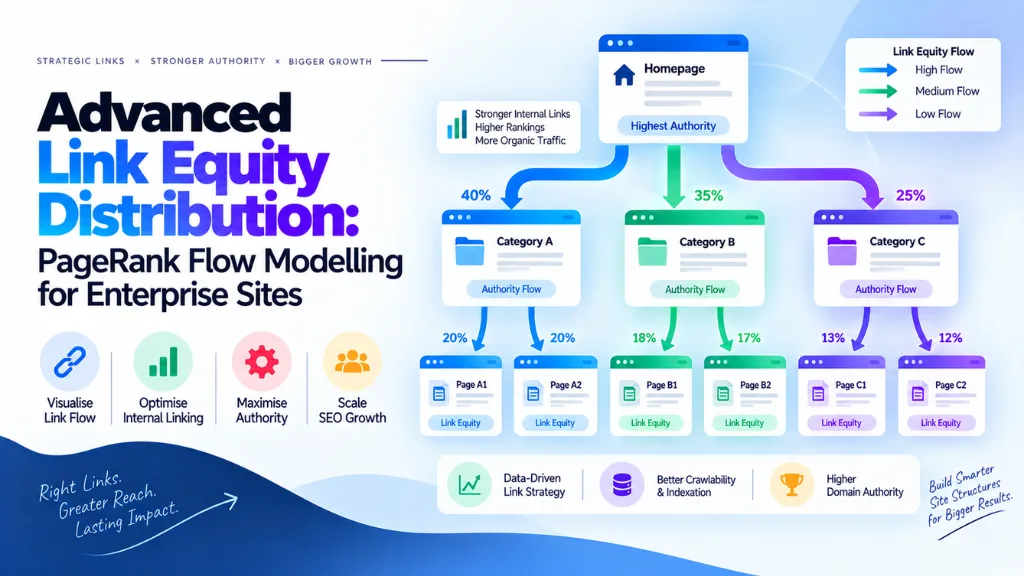

On a ten-page site, link equity distribution barely matters – there’s nowhere for authority to get lost. On a site with hundreds of thousands of URLs, faceted navigation generating millions of parameter combinations, and a backlink profile concentrated on a handful of pages, exactly where that authority flows determines which pages can rank at all. Advanced link equity distribution is the discipline of modeling and controlling that flow deliberately, rather than letting it default to whatever a site’s templates happen to produce – a problem Search Savvy sees most often on large ecommerce catalogs and content-heavy enterprise sites alike.
This article covers how PageRank actually flows through a site’s link graph, why link equity sculpting through nofollow stopped working over a decade ago, how faceted navigation silently dilutes equity at enterprise scale, and the practical methods for modeling and correcting link equity flow on a large site.
What Is Link Equity, and How Does It Actually Flow?
Link equity is the authority a page can pass to other pages through the links it contains, rooted in the original PageRank algorithm published by Larry Page and Sergey Brin in 1998. In the original model, a hypothetical “random surfer” clicks links on a page with no preference between them, and a page’s PageRank reflects the probability that this random browsing eventually lands on it – meaning authority passed through outbound links, split evenly across all of them, regardless of where those links sat on the page or how prominent they were.
Google has since moved well past that original random-surfer assumption. A patent Google was granted in 2010, widely referred to as the “Reasonable Surfer” model, describes a more realistic approach: a surfer following links is more likely to click prominent, contextually relevant links than a buried footer link, a “Terms of Service” page, or an unrelated banner. Under this model, a link’s position on the page, its font size and visual emphasis, the surrounding anchor text, and how relevant it is to the page’s content all factor into how much weight – and therefore how much link equity – that specific link actually passes, rather than every link on a page splitting authority evenly.
Why Does This Matter for Enterprise Link Architecture?
It means link equity distribution isn’t purely a matter of which pages link to which – it’s also about where on the page those links appear and how likely a real visitor would actually be to click them. A prominent, contextual link in body content passes meaningfully more equity than the same URL linked from a crowded footer, which has direct implications for how enterprise sites should prioritize navigation, related-content modules, and body-content cross-links when trying to route authority toward specific pages.
Why Link Equity Sculpting With Nofollow Stopped Working
For a period after nofollow was introduced, SEOs used it internally as a sculpting tool – adding rel=”nofollow” to internal links pointing at lower-priority pages, on the assumption that the equity those links would have carried was instead redistributed among the remaining, followed links on the page. Google’s Matt Cutts publicly disclosed in 2009 that this assumption was wrong: a nofollowed link still consumes its share of the linking page’s equity, but that equity simply isn’t passed anywhere – it’s lost rather than redistributed to the other links. Nofollowing a low-priority page doesn’t give a site’s product pages a bigger share of that page’s authority; it just wastes the share that would have gone to the nofollowed link.
Google further changed how nofollow is treated in 2019 and 2020, alongside the introduction of rel=”sponsored” and rel=”ugc”, downgrading nofollow from a strict directive to a hint Google may or may not follow. Neither change revived internal sculpting as a viable technique. The practical implication for enterprise sites is that equity is routed by deliberately choosing what to link to and how prominently, not by selectively blocking links to pages a site wants to deprioritize.
Faceted Navigation: The Enterprise-Scale Equity Leak
Faceted navigation – the filter and sort options common on large e-commerce and content sites – is the single largest source of uncontrolled link equity dilution on enterprise sites, simply because of the scale at which it multiplies URLs. A catalog with 10,000 products and 50 filter options can combinatorially generate more than 100 million distinct URL combinations, the overwhelming majority of which are near-duplicate pages carrying little unique value, each one splitting off a share of link equity from the parent category page that links to it. This is one of the most common findings in ecommerce SEO audits, precisely because the problem is invisible from looking at any single category page in isolation.
Does Nofollow on Facet Links Stop This Equity Dilution?
No. Since Google’s 2019 policy change treating nofollow as a hint rather than a directive, PageRank still distributes across facet links even when they carry rel=”nofollow”, and the attribute would need to be applied consistently to every single facet anchor to have any chance of limiting crawl behavior at all – which most implementations fail to do comprehensively. Relying on nofollow to control faceted navigation’s equity impact is a common source of false confidence; it doesn’t reliably prevent crawling and doesn’t meaningfully protect equity concentration on the pages that matter.
The more effective controls are architectural: canonical tags pointing filtered variations back to their primary category page, robots.txt disallow rules for parameter patterns that generate no unique value, and limiting which facet combinations are even linked from crawlable HTML in the first place – reserving JavaScript-rendered or otherwise non-crawlable interaction for filter combinations that don’t need to pass equity or be indexed at all.
Modeling External Link Equity Flow Into Internal Pages
Enterprise sites typically have backlink profiles heavily concentrated on a small number of pages – usually the homepage and a handful of flagship content pieces – which means most of a site’s earned external authority enters the link graph at just a few points. How that authority then flows into the rest of the site depends entirely on the internal links from those high-authority entry points.
A page with strong backlinks that links out to dozens of other internal pages splits its passed equity across all of them; the same page, restructured to link prominently to a smaller, prioritized set of pages, concentrates more equity on each one. This is why auditing which pages actually receive a site’s most valuable backlinks – and then deliberately reviewing what those specific pages link to – is one of the highest-leverage exercises in enterprise link equity work, often more impactful than acquiring additional backlinks elsewhere on the site.
Tools and Methods for Modeling PageRank Flow
Manually inspecting link equity flow on a site with hundreds of thousands of pages isn’t practical; enterprise link equity work relies on crawl-based tools that build a visual and quantitative model of the site’s actual link graph.
| Method | What It Reveals |
| Full-site crawl (Screaming Frog, Sitebulb) | Complete internal link graph, orphan pages, click depth, and internal PageRank-style scoring per URL |
| Log file analysis | Which pages Googlebot actually crawls and how frequently, revealing where crawl budget is being spent versus where equity should be concentrated |
| Backlink profile mapping (Ahrefs, Semrush) | Which specific pages hold the most external authority, informing where internal link prioritization should start |
| Visual link graph exports | Identifies clusters, isolated sections, and pages several links removed from any high-authority source |
Log file analysis in particular reveals something crawl tools alone can’t: whether Google is actually visiting the pages a site’s link structure suggests it should be prioritizing. A page that should be receiving strong equity based on its position in the link graph but rarely appears in Googlebot’s log file hits often indicates a crawl or rendering issue interfering with that equity actually being recognized – a common enough gap that reviewing log files is a standard part of a thorough technical SEO audit on large sites.
A Practical Framework for Enterprise Link Equity Distribution
- Map the current link graph using a full-site crawl, identifying orphan pages, average click depth by section, and pages currently receiving disproportionately high or low internal link counts.
- Identify where external authority enters the site by cross-referencing the backlink profile against the crawl data, flagging the specific pages carrying the most earned external equity.
- Audit what those high-authority pages link to. Confirm they’re passing equity toward genuinely important destinations rather than splitting it evenly across a large, undifferentiated navigation menu.
- Control faceted navigation’s URL footprint through canonicalization and crawl restrictions rather than relying on nofollow, so combinatorial filter pages stop diluting category-level equity.
- Cross-check with log files to confirm Googlebot is actually crawling the pages the link graph suggests should be prioritized, not just that the link structure looks correct on paper.
- Re-audit on a recurring schedule. Large sites change constantly – new products, expired campaigns, restructured navigation – and the link graph shifts with every change, so equity distribution isn’t a one-time fix, which is why this framework works best as a standing part of ongoing enterprise SEO management rather than a single project.
Search Savvy typically runs this framework as part of a broader website audit for enterprise clients, since link equity issues are rarely visible from looking at individual pages – they only show up once the full site’s link graph is mapped and cross-referenced against real crawl behavior.
Common Mistakes
- Relying on nofollow for internal equity sculpting. This has been ineffective since 2009 and simply wastes equity rather than redistributing it.
- Assuming faceted navigation’s equity dilution is a crawl-budget-only problem. It’s also a link-equity problem, since every crawlable facet link splits authority away from the category page generating it.
- Ignoring where backlinks actually land. Concentrated external authority on a handful of pages that don’t strategically link elsewhere leaves most of a site’s earned equity trapped in place.
- Treating link equity work as a one-time audit. Enterprise site structures change constantly, and equity distribution needs periodic re-mapping, not a single fix.
- Skipping log file analysis. Crawl and link-graph data alone can’t confirm whether Google is actually behaving the way the site’s structure suggests it should.
- Over-linking from high-authority pages without prioritization. Splitting equity evenly across dozens of links from a page’s most valuable real estate dilutes the benefit that page could otherwise concentrate on a smaller set of priority destinations.
Frequently Asked Questions
Can you still sculpt PageRank using nofollow links? No. Since Google’s 2009 change, a nofollowed link still consumes its share of the linking page’s equity without passing it anywhere, meaning nofollow wastes equity rather than redistributing it to other links on the page.
How does faceted navigation affect link equity at scale? Every crawlable facet combination generates a URL that receives a share of the parent category page’s link equity, and because facet combinations multiply combinatorially, this can dilute authority across millions of largely duplicate pages on a large catalog site.
What is the Reasonable Surfer model, and why does it matter for internal linking? It’s a Google patent describing a link-weighting model where prominent, contextually relevant links pass more equity than buried or unrelated ones, meaning where and how a link is placed on a page affects how much authority it actually transfers – not just whether the link exists.
How do I find out which pages hold the most link equity on my site? A full-site crawl combined with backlink profile data shows which pages carry the most external authority and how that authority is currently being distributed (or not) through internal links to the rest of the site.
Does log file analysis really add anything beyond a standard site crawl? Yes. A crawl shows the theoretical link structure; log files show what Googlebot actually does with that structure, revealing gaps where a page’s position in the link graph doesn’t match its actual crawl frequency.
How often should enterprise link equity be re-audited? There’s no universal schedule, but large, frequently changing sites generally benefit from a link equity review every few months, since new content, expired pages, and navigation changes continuously reshape the link graph.
Bottom Line
Link equity distribution at enterprise scale isn’t controlled by clever attribute tricks – nofollow sculpting has been dead for over a decade – it’s controlled by deliberate architectural decisions: which pages receive external authority, what those pages link to, how faceted navigation’s URL footprint is contained, and whether crawl behavior confirmed through log files actually matches what the link graph suggests should happen. Map the graph, control the largest structural leaks, and re-audit as the site changes, and link equity starts flowing toward the pages that actually need it instead of dissipating across the pages that happened to end up with the most links.