
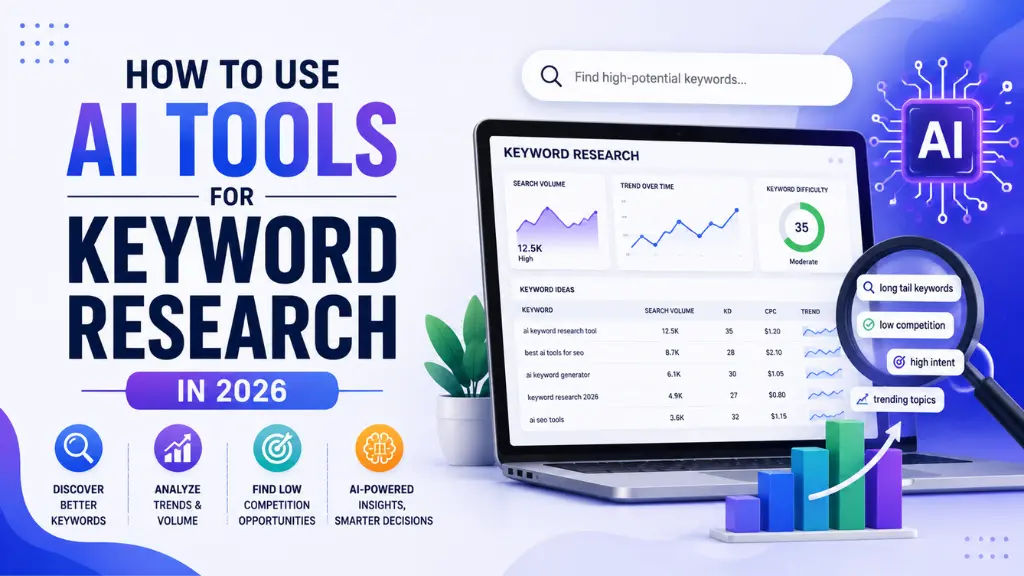

Here is the keyword research reality of 2026: 15% of daily searches on Google are brand new queries with no historical data. Traditional keyword tools built on volume databases have no record of these searches. The people using them are, by definition, researching what their audience was asking last year.
AI tools for keyword research change this equation. Instead of querying a static database of historical search volumes, AI-powered research identifies semantic relationships, predicts emerging queries, interprets search intent with 89% accuracy compared to 34% for volume-only tools, and surfaces the long-tail, scenario-specific opportunities that traditional tools miss entirely because they fall below meaningful monthly search volume thresholds.
AI tools for keyword research also address a structural change in how people search. Searches beginning with “tell me about…” jumped 70% year-over-year in 2025. Users are no longer searching for “CRM software pricing” – they are asking “What’s the best CRM for a 50-person marketing agency with Salesforce integration under $150 per user monthly?” Standard keyword databases struggle to surface this demand accurately. AI keyword research tools are built for it.
AI tools for keyword research also have a new job that did not exist two years ago: optimising for Answer Engine Optimisation (AEO) alongside traditional SEO. Content is no longer just competing for ten blue links – it is competing to be the cited source in ChatGPT (800 million+ weekly users), Perplexity, and Google AI Overviews. AI keyword research identifies which queries trigger AI citations and what content structure earns them.
At Search Savvy, we restructured keyword research workflows around AI tools in early 2025 and the efficiency gains are consistent across every client category. What previously took a full day of manual research now takes two to three hours – with more competitive insight and more content opportunity than manual research ever produced. This guide covers the exact workflow.
What Are AI Tools for Keyword Research and How Do They Work?
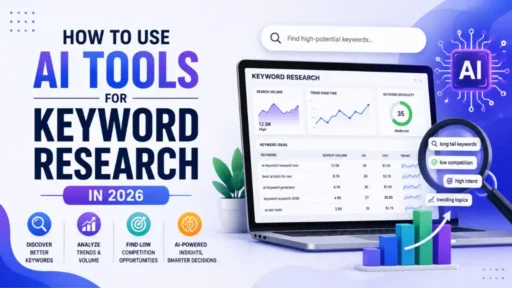
AI tools for keyword research are platforms that use natural language processing (NLP) and machine learning to automate and enhance the process of discovering, analysing, and organising keywords for SEO and content strategy.
AI tools for keyword research work differently from traditional keyword databases. Traditional tools query a historical database of search volumes for specific keyword strings. AI tools understand context – the semantic relationships between terms, the intent behind queries, the topic clusters that connect related searches – and generate insights from patterns rather than simply retrieving stored volume data.
In practice this means AI tools for keyword research can: predict search intent behind a query with significantly higher accuracy than volume-based tools; cluster thousands of related keywords into structured content opportunities automatically; identify semantic gaps where competing content lacks coverage; and surface emerging topics before they appear in conventional keyword databases.
People Also Ask: Can free AI tools like ChatGPT replace paid keyword research tools? Short Answer: Partially. ChatGPT and Claude are excellent for ideation – generating comprehensive keyword lists, exploring semantic variations, and mapping topic clusters conversationally. But they do not provide real-time search volume data, competition metrics, or backlink context. The most effective approach in 2026 combines free AI chatbots for discovery and clustering with paid tools like Semrush or Ahrefs for data validation and competitive analysis.
Why Is the AI Keyword Research Approach Different in 2026?
AI tools for keyword research in 2026 operate in a fundamentally changed search environment that makes the traditional approach – find high-volume keywords, optimise pages for them – increasingly insufficient.
Conversational search is accelerating: Full-question queries are becoming the norm rather than the exception. Traditional tools that measure volume for specific query strings cannot accurately represent the demand for scenario-specific, conversational questions – the exact queries AI search systems answer most often.
Zero search volume terms now convert: An estimated 15% of daily searches are brand new. Long-tail queries from Reddit threads, customer support logs, and Perplexity Related Questions represent real buyer intent even when no standard tool shows monthly search volume for them.
AEO has joined SEO as a parallel goal: AI tools for keyword research in 2026 must identify queries that trigger AI Overview citations, LLM responses, and voice search answers – not just blue-link positions. Ahrefs’ Brand Radar, for example, monitors brand visibility across 243 million+ monthly prompts on ChatGPT, Perplexity, Gemini, Copilot, Google AI Overviews, and Google AI Mode – a research capability that simply did not exist as recently as 2024.
What Is the AI Keyword Research Workflow for 2026?
AI tools for keyword research work best as a seven-step process that uses different tools at each stage rather than relying on a single platform end-to-end.
Step 1: Generate Seed Ideas With a General-Purpose AI Tool
AI tools for keyword research start with ideation – the stage where AI chatbots genuinely outperform database tools. Open ChatGPT or Claude and run a prompt like:
“I am creating content about [topic] for [target audience]. Generate 30 keyword ideas across three categories: broad informational terms, specific how-to queries, and comparison or vs. queries. Include long-tail variations that reflect how someone would ask a question to an AI tool rather than type a search fragment.”
The conversational interface lets you iteratively refine the list – asking for more ideas in a specific subtopic, requesting keyword variations for a different audience segment, or exploring seasonal or scenario-specific angles that a database tool would never surface.
Step 2: Find Zero Search Volume Opportunities
AI tools for keyword research in 2026 actively target keywords that traditional tools ignore because they show no measurable monthly search volume.
The best sources for these opportunities:
- Reddit and Quora: Real questions your audience is asking in community forums that have not yet generated enough search volume to appear in databases
- Customer support logs: The actual questions your existing customers ask represent exactly what potential customers will search for next
- Perplexity “Related Questions”: The follow-up queries Perplexity surfaces after an initial question reveal the semantic landscape around any topic
- Google Search Console impressions data: Queries where your site receives impressions but ranks on page two – pages Google knows are relevant but has not fully rewarded yet
Step 3: Validate With Data From a Dedicated SEO Platform
AI tools for keyword research provide creative discovery. Dedicated SEO platforms provide the data layer that turns a keyword list into a prioritised content plan.
For each term identified in steps one and two, validate against:
- Search volume – Semrush’s Keyword Magic Tool (25 billion+ keyword database) or Ahrefs Keywords Explorer (28.7 billion keyword database) for realistic monthly demand
- Keyword difficulty – Semrush provides personalised difficulty scores calibrated to your specific domain authority, showing which keywords you are actually likely to rank for rather than a generic score
- Competitor rankings – which of your direct organic competitors already rank for this term, and how strong their positions are
Step 4: Cluster Keywords by Topic and Intent
AI tools for keyword research excel at the clustering step – grouping related keywords into logical content opportunities rather than treating them as individual targets.
The Parent Topic feature in Ahrefs identifies when multiple keywords can be addressed by a single page rather than separate articles, reducing unnecessary content fragmentation. Semrush’s Topic Research tool uses AI to map semantic relationships and build content clusters automatically.
For a prompt-based alternative without a paid tool subscription:
“Here are 50 keywords from my research list: [paste keywords]. Group these into clusters where each cluster could be addressed by a single comprehensive article. Identify the primary keyword for each cluster and the related secondary terms that the article should cover.”
People Also Ask: How do AI tools cluster keywords better than manual methods? Short Answer: AI keyword clustering tools use semantic analysis to identify relationships between terms based on meaning and context, not just exact keyword matching. Manual clustering based on keyword string similarity frequently misses important topical relationships. AI-powered clustering in tools like Semrush and Ahrefs – or through prompt-based approaches in ChatGPT – produces clusters that reflect how Google actually organises topic authority, making the resulting content strategy significantly more aligned with how ranking works in practice.
Step 5: Map Intent to the Right Content Format
AI tools for keyword research in 2026 should classify every keyword by search intent before a brief is written – because mismatched intent is one of the most consistent ranking failure points, and it is entirely preventable.
Semrush now provides intent classification automatically for every keyword in its database, labelling queries as Informational, Navigational, Commercial, or Transactional. For queries not in a database, a simple AI prompt:
“Classify the search intent of each of these queries as informational (user wants to learn), commercial investigation (user is comparing options), navigational (user wants a specific website), or transactional (user wants to take an action or make a purchase): [paste queries]”
Getting intent right means the content format, length, and CTA are aligned with what the searching user actually wants – which is what Google’s algorithms evaluate as the primary quality signal.
Step 6: Identify AEO Opportunities for AI Visibility
AI tools for keyword research in 2026 need to evaluate which target keywords trigger AI Overviews, and what content characteristics earn citations in them.
Ahrefs’ 2026 Brand Radar feature tracks keyword visibility across six AI platforms. Semrush’s AI Visibility Score benchmarks brand presence in AI-generated answers on a 0 to 100 scale. For teams without access to these specific features, direct testing in Perplexity, ChatGPT, and Google AI Overviews for target queries reveals which already earn citations and from which types of pages.
The AEO keyword opportunity is specifically in the Golden Answer format: queries where a direct, concise 40-word answer immediately after an H2 heading earns the cited position. These are overwhelmingly question-format queries – “what is,” “how do,” “why does” – and they are best identified through PAA (People Also Ask) data from tools like AlsoAsked.
Step 7: Monitor, Measure, and Refine
AI tools for keyword research should not be used for a one-time project. The best research workflows are continuous loops where ranking data feeds back into research priorities.
The Google Search Console “hidden gem” technique: filter Search Console data for pages ranking positions 5 to 20 with significant impressions. These are queries Google already associates with your content – targeted content refresh or a dedicated new article can move them onto page one, producing ranking gains faster than targeting new keywords from scratch.
What Are the Best AI Tools for Keyword Research in 2026?
AI tools for keyword research exist in two categories – general-purpose AI chatbots for discovery and dedicated SEO platforms for data – and the best workflow uses both rather than choosing between them.
| Tool | Best Use | Free Option | Paid From |
| ChatGPT | Ideation, clustering, intent mapping | Free tier (GPT-5.3) | $20/month |
| Claude | Long-form keyword analysis, semantic exploration | Free tier | $20/month |
| Perplexity | Live query research + related questions | Free tier | $20/month |
| Semrush | Volume, difficulty, intent, AI visibility | 10 free searches/day | $119.95/month |
| Ahrefs | Competitor keywords, parent topics, Brand Radar | Limited free | $129/month |
| Keyword Insights | Bulk clustering, content briefs | Trial | $58/month |
| Ubersuggest | Budget alternative, gap analysis | Free (limited) | $29/month |
| AlsoAsked | PAA mapping for AEO opportunities | 3 free/day | $15/month |
AI tools for keyword research at the free tier – ChatGPT + Perplexity + AlsoAsked – cover ideation, semantic exploration, and PAA mapping effectively for teams just starting the AI research transition before a paid platform investment.
How Should Indian Businesses Use AI Tools for Keyword Research?
AI tools for keyword research offer Indian businesses a specific advantage: the ability to surface bilingual and regional keyword opportunities that standard English-language databases underrepresent. Ahrefs now supports AI translations that localise keyword lists into 40+ languages with full search volume, difficulty, and traffic potential data – making regional Indian language research significantly more practical than it was even 12 months ago.
AI tools for keyword research in India should also target conversational, scenario- specific queries that reflect real buying behaviour in Indian markets – “best affordable laptop under 40000 rupees for college student” rather than “best laptop” – since these long-tail, scenario-specific queries are where Indian voice and AI search activity is concentrated and where competition is most manageable.
According to Search Savvy’s insights from managing keyword research for Indian D2C and SMB clients in 2026, the single highest-ROI AI keyword research workflow is using ChatGPT to generate a scenario-specific long-tail keyword list from customer conversations, validating it against Search Console data, and mapping it against Perplexity-verified AEO opportunities before briefing any content. This combined workflow produces a research-to-content pipeline that is faster and more intent-aligned than any purely manual or purely automated alternative.
Conclusion: AI Research Plus Human Strategy
AI tools for keyword research reduce the time spent on keyword discovery by up to 70% and surface opportunities that traditional tools structurally miss. But they work best when a human strategy layer decides which opportunities to pursue, in which order, and with what content investment – because the tool can identify every keyword; it cannot decide which ones align with your specific competitive position, budget, and authority level.
Search Savvy uses the seven-step hybrid workflow described in this guide across every new client engagement, because the combination of AI discovery speed and data-validated prioritisation consistently produces content plans that outperform either approach used in isolation.
FAQ: AI Tools for Keyword Research – Your Questions Answered
Q1: Are AI keyword research tools more accurate than traditional keyword tools? On intent prediction, yes – AI tools predict search intent with 89% accuracy compared to 34% for volume-only tools. On raw search volume accuracy, dedicated SEO platforms like Semrush and Ahrefs remain more reliable than AI chatbots, since they draw on proprietary clickstream data that general-purpose AI models lack. The most accurate keyword research in 2026 uses AI for intent and clustering, and dedicated platforms for volume and competition data.
Q2: Can I do keyword research with just ChatGPT in 2026? Yes for discovery and clustering, not for data validation. ChatGPT generates comprehensive keyword lists, maps topic clusters, and analyses intent effectively. It does not provide real-time search volume, current keyword difficulty, or competitive backlink data. A ChatGPT-only approach misses the data layer that separates a creative brainstorm from a prioritised, data-backed content plan.
Q3: What is AEO and how does it change keyword research? Answer Engine Optimisation (AEO) is the practice of optimising content to be cited as a source in AI-generated responses from ChatGPT, Perplexity, Google AI Overviews, and similar platforms. AEO changes keyword research by adding a parallel objective – identifying which queries trigger AI citations and what content structure earns them – alongside the traditional objective of identifying keywords for SERP ranking positions.
Q4: What is the “hidden gem” technique in Google Search Console for keyword research? The hidden gem technique filters Search Console performance data for queries where your pages rank between positions 5 and 20 with meaningful impressions. These queries represent topics Google already associates with your content – a dedicated content refresh or a new article targeting these exact queries can produce faster ranking gains than targeting entirely new keywords, since you are building on existing relevance signals rather than starting from scratch.
Q5: How do I research keywords for AI Overviews specifically? Use AlsoAsked to map the full People Also Ask question tree for your core topic. Directly test target queries in Google AI Overviews, ChatGPT, and Perplexity to see which already generate AI responses and which sources are cited. Use Ahrefs’ Brand Radar or Semrush’s AI Visibility Score if available to track which of your competitors are earning citations for topic-relevant queries. The queries that trigger AI responses and currently cite competitors rather than your brand are the AEO keyword opportunities with the clearest upside.
Q6: What is the biggest keyword research mistake AI tools help avoid? Targeting keywords based on volume alone without evaluating intent. AI intent prediction tools eliminate one of the most common content strategy errors – creating informational content for transactional queries, or commercial content for purely educational queries – by surfacing intent classification before any content brief is written. Getting intent right means the content format, depth, and CTA are aligned with what the user actually wants at the moment they search.
Using keyword research to plan your content strategy but unsure whether your current approach captures the long-tail, AEO, and scenario-specific opportunities that AI search is rewarding in 2026? Visit Search Savvy for a keyword research audit that evaluates your current keyword portfolio against the full AI-search opportunity landscape.