
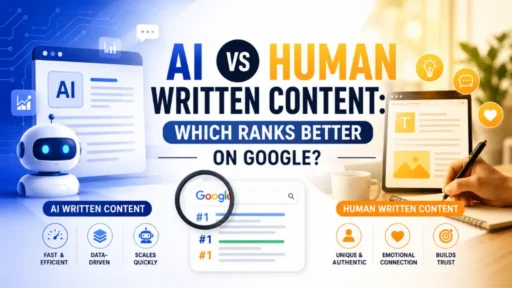

Here is the content question with the most real money riding on it in 2026: if you publish AI-written content versus human-written content on the same keyword, which one ranks higher on Google – and by how much?
AI vs human written content is no longer a theoretical debate. In 2026 we have the longitudinal ranking data to answer it with reasonable confidence, and the answer is more nuanced than either camp would like it to be.
AI vs human written content both rank, but not equally. Four independent studies across 2025 and 2026 point to the same conclusion from different methodological angles: pure, unedited AI content ranks meaningfully lower than human-written content. AI-assisted content with substantial human editorial input ranks within a few percentage points of fully human-written content. The variable that explains the gap is not who or what typed the words – it is the presence or absence of genuine expertise, original insight, and editorial judgment in the finished piece.
AI vs human written content also behaves differently at different stages of the buyer journey, across different keyword difficulty tiers, and on AI citation platforms versus traditional SERP positions. Understanding where each approach wins and where it loses is what determines whether an AI investment in content pays off or costs you organic authority.
At Search Savvy, we reviewed all four major 2026 studies on this question before structuring content workflow recommendations for clients, because the data matters more than either the optimistic or pessimistic narrative. This guide summarises what the evidence actually says.
What Does the 2026 Research Actually Say About AI vs Human Written Content?
AI vs human written content ranking performance has now been measured across multiple large-scale studies that are worth examining individually rather than as a blended average.
Study 1: The 16-Month 4,200-Article Tracking Study
AI vs human written content was tracked across 4,200 articles published between November 2024 and February 2026, covering 140 domains in 12 verticals. Key findings:
- Pure AI content ranked 23% lower on average than human-written articles across all tracked keyword difficulty tiers
- AI-assisted content with substantive human editing performed within 4% of fully human-written content on median ranking position
- Pure AI content acquired 61% fewer editorial backlinks than human-written articles on comparable topics
- The ranking gap widened after the March 2026 core update for unedited AI content
Study 2: Rankability’s 487-Page SERP Analysis
AI vs human written content at position one specifically was evaluated by Rankability’s annual study of top-ranking pages across a sample of 487 Google results. In the 2026 run, 83% of top-ranking pages read as human-written when scored by a blended AI-probability detector. There was an 80.5% probability that the number-one position was human-written, compared to 10% for purely AI-generated content.
Study 3: Addlly.ai’s Industry Workflow Survey
AI vs human written content workflow realities across 2026 SEO teams revealed:
- 86.5% of top-ranking pages contain some AI-generated content
- 64% of SEO teams use a human-led, AI-assisted workflow – the dominant model
- 72% of SEO professionals believe AI-assisted content performs as well or better than human-written content in rankings
- 70% cite faster production as the primary benefit of AI tools
Study 4: Semrush Sensor Data Post-March 2026 Update
AI vs human written content rankings shifted sharply following the March 2026 core update, which the Semrush Sensor registered as 9.5 out of 10 in volatility – affecting more than 55% of monitored sites with ranking changes within 14 days. Industry analysis suggests the update deployed a Gemini-powered semantic filter capable of evaluating content quality at the individual-article level rather than the domain level. Sites publishing original research and proprietary data saw a 22% visibility increase. Sites publishing unedited AI content saw average ranking declines.
People Also Ask: Does Google specifically penalise AI-written content? Short Answer: No. Google’s confirmed position is that it evaluates content quality and helpfulness regardless of how content was produced. What these studies show is that unedited AI content consistently fails on quality signals – original insight, editorial judgment, verifiable expertise – that drive rankings, rather than being penalised specifically for AI authorship. The mechanism is quality failure, not an AI detection penalty.
Why Does Pure AI Content Rank Lower Than Human-Written Content?
AI vs human written content ranking gaps in 2026 trace back to four specific quality dimensions where pure AI output structurally falls short of what top-ranking content demonstrates – and where human expertise is genuinely irreplaceable.
1. Experience Signals – The E in E-E-A-T
AI vs human written content differs most decisively on the Experience component of Google’s E-E-A-T framework. In 2026, this component has become the single strongest differentiator between content that earns top rankings and content that does not.
First-hand case studies, practitioner insights, original research, professional commentary based on real client work, and the specific detail that comes from having done something personally – these are signals that AI structurally cannot produce. An AI model generates what statistically follows from training data. It cannot describe what actually happened in a specific campaign, at a specific client site, in a specific market context. Only a human who was there can do that.
2. Backlink Acquisition
AI vs human written content earns editorial backlinks at dramatically different rates – 61% fewer for pure AI content, according to the 16-month tracking study. This matters enormously because backlinks remain a top-three ranking signal in 2026, and editorial backlinks require other publishers to judge a piece as worth citing.
Publishers cite content that offers original data, a unique perspective, or a specific insight they cannot find elsewhere. Generic AI content that summarises what already ranks does not provide these citing incentives, regardless of how fluently it is written.
3. Topical Depth and Originality
AI vs human written content differs on what Google’s March 2026 update specifically rewarded: content with “original research, proprietary surveys, internal data analyses, case studies with specific measurable outcomes” gained 22% visibility. Generic AI content, which largely rephrases existing top-ranking pages, cannot provide these originality signals and accordingly performs at lower positions where such signals are less essential to rank.
4. Semantic Sophistication of Google’s 2026 Evaluation
AI vs human written content is now being evaluated by a more capable Google than existed even one year ago. The March 2026 update appears to have deployed a Gemini-powered quality filter capable of evaluating individual article quality with a specificity that previous updates evaluated at domain level. This means the protection that domain authority once provided for low-quality pages on strong domains has been meaningfully reduced.
People Also Ask: Why does AI content get fewer backlinks than human-written content? Short Answer: Editorial backlinks require other publishers to judge a piece genuinely worth citing. AI content that rephrases existing information without adding original data, a first-hand perspective, or a unique angle provides no citing incentive beyond what already ranks. Human-written content that includes original research, specific case studies, or practitioner insights gives writers something to reference that they cannot generate themselves.
What Does AI-Assisted Human-Led Content Look Like in Practice?
AI vs human written content comparisons obscure the most important finding from the 2026 data: the best-performing content category is neither pure AI nor pure human, but a specific hybrid where AI handles efficiency and humans handle value.
The 64% of SEO teams using a human-led, AI-assisted workflow in 2026 are following the model that closes the performance gap between AI and human content to within 4 percentage points. What that model looks like in practice:
What AI handles in the hybrid model:
- Initial research aggregation and competitive landscape overview
- Outline generation based on research and PAA data
- First draft of sections that cover established, uncontested information
- Format adaptation for repurposing to social and email
What humans must supply:
- Original case studies, client results, or first-hand observations
- Strategic recommendations that require expertise to be credible
- Fact-checking and verification of every specific statistic and citation
- The editorial perspective and brand-specific angle that distinguishes the piece from every other content about the same topic
- Final voice, tone, and structural decisions that reflect editorial judgment
The difference between “AI-written with human proofreading” and “human-led with AI drafting assistance” sounds subtle but produces meaningfully different content. The first produces a polished AI output with corrections. The second produces human-designed content that was partially drafted by an AI.
People Also Ask: How much human editing does AI content need to rank as well as human-written content? Short Answer: The 2026 tracking data suggests that substantive human editing – adding original insight, verifying facts, restructuring around genuine expertise, and contributing brand-specific examples – brings AI-drafted content within 4% of fully human-written content in median ranking position. Surface-level proofreading that corrects typos without adding expertise or originality does not produce the same result.
AI vs Human Written Content: Which Wins by Content Type?
AI vs human written content performs differently across content categories – and this nuance is where the data becomes most actionable.
| Content Type | Recommended Approach | Why |
| Informational blog posts (low competition) | AI-assisted, human-edited | Good balance of speed and quality; originality less critical |
| Competitive informational content | Human-led, AI-supported | Backlink competition requires original insight |
| YMYL (health, finance, legal) | Human-written, expert-attributed | E-E-A-T requirements strictest in these verticals |
| Case studies and original research | Human-written | AI cannot fabricate genuine experience |
| Product pages | AI-assisted, human-edited | Conversion copy benefits from human voice and specificity |
| FAQs and structured data content | AI-assisted | Template-friendly; quality risk lower |
| Thought leadership and opinion pieces | Human-written | Value derives entirely from genuine expertise |
AI vs human written content strategy for most businesses in 2026 rationally combines both – using AI-assisted workflows for informational content at scale while reserving fully human-produced content for the high-competition, high-stakes, and experience-dependent formats where the backlink and E-E-A-T gap is most commercially significant.
What Does This Mean for AI Citation in AI Overviews and LLMs?
AI vs human written content performs differently not just in classic Google rankings but in AI Overview citations, where the bar for selection is higher still.
Content cited by ChatGPT, Perplexity, and Google AI Overviews requires strong E-E-A-T signals, clear authorship credentials, and verifiable expertise. Human- written content with visible, credentialed authors and original insight is significantly more likely to be selected by AI citation platforms than anonymous or unattributed AI-generated content.
The March 2026 update specifically rewarded original research with a 22% visibility increase – and AI citation platforms are directly incentivised to cite original, verifiable sources over generic summaries, since their own credibility depends on the quality of what they reference. For AI Overview eligibility, the quality gap between pure AI and human-expert content is wider than in traditional rankings.
How Should Indian Businesses Approach AI vs Human Written Content?
AI vs human written content strategy for Indian businesses should factor in both competitive category and the specific signals that matter most for Indian search behaviour and intent.
For Indian brands competing in high-trust categories – financial services, health and wellness, legal services, and education – the YMYL E-E-A-T requirements apply with full force, and fully human-written content with named, credentialed authors is not optional. These are exactly the categories where Google’s quality evaluators apply the strictest human review standards.
For Indian D2C and content brands competing in lower-stakes informational categories, AI-assisted workflows with genuine human editorial layers produce competitive content at a fraction of the per-piece cost of fully human production – making topical authority more achievable within realistic budget constraints.
According to Search Savvy’s insights from managing content strategies for Indian brands through the March and May 2026 core updates, the single most impactful editorial improvement for AI-drafted content is adding a specific, named case study or data point from the brand’s own experience before publishing. That addition typically doubles the time a piece takes to finalise but produces a measurably more original result that earns links and citation eligibility at a rate unedited AI content cannot match.
Conclusion: The Variable Is Expertise, Not Authorship
AI vs human written content is ultimately the wrong frame for making a content investment decision. The right frame is: does this piece demonstrate genuine expertise, contain original insight, and satisfy the reader better than competing pages – and if not, who or what needs to contribute more to make it do so?
Search Savvy builds content workflows where AI and human contribution are both assigned to the tasks they perform best – because the 4% ranking gap between AI-assisted-human-led and purely human content is a reasonable trade-off for a three-fold increase in publishing velocity, but only when the human layer is genuinely substantive rather than cosmetic.
FAQ: AI vs Human Written Content – Your Questions Answered
Q1: Does pure AI-generated content rank on Google in 2026? Yes, but at a disadvantage. The 16-month 4,200-article study found pure AI content ranking 23% lower on average than human-written articles. It can and does rank – particularly for low-competition keywords – but it structurally underperforms human content on the experience, originality, and backlink signals that determine top positions for competitive queries.
Q2: Can AI-assisted content match human-written content in rankings? Yes, within 4% on median ranking position, according to the same 16-month study. The qualifier is “substantive human editing” – meaning original insight, expert attribution, and editorial judgment applied to the AI draft, not just proofreading and grammar correction.
Q3: Which 2026 algorithm updates most affected AI vs human content rankings? The March 2026 core update had the most significant measured impact – registering 9.5 out of 10 in Semrush Sensor volatility and affecting more than 55% of monitored sites within 14 days. The update deployed what industry analysts believe is a Gemini-powered individual-article quality filter. Sites publishing original research saw 22% visibility gains; sites publishing unedited AI content saw consistent ranking declines.
Q4: Is human-written content worth the higher cost in 2026? For competitive keywords, YMYL categories, and content intended to earn editorial backlinks and AI citations, yes – the ranking and link acquisition gap justifies the cost differential. For low-competition informational content where speed and topical coverage matter more than originality, a well-supervised AI-assisted workflow produces a better cost-to-performance ratio.
Q5: What content types should never be written purely by AI? Case studies and original research, thought leadership and opinion pieces, YMYL content in health, finance, or legal categories, and any content where first-hand experience is the core value proposition. These formats depend on genuine expertise that AI cannot structurally produce – and their ranking performance reflects that dependency directly.
Q6: How is AI citation eligibility different from traditional Google ranking? AI citation platforms including ChatGPT, Perplexity, and Google AI Overviews apply a higher standard for source selection than traditional SERP ranking algorithms. They specifically prioritise verifiable expertise, clear author credentials, and original insight – making the E-E-A-T gap between pure AI content and human-expert content wider for AI citation eligibility than it is for traditional rankings.
Producing content with AI tools and unsure whether your editorial process is substantive enough to rank competitively – or wondering whether a shift in your content workflow could close the performance gap? Visit Search Savvy for a content quality audit that evaluates your current content against 2026 E-E-A-T and editorial standards.