

Marketers no longer debate whether to use AI in 2026 – they debate which tool to open for which specific task. All three major platforms cost roughly the same at the entry tier, all three can draft an email or summarise a document, and on the surface they can look nearly interchangeable. The differences only become clear once you compare them task by task.
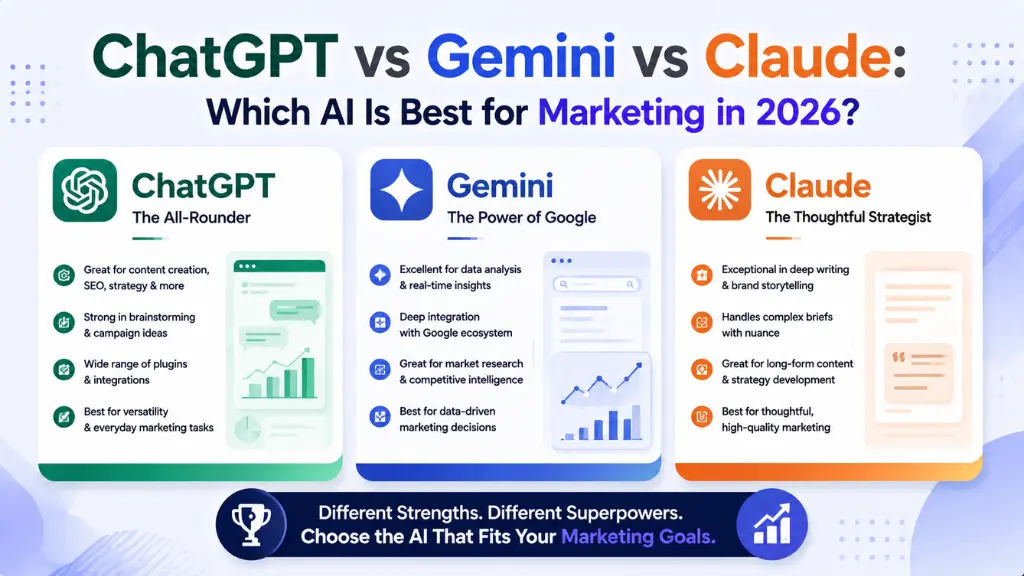
ChatGPT vs Gemini vs Claude breaks down cleanly once tested head-to-head. In a blind test of 134 participants rating outputs across eight prompt types with brand names removed, Claude won four of the eight rounds – with its largest margins in writing-focused categories – while ChatGPT won the structured business strategy round, and Gemini placed consistently without leading any single category, according to The AI Report’s 2026 comparison.
At Search Savvy, we help marketing teams figure out which tool actually fits which part of their workflow, rather than betting everything on one platform. This guide breaks down ChatGPT vs Gemini vs Claude across the marketing tasks that matter most, using current 2026 data.
How Does ChatGPT vs Gemini vs Claude Differ for Long-Form Content Writing?
ChatGPT vs Gemini vs Claude shows its clearest, most consistent gap in long-form writing quality, where Claude has repeatedly come out ahead across independent testing.
Claude is generally strongest for long-form writing, nuanced tone control, and brand-safe content where accuracy matters, according to Insidea’s 2026 digital marketing comparison. For agencies managing multiple brand voices specifically, Claude’s instruction-following and context retention are more reliable in most cases, per the same source. When given a brief specifying tone, a hard character limit, structure, and natural keyword placement, Claude tends to hold those constraints more reliably than its competitors, according to 5Day’s 2026 task-level marketing comparison.
ChatGPT still has a defined role in this workflow, particularly for the planning stage. ChatGPT handles SEO briefs and structured outlines more reliably, while Claude produces better prose once the structure is set – many marketers use ChatGPT to build the brief and Claude to write the draft, then edit the result, according to Okara’s 2026 marketing AI comparison.
People Also Ask: Which AI is best for writing long-form blog content in 2026? Short Answer: Claude has shown the strongest, most consistent performance in blind testing for long-form writing and tone control, particularly for content requiring precise brand voice and constraint-following. Many marketers use ChatGPT to build the structural brief first, then switch to Claude for the actual draft.
Which Tool Wins for High-Volume Content Production and Integrations?
ChatGPT vs Gemini vs Claude shifts in ChatGPT’s favour once the priority becomes breadth, third-party integration, and producing content at genuine scale across multiple formats.
ChatGPT is widely used for GPT-based workflows, Actions, and integrations for volume-based content production, and it has the broadest ecosystem of third-party integrations and plugins of the three, according to The AI Report’s 2026 analysis. It performs well for high-volume, multiformat production and data work, especially through reusable GPT workflows, according to Insidea’s 2026 comparison.
For marketing teams specifically, ChatGPT’s ecosystem advantage extends into practical automation. Teams can build custom GPTs for brand voice assistants, SEO brief generators, social copy tools, and ad copy frameworks, then connect ChatGPT to broader marketing tools via Zapier, Make, or the OpenAI API to build automated content pipelines, according to the same Insidea 2026 analysis.
People Also Ask: Is ChatGPT better than Claude for producing content at scale? Short Answer: For high-volume, multiformat production connected to broader marketing automation, ChatGPT generally has the advantage due to its broader third-party integration ecosystem and reusable GPT workflows. For quality-first, brand-voice-critical writing, Claude tends to perform more reliably.
Why Does Gemini Have an Advantage for Google-Tied Marketing Workflows?
ChatGPT vs Gemini vs Claude tips clearly toward Gemini whenever a marketing task is directly tied to Google’s own ecosystem of tools – this is a structural advantage the other two platforms cannot fully replicate.
Gemini connects directly with Google’s ecosystem – Search Console, Analytics, Docs, Ads, and YouTube, where supported – giving it a structural proximity advantage over Google’s systems that other tools do not have, according to Insidea’s 2026 report. For market analysis, competitive intelligence, news monitoring, or fact-checking – anything where recency of information matters – Gemini has a structural advantage that model quality alone cannot overcome, according to TechJournal’s 2026 comparison.
Gemini also leads clearly on multimodal and context-window capacity. While ChatGPT and Claude handle images competently, only Gemini natively processes video, audio, text, and images within a single unified model, according to LearnDrive’s 2026 deep comparison. Gemini’s massive context window is decisive specifically for research-heavy workflows requiring cross-document analysis – for example, synthesising findings across dozens of competitor websites at once – according to Improvado’s 2026 marketing comparison.
People Also Ask: Is Gemini the best choice for SEO and Google Ads workflows specifically? Short Answer: Often, yes, given its direct integration with Search Console, Analytics, Docs, and Ads. This structural proximity to Google’s own systems gives Gemini a genuine advantage for SEO and Google-tied marketing tasks that Claude and ChatGPT cannot fully replicate.
How Do Context Windows Actually Affect Marketing Use Cases?
ChatGPT vs Gemini vs Claude comparisons often cite raw context window size as a headline statistic, but the practical marketing impact depends heavily on the specific task, not just the number itself.
Claude’s context window delivers consistent quality throughout – information at the beginning of a long document is referenced just as accurately as information near the end – while a larger context window like Gemini’s can be impressive on paper but degrade in quality at extreme lengths, according to TechJournal’s 2026 testing. For most single-document marketing tasks – a content brief, a landing page, a single competitor teardown – this difference is largely academic, since none of the platforms’ standard limits are the bottleneck.
Where context window size becomes genuinely decisive is research-heavy, multi-document work. Improvado’s 2026 analysis describes a real workflow example: a marketer processing roughly 800 pages across 12 competitor websites switched to Gemini specifically for its context capacity, then copied key findings back into Claude for a more concise, polished rewrite – illustrating how the two tools can complement rather than compete with each other.
People Also Ask: Does a bigger context window automatically mean better marketing output? Short Answer: Not necessarily. Raw context window size matters most for research-heavy, multi-document tasks. For single-document writing tasks like a blog post or landing page, context window size is rarely the limiting factor, and output quality and consistency matter more.
How Should You Choose a Tool Based on Team Size and Workflow?
ChatGPT vs Gemini vs Claude decisions should ultimately be driven by which tool touches your highest-volume workflow, rather than an abstract judgment about which platform is “smartest” overall.
A practical decision rule that holds up across 2026 comparisons: choose ChatGPT if your team needs one broad AI assistant across many different tasks; choose Claude if your bottleneck is long documents or polished, brand-consistent writing; choose Gemini if your team already lives inside Google Workspace, according to Layer3 Labs’ 2026 small business guide. For marketing teams specifically, this often breaks down further by task: ChatGPT for campaign variants and volume production, Gemini for Workspace-native content, and Claude for polished, long-form writing, per the same source.
At the standard $20/month tier, all three platforms now offer access to their flagship model capability, meaning the meaningful differentiation for most marketing teams sits in workflow fit, not raw price, according to AI Buzz’s 2026 business comparison. Using two of the three tools together, at roughly $40/month combined, remains less expensive than a single mid-market SaaS subscription while covering nearly every professional marketing use case with the best available tool for each one, per the same analysis.
People Also Ask: Should a marketing team pick just one AI tool, or use more than one? Short Answer: Most experienced marketing teams end up using two of the three tools, assigning each to the task it handles best. Running two tools together typically costs around $40/month combined – still less than many standalone marketing SaaS subscriptions.
What Does This Mean for Marketing Teams in India Specifically?
ChatGPT vs Gemini vs Claude decisions carry a practical Indian dimension too, particularly for agencies and marketing teams already embedded in specific software ecosystems.
According to Search Savvy’s insights from working with Indian marketing teams across agencies and in-house departments, the choice often comes down to existing tool stack rather than pure capability comparison. Teams already running Google Workspace and Google Ads at scale tend to see faster, friction-free adoption with Gemini, while teams prioritising polished client-facing content and brand voice consistency across multiple accounts often lean toward Claude for the actual writing stage.
At Search Savvy, we recommend most growing marketing teams start with one tool matched to their single highest-volume task, learn its genuine limits over a few weeks, then add a second tool specifically where the first one falls short – rather than committing to a single platform based on general reputation alone.
FAQ: ChatGPT vs Gemini vs Claude for Marketing
Q1: Which AI tool is best for a small marketing team with a limited budget? A: ChatGPT is often recommended as the best default single tool for small teams, given its broad flexibility across tasks like customer reply drafts, marketing content, research summaries, and spreadsheet analysis, without needing multiple subscriptions immediately.
Q2: Is Claude better than ChatGPT for SEO content writing specifically? A: For the actual writing stage – tone, structure, readability – Claude generally performs more reliably. ChatGPT often handles the earlier brief and outline stage well, making a combined workflow common among experienced marketing teams.
Q3: Does Gemini’s integration with Google tools actually matter for most marketers? A: Yes, significantly, if your marketing operations already run through Google Ads, Analytics, Search Console, or Workspace. The advantage narrows considerably for teams not deeply embedded in Google’s ecosystem.
Q4: Are all three AI platforms roughly the same price in 2026? A: At the standard consumer tier, yes – all three cost approximately $20 per month for their flagship model access. Meaningful price differentiation shows up mainly at higher usage tiers and in API pricing for developers building custom workflows.
Q5: Can one AI tool completely replace a marketing team’s need for the other two? A: Rarely in practice. Most experienced marketing teams end up using at least two of the three platforms, assigning each to the specific task it performs best, since no single tool has led in every tested marketing category.
Q6: How often should a marketing team re-evaluate which AI tool they use? A: Fairly regularly, given the pace of model updates in 2026. All three providers have shipped significant capability updates throughout the year, meaning a comparison from six months ago may no longer reflect current performance.
Want help building an AI workflow strategy for your marketing team? Visit Search Savvy to speak with an expert who can match the right tool to each stage of your content and campaign process.