
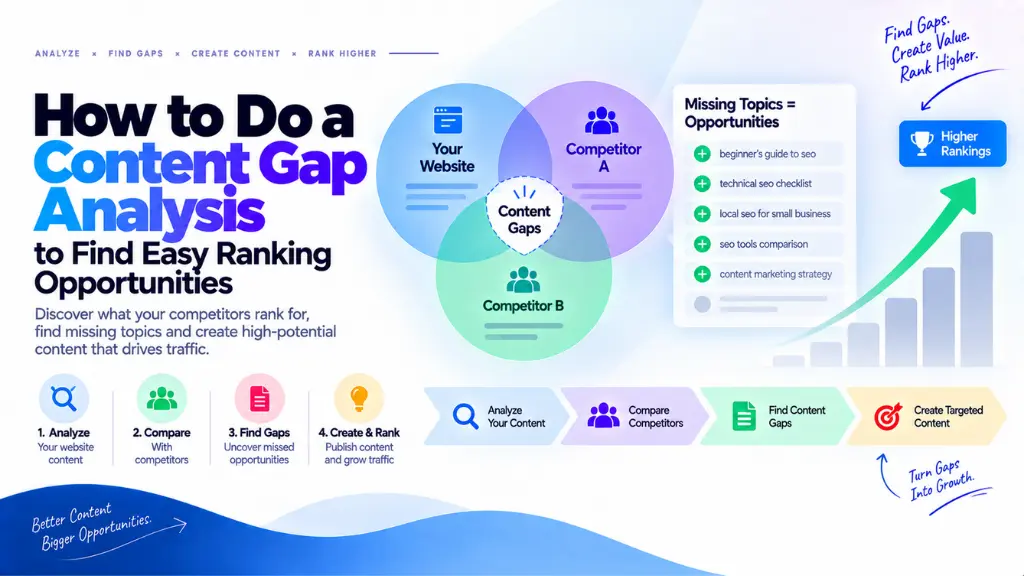

Most sites don’t lose rankings because their content is bad – they lose them because entire topics, subtopics, and questions were never covered in the first place. A content gap analysis is how you find those blind spots systematically, instead of guessing at what to publish next based on a brainstorm or a competitor’s most recent post.
This article walks through what a content gap analysis actually is, the four types of gaps worth checking (keyword, depth, format, and AI-citation), the tools and filters that separate a genuine opportunity from a list of ten thousand keywords nobody should target, and how to turn the output into a prioritized content plan rather than a spreadsheet that never gets actioned.
What Is a Content Gap Analysis?
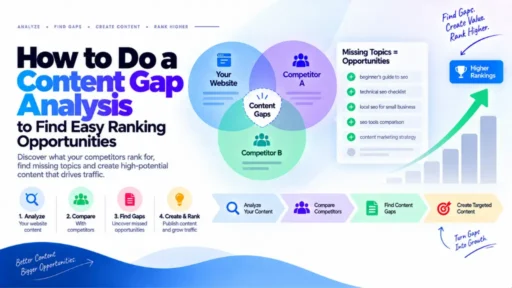
A content gap analysis is the process of comparing your existing content against competitors’ content and your audience’s actual search behavior to find topics, keywords, and subtopics you haven’t covered – or haven’t covered thoroughly enough to rank. The output isn’t a list of missing keywords alone; it’s a prioritized map of where your site is absent, where existing pages are too thin to compete, and which of those gaps are worth the effort to close.
The scale of the opportunity is larger than most teams assume, which is why Search Savvy treats gap analysis as a recurring diagnostic rather than a one-time exercise. A large share of pages on the web never earn meaningful organic visibility, and a substantial portion of that failure traces back to topics or subtopics that were never covered in enough depth to rank in the first place – not to poor writing on pages that do exist.
Why Does Content Gap Analysis Matter in 2026?
A content gap is no longer just a missing keyword in Google. It’s also a missing citation in ChatGPT, an absent brand in Perplexity’s answer, or a topic Gemini skips over entirely when assembling a response. Semrush’s research on AI search visibility found that when ChatGPT cites a webpage, that page ranks in traditional organic positions 21 or lower for the related query almost 90% of the time – meaning a page can be genuinely competitive for AI citation even while sitting well outside Google’s first two results pages. That changes what “closing a gap” means: it’s not only about climbing to position one, it’s about giving AI systems something structured and citable to draw from at all.
The Four Types of Content Gaps
Most teams stop at keyword gaps and miss three other categories that often hold the easier wins.
| Gap Type | What It Reveals | How to Find It |
| Keyword gap | Terms competitors rank for that you don’t | Ahrefs Content Gap, Semrush Keyword Gap |
| Depth gap | Pages where you rank but only weakly (positions 5–20) | Google Search Console performance report |
| Format gap | Competitors win with a format you haven’t tried (comparison, calculator, video) | Manual SERP review of top-ranking pages |
| AI-citation gap | Competitors get cited in AI Overviews or ChatGPT for a query you don’t appear in | Manual query testing across AI answer engines |
A keyword-only analysis leaves the other three categories – often the ones with the least competition – completely unexamined.
Step 1: Identify Your Real Competitors
Before running any tool, define who you’re actually competing against for visibility, which isn’t always the same as who you compete against for business. A content competitor is any site ranking for your target keywords, whether or not it sells anything resembling what you sell – a software company’s blog can easily outrank a specialized agency for a shared keyword. The most reliable way to build this list is a “competing domains” or “organic competitors” feature inside an SEO tool, which surfaces sites ranking for the largest number of keywords you also care about, rather than relying on instinct about who your business rivals are.
Step 2: Run the Keyword Gap Report
With three to five real content competitors identified, run a keyword gap comparison in a tool like Ahrefs’ Content Gap or Semrush’s Keyword Gap feature – validating what you find against proper keyword research rather than the tool’s raw volume estimates alone. Enter your domain alongside the competitor domains, and the tool returns every keyword where at least one competitor ranks and you don’t – often producing a raw list running into the thousands, which is far too large to act on directly.
How Do You Filter a Content Gap Report Down to Real Opportunities?
Filter for search intent that matches your business goals first, then for keywords where multiple competitors rank rather than just one, and finally for weak competing content – pages that are outdated, thin, or come from forums rather than structured articles. These three filters typically cut a raw keyword export by 80% or more while keeping the terms most worth targeting.
Three filters do most of the work:
- Intersection of multiple competitors. A keyword where three or more competitors rank is a stronger demand signal than one where a single competitor happens to rank.
- Search intent alignment. Filter out purely informational terms if your immediate goal is commercial or transactional traffic, and vice versa if you’re building topical authority first.
- Weak-ranking competitors. Keywords where the current top results are outdated articles, forum threads, or thin aggregator pages represent the easiest wins – a well-structured, current article can outrank them without needing exceptional domain authority.
Step 3: Find Depth Gaps With Search Console
Not every gap is a page you’re missing entirely – some are pages you already have that just aren’t ranking well enough to matter. Google Search Console’s performance report, filtered to queries where your average position sits between roughly 5 and 20, surfaces exactly this category. These are typically the cheapest gaps to close, because you’re expanding or restructuring an existing page rather than building topical authority from zero.
Step 4: Audit the Competitive Bar, Not Just the Keyword List
For each high-priority gap, look past the keyword and examine what’s actually ranking. Note the content format (guide, comparison, calculator, video), the depth of coverage, whether the page uses original data or expert commentary, and how it handles internal links to related content – the kind of structured review Search Savvy runs as part of a broader website audit. This step is what separates a real gap analysis from a keyword export – it tells you what a competitive page in this space actually needs to include, not just what term to target.
Step 5: Check the AI-Citation Layer
Test your priority queries directly in ChatGPT, Perplexity, and Google’s AI Overviews, and note whether competitors are cited and you aren’t. A page can rank respectably in classic organic search and still be invisible in AI-generated answers, because these systems often draw from pages ranking well outside the top few organic positions rather than strictly following classic rank order. Closing this gap generally means restructuring content around direct, answer-first paragraphs and clear definitions rather than chasing a higher organic position alone – the kind of structural work covered under AI search optimization for AEO and GEO.
Step 6: Prioritize – Don’t Try to Fill Every Gap at Once
A raw gap analysis on a mid-size site can easily surface more opportunities than any team can execute in a year. Prioritize using three factors together rather than any one alone:
- Search volume – how much demand actually exists for the term.
- Competition difficulty – how hard the current top-ranking pages will be to outrank.
- Business fit – whether the topic aligns with what you actually sell or want to be known for.
A high-volume keyword with weak competing content and strong business fit is a genuine easy win. A high-volume keyword dominated by entrenched, high-authority pages with no obvious content weakness usually isn’t worth the effort relative to other gaps on the list – chasing it wastes the exact prioritization discipline the analysis was supposed to create.
Step 7: Build the Content Plan
Once gaps are prioritized, map each one to a specific format, assign ownership, and set realistic timelines. A tool-assisted gap analysis on a mid-size site typically takes several hours for the research step and a similar amount of time to translate findings into a content plan, while enterprise-level analysis spanning multiple stakeholders and site sections can take considerably longer. Whatever the timeline, the output should be a prioritized list mapped to formats and owners – not a spreadsheet of keywords that never becomes a publishing calendar.
New content created from a gap analysis also creates natural internal linking opportunities, since a page built to fill a specific subtopic gap usually belongs inside an existing topic cluster rather than standing alone.
Common Mistakes
- Treating the raw keyword export as the plan. A ten-thousand-row spreadsheet isn’t a strategy; it’s raw material that still needs intent, competition, and business-fit filters applied.
- Stopping at keyword gaps and ignoring depth, format, and AI-citation gaps. These often hold the least-contested opportunities precisely because most teams never check them.
- Choosing gaps by search volume alone. A high-volume term with entrenched, high-authority competitors rarely justifies the effort compared to a lower-volume term with weak competing content.
- Analyzing without auditing the competitive content itself. Knowing a keyword exists tells you nothing about what format or depth is required to actually compete for it.
- Running the analysis once and never repeating it. Competitors publish continuously, and last year’s gap list is stale within a few months on any actively competitive topic.
- Filling gaps without a plan for internal linking. New content built from a gap analysis needs to connect into existing pages, or it risks becoming an orphaned page that never gets discovered or ranks on its own.
Search Savvy treats gap analysis as a recurring input into content planning rather than a one-time audit, which is a large part of how a content strategy and topical authority program stays current as competitors and AI answer engines both keep moving.
Frequently Asked Questions
What tools are best for content gap analysis? Ahrefs Content Gap and Semrush Keyword Gap are the standard paid options for competitor keyword comparisons, while Google Search Console is free and specifically useful for finding depth gaps – pages you already have that rank weakly rather than pages you’re missing entirely.
How many competitors should I analyze? Three to five real content competitors is typically enough. More than that produces diminishing returns and a keyword list too large to prioritize effectively.
Is content gap analysis only about keywords? No. A complete analysis also checks depth gaps (pages ranking weakly), format gaps (competitors winning with a format you haven’t tried), and AI-citation gaps (competitors appearing in AI Overviews or ChatGPT answers where you don’t).
How often should a content gap analysis be repeated? For actively competitive topics, quarterly is a reasonable baseline. Competitors publish continuously, and a gap analysis that’s a year old often no longer reflects the current competitive landscape.
Does ranking well in Google guarantee visibility in AI search? No. Research from Semrush found that pages ChatGPT cites frequently rank outside the top 20 organic positions for the related query, meaning strong organic rank and strong AI-citation visibility don’t always move together.
What’s the difference between a keyword gap and a depth gap? A keyword gap is a term you don’t rank for at all. A depth gap is a term where you do rank, typically in positions 5 through 20, but the page isn’t comprehensive or well-optimized enough to compete for the top positions.
Bottom Line
A content gap analysis works because it replaces guesswork with evidence: instead of brainstorming what to publish next, you’re looking directly at what your audience is searching for, what competitors have already validated as worth ranking for, and where the current competitive bar is genuinely low enough to clear. The teams that get the most out of this process treat it as a recurring input into their editorial calendar, checking all four gap types rather than keywords alone, and prioritizing by business fit and competition difficulty rather than search volume in isolation. Do that consistently, and the “easy ranking opportunities” in the title stop being a one-time find and start being a steady pipeline.