

Here is the question every content marketer asks eventually: are all those likes, comments, and shares on social media actually doing anything for my Google rankings, or am I just collecting vanity metrics?
Social signals – the measurable engagement interactions content receives across social platforms – sit at the centre of one of digital marketing’s most persistent debates. And in 2026, the debate has enough evidence on both sides to be genuinely confusing if you only look at one half of the picture.
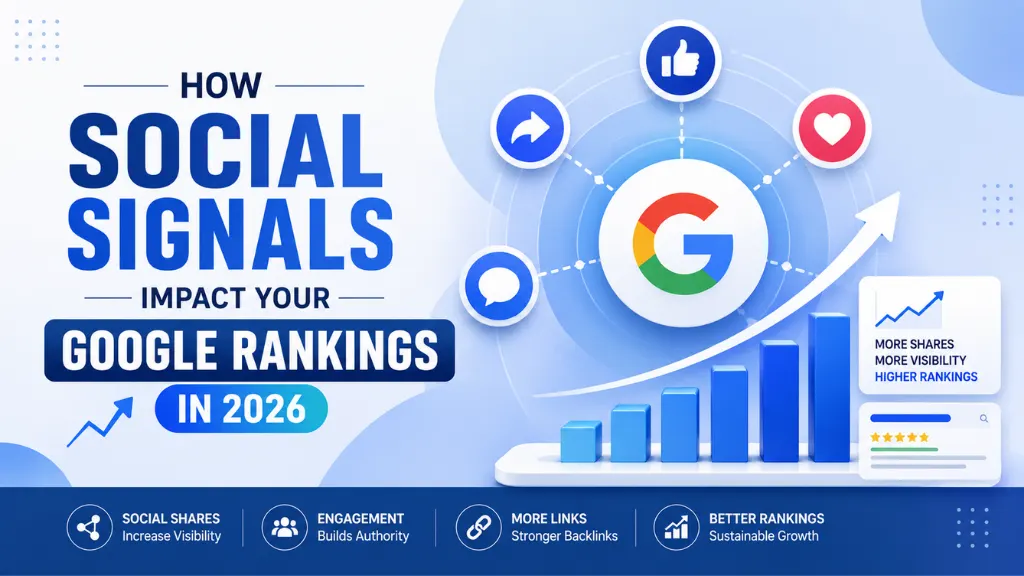
Social signals are not direct Google ranking factors. This is confirmed and documented, and pretending otherwise leads to misallocated effort. But social signals set off a chain reaction – across content discovery, backlink acquisition, branded search, and user engagement – that absolutely affects the factors Google does use to rank pages.
Social signals matter even more in 2026 because AI-powered search systems, including Google AI Overviews, are now evaluating broader patterns of brand authority, cross-platform credibility, and entity recognition when selecting sources to cite. Social signals contribute to all three, and brands ignoring social media are quietly weakening their eligibility for the AI-driven surface that now appears above organic results for over half of all search queries.
At Search Savvy, we build social signals into content strategy from the start – not because likes rank pages, but because the downstream effects of genuine social engagement compound into the ranking signals that matter. This is exactly how it works.
What Are Social Signals in SEO?
Social signals are the quantifiable engagement interactions that content receives across social media platforms – likes, shares, comments, reposts, saves, brand mentions, and follows. In the context of SEO, social signals refer specifically to how these engagement patterns are interpreted by or influence search engine ranking systems.
Social signals exist on a spectrum from highly visible (a viral LinkedIn post shared 500 times) to quietly influential (consistent brand mentions in niche industry communities). Their SEO relevance lies not in the numbers themselves, but in what those numbers trigger – content discovery, link opportunities, branded search, and engagement quality on the receiving website.
People Also Ask: What are social signals in SEO? Short Answer: Social signals are measurable engagement interactions that content receives on social media platforms – shares, likes, comments, saves, and brand mentions. In SEO, they are not direct ranking factors but act as indirect drivers of ranking-relevant outcomes including backlink acquisition, branded search volume growth, and content discovery speed.
Are Social Signals a Direct Google Ranking Factor?
Social signals as direct ranking factors has been explicitly addressed by Google. John Mueller and Gary Illyes have both confirmed, across multiple statements over the past decade, that social engagement metrics are not part of Google’s ranking algorithm.
Two structural reasons explain why Google does not use social signals directly:
Crawl access: Googlebot cannot access most social media content. Facebook, Instagram, and LinkedIn block search engine crawlers from indexing the majority of posts and profiles. Signals from content Google cannot read cannot be incorporated into ranking calculations.
Manipulation risk: Social metrics are easily and cheaply manipulated. Like counts, share counts, and follower numbers can be purchased in bulk from low-quality sources, making them too unreliable to incorporate as quality signals without being immediately gamed. Google’s ranking systems are specifically designed to resist manipulation, and social metrics fail that bar.
The correlation between high social share counts and high Google rankings – a pattern that studies consistently find – is explained by content quality. Excellent content earns social shares. Excellent content also earns the editorial backlinks and user engagement that rank pages. The content quality explains both outcomes; the social shares do not cause the rankings.
People Also Ask: Can buying social signals improve Google rankings? Short Answer: No, and doing so is a waste of budget. Purchased likes, shares, and followers are not processed by Google’s ranking algorithm. They may inflate visible engagement numbers but generate no editorial backlinks, no genuine branded search volume, and no real user engagement – the three outcomes that do influence rankings indirectly. Purchased social signals also risk damaging platform credibility if detected.
How Do Social Signals Influence Google Rankings Indirectly?
Social signals are more accurately described as ranking catalysts than ranking factors. They trigger a chain of downstream effects that each connect to signals Google does use. Understanding each link in that chain is what makes social media a strategic SEO investment rather than a brand awareness afterthought.
Social Signals Drive Editorial Backlink Discovery
Social signals generate their most direct SEO impact through backlink acquisition. When content achieves wide social distribution – shared across LinkedIn, quoted in X threads, embedded in YouTube breakdowns – it reaches an audience that includes writers, journalists, bloggers, and researchers who would not have discovered it through organic search alone. Some of those people publish references to the content, creating the editorial backlinks that are confirmed ranking factors.
The chain is: social signal → content discovery → editorial mention → backlink → ranking impact. The social signal begins the sequence; the backlink is what Google actually measures. Critically, this process cannot be replicated by simply building backlinks without social distribution – the discovery step is what makes the link acquisition organic and sustainable.
Social Signals Build Branded Search Volume
Social signals build brand familiarity through repeated exposure. Audiences who encounter a brand’s content on multiple platforms over time develop a recognition that eventually translates into intentional branded searches – searching the brand name directly on Google rather than finding it through generic keywords.
Branded search volume is a meaningful quality signal in Google’s ranking systems. A brand generating consistent branded searches is treated as a recognised, trusted entity in its category. This entity recognition influences rankings on both branded and non-branded queries, and it grows in direct proportion to the consistency and quality of social presence over time.
Social Signals Accelerate Content Indexation
Social signals speed up Googlebot’s discovery of new content. When a page is shared across social platforms immediately after publication, it generates external traffic and link references that signal to Google a new resource worth crawling exists. For competitive niches where timing matters – where being indexed and ranking a week faster than a competitor is meaningful – social distribution is the fastest available content discovery accelerator.
Tracking data confirms the mechanism: a spike in social referral traffic followed by a ranking movement within 7 to 14 days is a reliable pattern in campaigns where social distribution is intentional rather than incidental.
Social Signals Generate Quality Engagement Data
Social signals drive referral traffic, and the behaviour of that traffic on the receiving website contributes to user engagement signals that Google uses through mechanisms including NavBoost. Visitors arriving from social media who read the full article, visit additional pages, and return to the site on subsequent sessions contribute positive engagement data. Visitors who bounce in three seconds contribute negative data.
This means social signals are not equally valuable – they are only as good as the audience they send. A LinkedIn post targeting a professionally relevant audience that generates 200 highly engaged visitors is worth significantly more to SEO than an Instagram ad generating 2,000 visitors who leave without reading a sentence.
People Also Ask: How do social signals affect user engagement and SEO? Short Answer: Social platforms send referral visitors to your site. The behaviour of those visitors – time on page, pages per session, return visits – contributes to user engagement signals that Google incorporates through its ranking systems. High-quality social traffic that stays and engages improves engagement signals. Low-quality social traffic that immediately bounces can harm them. Social signal quality is determined by audience relevance, not by volume.
Which Social Platforms Generate the Most Valuable Social Signals for SEO?
Social signals from different platforms carry different types of SEO value, and understanding which platform contributes which outcome helps focus effort where it compounds most efficiently.
| Platform | Primary SEO Value | Google Visibility |
| Backlink discovery, professional branded search, E-E-A-T | Content indexes in Google search directly | |
| YouTube | Direct rankings on Google, second-largest search engine | Videos rank in Google web and image search |
| X (Twitter) | Fastest indexation acceleration, journalist discovery | Limited direct indexation |
| Branded search growth, broad audience awareness | Public professional accounts indexable | |
| Image-based referral traffic, long-tail visual search | Pins rank in Google image search | |
| Community credibility, editorial link sourcing | Reddit threads frequently rank in top results |
Social signals from LinkedIn are the most direct connector to editorial backlinks for B2B and professional content. When thought leadership content gains genuine traction on LinkedIn among industry professionals, the secondary effect of writers and editors discovering and citing it is consistent and measurable.
Social signals from YouTube are uniquely valuable because YouTube is simultaneously a social platform and a search engine – one where content can rank directly in Google search results, making YouTube SEO a parallel ranking opportunity entirely distinct from the indirect social signal effects that apply to other platforms.
Why Are Social Signals More Important for AI Search Visibility in 2026?
Social signals contribute to AI search visibility in 2026 through a mechanism that did not exist at the same scale two years ago: entity recognition.
Google’s AI Overviews and AI-powered ranking systems evaluate broader patterns of brand credibility – cross-platform presence, consistent topic expertise, and community recognition – when determining which sources to include in AI-generated answers. A brand generating genuine social signals across multiple platforms is building the kind of entity-level authority these systems reward.
Social signals appearing across LinkedIn, YouTube, and relevant niche communities collectively tell AI systems: this brand is recognised by real people as authoritative on this subject. That entity signal is one of the factors AI search systems use when selecting which sources to cite – and it is built through years of consistent social presence rather than any single viral moment.
Reddit deserves specific attention in 2026 as an AI signal. Reddit threads rank directly in Google results for an enormous range of queries, and AI systems including Google’s own Gemini frequently cite Reddit as a source in AI Overviews. A brand with a genuine, helpful presence in relevant subreddits is building AI visibility through community social signals that no amount of backlink building replicates.
What Are the Biggest Mistakes Around Social Signals and SEO?
Understanding social signals clearly also means avoiding the errors that waste time and occasionally cause active harm.
Buying social signals: Purchased likes, shares, and followers generate zero SEO value. They produce none of the downstream effects – backlinks, branded searches, quality engagement – that influence rankings. They waste budget and can damage platform account standing.
Treating follower count as an SEO KPI: Follower count does not translate to SEO benefit. An account with 500 highly engaged followers in a specific niche who regularly click, share, and cite content generates more SEO value than an account with 50,000 passive followers who never interact.
Ignoring social because “it doesn’t directly affect rankings”: The indirect effects are real, measurable, and compound over time. Brands that ignore social media are closing the top of the funnel that feeds backlink discovery, branded search growth, and entity recognition simultaneously.
Running social and SEO as separate silos: The highest compounding value comes from aligning social content with SEO keyword strategy – publishing social content around the same topics targeted in organic search so that branded and non-branded search volume rise in tandem.
How Should Indian Brands Approach Social Signals for SEO?
Social signals for Indian brands carry particular weight through YouTube and LinkedIn, since both platforms produce content that ranks directly in Google search results – creating a more direct social-to-ranking pathway than most other platforms.
Social signals for Indian local and D2C businesses are amplified by the depth of Google Business Profile activity alongside social presence. A consistent social presence combined with active GBP management – posts, reviews, Q&A responses – presents a richer entity picture to Google’s local ranking systems than either channel delivers independently.
According to Search Savvy’s insights from managing social-SEO integrations for Indian SMB and professional services clients, the consistently highest-performing approach is a three-platform strategy: YouTube for direct ranking potential, LinkedIn for professional credibility and backlink discovery, and Instagram for branded search volume growth through consistent audience recognition.
Conclusion: Social Signals Are Ranking Catalysts, Not Ranking Factors
Social signals do not rank pages. They catalyse the process through which pages earn the signals that do rank them – backlinks, branded search, engagement quality, and entity recognition. That distinction matters practically, because it changes what you optimise for: genuine audience engagement that triggers downstream effects, not vanity metrics that stop at the like button.
Search Savvy integrates social signal strategy into every comprehensive SEO engagement because the brands building durable organic visibility in 2026 are consistently the ones treating social and search as a connected system rather than parallel channels with separate goals.
FAQ: Social Signals and Google Rankings – Your Questions Answered
Q1: Are social signals a direct Google ranking factor in 2026? No. Google has confirmed consistently that likes, shares, comments, and follower counts are not part of its ranking algorithm. The correlation between high social engagement and high rankings is explained by content quality – excellent content earns both social shares and the editorial backlinks that influence rankings. The social shares themselves do not cause the ranking improvements.
Q2: Which social platform sends the most SEO value? LinkedIn and YouTube generate the most direct SEO value in 2026. LinkedIn content indexes in Google search and drives backlink discovery among professional audiences. YouTube videos rank directly in Google web search and function as a parallel search engine. The “best” platform depends on your audience and content type, but these two consistently produce the most measurable SEO downstream effects.
Q3: How quickly do social signals affect SEO performance? Indirectly and with a lag. Indexation acceleration effects appear within days of social distribution. Backlink acquisition from social-driven discovery builds over 4 to 8 weeks. Branded search volume growth from sustained social activity is measurable over 30 to 90 days. Entity recognition improvements from consistent cross-platform presence compound over 6 to 12 months.
Q4: Do social media links pass link equity to my website? No. Almost all major social platforms apply nofollow attributes to outbound links, meaning they do not pass PageRank to the linked pages. The SEO link value of social media comes from editorial links that third parties create after discovering content through social distribution – not from the social platform links themselves.
Q5: Should I optimise my social profiles for SEO? Yes. Social profiles frequently appear in Google search results for branded queries, giving you additional control over what users see when they search for your brand. Consistent brand name, URL, and category description across all platforms strengthens entity recognition. LinkedIn and YouTube profiles in particular can rank for professional and brand queries alongside your main website.
Q6: Do social signals affect AI Overview citations in 2026? Yes, indirectly. AI systems including Google AI Overviews evaluate brand entity recognition and cross-platform authority as factors in source selection. Brands with consistent, substantive social presence across relevant platforms – particularly LinkedIn, YouTube, and community platforms like Reddit – demonstrate the kind of entity-level credibility that AI systems favour when selecting citation sources.
Not sure whether your current social activity is generating the downstream SEO effects that actually compound into rankings – or whether social and SEO are being managed as separate silos that could be delivering more together? Visit Search Savvy for an integrated social and SEO audit that maps the specific signals your content is currently generating and missing.