What Is a Content Silo and How to Structure One for SEO?
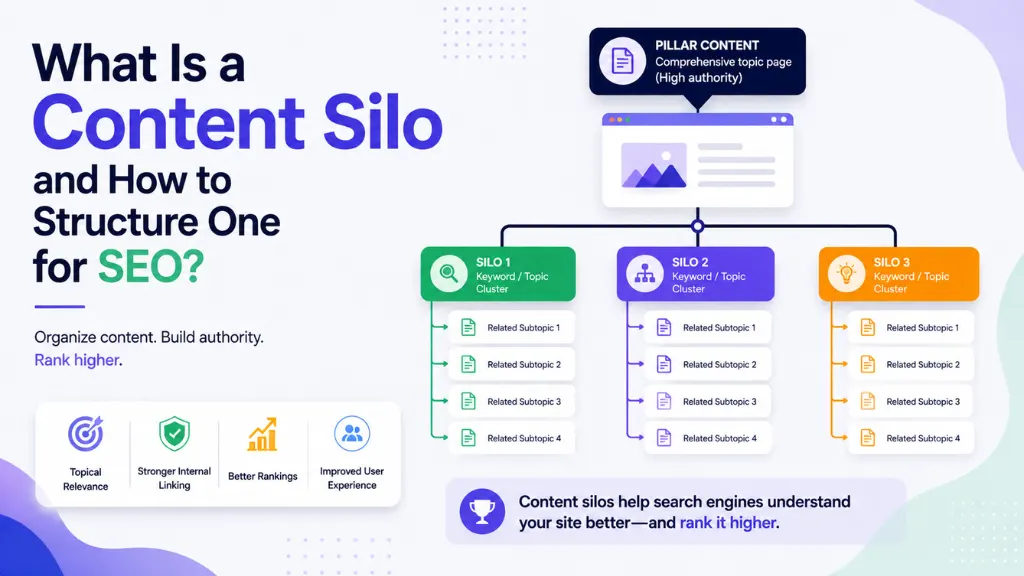

Most websites grow the same way: someone writes a blog post when inspiration strikes, links it to whatever feels relevant at the time, and repeats that process for years without a plan. The result is a pile of content that Google struggles to make sense of – because nothing tells it which pages belong together.
In this article8 sections
A content silo is the fix for exactly this problem. It groups related content into a clear, interlinked structure so search engines can easily identify your site as an authority on specific topics, according to GitNexa’s 2026 content silo guide. When Google sees a cluster of interlinked pages all addressing different aspects of the same subject, it becomes far easier to assign topical relevance and trust to your site.
At Search Savvy, restructuring a client’s existing content into proper silos is one of the highest-leverage SEO fixes we make, because most sites already have the content – it just is not organized in a way Google can reward. This guide breaks down exactly what a content silo is, how it differs from a topic cluster, and how to build one correctly in 2026.
What Is a Content Silo, Exactly?#
A content silo is a way of organizing your website so that all the content related to one specific topic lives together, connected through both site structure and internal links, rather than scattered randomly across the site.
By grouping all related keywords and information into one branch of the site, SEO teams can prevent topic dilution, improve crawlability, and position the site as an authoritative source for specific themes, according to HubSpot’s 2026 silo SEO guide. A traditional silo typically follows a rigid URL hierarchy – a pillar page at the top, with category pages beneath it, and specific supporting content beneath those categories, all within a consistent folder structure.
A content silo works through two mechanisms at once: physical structure, meaning URL paths and site navigation, and internal linking, meaning the actual hyperlinks connecting pages to each other. Both reinforce the same signal to Google – that these pages belong to the same topical family and deserve to be evaluated together.
People Also Ask: What is the main purpose of a content silo in SEO? Short Answer: A content silo groups related content together through structure and internal links so search engines can clearly identify a website as an authority on a specific topic. It prevents topic dilution and improves how easily Google can crawl and understand related pages.
How Does a Content Silo Actually Work Behind the Scenes?#
A content silo works by using internal links to pass what SEOs call link equity – essentially, authority and relevance signals – down through a vertical hierarchy of pages, reinforcing the relationship between a broad topic and its specific subtopics.
Parent and child pages are connected with internal links to create a website silo architecture, and using contextual anchor text in that internal linking strategy maximizes how effectively link equity transfers between pages, according to the same HubSpot 2026 guide. This is why a well-built silo typically outperforms the same content published without any deliberate linking structure – the pages are individually strong, but collectively, they signal far more depth to Google.
A content silo generally has three structural levels:
- Pillar page (silo root) – the top-level, comprehensive page covering the main topic broadly
- Category pages (silo branches) – mid-level pages covering specific subtopics within the pillar
- Supporting content pages – the most specific, long-tail articles addressing individual questions or narrow angles within each category
People Also Ask: What does “link equity” mean in the context of a content silo? Short Answer: Link equity refers to the authority and relevance value passed between pages through internal links. In a content silo, link equity flows from the pillar page down to category and supporting pages, reinforcing their topical relationship to search engines.
Is a Content Silo the Same Thing as a Topic Cluster?#
A content silo and a topic cluster are closely related but not identical – understanding the distinction matters because the two approaches involve different structural trade-offs.
Topic clusters connect a pillar page with supporting articles through internal links, while traditional silos rely on a rigid URL hierarchy – both build topical authority, but topic clusters are considerably more flexible, according to the same HubSpot 2026 analysis. A topic cluster is essentially a hub-and-spoke model: one broad pillar page surrounded by detailed subtopic pages, all linked together, without requiring a strict folder structure, per Boston Web Marketing’s 2026 guide.
In practice, the most effective modern SEO architectures combine both approaches – silo structure for the organizational framework, and topic cluster methodology for the content strategy within each silo, according to Clap Creative’s 2026 silo structure guide. You do not necessarily need to rebuild your entire URL structure; you need to cover your core topics thoroughly and link them together deliberately.
People Also Ask: Do I need to change my website’s URL structure to build a content silo? Short Answer: Not necessarily. Strict silos require a rigid URL hierarchy, but the topic cluster approach achieves the same authority-building effect through internal linking alone, without requiring you to rebuild your existing site’s URL structure.
Why Does a Content Silo Improve Rankings in 2026 Specifically?#
A content silo has become more important in 2026 because Google’s Helpful Content system now evaluates the depth and breadth of your coverage across an entire topic, not just the quality of one isolated page.
A site with 20 interconnected articles covering a topic thoroughly will consistently outrank a site with a single, technically superior 5,000-word guide standing alone, according to DigitalApplied’s 2026 content cluster guide. Content clusters built this way have been shown to increase organic traffic by roughly 40% through the topical authority they establish, per the same analysis.
A content silo also plays directly into how AI search systems generate answers. Well-defined topic clusters help AI search experiences understand a site’s expertise more reliably, and sites with clean silo structures feed these systems more effectively than sites with scattered, disconnected content, according to GitNexa’s 2026 forward-looking analysis.
People Also Ask: Does having more content always improve topical authority? Short Answer: Not by itself. Google’s Helpful Content system rewards comprehensive, interconnected coverage of a topic – quantity alone does not help if the content is disconnected. A well-linked silo of moderate-length articles typically outperforms scattered, unlinked content of similar total volume.
How Should You Actually Build a Content Silo, Step by Step?#
A content silo starts with identifying the right number of broad topics before any content gets written, since starting with content and retrofitting structure afterward almost always produces a weaker result.
Start by determining the three to five broad topics a brand wants to be known for – these will serve as the parent pages for your silos, according to HubSpot’s 2026 guide. For each pillar, conduct keyword research to identify child topics, then map long-tail, specific queries beneath each of those. The output of this process is a topical map – a visual or spreadsheet representation of which topics belong together and which are distinct enough to warrant a separate silo.
A practical step-by-step build process:
- Identify three to five broad pillar topics that represent your core business areas
- Research subtopics and long-tail queries for each pillar using tools like Ahrefs, Semrush, or Google’s own “People Also Ask” data
- Build the pillar page first – 3,000–5,000 words of comprehensive coverage, according to Writory Buzz’s 2026 pillar page guide
- Write the pillar with gap-filling in mind, leaving deliberate openings where future cluster articles can link in without requiring a full rewrite
- Build cluster pages in thematic batches – completing one full cluster of 8–12 articles before starting the next, rather than spreading effort thin across multiple clusters at once
- Link every cluster page back to the pillar using anchor text that includes the pillar’s target keyword
People Also Ask: How long should a pillar page be for a content silo? Short Answer: Most 2026 guidance recommends 3,000–5,000 words for competitive topics. The actual driver of length is comprehensive coverage of the full topic scope, not an arbitrary word count target – a pillar page should function as a genuine, complete overview.
What Mistakes Undermine a Content Silo’s Effectiveness?#
A content silo can fail to deliver results even when the individual content is strong, usually because of a handful of structural mistakes that quietly undercut the whole system.
Building the cluster from the wrong end is one of the most common errors – publishing cluster articles before the pillar page exists means those articles have nothing authoritative to link back to, losing the return-link authority benefit from the very start, according to Writory Buzz’s 2026 analysis. Spreading effort too thin is another frequent mistake: creating ten silos with only three pages each produces shallow coverage that fails to establish real authority in any single topic area, per Clap Creative’s 2026 guide.
Common mistakes to avoid:
- Publishing cluster content before the pillar exists – leaves early articles with no authoritative hub to link back to
- Spreading too thin across too many silos – depth within fewer topics beats shallow coverage across many
- Leaving pillar pages stale – a pillar written once and never refreshed sends a freshness signal that quietly erodes the entire silo’s authority
- Creating orphan pages – content with no internal links pointing to it loses its place within the silo entirely
- Overlapping silos – topics that are too similar compete with each other rather than reinforcing a distinct theme
According to Search Savvy’s insights from auditing client sites, orphan pages are one of the most common – and most overlooked – problems we find. A page with essentially no internal traffic is often one Google has quietly stopped treating as relevant to any topic cluster.
People Also Ask: What happens if I build cluster content before my pillar page exists? Short Answer: Those cluster articles have no authoritative hub page to link back to, which means they miss out on the return-link authority benefit that makes the silo structure work. Building the pillar page first is generally the recommended sequence.
How Should You Maintain a Content Silo Over Time?#
A content silo is not a one-time project – it requires ongoing maintenance to keep delivering the authority signal it was built to create.
Keep pillar pages evergreen and update them on a quarterly basis, and use breadcrumb navigation to reinforce the hierarchy for both users and search engines, according to GitNexa’s 2026 maintenance recommendations. Tracking performance at the silo level – not just individual page level – also matters, since total organic traffic across all pages within a cluster reveals whether the structure is compounding as intended, per Writory Buzz’s 2026 guide.
At Search Savvy, we recommend a quarterly silo review as standard practice: checking for orphan pages, refreshing pillar content, and confirming that content published since the last review has actually been linked into the correct silo, rather than left disconnected.
FAQ: Content Silos and SEO#
Q1: Do I need to restructure my entire website to build a content silo? A: Not necessarily. If a full URL restructure is not feasible, the topic cluster approach – strong internal linking between a pillar and related content – delivers similar authority benefits without requiring you to rebuild your existing site architecture.
Q2: How many silos should a website have? A: Most guidance recommends three to five broad pillar topics to start. Fewer, deeper silos generally outperform many shallow ones, since depth of coverage is what signals genuine authority to search engines.
Q3: Can a small business with limited content still benefit from a content silo? A: Yes. Even a modest number of well-organized, interlinked pages around one core topic outperforms the same content scattered without structure. Start with a single silo around your most important topic before expanding.
Q4: How often should a content silo’s pillar page be updated? A: Quarterly is the general recommendation. An outdated pillar page left untouched for years sends a freshness signal that can quietly erode the authority of the entire silo built around it.
Q5: What is an orphan page, and why does it matter for a content silo? A: An orphan page is content with no internal links pointing to it from other pages on the site. Orphan pages effectively fall outside the silo structure, losing the authority-building benefit that comes from being connected to a topical hub.
Q6: Does building a content silo help with AI search visibility as well as traditional SEO? A: Yes. Well-structured topic clusters help AI search systems understand a site’s expertise more reliably, meaning sites with clean silo architecture are better positioned for both traditional rankings and citation within AI-generated answers.
Want help auditing or restructuring your website’s content into proper silos? Visit Search Savvy to speak with an SEO expert who can build a topical architecture designed to grow your rankings.