How AI Mode Is Changing Google Search Behavior in 2026
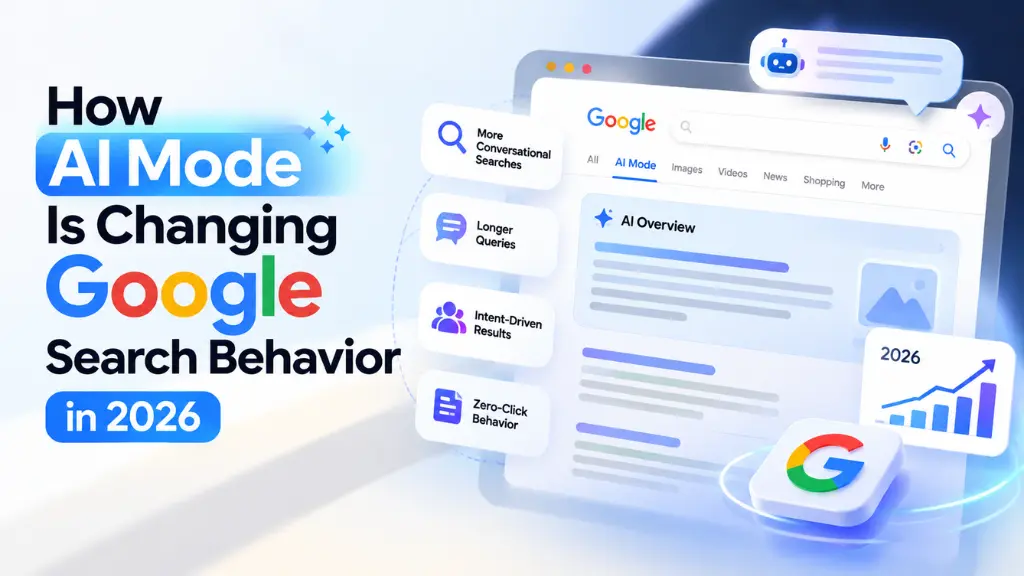

Google AI Mode has grown from a Search Labs experiment into a search surface that Google says has passed one billion monthly users. That figure is self-reported and worth treating with care, but the behavior change behind it is well documented. Searchers are typing longer questions, asking follow-ups instead of starting over, and clicking through to websites less often.
In this article18 sections
This guide explains what Google AI Mode is, how it differs from traditional results and from Google SGE, what independent research shows about search behavior, and what to change in your strategy. The short version: classic SEO fundamentals still matter, but visibility increasingly means being cited inside an answer, not just ranking on a page.
What Is Google AI Mode?#
Google AI Mode is a conversational search experience inside Google Search that answers complex questions with a synthesized, AI-generated response and supporting links. Instead of returning ten links for one short query, it breaks a question into subtopics, searches each one, and lets you keep refining the answer in the same thread.
Google introduced it as a Search Labs experiment in March 2025, and since May 2026 Gemini 3.5 Flash has been its default model. Under the hood, Google’s documentation describes a technique called query fan-out: the model issues several related searches at once, then builds a response grounded in pages from Google’s index. A question about fixing a weedy lawn, for example, may quietly trigger separate searches about herbicides, chemical-free removal, and prevention.
How Does AI Mode Differ From Google SGE and AI Overviews?#
Google SGE (Search Generative Experience) was the 2023 Labs test that became AI Overviews in May 2024. AI Overviews are summaries that sit above a normal results page. AI Mode is a separate, fully conversational experience. The two are now connected: Google says you can ask a follow-up directly from an AI Overview and continue into AI Mode with your context intact, on desktop and mobile worldwide.
How Big Is Google AI Mode in 2026?#
Google announced at I/O on May 19, 2026 that AI Mode had passed one billion monthly users, with queries more than doubling every quarter. It is available in roughly 200 countries and territories, and Google reported that last quarter’s total search queries hit an all-time high.
Two caveats keep the headline in perspective. First, the one-billion figure is Google’s own and does not show how often people use the feature. Second, AI Mode is still a small slice of total volume. Similarweb data analyzed by SparkToro found that only 0.34% of US Google searches reached AI Mode between January and April 2026, while 68.01% of US searches ended without a click. So AI Mode is not yet the main cause of zero-click behavior; AI Overviews and other on-page answers are. The trajectory matters more than today’s share.
How Google AI Mode Is Changing Search Behavior#
Are People Searching Differently in AI Mode?#
Yes. Searchers in AI Mode write longer, more conversational questions than they do in traditional search. Semrush’s clickstream analysis of about 69 million US desktop sessions in mid-2025 found an average AI Mode query of 7.22 words versus 4.0 words for standard Google queries. Instead of “used car for sale,” people ask for “the safest and most affordable car for teenagers.”
Pew Research shows the same pattern from the other side: searches of ten or more words produced an AI summary 53% of the time, versus 8% for one- or two-word searches. Google’s redesigned Search box, announced at I/O 2026, expands as you type, offers AI suggestions that go beyond autocomplete, and accepts text, images, files, videos and Chrome tabs. That design invites description rather than keywords, which is what conversational search looks like in practice. Note that the Semrush sample reflects early adopters in 2025, so current habits may have moved further.
What Are Follow-Up Questions in AI Mode?#
Follow-up questions in AI Mode are additional prompts typed within the same conversation, so Google keeps the earlier context and refines the answer instead of starting a new search. Semrush found AI Mode sessions averaged two to three searches, roughly half as many as traditional sessions, where people often rephrase the same query several times. Google says that as users explore more deeply, the links and supporting articles get more relevant to the conversation.
Users are also staying inside Google longer. SparkToro’s 2026 analysis shows the share of searches followed by another Google search rose 7.2 percentage points between 2024 and 2026. The practical takeaway: a journey that once spanned five searches and three websites can now unfold in one thread, and your content may be cited at step two or three rather than at the first query.
Why Are Clicks Falling?#
Clicks fall because the answer appears on the results page, leaving fewer reasons to visit a source. Semrush measured 6 to 8% of AI Mode sessions ending in a visit to an external domain, meaning 92 to 94% were zero-click. For AI Overviews, Pew found people clicked a traditional result in 8% of visits versus 15% without a summary, and clicked a link inside the summary in just 1%.
Decision-making shifts too. A Growth Memo analysis of 185 high-stakes purchase tasks (April 2026) found that 88% of AI Mode users took the AI’s shortlist as-is, 74% chose the first item, and 64% clicked nothing. That is a small sample, but the direction fits the larger datasets. As Search Engine Land’s Barry Schwartz put it in a Semrush webinar, “It’s billboard SEO now.” Value comes from being seen and named, not only clicked.
AI Mode vs Traditional SERP: What Actually Changes#
| Traditional results | Google AI Mode | |
| Typical input | Short keywords (about 4 words in one 2025 sample) | Full questions (about 7 words), plus images, files and video |
| Output | Ranked links and SERP features | Synthesized answer with supporting links |
| Query handling | One query, one results page | Query fan-out across related subtopics |
| Refinement | Rewrite the query | Follow-up questions in the same thread |
| Zero-click level | 68% of US searches (2026) | 92 to 94% of sessions (2025 US desktop sample) |
| Success signals | Rankings, click-through rate | Citations, impressions, brand mentions |
The two zero-click figures come from different studies and methods, so read them as directional rather than a like-for-like comparison.
How to Adapt Your Search Strategy in 2026#
Google’s own advice is reassuringly plain. Its guide to optimizing for generative AI features says SEO best practices remain relevant because AI features are rooted in core ranking and quality systems. Here is a practical order of operations.
- Confirm eligibility. A page must be indexed and eligible to appear with a snippet to show up in generative AI features. A technical SEO audit catches blocked resources, indexing gaps and duplicate content before anything else.
- Cover the whole question, not just the keyword. Because of fan-out, one prompt draws on many subtopics. Build clusters that answer the follow-ups a buyer would ask, guided by intent-led keyword research and a topic cluster strategy. Google warns that creating a separate page for every query variation to manipulate results can violate its scaled content abuse policy.
- Publish non-commodity content. Google says a unique point of view, first-hand experience and expert analysis matter more than restating what already exists.
- Write clearly for people. Direct answers under question-style headings help readers, and that is reason enough to use them. Google says you do not need to chunk content or write specially for AI. For plain-English definitions of terms like fan-out, AEO and GEO, Search Savvy maintains an AEO, GEO and AI search glossary.
- Measure visibility, not just visits. Google’s Generative AI performance reports in Search Console show impressions in AI Overviews and AI Mode by page, country, device and date, and Google says they reached all websites worldwide as of August 31, 2026. Track algorithm changes alongside them; Search Savvy’s Google algorithm update tracker is one place to follow them.
Common Mistakes to Avoid#
- Chasing “AI hacks.” Google states that llms.txt files, special markup, content chunking and inauthentic mentions are not needed for Google Search.
- Mass-producing variation pages. Thin pages built for every fan-out query risk scaled content abuse, however they are produced. Google’s guidance on AI-generated content allows AI assistance but not content made mainly to manipulate rankings.
- Judging success by clicks alone. Impressions and brand recall inside AI answers carry value that a session report will not show.
- Treating 2025 data as settled. Several widely cited AI Mode figures come from early-adopter samples. Recheck them as behavior evolves.
Frequently Asked Questions#
Is Google AI Mode replacing traditional Google Search?#
Not yet. Google says people will continue to get a range of results from Search alongside AI responses. But Google is steering users toward AI Mode, for example through follow-up questions launched from AI Overviews, so the balance is shifting gradually rather than switching overnight.
Is Google AI Mode free, and where is it available?#
AI Mode is available in roughly 200 countries and territories and nearly 100 languages without a subscription. Google has described paid tiers only for add-ons: information agents and custom mini apps launch first for Google AI Pro and Ultra subscribers, while some agentic booking features roll out first in the US.
Does Google AI Mode hurt organic traffic?#
It can reduce clicks on informational queries, but the evidence varies by feature and date. Pew found fewer clicks when AI Overviews appear, and Semrush found few AI Mode sessions ending in a site visit. Yet SparkToro found AI Mode was only 0.34% of US searches in early 2026, so its direct effect is still limited.
How do I get my content cited in Google AI Mode?#
Follow core SEO. Make pages indexable and eligible for snippets, publish original, expert, people-first content, and keep a clear technical structure. Google says no special markup, llms.txt file or content chunking is required, and that no third-party tool has access to its internal ranking systems.
Can I track AI Mode performance in Search Console?#
Partly. The Generative AI performance report shows your impressions in AI Overviews and AI Mode by page, country, device and date. Google also counts these appearances in the overall Performance report under the Web search type, so clicks are not separated out in the same way.
Does keyword research still matter for AI Mode?#
Yes, but the unit shifts from single keywords to questions and topics. Use research to map intents and likely follow-ups, then answer them in depth on the fewest useful pages. Google notes its systems understand synonyms and meaning, so you do not need a page for every long-tail variant.
The Bottom Line#
Google AI Mode changes how people ask, refine and decide, but not what earns visibility: helpful, original, technically sound content from a source people trust. Your next step is practical. Open the Generative AI performance report, find the pages already earning impressions in AI features, and expand them into fuller answers to the follow-up questions readers would ask next. If you want a second opinion on where your site stands, Search Savvy’s AI search optimization services are a good place to start.