
Google has said for years, consistently and directly, that likes, shares, and follower counts are not a ranking factor. That statement is true, and it’s also the least interesting part of the answer. Does social media help SEO? Not by feeding signals straight into Google’s ranking algorithm – but through a growing set of indirect effects that are measurably real, and a newer effect in 2026 that has nothing to do with Google’s classic algorithm at all: AI answer engines increasingly cite social platforms directly when constructing responses.
This article separates the settled question – direct ranking impact – from the two that actually matter for strategy: the indirect SEO benefits social media has always provided, and the emerging role of platforms like Reddit, YouTube, and LinkedIn as citation sources for AI-generated answers.
The Direct Answer: No, Social Signals Are Not a Ranking Factor
Google has repeatedly confirmed that individual social engagement metrics – likes, shares, comments, follower counts – are not inputs into its organic ranking algorithm. A company with a large LinkedIn following does not automatically outrank a competitor with fewer followers but stronger on-page SEO and backlinks. Studies over the years have found a correlation between high social-share counts and higher search rankings, but correlation isn’t causation: pages that get shared widely also tend to be genuinely well-written, well-promoted, and well-linked, which are the actual factors driving the ranking.
Most social platforms also apply nofollow attributes to outbound links by default, meaning a link shared on Facebook or X doesn’t pass the same direct authority signal a standard editorial backlink would. Treating social shares as a backlink substitute misunderstands how the mechanism works.
The Indirect Answer: Yes, and It’s More Than a Consolation Prize
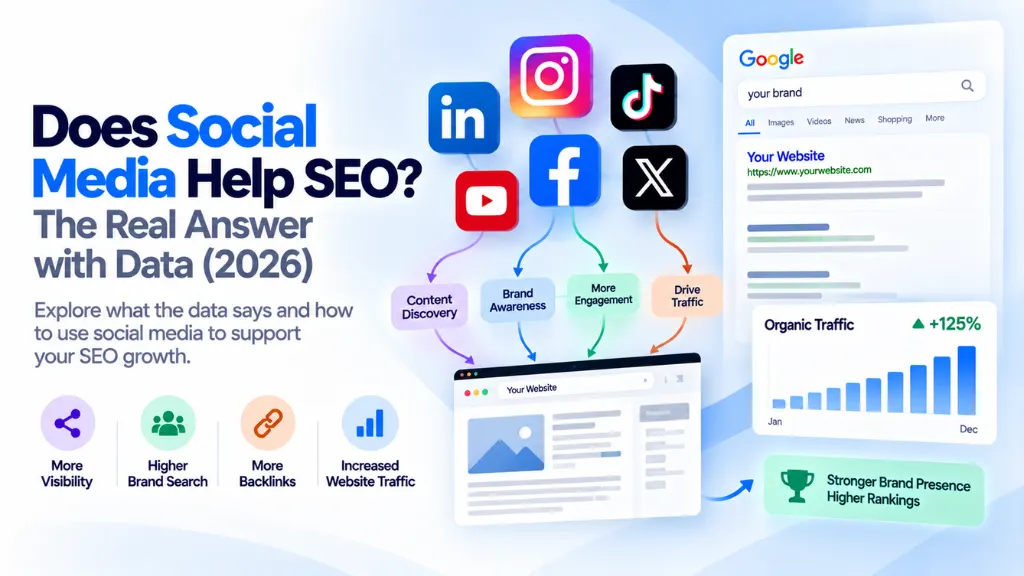
Dismissing social media because it’s “not a ranking factor” is a bit like ignoring email marketing for the same reason – the point was never that the channel is itself a ranking signal, but what it consistently enables. The indirect mechanisms are well documented and fall into a few clear categories:
| Mechanism | How It Works |
| Referral traffic | Social platforms send real visitors who generate genuine engagement data – time on page, pages per session – that feeds into how a search engine ultimately evaluates content quality |
| Backlink acquisition | Journalists, bloggers, and site owners frequently discover content through social feeds before linking to it from their own sites |
| Branded search volume | Repeated brand exposure on social media leads some people to search for the brand directly on Google rather than clicking a post – a trust signal Google can measure with far more confidence than a like count |
| Faster indexation | Widely shared content is more likely to be encountered by crawlers sooner, since sharing increases the number of paths leading back to it |
| Brand entity signals | Consistent presence across social platforms, reviews, and mentions contributes to how holistically Google evaluates a business’s overall authority and trustworthiness, beyond the website alone |
| Platform-native search | Several social platforms are substantial search engines in their own right – YouTube, Pinterest, and increasingly TikTok – generating discovery entirely separate from Google |
None of these require a single like or share to be a direct ranking input. They work because social platforms function as a distribution and discovery layer that surrounds the content search engines actually evaluate.
The New Variable in 2026: AI Answer Engines Cite Social Content Directly
This is the part of the “social media and SEO” conversation that’s genuinely different from even two years ago. AI answer engines – ChatGPT, Perplexity, Google’s AI Overviews and AI Mode, Gemini, and others – don’t just rank pages; they construct answers by selecting and citing sources, and social platforms have become a measurable share of those citations.
An analysis covering more than 350,000 citations across major AI platforms found social media’s overall share of AI citations climbed from roughly 4.9% to about 7.2% between January and August 2026 – a meaningful increase in a relatively short window, and one running well ahead of the growth in citations to brands’ own owned content over the same period. A separate large-scale study of roughly 30 million cited sources across ChatGPT, Google AI Mode, Gemini, Perplexity, and AI Overviews found Reddit to be the single most-cited domain overall, with YouTube, LinkedIn, Wikipedia, and Forbes rounding out the next most-cited sources.
The behavior varies enormously by platform, though, and that variance matters more than the headline number. Reddit accounted for a large share of social citations inside Google’s AI Overviews, but only a small fraction of citations within Google’s own Gemini product – a striking gap given both are Google surfaces. Perplexity leaned on social sources, particularly Reddit, far more heavily than most other platforms tracked. ChatGPT’s citation behavior skewed more toward reference and editorial sources like Wikipedia alongside Reddit, rather than video or other social formats.
This citation behavior is also unusually volatile. One research series tracking nearly 1.9 million social citations across ten AI surfaces found the major AI platforms changed which social platforms they favored sixteen separate times over a seven-month period in 2026, with several of those changes later reversing course, none of them announced in advance. A brand strategy built entirely around a single month’s citation snapshot would likely have been out of date within weeks.
The practical takeaway isn’t “post more on Reddit” or “prioritize LinkedIn” as a fixed rule – it’s that a presence on the platforms your specific industry’s AI citations lean toward is worth building deliberately, while accepting that the citation landscape itself is still shifting quickly enough that no single tactic should be treated as permanent.
Comparing the Two Effects: Classic SEO vs. AI Citation Visibility
| Classic Google Ranking Impact | AI Answer Engine Citation Impact | |
| Direct signal from likes/shares/followers? | No, confirmed repeatedly by Google | Not directly either – citation depends on content being retrievable and judged relevant |
| Primary mechanism | Referral traffic, backlinks, branded search, faster indexation | Direct selection and citation of social content when constructing an AI-generated answer |
| Stability over time | Relatively stable, well-understood ranking factors | Highly volatile – citation source preferences shift across platforms and over short time windows |
| Where it shows up | Organic search rankings and traffic | AI Overviews, AI Mode, ChatGPT, Perplexity, and similar answer surfaces |
How to Measure Social Media’s Indirect SEO Impact
Because the effect is indirect and lagged, measuring it requires isolating variables rather than looking for a single metric that proves causation:
- Segment social referral traffic in Google Analytics by platform, tracking session duration, pages per session, and conversion rate separately from other traffic sources.
- Log major publishing events – a piece going unusually viral on a platform, a notable spike in shares – with a timestamp you can cross-reference later.
- Watch for a ranking or backlink lift in the following one to two weeks. A spike in social referral traffic followed by a measurable ranking improvement or new backlinks within roughly seven to fourteen days is reasonably strong evidence of an indirect effect, even without a way to prove causation definitively.
- Track branded search volume in Search Console over the same window, since a rise in searches for your brand name following a social campaign is one of the cleaner indirect signals to observe.
Which Social Platforms Matter Most for SEO?
Not every platform contributes equally, and the honest answer depends on your content type and industry:
- YouTube functions as the world’s second-largest search engine in its own right, and video content frequently ranks directly inside Google’s own search results.
- Reddit carries outsized weight in several AI platforms’ citation behavior, particularly for product research and comparison-style queries, though its exact share varies significantly by which AI tool a customer happens to use.
- LinkedIn content indexes and ranks in Google search results directly, and has grown as a citation source across several AI platforms through 2026.
- Pinterest operates as a genuine visual search engine, driving long-tail, compounding traffic distinct from typical social discovery.
Common Mistakes When Evaluating Social Media’s SEO Value
- Treating “not a ranking factor” as “not worth doing.” The mechanism isn’t direct, but the downstream effects on traffic, backlinks, and branded search are measurable and real.
- Chasing vanity metrics. Follower counts and like totals correlate poorly with actual SEO benefit compared to referral traffic quality and backlink acquisition.
- Overfitting a strategy to a single month’s AI citation data. Citation source preferences across AI platforms have shown enough volatility in 2026 that a static, one-time analysis risks going stale within a quarter.
- Assuming every platform behaves the same way. A tactic that performs well for AI citation visibility on one platform can be nearly irrelevant on another operated by the same company.
- Ignoring platform-native search entirely. YouTube, Pinterest, and LinkedIn each function as search engines in their own right, independent of any Google ranking effect.
Frequently Asked Questions
Do Facebook or Instagram likes and comments affect Google rankings? No. Google has confirmed that individual engagement metrics like likes and comments on social platforms are not factored into its ranking algorithm directly.
If social signals aren’t a ranking factor, why do marketers keep saying social media helps SEO? Because the indirect effects are real and measurable – referral traffic, backlink acquisition, branded search growth, and faster content indexation all consistently correlate with active social media presence, even though none of them are the “signal” itself.
Does posting on Reddit or LinkedIn actually help a brand appear in ChatGPT or AI Overviews? It can, but the effect varies significantly by platform and changes over time. Reddit and LinkedIn have both grown as citation sources across several AI platforms in 2026, but citation behavior differs meaningfully even between AI products made by the same company.
How long does it take to see an indirect SEO benefit from a social media campaign? There’s no fixed timeline, but a common measurement window is seven to fourteen days after a spike in social activity, looking for corresponding lifts in referral traffic, backlinks, or branded search volume.
Is it better to focus SEO effort on Google rankings or AI citation visibility? They’re not mutually exclusive, and the underlying content quality that earns backlinks and organic rankings also tends to be the kind of content AI systems find worth citing. Splitting attention entirely away from traditional SEO to chase AI citations specifically isn’t necessary for most businesses.
Which social platform has the biggest SEO impact? It depends on content type and industry. YouTube and Pinterest function as search engines with strong, direct discovery potential; Reddit and LinkedIn carry particular weight for AI citation visibility in many categories, though their influence shifts over time.
The Bottom Line
Social media doesn’t help SEO the way many marketers once believed – Google isn’t counting likes or shares as a ranking input, and it never has been. What it does do is generate referral traffic, backlinks, branded search demand, and faster indexation, all of which genuinely move organic performance, and it increasingly feeds a second, faster-moving channel: direct citation inside AI-generated answers, where platform behavior is still shifting month to month. Treat social media as a distribution and discovery layer that supports SEO rather than a shortcut around it. Search Savvy’s social media services and off-page SEO and link building services are typically built around exactly this kind of indirect-effect strategy, and AI search optimization (AEO/GEO) services address the newer citation-visibility layer this article covers.