How to Write Better ChatGPT Prompts for Blog Writing
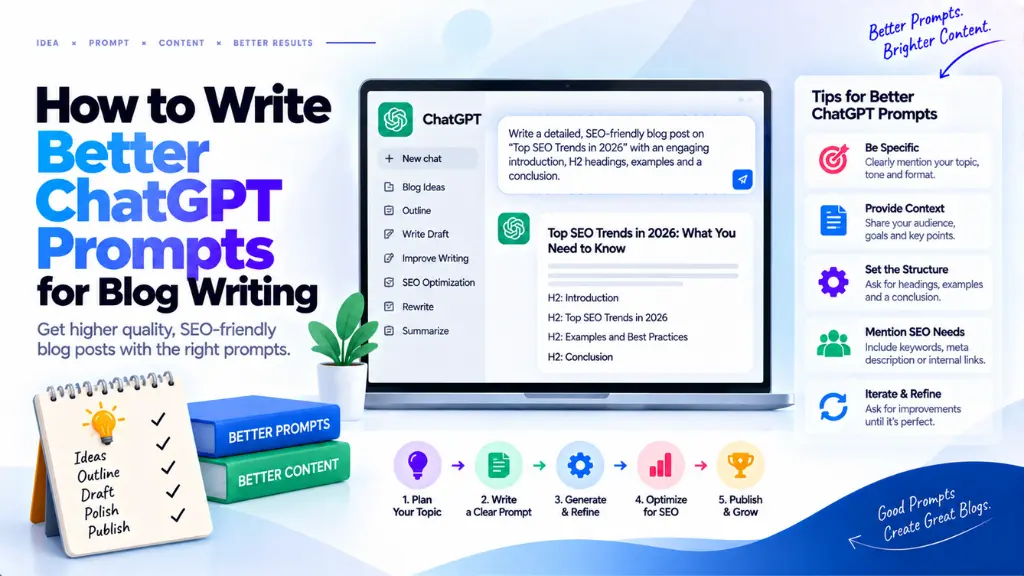

Telling ChatGPT to “write a blog post about content marketing” is like telling a brand-new intern to “write me something good” and expecting a finished, publishable draft back. It can technically produce an answer, but it has no idea who it’s writing for, what tone to use, how long the piece should be, or what a good version of it even looks like. Better ChatGPT prompts for blog writing come down to giving the model the same information you’d give a human writer before handing off an assignment – not clever wording or trial and error, but a clear, structured brief.
In this article10 sections
This article covers the specific prompt structure that consistently produces usable blog drafts, why asking for an entire post in one shot usually backfires, and the prompting techniques that separate writers who get reliable results from ChatGPT from those still fighting generic, forgettable output.
What Makes a ChatGPT Prompt Actually Work for Blog Writing?#
The gap between passable AI-written text and genuinely useful output in 2026 comes down to one factor more than any other: how specifically the prompt is framed. Most people already know how to ask ChatGPT to “write a blog post about X.” Fewer realize that vague instructions actively hold the model back, because ChatGPT fills every gap you leave with a generic, statistically average assumption – a generic audience, a generic tone, a generic structure – rather than the specific choices that would actually fit your blog.
Writers who get consistent value from ChatGPT don’t rely on trial and error. They define a role for the model, impose explicit constraints, and control the order in which the model thinks through the task – treating the prompt as a professional brief rather than a casual request.
The Four-Part Prompt Structure: Role, Context, Task, Format#
A good blog-writing prompt reliably includes four components, and combining all four is what turns a vague request into something close to an autopilot for usable output:
- Role. Tell ChatGPT what persona or expertise to simulate – “act as an SEO content strategist” or “act as a travel blogger writing for budget-conscious millennials” gives the model a consistent lens to write through, rather than defaulting to a generic, unplaced voice.
- Context. Describe who the piece is for, what the blog covers, and what the content will be used for. A prompt that specifies the audience’s skill level, region, or specific pain point produces meaningfully more relevant output than one that names only the general topic.
- Task. State exactly what you want produced – a full draft, an outline, a list of title options, a set of subheadings – rather than a vague “help me with this post” request.
- Format and constraints. Specify word count, tone, structure (H2s, H3s, FAQs), and anything the model should explicitly avoid. Constraints consistently produce better output than an open-ended request, because they remove the guesswork the model would otherwise fill with generic defaults.
A prompt combining all four might read: “Act as a content strategist writing for a B2B SaaS blog. The audience is mid-level marketing managers evaluating automation tools. Write a 1,200-word outline for a post titled ‘[title]’ with an H2 for each major section, three FAQ questions, and a professional but conversational tone. Avoid generic phrases like ‘in today’s digital landscape.'” That single prompt does more work than a dozen follow-up corrections to a vague one.
Why “One Giant Prompt” Fails: Build the Outline First#
A common mistake is asking ChatGPT to write an entire 2,000-word blog post in a single prompt. This routinely produces repetitive sections, a structure that drifts as the piece goes on, and a draft that reads like it was generated in one uninterrupted pass – because it was. A more reliable workflow separates the task into stages: first ask for a structured outline – search intent, H2 headings, H3 subheadings, FAQ questions, and internal link opportunities – and review that outline critically before asking for a single word of the actual draft.
Reviewing the outline is not optional. Remove repeated sections, add missing steps, and check that the structure flows logically from one section to the next before moving forward. A weak outline reliably produces a weak article, regardless of how well the eventual drafting prompt is written – the outline stage is where structural problems are cheapest to fix.
Should I Ask ChatGPT to Write the Whole Post at Once?#
No, not for anything longer than a short piece. Building the outline first, reviewing it, and then drafting section by section produces a more coherent, better-structured result than a single request for a complete post, and it gives you natural checkpoints to correct direction before too much text has already been generated.
Turning ChatGPT Into an Editor, Not Just a Writer#
Most people only ask ChatGPT to write. A more advanced technique asks it to edit instead – framing the model as a senior editor whose job is to improve clarity, structure, and flow without introducing new ideas or altering your original intent. A prompt like “review the text below and provide feedback only, focused on clarity, argument strength, and structure; do not rewrite or suggest replacement sentences” produces a genuinely different, often more useful kind of output than asking for a rewrite outright, because it forces the model to diagnose problems rather than simply paper over them with its own version of the content.
This editing mode is particularly useful once you already have a draft – whether self-written or AI-assisted – and want a structural gut check rather than a full regeneration. It also keeps your own voice intact in a way that repeated full rewrites tend to erode over successive passes.
Matching Your Brand Voice with Few-Shot Examples#
ChatGPT can mimic an established tone reasonably well if you give it real examples to work from rather than describing the tone abstractly. Pasting three to five samples of existing blog content and instructing the model to “study this writing style, note the sentence length, vocabulary, rhythm, and common transitions, then write the new piece in the same style” consistently outperforms an adjective-based description like “write in a friendly, professional tone.”
The practical sweet spot for this kind of context is roughly 200 to 800 words of example material with one to three samples – enough for the model to identify genuine patterns without diluting the effect by providing so much material that no single voice comes through clearly. This technique works less reliably for highly distinctive, idiosyncratic voices, since the model tends to blend the provided samples with its own general training patterns rather than reproducing an unusual style exactly – but for a consistent business or blog voice, it’s a meaningfully better starting point than describing tone in the abstract.
Prompt Templates for Common Blog Writing Tasks#
Different stages of blog production call for differently structured prompts, since asking for ideation and asking for a polished draft require different levels of specificity.
| Task | What the Prompt Should Specify | Example Framing |
| Topic ideation | Audience, niche, and the outcome the ideas should serve (traffic, shares, links) | “Give me 15 blog topic ideas for [audience] focused on [specific pain point], each addressing one practical problem” |
| Outline building | Search intent, required sections, FAQ inclusion, internal link opportunities | “Create an SEO outline for ‘[title]’ targeting [intent], with H2/H3 headings, three FAQ questions, and internal link suggestions” |
| Section drafting | One section at a time, with the surrounding context provided | “Using this outline [paste], write only the section under ‘H2 heading’, roughly 200 words, in [tone]” |
| Editing and feedback | Explicit instruction to critique rather than rewrite | “Review this draft for clarity and structure only. Do not rewrite sentences – flag what’s unclear and why” |
Search Savvy’s content strategy and topical authority work builds this same staged approach – ideation, outline review, section-by-section drafting, and a separate editorial pass – into how AI-assisted content actually gets produced for clients, rather than relying on a single prompt to do every job at once. Readers newer to terms like search intent or internal linking can cross-reference the SEO glossary alongside this staged workflow.
Common Mistakes When Prompting ChatGPT for Blog Content#
- Not specifying a target audience. Different readers need different tones and levels of explanation, and a prompt without an audience defaults to a generic middle ground that fits nobody particularly well.
- Asking for an entire post in one prompt. This produces repetitive sections and structural drift; building and reviewing an outline first consistently produces a more coherent result.
- Describing tone abstractly instead of showing examples. “Write in a friendly, professional tone” is far less effective than pasting real examples and asking the model to match the specific patterns in them.
- Accepting the first outline or draft without revision. Treating the first output as a finished product rather than a draft to be refined skips the step where most of the real quality improvement happens.
- Adding unrelated keywords to a content brief just because they look popular. Keyword ideas generated by ChatGPT should be filtered against what genuinely fits the piece, not added wholesale because a tool suggested them.
The Bottom Line#
Better ChatGPT prompts for blog writing come down to treating each prompt as a structured brief – role, context, task, and format – rather than a vague request, and breaking the writing process into stages instead of asking for a finished post in one shot. Outline-first drafting, edit-mode prompting for structural feedback, and few-shot voice-matching examples consistently produce more usable, on-brand output than any single clever prompt phrasing could.
The practical next step is taking your next blog topic and writing out the four-part prompt structure explicitly – role, context, task, format – before asking ChatGPT for anything at all. This is the same content production discipline Search Savvy applies before any AI-assisted draft goes out the door. Search Savvy’s content marketing services build this staged, brief-driven approach into ongoing content production, so AI-assisted drafts start from a genuinely tailored foundation rather than a generic first pass.
Frequently Asked Questions#
What’s the most important thing to include in a ChatGPT prompt for blog writing? Specificity across four components: a role for ChatGPT to simulate, context about your audience and purpose, a clear task, and format constraints like tone, length, and structure. Vague prompts consistently produce generic, forgettable output.
Should I ask ChatGPT to write my entire blog post in one prompt? For anything longer than a short piece, no. Building a structured outline first, reviewing it critically, and then drafting section by section produces a more coherent, better-organized result than asking for a full draft in a single request.
How can I get ChatGPT to match my brand’s writing voice? Paste three to five real samples of your existing content and ask the model to study the sentence length, vocabulary, rhythm, and transitions before writing new content in the same style. This works better than describing the tone abstractly with adjectives.
Can ChatGPT edit my writing instead of rewriting it? Yes. Framing the model as an editor and explicitly instructing it to provide feedback only, without rewriting sentences, produces a genuinely different and often more useful kind of output than asking for a full rewrite.
How long should my example content be when trying to match a specific tone? A practical sweet spot is roughly 200 to 800 words of example material across one to three samples. This is enough for the model to identify genuine stylistic patterns without diluting the effect with too much material.
Why does my ChatGPT blog draft feel generic even with a detailed topic? A detailed topic alone isn’t enough – the model still needs an explicit role, audience context, and format constraints to avoid filling those gaps with generic defaults. A topic without those additional details usually produces broadly competent but forgettable writing.