What Are AI Hallucinations and Why Should Marketers Care?
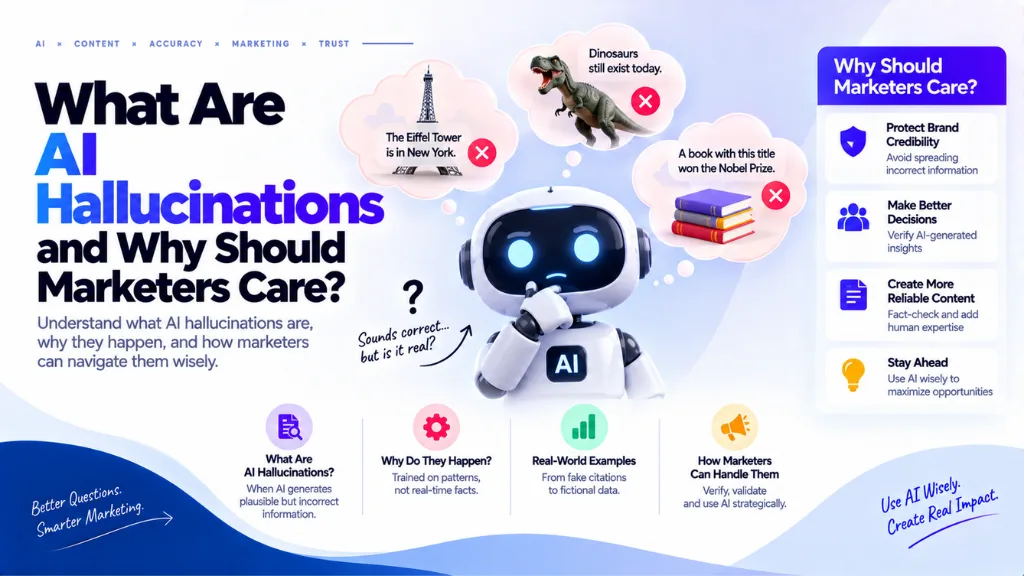

An AI system doesn’t say “I’m not sure” when it doesn’t know something – it generates the most statistically plausible answer it can, with exactly the same confident tone whether that answer is accurate or completely fabricated. That gap between confidence and accuracy is what’s called an AI hallucination, and for marketers increasingly relying on generative AI for content, customer interactions, and competitive research, it’s become a genuine operational and reputational risk rather than a curiosity.
In this article16 sections
This article explains what AI hallucinations actually are, why they happen, the real-world cases that show what’s at stake, and the practical steps marketers can take to catch and prevent them before they reach a customer or a published campaign.
What Is an AI Hallucination?#
An AI hallucination is when a generative AI model produces information that sounds plausible and is stated with confidence, but is factually incorrect, fabricated, or unsupported by any real source. The term applies to large language models like ChatGPT, Gemini, Claude, and Perplexity generating invented statistics, fake citations, incorrect product details, or entirely fictional facts about a person, company, or event – all delivered with the same fluent, assured tone the model uses for accurate information.
Why Do AI Models Hallucinate in the First Place?#
Large language models generate text by predicting the next most statistically likely word in a sequence based on patterns learned during training, not by retrieving verified facts from a database or checking claims against a source of truth. When a model is asked something it has limited or no reliable information about, it doesn’t have a built-in mechanism to recognize that gap and default to uncertainty – it fills the gap with a plausible-sounding continuation instead, and that continuation isn’t necessarily distinguishable, from the outside, from a genuinely accurate answer.
Why This Matters Specifically for Marketers#
Brand Misrepresentation in AI-Generated Answers#
As more consumers use ChatGPT, Gemini, Claude, and Perplexity to research products, compare options, and get quick answers instead of running a traditional search, an AI system hallucinating incorrect pricing, outdated features, or a fabricated policy about your brand can shape a purchasing decision before your actual website ever enters the picture. Unlike a factual error in a published article, there’s typically no simple correction mechanism – an inaccurate claim embedded in how a model responds to queries about your brand can persist and resurface across many different conversations until the underlying issue is addressed.
Customer-Facing AI Tools Create Direct Legal Exposure#
When a business deploys an AI chatbot for customer service, hallucinated responses can create binding obligations the business didn’t intend to make. A Canadian tribunal ruled in February 2024 that Air Canada was liable for its customer-service chatbot’s inaccurate claim that a bereaved customer could apply for a discounted bereavement fare retroactively – a claim that directly contradicted the airline’s actual policy. Air Canada argued it shouldn’t be held responsible for the chatbot’s own words, and the tribunal rejected that argument outright, ruling that a chatbot is simply part of a company’s website and the company is responsible for everything it says, whether generated dynamically or published as static text. The airline was ordered to honor the promised discount plus damages.
Generated Content Can Introduce Fabricated Facts Into Published Material#
The same pattern that produced the Air Canada ruling shows up whenever AI-generated content is published without adequate verification. In a widely reported 2023 case, attorneys representing a plaintiff in a personal injury suit submitted a legal brief containing six case citations entirely fabricated by ChatGPT, complete with invented judges, fake quotations, and nonexistent docket numbers. When one of the attorneys asked ChatGPT to confirm the cases were real, the model reaffirmed that they were – a second hallucination compounding the first. The presiding federal judge sanctioned both attorneys. The underlying lesson applies well beyond legal work: asking an AI system to verify its own previous claim isn’t a reliable check, since the same pattern-matching process that produced the original error can just as easily reproduce it when asked to confirm it.
Where Hallucinations Most Commonly Show Up in Marketing Workflows#
- Statistics and data points in content. AI-drafted blog posts, social copy, or reports can include specific-sounding statistics that were never actually published anywhere, invented to fill a gap in the model’s training data – a real risk in any AI-assisted content strategy and topical authority program that doesn’t build in a verification step.
- Competitor comparisons. AI-generated competitive analysis can attribute features, pricing, or capabilities to the wrong company, especially for less prominent brands with limited information available online.
- Customer service and chatbot responses. As the Air Canada case demonstrates, a chatbot confidently stating an incorrect policy can create real financial and legal consequences.
- Third-party summaries of your own brand. When AI systems summarize what a company does, its pricing, or its policies, gaps in publicly available, verified information get filled with plausible-sounding guesses rather than left blank.
- Quotes and attributions. AI models can generate plausible-sounding quotes and attribute them to real people or organizations who never said anything of the sort.
How Marketers Can Reduce Hallucination Risk#
Verify Before Publishing, Every Time#
Any specific statistic, named source, quote, or factual claim generated by AI needs to be checked against an actual, verifiable source before it appears in published content – not spot-checked occasionally, but verified as standard practice. This is the same discipline behind avoiding unverified statistics generally: if a claim can’t be traced to a credible, named source, it shouldn’t be published regardless of how confidently it was generated.
Strengthen Your Brand’s Verified Entity Signals#
AI systems fill information gaps about a brand with plausible guesses when clear, structured, and verified information isn’t readily available. Ensuring consistent, accurate brand information across your website, schema markup, and authoritative third-party sources reduces the raw material available for a model to hallucinate incorrect details about pricing, policies, or positioning. This is the same underlying discipline behind broader entity-focused work under AI search optimization for AEO and GEO – making a brand’s facts unambiguous and easy for AI systems to retrieve accurately, rather than infer.
Never Let Customer-Facing AI Make Unreviewed Policy Claims#
Any AI chatbot or assistant handling customer-facing interactions about policies, pricing, refunds, or commitments needs guardrails that prevent it from generating unsupported claims – and, ideally, a review process for edge cases the guardrails don’t anticipate. The Air Canada case demonstrates clearly that a business remains legally responsible for what a customer-facing AI tool says, regardless of whether a human wrote those exact words.
Monitor What AI Systems Are Actually Saying About Your Brand#
Periodically checking what ChatGPT, Gemini, Perplexity, and similar systems say when asked about your brand, products, and policies surfaces hallucinations before they compound into a larger reputational issue. This kind of monitoring is becoming a standard component of broader AI visibility work, since appearing in AI-generated answers and the accuracy of what’s actually being said are two sides of the same problem – something Search Savvy increasingly folds into ongoing AI search tracking for clients rather than treating as a separate audit.
Treat AI-Generated Drafts as a Starting Point, Not a Final Product#
Content drafted with AI assistance should go through the same fact-checking and editorial review any published material requires, rather than being treated as reliably accurate simply because it reads fluently. Fluency and accuracy are produced by entirely different mechanisms in these systems, and confident phrasing is not evidence of correctness.
Common Mistakes#
- Assuming confident-sounding output means accurate output. A hallucinated fact and an accurate one are stated with identical tone and fluency, so confidence is not a useful signal of reliability.
- Asking an AI model to verify its own previous claim. The same generative process that produced a hallucination can reaffirm it when asked, as the legal citation case demonstrates directly.
- Deploying customer-facing AI without guardrails around policy-sensitive topics. Refunds, pricing exceptions, and legal commitments are exactly the areas where an unreviewed hallucination creates real liability.
- Publishing AI-generated statistics without independent verification. A specific-sounding number is not evidence that number exists anywhere in reality.
- Ignoring what AI systems already say about your brand. Unmonitored hallucinations about pricing, features, or policies can spread across many AI conversations before anyone at the company notices.
- Treating hallucination risk as solely a technology problem. It’s also an editorial and governance problem – the fix requires verification processes, not just better AI models.
Search Savvy builds AI-content verification into standard content marketing workflows now, since fact-checking generated drafts has become as fundamental a step as basic proofreading.
Frequently Asked Questions#
What causes an AI model to hallucinate? AI language models generate text by predicting statistically likely word sequences based on training data, not by verifying facts against a source of truth. When information is missing or ambiguous, the model fills the gap with a plausible-sounding answer rather than indicating uncertainty.
Can AI hallucinations create legal liability for a business? Yes. A Canadian tribunal ruled Air Canada liable for its chatbot’s inaccurate statements about a fare policy, establishing that businesses are responsible for what their AI tools say to customers, just as they would be for information on a static webpage.
How can marketers tell if AI-generated content contains a hallucination? The only reliable method is independent verification against an authoritative source – checking whether a cited statistic, quote, or fact actually exists where it’s claimed to exist. Asking the AI system itself to confirm its own output is not a reliable check.
Do AI hallucinations affect how AI systems describe my brand even if I never use AI myself? Yes. AI systems can generate incorrect information about any brand when asked, based on whatever information is available (or missing) from their training data and any live retrieval they perform, regardless of whether the brand itself uses AI tools.
Is it possible to completely eliminate hallucination risk? No current AI model eliminates hallucination risk entirely. The realistic goal is reducing exposure through verification processes, guardrails on customer-facing tools, and strong, unambiguous brand information that AI systems can retrieve rather than infer.
Should marketers stop using AI tools because of hallucination risk? Not necessarily. The risk is manageable with proper verification and review processes; the mistake is treating AI output as reliably accurate without those safeguards, not using AI tools at all.
Bottom Line#
AI hallucinations aren’t a rare glitch – they’re a structural feature of how generative AI models work, and marketers who treat AI output as automatically reliable are taking on real reputational, financial, and in some cases legal risk without realizing it. Verify every specific claim before it’s published, put guardrails around any customer-facing AI handling policy-sensitive topics, and monitor what AI systems are already saying about your brand. The businesses that get burned by hallucinations aren’t usually the ones using AI – they’re the ones using it without checking its work.