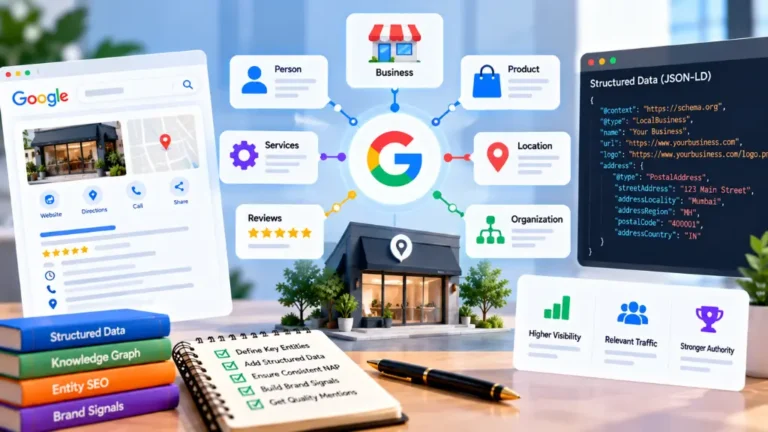
Best AI SEO Tools in 2026 That Actually Save You Time
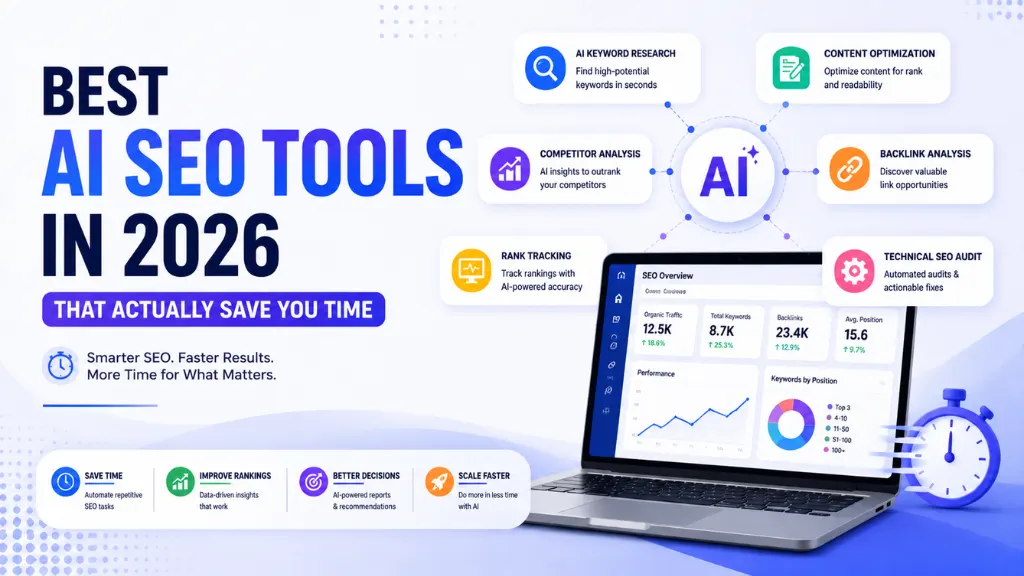

Here is the problem with most AI SEO tool roundups: they list twenty platforms, describe every feature equally, and leave you no clearer on which one to actually open on Monday morning.
In this article16 sections
AI SEO tools in 2026 have split into three genuinely different categories – traditional SEO platforms with AI features bolted on, AI-native content tools built specifically for writing and optimisation, and fully autonomous AI agents that run SEO tasks without manual input. Treating all three as interchangeable is why most SEOs end up paying for five tools that overlap instead of three that each do a distinct job.
AI SEO tools matter more in 2026 than at any point before because SEO itself has changed. Tracking rankings on Google is no longer enough; teams now need to monitor visibility in AI Overviews, ChatGPT, Perplexity, and Gemini simultaneously – and the tools that save the most time are the ones built specifically for this dual-surface reality.
AI SEO tools are only worth their subscription if they genuinely reduce the time spent on repeatable work – keyword clustering, content briefing, site auditing, and AI visibility reporting – without replacing the strategic judgment that still needs a human. At Search Savvy, we test tools based on a single question: does this give an hour back, or just add another dashboard to check? Here are the picks that consistently pass that test.
What Are AI SEO Tools and How Do They Work?#
AI SEO tools are software platforms that use artificial intelligence and large language models to automate, accelerate, or enhance SEO tasks – from keyword research and content briefing to technical audits, rank tracking, and now AI search visibility monitoring.
AI SEO tools work by combining large datasets – search volume, SERP data, backlink indexes, and increasingly LLM prompt-tracking data – with AI models that can interpret patterns, generate recommendations, and in some cases implement changes directly on a website.
People Also Ask: What is the difference between an AI SEO tool and a traditional SEO tool? Short Answer: Traditional SEO tools present data and leave decisions to the user. AI SEO tools interpret that data, generate specific recommendations, and in advanced cases implement changes autonomously. The key practical difference in 2026 is that AI SEO tools also track visibility in AI Overviews and LLM-generated answers, not just classic Google rankings.
Why Do AI SEO Tools Matter More in 2026?#
AI SEO tools matter more in 2026 because search has genuinely fractured across surfaces. A page can rank well in Google’s classic results while being completely absent from AI Overviews – or cited by ChatGPT while ranking on page three organically. These are now separate visibility problems that require separate tracking.
AI SEO tools also matter because the volume of SEO tasks has increased faster than team sizes. Keyword clustering, content gap analysis, technical audit triage, and competitor monitoring used to take full days of manual work. The best AI SEO tools compress those tasks into hours or minutes without sacrificing accuracy.
- Traditional Google rank tracking is no longer sufficient – AI Overview and LLM citation tracking are now separate requirements
- Teams using AI SEO tools test, publish, and optimise at a higher frequency – a compounding competitive advantage
- Automated site audits catch issues that manual checks miss, particularly at scale on large or rapidly growing sites
- AI content optimisation tools reduce research-to-publish time by 50 to 70% for content-heavy teams
People Also Ask: Can AI SEO tools replace an SEO specialist in 2026? Short Answer: No. AI SEO tools accelerate data processing, pattern recognition, and repeatable tasks, but SEO strategy, client communication, creative content direction, and nuanced judgment still require human expertise. The most effective approach in 2026 is an AI-augmented SEO professional, not AI as a replacement.
What Are the Best AI SEO Tools in 2026 by Category?#
AI SEO tools are most useful when chosen by specific job rather than by brand recognition alone. Here is the breakdown by category.
Best All-in-One AI SEO Platform: Semrush#
AI SEO tools do not come more comprehensive than Semrush in 2026. Semrush Copilot, the platform’s built-in AI assistant, flags technical issues, toxic backlinks, traffic drops, and keyword gaps automatically – with explanations of why each issue matters, not just a list of what is wrong.
Semrush’s Visibility Overview tool tracks how a site performs in ChatGPT and AI Overviews simultaneously, showing the exact prompts a brand ranks for, the LLM’s generated response, and a breakdown of overall AI visibility score. The Starter plan ($199/month) includes 50 daily AI prompts to track alongside the full SEO toolkit.
Best for: Agencies and in-house teams that need traditional SEO data and AI visibility tracking in one environment.
Best for Content Optimisation: Surfer SEO#
AI SEO tools focused on content optimisation are led by Surfer SEO, which remains the gold standard for making individual pieces of content rank. Surfer’s content editor analyses top-ranking pages and provides real-time scoring as you write, with AI that has significantly improved at understanding semantic relevance rather than just keyword density.
Surfer SEO’s AI has gotten meaningfully better at separating topical depth from keyword stuffing – a critical distinction in a post-Helpful Content landscape where the former is rewarded and the latter is penalised.
Best for: Content teams and individual SEOs who need to optimise specific articles to rank – not a full SEO suite, but the best single-purpose tool for this job.
Best for Keyword Clustering: Keyword Insights#
AI SEO tools for keyword research have evolved well beyond simple volume lookups. Keyword Insights transforms raw keyword lists into organised topic clusters, complete content briefs, and draft articles in a single workflow – eliminating the manual grouping step that used to consume hours of spreadsheet work.
A newer Keyword Insights feature, Social Sources, highlights where user-generated platforms like Reddit, YouTube, or Quora appear in search results for clustered keywords – a signal that helps anticipate which queries are likely to trigger AI Overviews citing community content.
Best for: SEOs and content strategists who receive large keyword lists and need to structure them into a publishable content plan quickly.
Best for Content Research and Briefing: Frase#
AI SEO tools at the research and briefing stage are best represented by Frase, which takes a target keyword, analyses the SERP, builds a comprehensive content brief, and generates a working draft in minutes. The research capabilities alone – pulling structure and key points from top-ranking competitor content – save hours of manual review.
At $45/month, Frase is accessible for small businesses and solo operators who need a research-to-draft workflow without committing to an enterprise-level platform.
Best for: Small businesses, bloggers, and individual content creators who need to streamline the research and briefing process without a full SEO toolkit.
Best for Technical SEO Automation: Alli AI#
AI SEO tools for technical SEO have traditionally required developer involvement to action recommendations. Alli AI changes this – it pushes real-time changes to a site without requiring development resource, making it particularly valuable for teams managing multiple sites or implementing bulk technical updates at scale.
Alli AI is especially useful for automating meta tag optimisation, heading structure improvements, and internal linking across hundreds or thousands of pages simultaneously – the kind of work that could otherwise take weeks of manual implementation.
Best for: Agencies managing multiple client sites, or larger sites with recurring technical SEO backlogs that cannot be addressed quickly through standard development queues.
Best for AI Visibility Tracking: SE Ranking#
AI SEO tools for tracking visibility in AI search results have emerged as a distinct category in 2026, and SE Ranking leads it on price-to-value grounds. SE Ranking tracks keyword performance across Google, Bing, and Yahoo alongside AI Overview presence and LLM citation monitoring.
SE Ranking’s AI Search Visibility report shows how a brand appears in AI search results, which keywords trigger AI Overviews, and how visibility changes over time – all at a significantly lower price point than enterprise-level competitors.
Best for: Small to mid-sized businesses that need AI visibility tracking without the cost of a full enterprise platform like Semrush or Ahrefs.
Best for People Also Ask and Topic Cluster Research: AlsoAsked#
AI SEO tools designed around conversational and AI search patterns include AlsoAsked, which maps People Also Ask query trees to reveal the exact follow-up questions users (and AI systems) associate with any given topic. This is particularly valuable for structuring content that AI Overviews are likely to cite, since these tools rely on clearly structured, question-led content.
AlsoAsked offers three free credits per day on its basic free tier, making it accessible for testing before committing to a paid plan starting at $15/month.
Best for: Content strategists and SEOs building topic clusters and FAQ sections designed to capture AI Overview citations and conversational search queries.
Best for Fast Indexing: Indexly#
AI SEO tools do not all focus on content or rankings. Indexly solves a narrower but frequently painful problem: getting pages indexed quickly, including LLM indexability – checking whether pages are accessible to ChatGPT and other AI crawlers, not just Googlebot.
One documented use case involved a site migration with 500+ product pages, where 80% were indexed within three days using Indexly’s bulk indexing feature – compared to weeks of gradual indexing through standard submission alone.
Best for: Sites undergoing migrations, large e-commerce stores with hundreds of product pages, or any site where slow indexation is visibly costing organic performance.
AI SEO Tool Comparison at a Glance#
| Tool | Best For | Starting Price | Free Option? |
| Semrush | All-in-one SEO + AI visibility | $199/month (Starter) | Free trial |
| Surfer SEO | Content optimisation and scoring | $89/month | No |
| Keyword Insights | Keyword clustering and briefs | $58/month | Trial available |
| Frase | Content research and briefing | $45/month | 5-day free trial |
| Alli AI | Technical SEO automation | $299/month | Free trial |
| SE Ranking | Budget AI visibility tracking | $65/month | 14-day free trial |
| AlsoAsked | PAA and topic cluster research | $15/month | 3 free credits/day |
| Indexly | Fast page indexing + LLM access | Custom / per site | Limited free tier |
People Also Ask: Which AI SEO tool saves the most time in 2026? Short Answer: The answer depends on where your time is currently going. For agencies spending hours on reporting, Semrush Copilot and Whatagraph’s AI Summary feature save the most time. For content teams, Frase compresses research-to-draft from hours to minutes. For technical teams, Alli AI eliminates development dependency on routine fixes. Match the tool to your biggest time drain, not the highest-profile name.
How Should You Choose the Right AI SEO Tool?#
AI SEO tools should be selected based on the specific task consuming the most hours in your current workflow, not by chasing the platform with the most features. A team spending four hours per week on keyword clustering has a different tool priority than one spending four hours on content briefing.
AI SEO tools stack most effectively when chosen one per job category rather than picking one all-in-one platform and expecting it to excel across every use case. Semrush or SE Ranking as the data and visibility backbone, Surfer SEO for content optimisation, and Frase or Keyword Insights for briefing and clustering covers most agency and in-house team workflows without significant overlap.
According to Search Savvy’s insights from building AI SEO workflows for Indian digital marketing teams and content brands, the highest time-saving gains come from automating the keyword clustering and content briefing steps first – since these are the highest-friction, most repeatable tasks that precede every piece of content a team publishes.
How Should Indian SEO Teams Use AI SEO Tools?#
AI SEO tools for Indian teams should factor in INR-based budgets when comparing global pricing, since the cost difference between a $45/month and a $199/month tool is significant relative to typical Indian agency billing rates.
AI SEO tools like SE Ranking and Frase offer a strong price-to-feature ratio for Indian SMBs and content agencies, covering AI visibility tracking and research-to-brief workflows at a fraction of the cost of enterprise platforms – with free trials on both that allow genuine testing before commitment.
Conclusion: Match the Tool to the Task#
AI SEO tools in 2026 range from genuinely transformative to merely adding another dashboard to your stack. The ones that save real time are the ones matched precisely to the task that was previously consuming the most hours – and used consistently enough to build the data history that makes their recommendations reliable.
Search Savvy integrates AI SEO tools into every strategy and audit we run, because the competitive edge in search right now belongs to teams who can research faster, publish more strategically, and track visibility across both traditional and AI search surfaces – all of which require the right tools working in the right sequence.
FAQ: AI SEO Tools – Your Questions Answered#
Q1: Are free AI SEO tools worth using in 2026? Yes, selectively. Google Search Console remains the most valuable free SEO tool available. AlsoAsked’s free tier covers light PAA and cluster research. ChatGPT’s free tier handles keyword clustering and brief drafting effectively at low volume. For serious, ongoing SEO work, paid tools deliver meaningfully better data and automation – but free tools are a legitimate starting point.
Q2: What is the best AI SEO tool for a solo blogger or freelancer? Frase at $45/month covers research, briefing, and first-draft generation in one workflow – the highest value single tool for solo operators who spend the most time on content research. SE Ranking at $65/month adds rank tracking and AI Overview monitoring if search visibility data is also needed.
Q3: Do AI SEO tools guarantee better rankings? No. AI SEO tools accelerate research, optimisation, and monitoring, but rankings depend on content quality, authority, technical health, and search intent satisfaction – factors that still require strategic human judgment. Tools improve the speed and consistency of execution; they do not bypass the quality requirements that determine who ranks.
Q4: How is AI SEO tool capability different in 2026 vs previous years? The biggest change is AI visibility tracking – the ability to monitor a brand’s presence in ChatGPT, Perplexity, and Google AI Overviews, not just classic SERP positions. Most leading tools now include some form of LLM mention tracking, whereas this capability did not exist in mainstream SEO platforms even eighteen months ago.
Q5: Can AI SEO tools help with local SEO for Indian businesses? Yes. Semrush and SE Ranking both support local rank tracking by location. Tools like Localo are built specifically for Google Business Profile optimisation and local schema generation – particularly useful for Indian businesses competing in city-specific searches where GBP signals carry significant ranking weight.
Q6: How many AI SEO tools does a typical team actually need? Most teams work most effectively with two to three tools covering distinct jobs: one for data and visibility tracking (Semrush or SE Ranking), one for content research and optimisation (Frase or Surfer SEO), and one for a specific workflow gap like keyword clustering or technical automation. Stacking more than three tools of the same type creates overlap rather than additional capability.
Not sure which AI SEO tools are right for your team’s specific workflow – or wondering whether the tools you currently pay for are actually saving time or just adding noise? Visit Search Savvy for an SEO stack audit that maps the right tools to your real bottlenecks.