What Is AI Content Writing and Does Google Penalize It in 2026?
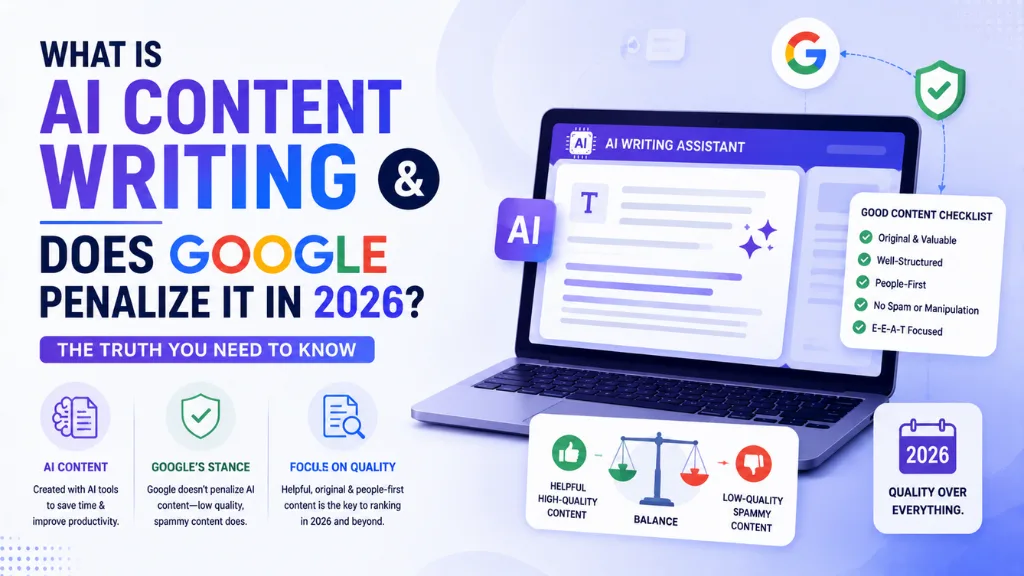

Here is the question that has been circulating in every marketing Slack channel and SEO forum for the last two years: will Google quietly tank my rankings if it figures out my blog was written with AI?
In this article11 sections
AI Content Writing has become so common that the fear feels reasonable. But the actual answer, backed by Google’s own statements and independent research, is more nuanced – and more reassuring – than most panic-driven headlines suggest.
AI Content Writing now appears in the vast majority of top-ranking pages. An Ahrefs study of 600,000 web pages found that 86.5% of top-ranking content contained some level of AI assistance, with a correlation of just 0.011 between AI content percentage and ranking position – a number so close to zero it is statistically meaningless.
AI Content Writing is clearly not the liability many marketers assume it is. But that does not mean every AI-generated page is safe. Google has been explicit that its quality systems target outcomes, not authorship, and that distinction matters enormously for how you should actually use AI in your content workflow.
At Search Savvy, we use AI Content Writing tools daily across client work, but always inside a human-led editorial process. This guide explains exactly what AI content writing is, what Google’s policy actually says in 2026, and how to use AI without putting your rankings at risk.
What Is AI Content Writing?#
AI Content Writing refers to using artificial intelligence tools – such as ChatGPT, Claude, or Jasper – to draft, outline, or fully generate written content like blog posts, product descriptions, and marketing copy.
AI Content Writing exists on a spectrum rather than as a single category. On one end sits fully automated, unedited AI output published at scale with no human review. On the other end sits AI-assisted writing, where a tool handles research, structure, or a first draft, and a human editor adds judgment, original examples, and final polish.
People Also Ask: Is all AI-generated content the same in Google’s eyes? Short Answer: No. Google evaluates the final published content, not the production method. A heavily edited, fact-checked, AI-assisted article is treated very differently from a thousand unedited AI articles published purely to manipulate rankings, even though both technically involve AI.
Does Google Penalize AI Content Writing in 2026?#
AI Content Writing is not penalized by Google simply because AI was involved in producing it. Google’s Danny Sullivan stated the company’s position clearly in 2023 – “We focus on the quality of content, not how content is produced” – and that position remains unchanged in 2026.
AI Content Writing is treated the same way as human-written content under Google’s quality systems: judged on helpfulness, accuracy, and how well it satisfies search intent, not on which tool typed the words.
AI Content Writing concerns are addressed directly in Google’s own guidance on AI-generated content, which states that using automation, including AI, to generate content with the primary purpose of manipulating search rankings violates spam policies – but clarifies that not all automated content is spam, since automation has long powered genuinely helpful content like sports scores and weather forecasts.
People Also Ask: Does Google have a tool that detects and penalizes AI writing? Short Answer: Google has not confirmed a dedicated “AI detector” that automatically penalizes content. Instead, its systems and human reviewers look for quality signals – vague language, repetition, shallow coverage, and weak user engagement – that happen to be common in unedited AI output, regardless of how the content was produced.
How Does Google’s Algorithm Actually Evaluate AI Content Writing?#
AI Content Writing gets evaluated through the same E-E-A-T framework – Experience, Expertise, Authoritativeness, and Trustworthiness – that applies to all content, AI-assisted or not.
AI Content Writing that lacks first-hand experience, original examples, or genuine expertise tends to struggle, not because Google detects “AI,” but because that content fails to demonstrate the depth Google’s quality systems now require.
AI Content Writing performance also depends heavily on user behaviour signals. If readers click into a page, skim for a few seconds, and bounce straight back to the search results, that pattern signals dissatisfaction regardless of whether a human or an AI wrote the page.
- Content quality and intent satisfaction remain the primary evaluation criteria
- E-E-A-T signals – real expertise, original insight, transparent authorship – carry significant weight
- User engagement data (time on page, bounce-back behaviour) feeds into ranking systems
- Human review during Google’s quality evaluations specifically flags vague, repetitive, shallow content
What Does Google Actually Penalize Instead of AI Content Writing?#
AI Content Writing becomes risky only when it crosses into what Google classifies as scaled content abuse – producing large volumes of low-quality pages primarily to manipulate rankings, regardless of whether AI or humans created them.
AI Content Writing at scale without editorial oversight is the clearest pattern Google’s spam policies target. Site owners who published 1,000 or more unedited AI articles saw traffic drops of 40% to 90% after recent core updates, while sites publishing 50 to 100 quality AI articles with genuine human editing saw traffic increases of 30% to 80% over the same period.
- Scaled content abuse – mass-producing thin pages with little to no human input
- Misleading content – clickbait titles, false claims, or outdated facts presented as current
- Doorway pages – automatically generated pages built solely to capture search traffic
- Factual errors – AI content using outdated training data presented as 2026-current information
People Also Ask: What is “scaled content abuse” in Google’s spam policy? Short Answer: Scaled content abuse refers to publishing large volumes of low-value pages, generated with little or no human oversight, primarily to manipulate search rankings. Google’s spam policies target this pattern directly, whether the content was produced by AI, spinning software, or low-effort human writing.
How Should You Use AI Content Writing Safely in 2026?#
AI Content Writing works best as a drafting and research accelerator, not a publish-button shortcut. The winning model across 2026 case studies is consistently AI-assisted, human-led content, where automation handles scale and humans handle insight, accuracy, and accountability.
AI Content Writing should always pass through editorial review before publishing, specifically checking for generic phrasing, unverified claims, and missing brand-specific detail that readers – and Google’s quality systems – both notice quickly.
What Should You Edit Out of AI Content Writing Drafts?#
AI Content Writing drafts commonly contain telltale generic phrases that signal a lack of human refinement, such as “in today’s fast-paced digital landscape” or vague claims of being “comprehensive” without specific evidence to back it up.
- Replace generic transitions and filler phrases with specific, brand-relevant detail
- Add first-party data, case studies, or original examples the AI could not have generated
- Fact-check every statistic, date, or claim, since AI training data can be outdated
- Include genuine author attribution and credentials, especially for YMYL topics like health or finance
How Much Human Editing Does AI Content Writing Actually Need?#
AI Content Writing does not have a fixed editing percentage that guarantees safety. There is no magic ratio of AI-to-human content that Google rewards or penalizes; what matters is whether the finished page feels trustworthy, specific, and genuinely useful to the person reading it.
People Also Ask: Can AI-written content rank #1 on Google? Short Answer: Yes. AI-assisted content can rank first if it is accurate, original, and satisfies search intent better than competing pages. Ahrefs’ research found that the vast majority of top-ranking pages contain some AI assistance, confirming that production method alone does not determine ranking outcomes.
How Does AI Content Writing Affect Visibility in AI Overviews and ChatGPT?#
AI Content Writing that is well-edited and genuinely useful is just as eligible for citation in AI Overviews, Perplexity, and ChatGPT as human-written content, since these tools select sources based on trust and clarity, not authorship method.
AI Content Writing tends to get indexed quickly when published on an already-trusted domain, with studies showing the majority of new pages getting indexed within roughly five weeks regardless of how they were drafted.
According to Search Savvy’s insights from managing AI-assisted content production across multiple client sites in 2026, the pages that consistently earn AI Overview citations are the ones combining AI-drafted structure with specific, India-relevant data points and a clear human editorial pass – generic AI output, however well-formatted, rarely gets selected.
How Should Indian Businesses Approach AI Content Writing?#
AI Content Writing offers genuine speed advantages for Indian businesses publishing across multiple languages or regional markets, but the same editorial discipline applies regardless of audience size or language.
AI Content Writing for Indian audiences performs best when it includes specific local detail – INR pricing, India-specific examples, regional platforms like Justdial or IndiaMART – details a generic AI prompt rarely produces without explicit direction and human review.
At Search Savvy, we recommend Indian brands scaling content with AI treat every draft as a starting point, not a finished asset, since thin or generic AI content is just as likely to underperform in India’s competitive SERPs as anywhere else.
Conclusion: The Tool Doesn’t Matter, the Outcome Does#
AI Content Writing is not the risk it is often made out to be. Google’s policy has been consistent since 2023: content is evaluated on quality and helpfulness, not on whether a human or an AI typed the first draft.
Search Savvy builds every content engagement around AI-assisted drafting paired with rigorous human editing, because that combination – not avoiding AI altogether – is what actually protects rankings and builds lasting authority in 2026.
FAQ: AI Content Writing – Your Questions Answered#
Q1: Does Google penalize blog posts written with ChatGPT or Claude? No, not simply for using these tools. Google evaluates the final content’s quality, accuracy, and helpfulness, regardless of whether ChatGPT, Claude, or a human writer produced the first draft.
Q2: What percentage of top Google results contain AI content? An Ahrefs study of 600,000 pages found that 86.5% of top-ranking pages contained some level of AI-assisted content, with no meaningful correlation between AI usage and ranking position.
Q3: Can publishing too much AI content hurt my whole website? Yes, if it is published at scale without human editorial oversight. Sites that mass-published unedited AI articles saw significant traffic drops during recent core updates, while sites combining AI drafts with genuine editing saw traffic gains.
Q4: Do I need to disclose that content was written with AI? Google does not require disclosure of AI assistance in content. What matters for ranking purposes is content quality and accuracy, though some industries or platforms may have their own disclosure expectations.
Q5: Is AI content writing safe for YMYL topics like health or finance? AI content writing can support YMYL topics, but it requires strong human oversight, expert review, and accurate sourcing, since Google’s E-E-A-T standards are especially strict for content that affects a reader’s money or wellbeing.
Q6: How can I tell if my AI content needs more editing before publishing? Check for generic filler phrases, unverified claims, missing original examples, and a lack of brand-specific detail. If the content could plausibly belong to any company in your industry, it needs more human input before it is ready to publish.
Wondering whether your AI-assisted content is actually edited enough to rank – or worried it might be hurting your site’s overall trust signals? Visit Search Savvy for a content quality audit that checks your pages against what Google’s 2026 systems actually reward.