Authority Content Architecture: Building a Cross-Platform Content Moat That Compounds Over Time
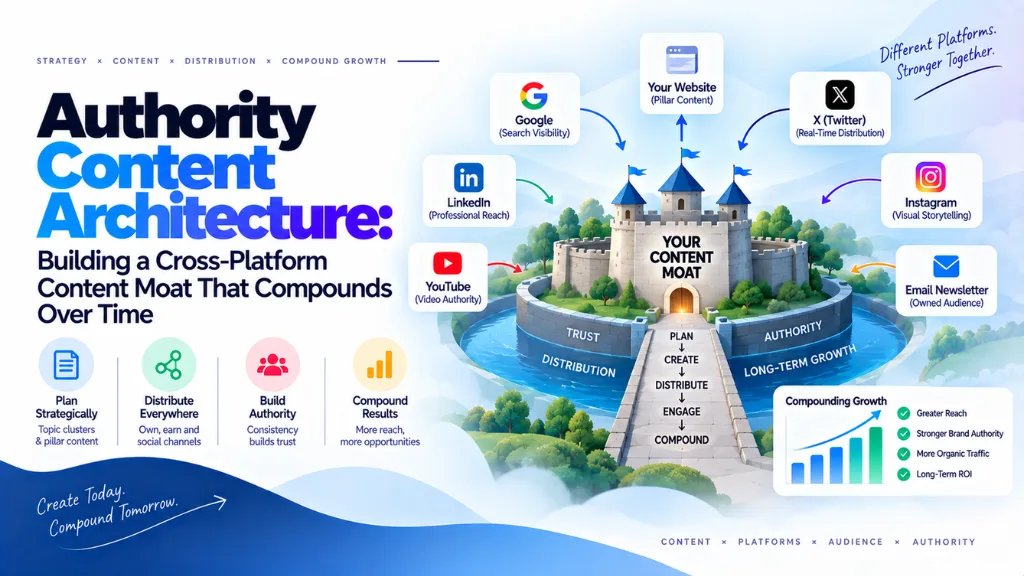

For a decade, the content moat was simple: publish more than your competitors could afford to. That advantage is gone. AI-assisted production has made volume cheap for everyone, which means volume alone no longer separates a defensible content asset from a pile of pages that decays the moment attention moves on. Authority content architecture is the deliberate structuring of content – within a site and across platforms – so that each new piece reinforces the ones before it, building a compounding advantage rather than a growing but disconnected archive.
In this article10 sections
The distinction matters more than it sounds. A well-structured library of interconnected content continues generating traffic and leads for years; scattered, unconnected posts decay individually and never add up to more than their sum. This article breaks down what authority content architecture actually consists of, how to extend it across platforms without diluting it, and why it compounds faster in 2026 than it did even two years ago.
What Is Authority Content Architecture?#
Authority content architecture is the structural design of a content library – pillar pages, supporting clusters, internal linking, and cross-platform reinforcement – built specifically so that authority signals accumulate at the site or brand level rather than resetting with every new piece published. It’s the difference between publishing 250 scattered articles across a generalist topic list and publishing 25 tightly interconnected articles on a defined subject: the smaller, structured set consistently outperforms the larger, disconnected one, because search systems and AI models alike read coherence and depth as evidence of genuine expertise.
This isn’t a new idea in isolation – the pillar-cluster model has been a staple of content strategy since the mid-2010s. What’s changed is where that structural coherence gets rewarded now: not just in traditional rankings, but in whether an AI system treats your content as reliable enough to cite.
Why Volume Alone No Longer Builds a Moat#
The old logic was straightforward: whoever could afford to publish fifty articles a month while a competitor managed five held an effectively insurmountable advantage in keyword coverage. AI production tools have removed that cost barrier entirely, which means raw output is no longer scarce, and it’s no longer a moat.
What is scarce is structural coherence. Research on content clusters has found sites implementing them see meaningfully higher organic traffic than sites publishing the same volume of unconnected content, because a search system’s helpful-content evaluation weighs the depth and breadth of coverage across a defined topic, not keyword density on individual pages. A site with twenty interconnected articles on a specific subject will consistently outrank a site with one longer, technically superior article standing alone – concentration beats volume, provided the concentration is structured, not just topically adjacent.
The Pillar-Cluster Model as the Structural Backbone#
The architecture itself follows a consistent pattern regardless of industry: a central pillar page, typically 2,500 to 4,000 words, covers a broad topic comprehensively and links out to a set of cluster articles – commonly 8 to 15 per pillar – each going deep on a specific subtopic and linking back to the pillar and to each other where genuinely relevant.
This length range isn’t arbitrary. Pillars need enough depth to demonstrate topical authority to both search algorithms and AI systems, but pages that stretch past roughly 5,000 words risk diluting passage-level relevance, since AI systems extract individual passages from a page rather than treating the whole document as a single unit. The pillar should summarize each subtopic and explicitly hand off full treatment to its corresponding cluster article, rather than trying to cover everything at maximum depth in one place.
How Many Cluster Articles Does a Pillar Need?#
Most effective pillar-cluster structures use somewhere between 8 and 15 cluster articles per pillar. Fewer than that rarely demonstrates enough topical depth to establish real authority; significantly more can start diluting internal-link equity across too many pages and making the cluster harder for a reader – or an AI system – to navigate coherently.
Before adding new clusters to an existing library, it’s worth running a structural audit first: merging pages that are cannibalizing each other for the same query, retiring or consolidating orphaned pages with no internal links pointing to them, and tightening the link topology across what already exists. Recovering authority that’s currently scattered across a messy structure is usually higher-leverage than publishing new clusters onto a foundation that isn’t organized yet. This is precisely the audit work Search Savvy runs as part of its content strategy and topical authority engagements before recommending any new cluster investment.
Extending the Architecture Across Platforms#
A content moat built entirely inside one website’s internal link graph is only half the structure that compounds in 2026. The same pillar-and-cluster logic can – and increasingly should – extend across platforms, using a single deep piece of source content as the foundation for a coordinated set of platform-native derivatives rather than treating each platform as a separate content operation.
A practical version of this: a single long-form recording or in-depth report becomes the “pillar” of a content cycle. From it, several cluster-style outputs get produced – a blog article covering the core findings, a set of native short-form video clips built for the specific platforms they’ll run on, and a LinkedIn carousel breaking down one specific insight in more depth. Each derivative reinforces the same underlying authority claim from a different angle and format, rather than existing as an unrelated one-off post competing for attention on its own.
The key discipline here is native reformatting, not copy-paste distribution. A cross-platform moat built by posting the identical asset everywhere unedited doesn’t compound – it dilutes, since neither platform’s audience gets content built for how they actually consume it there. Search Savvy’s social media services apply this same source-to-derivative model, producing platform-native versions of a single authoritative piece rather than distributing one asset unedited across every channel.
The AI Citation Flywheel: Why Authority Compounds Faster Now#
What makes authority content architecture compound faster in 2026 than it did even a couple of years ago is a self-reinforcing loop specific to AI search: original research generates citations from other publishers, those citations build brand recognition, brand recognition increases the likelihood of being surfaced and cited inside AI-generated answers, and that AI visibility in turn attracts more opportunities to be the source others cite for related research.
This flywheel rewards exactly the kind of structured depth a pillar-cluster architecture is built to produce – a defined topic covered comprehensively enough that other sources reference it as the canonical treatment, rather than a scattered set of surface-level posts none of which is authoritative enough to earn that reference. Top-of-funnel, evergreen educational content plays a particularly important role here: even when click volume on a specific page declines, AI systems often continue drawing on foundational content as source material for an entire category, which means maintaining and connecting that content within the architecture still pays off even as direct traffic patterns shift.
A Practical Framework for Building the Architecture#
- Audit before you build. Identify cannibalizing pages, orphaned content with no internal links, and existing pillars that lack real cluster support before committing to new topics.
- Choose pillars deliberately, not opportunistically. A pillar topic is a strategic commitment that shapes what gets produced across formats and platforms for months, not a single article decision.
- Build the cluster before claiming the authority. A pillar published without at least a handful of supporting cluster articles signals shallow coverage rather than depth, to both readers and AI systems.
- Design cross-platform derivatives from the source content, natively. Plan the blog article, the short-form clips, and the platform-specific breakdowns as one coordinated cycle from a single deep asset, each reformatted for its destination.
- Maintain the architecture, not just the pillar. Revisit cluster pages as the topic evolves; an unmaintained cluster erodes the coherence signal the entire structure depends on.
Search Savvy’s content marketing services are built around this audit-pillar-cluster-distribution cycle, treating each new piece of content as an addition to a compounding structure rather than a standalone deliverable.
Common Mistakes in Authority Content Architecture#
- Publishing pillars without adequate cluster support. A pillar page standing alone with no supporting depth reads as thin authority, not comprehensive coverage.
- Letting pillars exceed the useful length range. Pages stretched past roughly 5,000 words risk diluting the passage-level relevance AI systems extract from, rather than demonstrating more expertise.
- Cross-posting identical content across platforms. This dilutes the cross-platform moat rather than reinforcing it, since neither platform’s audience gets a version built for how they consume content there.
- Chasing new topics before fixing existing structure. Publishing new clusters onto a foundation with unresolved cannibalization or orphaned pages wastes the new content’s potential authority contribution.
- Treating the architecture as a one-time project. An unmaintained cluster loses coherence over time as the topic evolves around it, eroding the compounding effect the structure was built to create.
The Bottom Line#
Authority content architecture is what separates a content library that compounds from one that simply accumulates. The structural discipline – a pillar backed by genuine cluster depth, internal links that route authority deliberately, and cross-platform derivatives built natively rather than copy-pasted – is what search systems and AI models alike read as evidence of real expertise, and it’s what continues to pay off as an asset years after a single post would have decayed.
The practical next step is auditing your existing content for cannibalization and orphaned pages before adding a single new piece, then committing to one pillar topic worth building genuine depth around. Search Savvy’s topical authority services and AI search optimization (AEO/GEO) services are built specifically around this compounding structure, so content investment builds a defensible moat rather than another page that decays on its own.
Frequently Asked Questions#
What is authority content architecture? It’s the deliberate structuring of a content library – pillar pages, supporting clusters, internal linking, and cross-platform derivatives – so that authority signals accumulate across the whole structure rather than resetting with each new piece published.
How is a content moat different from just publishing a lot of content? Volume alone no longer creates a defensible advantage, since AI tools have made high-output production cheap for everyone. A moat comes from structural coherence – interconnected, deeply covered topics – which search systems and AI models read as evidence of genuine expertise rather than surface-level coverage.
How many cluster articles does a pillar page need? Most effective structures use 8 to 15 cluster articles per pillar. Fewer typically doesn’t demonstrate enough topical depth, while significantly more can dilute internal-link equity and make the structure harder to navigate.
Why shouldn’t I just repost the same content across every platform? Cross-posting identical, unedited content dilutes a cross-platform moat rather than reinforcing it. Each platform’s audience consumes content differently, so a genuinely compounding architecture requires native, platform-specific derivatives built from the same source material.
What is the AI citation flywheel? It’s the compounding loop where original research earns citations from other publishers, those citations build brand recognition, brand recognition increases the likelihood of AI systems surfacing and citing the content, and that visibility attracts further opportunities to be the cited source on related topics.
Should I fix my existing content structure before publishing new pillars? Generally yes. Cannibalizing pages, orphaned content, and thin existing pillars all undermine the authority signal new content is meant to build on. An audit before expansion typically recovers more value than adding new topics onto an unresolved structure.