Algorithmic Content Distribution: Engineering Virality Through Platform-Specific Signal Stacking
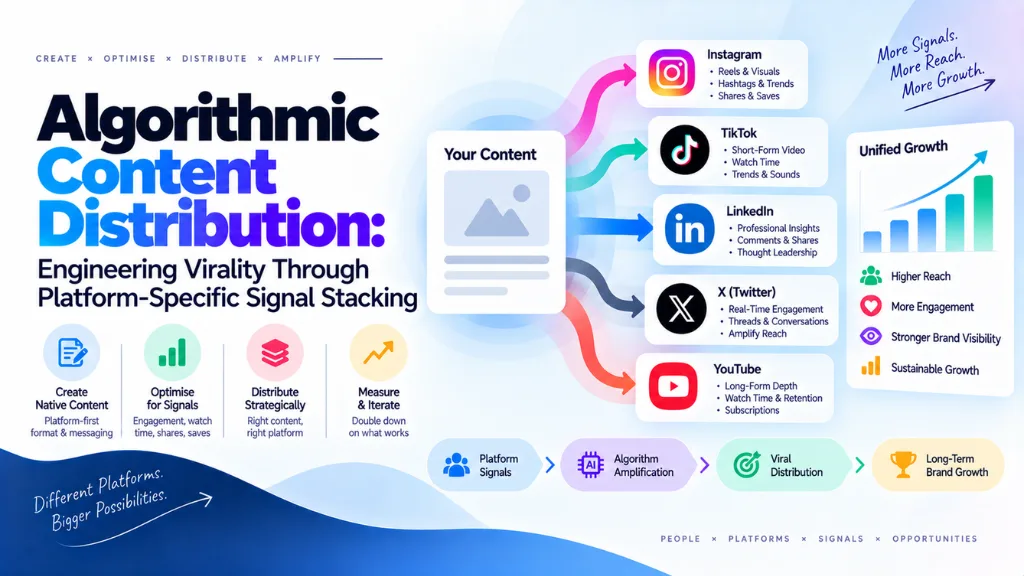

Follower count used to be the closest thing social media had to a reach guarantee. That relationship has broken down. Every major platform – Instagram, TikTok, LinkedIn, and Facebook – shifted between 2025 and 2026 toward interest-graph distribution, meaning content can now reach people who have never followed the account that posted it, and accounts with modest followings can outperform much larger ones on a single post. Algorithmic content distribution is the process by which a platform’s ranking system decides how far a piece of content travels beyond its original audience, based on how strongly that content triggers the specific signals the platform’s algorithm is built to reward.
In this article12 sections
Signal stacking is the practical response to this shift: designing a single piece of content to trigger multiple high-weight ranking signals simultaneously – on the specific platform it’s built for – rather than optimizing for one generic engagement metric and hoping it travels everywhere. This article breaks down what actually drives distribution on today’s major platforms, and how to engineer content that stacks the right signals instead of guessing.
What Is Algorithmic Content Distribution?#
Algorithmic content distribution refers to how a platform’s recommendation system decides which content gets shown beyond a creator’s existing audience – the mechanism behind a Reel reaching people who don’t follow the account, or a LinkedIn post surfacing in the feed of someone outside a poster’s network. Every major platform now runs on some version of an interest graph: transformer-based models that infer what a piece of content is about directly from its audio, visuals, and text, then match it to users predicted to engage with that topic, regardless of whether they follow the creator.
This is a structural change from the follow-graph model most platforms ran for the previous decade, where reach was largely capped by follower count. Under an interest graph, content has to earn its distribution on its own merits, post by post – which is exactly why understanding the specific signals a platform’s algorithm weights has become the actual lever for virality, not audience size.
Why Follower Count No Longer Predicts Reach#
The clearest illustration of this shift is TikTok’s For You Page, which by late 2025 accounted for over 70% of video views and was built from the outset to surface content from strangers rather than accounts a user already follows. But the same logic now applies broadly: engagement rate matters more than engagement volume, since a smaller, genuinely engaged audience moves content further than a large, passive one. Two hundred authentic interactions from a relevant audience can outperform two thousand passive likes from disengaged followers.
This also means vanity metrics have stopped working as proxies. Likes remain one of the weakest-weighted signals across every major platform in 2026, and follower count is close to irrelevant for Reels, For You, and Explore-style distribution.
The Core Signals Platforms Actually Weight in 2026#
While every platform has its own recommendation model, a handful of signal categories consistently carry the most distribution weight across 2026’s major platforms.
| Signal | What It Measures | Platforms Where It’s Most Weighted |
| Watch time / dwell time | How long a user stays with a piece of content relative to its length | TikTok, YouTube, Instagram Reels, LinkedIn |
| Completion rate | Percentage of viewers who watch or read to the end | TikTok, YouTube Shorts |
| Send/share rate to DMs | Content forwarded privately rather than just liked publicly | Instagram, increasingly other platforms |
| Comment/discussion quality | Depth and sentiment of comments, not just comment count | |
| Originality signals | Whether content is native and unrecycled versus reposted or cross-platform | Instagram, TikTok |
Instagram: Send Rate Is the Strongest Signal#
On Instagram specifically, a share sent via direct message now carries more distribution weight than a public like. The logic is straightforward: sending something to a specific friend costs the sender a small amount of social capital, so the algorithm treats that action as a much stronger endorsement of real-world value than a passive tap. The practical design question for every Instagram post becomes blunt – would a real person actually send this to someone they know? Content built around a strong send trigger, such as a genuinely useful tip or a relatable moment, tends to earn expanded distribution fast, independent of the poster’s follower count.
TikTok: Completion Rate and Rewatches#
TikTok’s recommendation system is explicitly built to maximize watch time and engagement, filtering content through a multi-step selection process based on interest signals rather than social connections. Completion rate and rewatches carry more weight here than almost anywhere else, which is why TikTok content built around a strong hook in the first two seconds and a payoff that rewards a second viewing consistently outperforms content optimized for likes or follows.
LinkedIn: Dwell Time and Discussion Quality#
LinkedIn’s algorithm favors content that holds attention and generates substantive discussion rather than quick, low-effort reactions. Document-style carousel posts have become one of the platform’s highest dwell-time formats, with a well-designed multi-slide carousel capable of holding a viewer’s attention for 20 seconds or more per impression – a significant ranking signal relative to a single static post. Comment quality also matters more here than raw comment count, since LinkedIn’s ranking considers the substance and sentiment of the discussion a post generates, not just its volume.
What Is Signal Stacking?#
Signal stacking means deliberately designing a single piece of content to trigger several of a platform’s highest-weighted signals at once, rather than optimizing for one metric in isolation. A short-form video built purely to maximize likes might miss the completion-rate and rewatch signals that actually drive TikTok distribution. A piece designed around all three – a fast hook for completion, a loop-friendly ending for rewatches, and a specific, shareable insight – stacks the signals the algorithm is actually built to reward.
This is fundamentally a content design decision made before production starts, not something applied retroactively through captions or hashtags. Hashtags have stopped functioning as a meaningful interest-graph discovery mechanism on Instagram or TikTok in 2026, since both platforms now read captions, on-screen text, and audio directly to understand a post’s topic – making natural-language framing far more important than tag volume.
A Platform-Specific Signal Stacking Playbook#
- Choose the platform’s top one or two signals before scripting or writing anything. For TikTok, that’s completion and rewatch; for Instagram, send rate; for LinkedIn, dwell time and discussion quality.
- Build the content structure around those signals directly. A TikTok hook engineered for the first two seconds, an Instagram caption that poses a question worth forwarding to a friend, or a LinkedIn carousel structured to reward slow scrolling all serve this purpose.
- Native-format everything. Never publish a watermarked cross-post; re-edit for each platform’s aspect ratio, pacing, and opening style rather than repurposing the same file.
- Track the signal, not just the outcome. Watch completion rate and rewatch percentage on TikTok, DM share rate on Instagram, and comment sentiment on LinkedIn – rather than relying on likes or follower growth as a proxy for whether the content actually stacked correctly.
- Iterate by signal, not by vanity metric. If a post underperformed on sends but got strong likes, the fix is a stronger reason to forward it, not a better hook to get more surface engagement.
Search Savvy applies this platform-specific playbook inside its platform growth and account optimization services, building content briefs around the actual weighted signal for each platform rather than a generic engagement target.
The Cross-Posting Penalty: Why Native Format Matters More Than Ever#
Every major 2026 algorithm now actively detects and penalizes obvious cross-posts. Instagram’s originality classifier suppresses recognizably reposted content, and accounts publishing ten or more reposts within a 30-day window can be excluded from recommendation surfaces entirely. A TikTok watermark carried into an Instagram Reel gets flagged the same way, and vertical video posted natively to LinkedIn without re-editing for the platform’s pacing and opening style consistently underperforms a version built specifically for it. Original, platform-native content receives roughly 40% to 60% more distribution than recycled content on Instagram – a gap large enough that the “post everywhere, unedited” strategy that worked in 2023 has become an active liability rather than an efficiency shortcut.
This is where a dedicated production process for each platform pays off. Search Savvy’s reels and short-form video production services and broader content calendar and creative production services are built specifically to produce native versions per platform rather than one asset spread everywhere unedited.
Common Mistakes in Algorithmic Content Distribution#
- Optimizing for likes. Likes remain one of the weakest distribution signals on every major platform in 2026; content built to maximize likes often misses the signals that actually drive reach.
- Cross-posting unedited content. Watermarks, wrong aspect ratios, and mismatched pacing trigger originality penalties rather than simply underperforming quietly.
- Chasing hashtag volume. Hashtags no longer function as a primary discovery mechanism on Instagram or TikTok, since both platforms read captions, audio, and on-screen text directly.
- Treating follower count as a distribution strategy. Follower count is close to irrelevant for interest-graph-driven surfaces like Reels, For You, and Explore.
- Measuring success by one metric across every platform. A post that performs on Instagram sends won’t automatically perform on TikTok completion rate; each platform needs its own success metric tracked separately.
The Bottom Line#
Algorithmic content distribution in 2026 rewards content engineered for specific, platform-weighted signals – send rate on Instagram, completion and rewatches on TikTok, dwell time and discussion quality on LinkedIn – not content built for generic engagement or a large follower base. Signal stacking means designing for those specific signals before production starts, and tracking the signal itself rather than a vanity metric to know whether it worked.
The practical next step is auditing your last five posts on each platform against that platform’s actual top-weighted signal, rather than a shared engagement dashboard. Search Savvy’s social media services build this platform-by-platform signal discipline into every content brief, so distribution is engineered deliberately rather than left to chance.
Frequently Asked Questions#
What is algorithmic content distribution? It’s the process by which a platform’s recommendation system decides how far content travels beyond a creator’s existing audience, based on how strongly the content triggers the specific ranking signals that platform’s algorithm rewards, such as watch time, completion rate, or share rate.
What is signal stacking in social media strategy? Signal stacking means designing a single piece of content to trigger several of a platform’s highest-weighted ranking signals at once – for example, a hook built for completion rate alongside an ending built for rewatches on TikTok – rather than optimizing for one generic engagement metric.
Does follower count still matter for reach in 2026? Follower count matters far less than it used to. Every major platform has shifted toward interest-graph distribution, meaning content can reach users who don’t follow the account, and a smaller, engaged audience often outperforms a larger, passive one.
Why do hashtags no longer drive discovery on Instagram or TikTok? Both platforms now use models that read captions, on-screen text, and audio directly to understand a post’s topic, making natural-language framing more important than hashtag volume. A handful of relevant tags does no harm, but stuffing dozens of tags no longer meaningfully improves discovery.
What happens if I cross-post the same content to multiple platforms unedited? Most major platforms now detect and penalize obvious cross-posts. Watermarked exports, mismatched aspect ratios, and recycled content can trigger originality-detection systems that suppress reach, sometimes excluding an account from recommendation surfaces entirely if the pattern repeats.
Which signal matters most on LinkedIn compared to Instagram or TikTok? LinkedIn weights dwell time and discussion quality most heavily, favoring formats like multi-slide carousels that hold attention. Instagram weights DM share rate most heavily, while TikTok prioritizes completion rate and rewatches – each platform requires a different content design to stack its top signal effectively.