
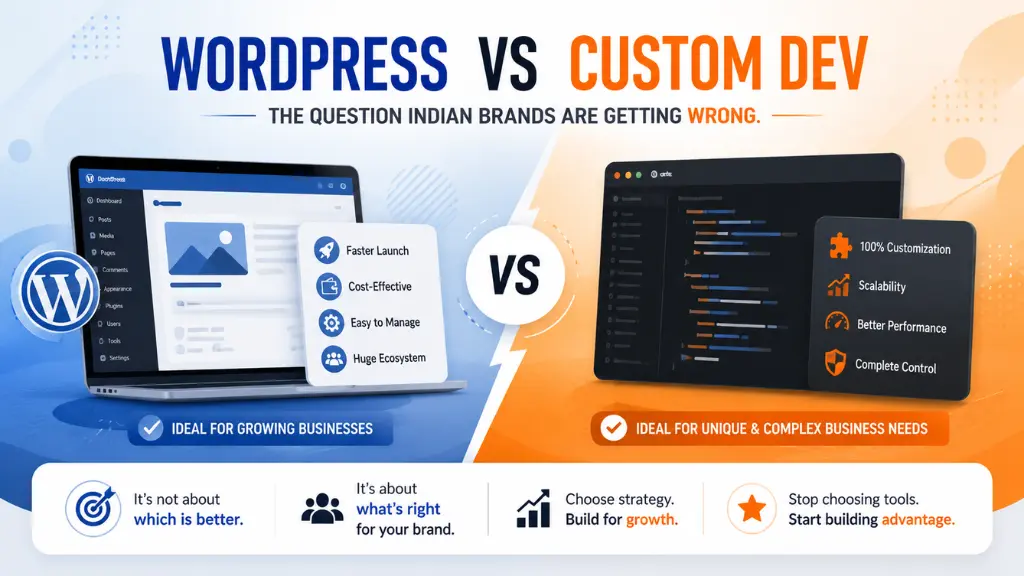

The WordPress vs custom website decision is one of the most consequential choices an Indian brand or SMB makes in its digital journey – and most get it wrong in both directions simultaneously. Some brands spend ₹15–20 lakh on a custom-built website that does exactly what WordPress would have done for ₹2 lakh. Others take a ₹15,000 WordPress site from a local freelancer, end up with 22 plugins, a heavy multipurpose theme, pages that haven’t been indexed after six months, and a developer who isn’t answering calls.
Neither outcome reflects the platform. Both reflect a decision made without the right framework.
WordPress powers 43% of all websites on the internet in 2026. Some of the world’s most technically sophisticated brands run on it. Some of the most underperforming Indian SMB websites run on it too. The platform is not the variable. The decision is.
At Search Savvy, this is a conversation we have with clients at every stage – from funded D2C startups choosing their first serious tech stack to established service businesses trying to understand why a new custom site they paid significantly for is underperforming their old WordPress site on every organic metric. This post gives you the honest, India-specific comparison: real costs, real performance trade-offs, real SEO implications, and the decision framework that tells you which is right for your specific situation.
What Is the WordPress vs Custom Website Decision Really About?
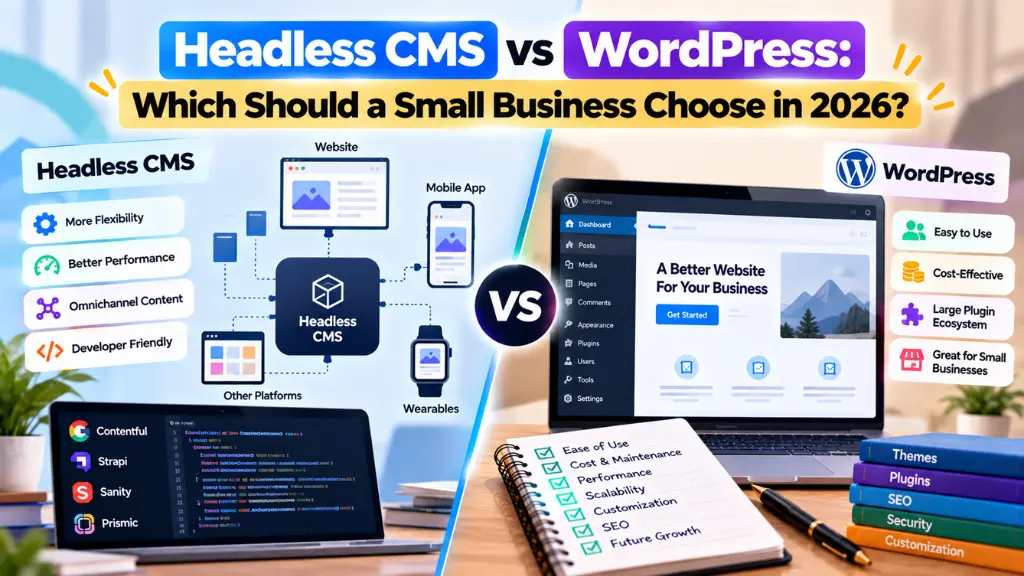
The WordPress vs custom website question is not fundamentally a technology question. It is a question about whether your requirements genuinely exceed what a well-configured off-the-shelf platform can deliver – and for most Indian brands, the honest answer to that question is no.
WordPress is a CMS (Content Management System) built on PHP and MySQL, running on open-source infrastructure, with a plugin ecosystem of over 60,000 plugins that extend its functionality across virtually every business use case. A properly built WordPress site with quality hosting, a lightweight theme, and selective plugin use is not a compromise – it is a mature, proven platform with a larger developer community, more SEO tooling, and lower total cost of ownership than custom development for the majority of use cases.
A custom-built website – whether in Next.js, Laravel, Django, or any other framework – is an entirely custom application. Every feature, every component, every integration is built from scratch by your development team. This gives you total architectural control. It also creates total architectural dependency: on your developers, on your budget, and on your ability to maintain what you have built.
The framing that most sales pitches get wrong, in both directions: custom development is not automatically better than WordPress, and WordPress is not automatically right for every budget. The decision should be made on the basis of your actual requirements – not on the basis of what an agency prefers to build, what sounds more impressive, or what was right for a brand in a completely different context.
How Do the Real Costs Compare: WordPress vs Custom Website in India?
The WordPress vs custom website cost comparison for Indian businesses looks very different from international benchmarks – because India has one of the most price-competitive development markets in the world, and the actual numbers are far more nuanced than the standard “WordPress is cheap, custom is expensive” narrative.
WordPress development costs in India (2026):
| Project Type | Typical Budget Range |
| Basic business site (5–10 pages) | ₹25,000 – ₹1,00,000 |
| Professional business site (services, blog, contact) | ₹75,000 – ₹2,50,000 |
| WooCommerce e-commerce (up to 500 products) | ₹1,00,000 – ₹4,00,000 |
| Complex WordPress with custom integrations | ₹3,00,000 – ₹8,00,000 |
WordPress development costs are 60–80% less than equivalent custom solutions for standard business websites.
Custom development costs in India (2026):
| Project Type | Typical Budget Range |
| Basic custom brochure site | ₹1,50,000 – ₹5,00,000 |
| Full business site with CMS | ₹3,00,000 – ₹15,00,000 |
| Custom e-commerce platform | ₹8,00,000 – ₹40,00,000+ |
| SaaS or application-grade custom build | ₹20,00,000 – ₹1,00,00,000+ |
But the build cost is only one line item. The more important number in the WordPress vs custom website analysis is total cost of ownership over 3–5 years.
The hidden cost no one talks about:
For WordPress: If your site breaks because of a plugin conflict or gets hacked, fixing it can cost ₹3,000 to ₹10,000 in emergency developer fees, and you may be offline for 12–48 hours. That lost business rarely gets calculated into the initial “cheap WordPress site” equation.
For custom development: The biggest hidden cost is not the build – it is the ongoing developer dependency. Every content update, every new feature, every text change on a purely custom site requires developer time. Indian freelancer rates for custom maintenance run ₹2,000–₹8,000 per hour, compared to ₹500–₹2,000 per hour for WordPress support. The independence that business owners can have on a well-built WordPress site – updating content, adding products, publishing blog posts without developer involvement – has genuine operational and cost value over a 3–5 year horizon.
WordPress sites go live in 2–6 weeks. Custom development typically takes 4–12 months for a full business site. For businesses needing immediate online presence – a coaching institute before admissions season, a D2C brand before festival sales – this speed-to-market difference is commercially significant.
How Does WordPress vs Custom Website Affect SEO Performance?
The WordPress vs custom website SEO comparison requires separating two distinct questions: the platform’s SEO capability in theory, and the SEO performance a typical implementation of each actually delivers in practice.
The theory:
Both platforms can achieve excellent SEO performance. WordPress is SEO-friendly by default, with clean URL structures, native meta tag management, and a plugin ecosystem (Yoast SEO, Rank Math, All in One SEO) that provides advanced optimisation capabilities without code. Custom sites can be built with exceptional SEO architecture – but this requires the developer to deliberately implement SEO best practices throughout the build process.
The honest winner on SEO theoretical capability: tie, with WordPress having easier defaults.
The practice:
In real Indian SMB deployments, the SEO performance comparison tilts significantly. The most common outcome in our experience:
- A custom site built by a developer who did not prioritise SEO has no schema markup, no structured sitemap, non-canonical URL structures, and meta tags that are hardcoded identically across all pages
- A properly configured WordPress site with Rank Math or Yoast provides automated sitemap generation, on-page SEO guidance per post and page, schema markup through plugins, and canonical URL management – all accessible to non-developers
Indian businesses using WordPress properly often rank ahead of competitors with custom sites that lack proper SEO architecture. This is the practical reality: the platform does not determine SEO performance. The implementation does. And WordPress’s implementation defaults are substantially more SEO-friendly than the average custom site built by a developer whose primary focus is code functionality, not search visibility.
The 2026 Core Web Vitals dimension:
Custom sites built with clean code consistently achieve faster raw load speeds – custom sites load 2–3 seconds faster on average than bloated WordPress installations with heavy themes and 20+ plugins. But the key phrase is “bloated WordPress.” A WordPress site with a lightweight theme (Astra, GeneratePress, Bricks), selective plugin use, quality hosting, and image optimisation achieves Core Web Vitals scores that match or exceed most custom builds at a fraction of the cost.
For Indian SMBs where site performance is primarily a mobile-first concern – more than 80% of searches in India happen on mobile phones – the hosting quality and image optimisation choices matter far more than whether the site runs on WordPress or custom code.
When Should You Choose WordPress for Your Indian Business?
The WordPress vs custom website decision has clear cases where WordPress is definitively the right choice – and understanding them prevents the most common version of this mistake: paying custom development rates for requirements that WordPress handles natively.
WordPress is the right choice when:
- You need content independence – your team needs to publish blog posts, update service pages, add products, or edit copy without filing developer support tickets. WordPress’s admin interface is accessible to non-technical users. A custom CMS is not, unless significant additional budget is spent building a CMS interface.
- Your site functions as a content or marketing platform – blogs, news sites, coaching institutes, service businesses, and most D2C brands are content-first businesses. WordPress’s editorial workflow, category and tag architecture, and blogging engine are mature, battle-tested, and deeply integrated with every major SEO tool available.
- You need e-commerce under ₹20 lakh – WooCommerce powers some of India’s largest D2C brands. With a premium product theme, Razorpay, PayU, or Paytm integration, and an inventory management plugin, WooCommerce handles the full ecommerce stack for most Indian SMB use cases without custom development costs.
- You need to launch quickly – a professionally built WordPress site is live in 2–6 weeks. If your business context has a time-sensitive launch (festival season, funding announcement, product launch), custom development’s 4–12 month timeline is not compatible with your requirements.
- Your SEO strategy is content-led – the combination of Rank Math or Yoast, native permalink management, automatic XML sitemap generation, and structured data plugins makes WordPress the platform where content-led SEO scales most efficiently. A custom site with equivalent SEO tooling requires significant bespoke development investment.
- You want a large, available developer pool – finding a WordPress developer in India is straightforward; hourly rates are ₹500–₹2,000. Finding a specialist in a less common custom stack (Next.js + Strapi, for example) requires a significantly narrower search and higher rates.
When Should You Choose Custom Development Instead?
The WordPress vs custom website decision also has clear cases where custom development is genuinely justified – and understanding these prevents the opposite mistake: under-building for requirements that WordPress cannot actually meet efficiently.
Custom development earns its premium when:
- You are building a SaaS, platform, or application – if your “website” includes user authentication, user-specific data, dynamic dashboards, complex API integrations, or application-grade logic, you are building a software application, not a website. WordPress was not designed for this and bending it to fit creates compounding technical debt.
- You need maximum performance at genuine scale – sites serving millions of users per day, handling real-time data feeds, or requiring sub-100ms response times at global scale genuinely benefit from custom architecture optimised for those requirements. This describes a small minority of Indian businesses, but they do exist.
- You have specific security or compliance requirements – heavily regulated industries (banking, healthcare data, government) with strict data residency, compliance, and security architecture requirements may need custom builds that satisfy those constraints precisely.
- Your functionality requirements are uniquely complex – over 60,000 WordPress plugins solve the majority of business requirements. When your specific requirement cannot be addressed by any existing plugin combination, and the custom development of that functionality within WordPress’s framework would be more complex than building it independently, custom development is justified.
- You have a permanent internal development team – the developer dependency risk of a custom site is manageable when you have developers on payroll who own the codebase permanently. Without this, a custom site creates a long-term maintenance vulnerability.
What Does the Hybrid Approach Look Like for Indian Brands?
The WordPress vs custom website binary is not the only option – and for many Indian brands at specific growth stages, a hybrid approach is the most rational choice.
The most common and effective hybrid patterns:
WordPress as the marketing site + Custom for the application layer: Your public-facing website, blog, pricing page, and landing pages run on WordPress (fast to update, SEO-friendly, content-team-accessible). Your product dashboard, customer portal, or booking application runs on a custom stack. This is how many of India’s growing SaaS and service brands operate – and it delivers the content agility of WordPress with the application capability of custom development where each is most needed.
WordPress with custom plugin or theme development: Standard WordPress installation, but specific functionality that no plugin handles adequately is built as a custom plugin or custom Gutenberg block. This keeps 80–90% of the site in the low-maintenance WordPress ecosystem while extending capability precisely where required.
Headless WordPress: WordPress as a backend CMS (familiar editorial interface, plugin ecosystem, content workflow) with a custom Next.js or Gatsby frontend for maximum performance. As discussed in our headless CMS post – this is a viable approach but requires permanent developer involvement and significantly higher initial investment. It is the right hybrid for brands that have outgrown standard WordPress performance but cannot manage a full platform migration.
FAQ: WordPress vs Custom Website for Indian Businesses in 2026
Q1: Is WordPress better than a custom website for SEO in India? Both platforms achieve excellent SEO when implemented correctly – but WordPress is easier to implement correctly. WordPress includes SEO-friendly URL structures, native sitemaps, and plugins like Rank Math and Yoast that provide on-page optimisation guidance accessible to non-developers. Custom sites can match or exceed this – but only when the developer deliberately implements SEO architecture throughout the build. In practice, Indian businesses using properly configured WordPress often outrank competitors with custom sites that lack structured SEO implementation.
Q2: What does a WordPress website cost in India in 2026? A professional WordPress business site ranges from ₹25,000 to ₹2,50,000, depending on complexity. WooCommerce e-commerce implementations typically run ₹1,00,000 to ₹4,00,000 for up to 500 products with Indian payment gateway integration (Razorpay, PayU, Paytm). Complex WordPress sites with custom integrations can reach ₹3,00,000 to ₹8,00,000. These costs are 60–80% lower than equivalent custom development.
Q3: Is a custom website faster than WordPress? Custom sites built with clean, minimal code can load 2–3 seconds faster than poorly built WordPress sites. However, a WordPress site with a lightweight theme (Astra, GeneratePress), selective plugin use, optimised images, and quality hosting achieves Core Web Vitals scores that match or exceed most custom builds. The performance difference is not platform-inherent – it is implementation-dependent. A bloated WordPress site with 22 plugins is slower. A lean, well-hosted WordPress site with strong technical SEO is not.
Q4: How long does it take to build a custom website vs WordPress in India? A professional WordPress site typically launches in 2–6 weeks. Custom development for a full business site takes 4–12 months. For time-sensitive launches – festival sales campaigns, product launches, funding announcements – WordPress’s speed to market has direct commercial value. Custom development’s timeline is justified when the requirements genuinely demand it and the brand has runway to absorb the development period.
Q5: What are the hidden costs of WordPress vs custom development? For WordPress: plugin conflicts, security vulnerabilities from outdated plugins, emergency developer fees (₹3,000–₹10,000 for emergency fixes), and potential downtime. For custom development: the ongoing developer dependency – every content change, feature addition, and bug fix requires developer time at ₹2,000–₹8,000 per hour. Business owners on custom sites have significantly less content independence than on WordPress, creating an ongoing cost that compounds over years.
Q6: Should a D2C brand in India use WordPress or custom development? For most Indian D2C brands – especially those with under ₹20 lakh in annual digital budget – WordPress with WooCommerce is the stronger choice. WooCommerce handles product catalogues, Indian payment gateways (Razorpay, PayU, Paytm), inventory management, and shipping integrations without custom development cost. It provides content independence for the marketing team and a strong SEO foundation. Custom e-commerce development is justified when the business has reached a scale where WooCommerce’s performance or feature limitations are genuinely constraining growth – typically above ₹50–100 crore GMV with complex operational requirements.
The Bottom Line
The WordPress vs custom website decision is not a question of which platform is better in the abstract. It is a question of which platform is right for your specific requirements, budget, team capability, and timeline – and the honest answer for most Indian brands, at most stages of growth, is WordPress.
Not because custom development is worse. Because for the requirements most Indian SMBs actually have – a professional website, a content strategy, a blog, possibly an e-commerce store with Indian payment gateways – WordPress delivers those capabilities faster, at lower cost, with more content independence, and with better SEO defaults than a custom build provides for the same investment.
Custom development earns its premium when requirements genuinely exceed what WordPress can deliver. When you are building application-grade functionality, operating at genuine scale, or have compliance requirements that demand architectural control – custom development is the right answer. For a 10-page services website, it is not.
According to Search Savvy’s web strategy practice, the most consequential outcome of choosing the wrong platform is not the initial build cost – it is the opportunity cost. A ₹15 lakh custom brochure site that took 8 months to build and requires developer support for every content update is 8 months of organic content strategy you didn’t publish and ₹13 lakh you didn’t invest in marketing. That is the real cost of the wrong platform decision.
If you are making this decision now – or re-evaluating a platform choice that is not serving your business – reach out to the Search Savvy team. We’ll help you make the decision that matches your actual requirements, not the most impressive-sounding answer.