

Every SEO strategy eventually falls into one of three categories, whether the business choosing it realises this or not. One builds rankings that compound for years. Another can wipe out a site’s entire traffic within 72 hours. The third used to be a genuine grey area – in 2026, that grey area has almost entirely disappeared.
White hat vs black hat vs grey hat SEO is not just an ethical debate; it is a practical risk calculation with real financial stakes attached. Black hat tactics typically result in 50–95% traffic drops within 72 hours, with recovery periods of 6 to 18 months or longer, according to Whitehat SEO’s 2026 black hat analysis. Google’s SpamBrain AI system now operates in near real time, meaning detection that once took months can happen within days, according to iMark Infotech’s 2026 grey hat guide.
At Search Savvy, we get asked constantly whether faster, riskier tactics are worth considering when a client wants quicker results. This guide breaks down white hat vs black hat vs grey hat SEO clearly, using current 2026 penalty and recovery data, so the decision is grounded in actual risk, not guesswork.
What Actually Separates White Hat vs Black Hat vs Grey Hat SEO?
White hat vs black hat vs grey hat SEO comes down to one core distinction: adherence to Google’s published guidelines, and how directly a tactic attempts to manipulate ranking signals rather than earn them.
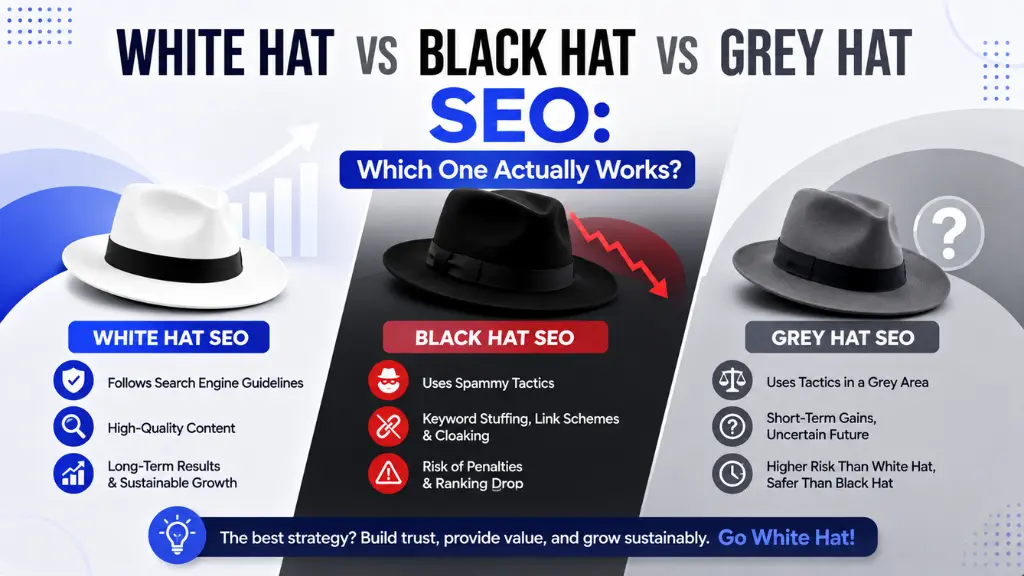
White hat SEO follows Google’s published guidelines exactly – real content, real outreach, real editorial value. Black hat SEO openly breaks the rules through link farms, private blog networks, automated content spam, cloaking, and hidden text. Grey hat sits between the two, bending rules without explicitly breaking them, with lines that get redrawn every time Google updates its algorithm, according to Respona’s 2026 grey hat SEO analysis.
White hat vs black hat vs grey hat SEO also differs in how Google’s enforcement systems treat each category. Google employs two distinct enforcement mechanisms – algorithmic penalties, which are automated, and manual actions, which are human-reviewed – and its SpamBrain AI system processes billions of signals daily to maintain search quality, according to Whitehat SEO’s 2026 report.
People Also Ask: Is grey hat SEO actually against Google’s rules? Short Answer: Not explicitly, which is exactly what defines it. Grey hat tactics bend Google’s guidelines without breaking them outright, but the boundary shifts constantly as Google’s algorithm evolves, meaning a technique considered acceptable today can be reclassified as manipulative after a future update.
How Does White Hat SEO Actually Perform in 2026?
White hat vs black hat vs grey hat SEO increasingly resolves in white hat’s favour as Google’s detection systems mature, since white hat’s compounding nature aligns directly with how modern ranking and AI citation systems evaluate content quality.
White hat SEO in 2026 is not a choice between ethical and effective – it is described as the only sustainable strategy across every search surface, including Google, ChatGPT, Perplexity, and emerging AI platforms, according to Whitehat SEO’s 2026 white hat guide. This alignment is not accidental: expertise, original research, transparent sourcing, and real authority compound together across both traditional rankings and AI citation systems, which increasingly reward the same underlying quality signals.
The data backs this alignment concretely. Following Google’s December 2025 core update, sites demonstrating strong E-E-A-T signals saw visibility gains averaging 23%, while health and finance sites lacking demonstrable expertise experienced ranking losses exceeding 60%, per the same Whitehat SEO analysis. Structured, well-organised pages also carry a genuine advantage into the AI search era – pages with clear H1-H2-H3 hierarchy are 2.8 times more likely to be cited by AI systems, according to Incremys’ 2026 black hat risk analysis.
People Also Ask: Does white hat SEO still work as well as it used to, given how much search has changed? Short Answer: Yes, and arguably better. White hat principles – genuine expertise, original research, transparent sourcing – now align directly with both traditional Google rankings and AI citation systems, meaning the same quality work increasingly earns visibility across multiple search surfaces simultaneously.
What Actually Happens When Black Hat SEO Gets Caught?
White hat vs black hat vs grey hat SEO shows its starkest contrast in penalty consequences, and 2026 data on black hat outcomes is genuinely severe compared to what many site owners expect going in.
Black hat tactics typically result in 50–95% traffic drops within 72 hours of detection, with recovery periods running 6 to 18 months or longer, according to Whitehat SEO’s 2026 analysis. The financial consequences compound from there: 40% of businesses hit with a penalty close within six months, based on Whitehat SEO’s analysis of post-penalty businesses.
Brand size offers no real protection either. Google’s March 2024 Core Update – described as the most aggressive spam crackdown in a decade – deindexed major publishers including Forbes Advisor, CNN Underscored, and WSJ’s Buy Side, demonstrating that brand authority no longer provides immunity from enforcement, per the same source. In 2026, black hat has also expanded to include “AI-washing” – the mass production of low-quality, AI-generated content designed to flood search results, according to Agnikii Digital’s 2026 black hat guide.
People Also Ask: How quickly can a black hat SEO penalty destroy a website’s traffic? Short Answer: Very quickly – typically a 50–95% traffic drop within 72 hours of detection, according to 2026 data. Recovery, if it happens at all, generally takes 6 to 18 months or longer, making black hat tactics a genuinely severe financial risk, not a manageable trade-off.
Why Has the Grey Hat SEO Middle Ground Nearly Disappeared?
White hat vs black hat vs grey hat SEO used to offer grey hat as a genuine strategic middle path – faster results than white hat, less risk than black hat. In 2026, that positioning has become considerably harder to defend.
Grey hat SEO sits in the gap between white hat and black hat, but in 2026, that gap is almost gone, according to Respona’s 2026 analysis. Classic grey hat tactics still circulating – private blog networks, link exchanges at scale, undisclosed paid links – either stopped working or get devalued quickly, since Google’s algorithm now catches most rank- manipulating signals quietly, without issuing a manual penalty notification. You simply stop ranking, without warning.
The recovery data for grey hat specifically is discouraging. Only 30% of penalised sites recover their rankings within a year, and practices like buying niche edits, scaling unreviewed AI content, and operating private blog networks now regularly trigger penalties, according to iMark Infotech’s 2026 grey hat guide. There is also significant 2026 data suggesting Google penalties are becoming more permanent – even after correcting violations and requesting reconsideration, some site owners are rejected, according to Digitalup’s 2026 grey hat analysis.
People Also Ask: Is grey hat SEO worth the risk for faster results in 2026? Short Answer: Generally, no. Only about 30% of penalised sites recover their rankings within a year, and Google’s SpamBrain AI now detects manipulation patterns in near real time, meaning the “safe ambiguity” that once made grey hat tactics appealing has largely disappeared.
Why Does Google Evaluate Grey Hat Tactics as a Pattern, Not Individually?
White hat vs black hat vs grey hat SEO classification is not decided technique by technique in 2026 – Google’s systems increasingly evaluate the overall pattern a site’s tactics create together, which is precisely why grey hat has become so much riskier.
Google evaluates tactics not individually but as a whole – even if each individual element is technically defensible, the manipulation pattern they collectively create can still trigger a penalty, according to Digitalup’s 2026 report. This pattern-level evaluation is a genuine shift from earlier SEO eras, when individual tactics could sometimes be assessed and tolerated in relative isolation.
The pace of algorithmic change has accelerated this shift further. Google now ships roughly 500 to 600 updates per year, according to SEO.com data cited in Incremys’ 2026 analysis, meaning a grey hat technique considered borderline-acceptable today can be explicitly reclassified within weeks, without any specific announcement targeting that individual tactic.
People Also Ask: Can one individually “safe” SEO tactic still result in a penalty? Short Answer: Yes, if it forms part of a broader manipulation pattern. Google increasingly evaluates the collective pattern of tactics a site uses, not just whether each individual technique technically complies with guidelines in isolation.
What Does a Penalty Actually Cost Beyond Lost Traffic?
White hat vs black hat vs grey hat SEO risk calculations often focus narrowly on lost search traffic, but 2026 penalties carry consequences that extend well beyond a traditional ranking drop.
A penalty does not just reduce clicks – it can also remove a site’s presence from AI answers, where an increasing share of visibility is now decided, according to Incremys’ 2026 analysis. Given that Gartner projects traditional search traffic could drop roughly 25% by the end of 2026, losing visibility in AI-generated answers alongside traditional search represents a genuinely compounding loss, not two separate risks.
Reputational cost compounds the financial one further. Association with spammy practices, negative mentions, and reduced commercial credibility are especially damaging in B2B contexts, where trust signals weigh heavily in purchase decisions, per the same source.
People Also Ask: Do SEO penalties affect visibility in AI search tools too, not just Google’s traditional results? Short Answer: Yes. A penalty can remove a site’s presence from AI-generated answers alongside traditional search rankings, which matters increasingly given how much visibility is now determined by AI platforms rather than traditional blue-link results alone.
How Should You Actually Build a Sustainable SEO Strategy?
White hat vs black hat vs grey hat SEO decisions should be guided by the compounding-versus- half-life distinction that separates genuinely sustainable strategy from short-term gambling.
The organic traffic built through white hat work compounds – grey hat work, by contrast, has a half-life, according to Respona’s 2026 analysis. White hat SEO is described as an investment in sustainable competitive advantage that accelerates over time, rather than a tactic that needs to be replaced or refreshed once its effect quietly decays.
According to Search Savvy’s insights from auditing sites that previously used grey or black hat tactics before coming to us, the cleanup cost – disavowing manipulative links, rebuilding content, restoring trust signals – consistently exceeds what the original shortcut ever saved.
A practical framework for a sustainable strategy:
- Build content around genuine expertise and original research, since these signals compound across both traditional rankings and AI citation systems
- Structure content with clear heading hierarchy, given its documented advantage for AI citation eligibility
- Avoid any tactic explicitly designed to manipulate ranking signals rather than earn them, regardless of how common it appears among competitors
- Treat E-E-A-T signals as core infrastructure, not an occasional content addition
- Expect black hat and grey hat competitors to eventually face penalties, and build your own strategy to be unaffected when that happens
At Search Savvy, we recommend building an SEO strategy assuming Google’s detection capabilities will only get stronger over time – because based on every available 2026 data point, that trend shows no sign of reversing.
FAQ: White Hat vs Black Hat vs Grey Hat SEO
Q1: Is it ever worth using black hat SEO tactics for a short-term campaign? A: Generally, no. Black hat tactics typically result in 50–95% traffic drops within 72 hours of detection, with recovery periods of 6 to 18 months or longer – a risk-reward calculation that rarely favours the short-term gain for most legitimate businesses.
Q2: How can I tell if a tactic is grey hat rather than black hat? A: Grey hat tactics bend Google’s guidelines without explicitly breaking them, while black hat tactics openly violate published policies. However, this distinction matters less in 2026 than it used to, since Google increasingly evaluates the overall pattern a tactic contributes to.
Q3: Does Google always send a warning before penalising a site? A: No, and this is a common misconception. The more common scenario is quiet, algorithmic devaluation of specific pages or links, where a site simply stops ranking for queries it previously ranked for, without any notification in Search Console.
Q4: Can a site fully recover after a black hat or grey hat SEO penalty? A: Recovery is possible but not guaranteed. Only about 30% of penalised sites recover their rankings within a year, and there is growing 2026 evidence that some penalties are becoming effectively permanent, even after violations are corrected and reconsideration is requested.
Q5: Why do competitors using grey hat tactics sometimes seem to outrank white hat sites? A: Grey hat tactics can produce short-term ranking gains before detection catches up, creating a temporary, misleading advantage. This advantage has a documented half-life, though, and tends to reverse once Google’s systems identify the manipulation pattern.
Q6: Is white hat SEO still competitive against businesses using faster tactics? A: Yes, and increasingly more so. White hat principles align directly with what both traditional Google rankings and AI citation systems reward in 2026, meaning the compounding advantage of white hat work often outpaces short-term gains from riskier tactics over any meaningful time horizon.
Want an SEO strategy audit to confirm your site is built on sustainable, white hat foundations? Visit Search Savvy to speak with an expert who can identify any risk sitting in your current approach.