
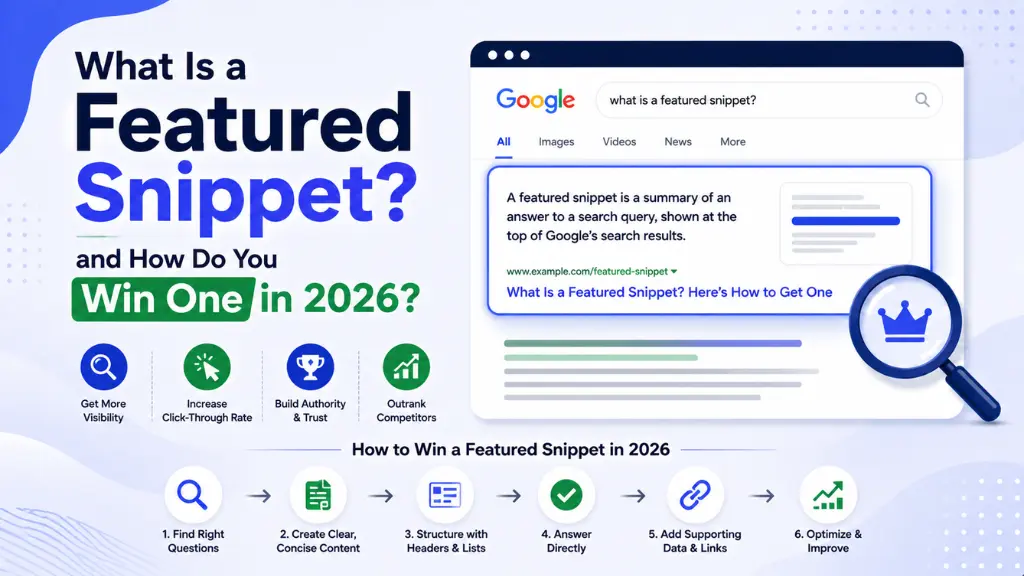

There is a spot on Google’s results page that outranks the number one organic listing entirely – sitting above every traditional result, in a highlighted box with your brand name and URL attached. Marketers have called it “position zero” for years, and in 2026, it remains one of the most valuable, attributable pieces of search real estate available.
A featured snippet is a highlighted answer box that appears above the standard organic results, pulling a direct answer from a single page in response to a specific search query. Featured snippets still appear in 19% of queries alongside AI Overviews, even as Google’s AI Overviews now appear on 58% of queries as of early 2026, frequently displacing traditional snippets, according to DigitalApplied’s 2026 featured snippet guide.
At Search Savvy, featured snippet optimisation remains one of the highest-leverage tactics we use for clients, precisely because it is dual-purpose in 2026 – the same structural discipline that wins a snippet also makes content far more likely to earn AI Overview citation. This guide breaks down what a featured snippet is, how it works alongside AI Overviews, and how to win one.
What Is a Featured Snippet, Exactly?
A featured snippet is a distinct search result format that displays a direct answer, list, table, or short video segment above all standard organic listings, pulled and attributed to one single source page.
Featured snippets place your brand, URL, and answer in a defined box above all organic results – a distinction that still drives brand recall and topical authority signals, according to StackMatix’s 2026 position zero guide. This single-source attribution is precisely what separates a featured snippet from an AI Overview: AI Overviews synthesise multiple sources without prominently crediting any individual site, while a featured snippet credits exactly one page, in a highly visible way, per the same source.
A featured snippet also levels the competitive field in a way raw domain authority normally does not allow. A well-structured answer on a lower-authority domain can outrank a legacy competitor with far higher authority, if the content matches query intent more precisely, since Google prioritises format fit over raw authority for the majority of snippet-triggering queries, according to StackMatix’s 2026 analysis.
People Also Ask: What is the difference between a featured snippet and a regular search result? Short Answer: A featured snippet appears above all standard organic results in a highlighted box, pulling a direct, specific answer from one source page. Regular results simply list a page’s title, URL, and meta description without extracting and displaying an actual answer.
How Is a Featured Snippet Different From an AI Overview?
A featured snippet and an AI Overview both aim to answer a query directly on the results page, but they work through genuinely different mechanisms with different implications for attribution and visibility.
Featured snippets pull one block of text from one source, while AI Overviews synthesise from multiple sources – making it possible to be cited alongside other authorities rather than needing to win a single spot, according to Robiz Solutions’ 2026 AI Overview guide. Research shows a strong correlation between pages previously selected as featured snippets and pages later cited as sources in AI Overviews, according to DigitalApplied’s 2026 report – meaning snippet optimisation is not a competing strategy to AI Overview visibility, but the highest-leverage path toward it.
- Featured snippet – one source, one highlighted box, direct brand and URL attribution
- AI Overview – multiple sources synthesised together, less prominent individual attribution
- Overlap – pages earning featured snippets are meaningfully more likely to also earn AI Overview citation for the same or related queries
People Also Ask: If I optimise for featured snippets, does that also help with AI Overviews? Short Answer: Yes, considerably. Content earning featured snippets tends to use the same structural signals – direct answers, authoritative sourcing, clean schema – that also make content citation-worthy for AI Overviews, so optimising for snippets naturally improves AI citation eligibility.
Which Types of Search Queries Actually Trigger a Featured Snippet in 2026?
A featured snippet is far more likely to appear for certain query formats than others, and understanding which types trigger a snippet rather than an AI Overview is now essential for prioritising optimisation effort.
Queries starting with “how to,” followed by a specific task, regularly trigger ordered-list snippets and have lower AI Overview trigger rates than pure definitional queries, according to DigitalApplied’s 2026 guide. “X vs Y” and “difference between X and Y” comparison queries also reliably favour the featured snippet format over a full AI Overview.
Pages typically need to rank in the top 10 to be selected for a featured snippet at all, and the highest-probability candidates for winning one already rank between positions 2 and 8 – genuinely visible but not yet holding the snippet, per the same source. This makes prioritisation straightforward: identify the queries where you already rank on page one but a competitor holds the box, rather than starting from queries where you do not rank at all.
People Also Ask: What kinds of queries are most likely to show a featured snippet instead of an AI Overview? Short Answer: “How to” queries tied to a specific task, and “X vs Y” comparison queries, both reliably favour the featured snippet format. Pure definitional or broad informational queries are more likely to trigger a full AI Overview instead.
How Should You Structure Content to Win a Featured Snippet?
A featured snippet is won largely through formatting discipline – Google extracts the most directly usable, self-contained answer it can find, so burying the answer beneath a long preamble defeats the purpose entirely.
A 200-word preamble before the actual definition or answer is one of the most common mistakes that causes otherwise strong content to lose the snippet, according to StackMatix’s 2026 guide. Every H2 and H3 section should fully answer its specific sub-question on its own – do not split an answer across multiple sections, and do not assume the reader has already read your introduction, according to ResultFirst’s 2026 guide.
Passage length also matters at a genuinely specific level. AI Overview and snippet extraction favours 134–167 word self-contained passages, with 62% of featured content landing between 100 and 300 words, according to Wellows’ 2026 research, based on analysis of nearly 16,000 AI Overview results across 63 industries.
Practical formatting principles for winning a featured snippet:
- Lead with the direct answer, immediately after the heading, before any elaboration
- Keep answer passages to roughly 40–60 words for paragraph-style snippets, or 134–167 words for longer, self-contained answer blocks
- Use ordered lists for “how to” content, since numbered steps consistently trigger list- format snippets
- Use tables for comparison content, since “X vs Y” queries frequently trigger table-format snippets
People Also Ask: How long should the answer be to win a featured snippet? Short Answer: Roughly 40–60 words for a typical paragraph snippet, though longer, self-contained passages of 134–167 words also perform well for AI extraction more broadly. The key requirement is that the answer is complete and does not require reading surrounding content to make sense.
Why Does Data Specificity Improve Your Chances of Winning a Featured Snippet?
A featured snippet is significantly more likely to come from content that includes concrete, verifiable data rather than generic, conceptual statements – specificity functions as a genuine citation hook, not just good writing style.
Data-backed snippets show 40% higher citation rates than purely conceptual answers, since AI models prioritise verifiable information – statistics, dates, specific numbers, percentages, and concrete examples, according to Yarnit’s 2026 guide. Generic advice tends to get summarised in someone else’s words; specific data tends to get cited directly, with attribution intact.
A weak, unstructured sentence like “SEO professionals should focus on several key factors including content quality, technical optimisation, and user experience” performs considerably worse than a structured, specific version: “SEO success requires three core elements. Content quality ranks first. Technical optimisation ranks second. User experience ranks third,” per the same Yarnit analysis – the second version isolates each point cleanly, making it far easier to extract as a standalone answer.
People Also Ask: Does including statistics actually improve featured snippet chances? Short Answer: Yes, substantially. Data-backed answers show roughly 40% higher citation rates than purely conceptual ones, since AI models and Google’s extraction systems both prioritise verifiable, specific information over generic, unattributed advice.
Does Schema Markup Help You Win a Featured Snippet?
A featured snippet benefits meaningfully from proper schema markup, since structured data helps Google’s systems interpret exactly what a piece of content represents before deciding whether to extract it.
Pages with valid schema are two to four times more likely to appear in AI Overviews and featured snippets, and sites with complete schema implementation see up to 40% more AI Overview appearances, according to ResultFirst’s 2026 guide. Google, Microsoft, and ChatGPT all confirmed in 2025 that they use schema markup to power their generative AI features, making structured data a core requirement for AI visibility rather than an optional technical nicety.
Practical schema steps worth implementing:
- Use JSON-LD format specifically, since it is the format Google explicitly recommends
- Run every key page through Google’s Rich Results Test before publishing
- Test regularly, since schema errors can silently cost visibility for months if left unnoticed
- Add FAQ schema to genuine Q&A content, supporting both snippet and AI citation eligibility
People Also Ask: Is schema markup required to win a featured snippet? Short Answer: Not strictly required, but it significantly improves the odds. Pages with valid schema are two to four times more likely to appear in featured snippets and AI Overviews, according to 2026 data, making it one of the highest-return technical investments available.
How Should You Actually Prioritise Which Queries to Target?
A featured snippet strategy works best when built around a clear prioritisation framework, rather than attempting to optimise every page on a site simultaneously for snippet capture.
Start with the queries where you already rank in the top five and a competitor currently owns the box – this dual-coverage opportunity is where most teams see the fastest wins, according to StackMatix’s 2026 guide. If a page sits on page two of results, close the ranking gap first before investing time in snippet-specific formatting, since Google pulls snippets almost exclusively from page-one results.
According to Search Savvy’s insights from running snippet optimisation for clients, the fastest, highest-return wins consistently come from restructuring existing page-one content rather than publishing new pages chasing snippets from scratch.
A practical prioritisation sequence:
- Identify queries where you rank positions 2–8 and a competitor holds the snippet
- Confirm the query type – “how to,” comparison, or definitional – to choose the right answer format
- Restructure the relevant section to lead with a direct, 40–167 word self-contained answer
- Add supporting schema markup, particularly FAQ schema where genuinely applicable
- Add a visible “Last Updated” timestamp and refresh statistics regularly, since freshness is a quality signal both traditional snippets and AI systems weigh
FAQ: Featured Snippets in 2026
Q1: Do featured snippets still matter now that AI Overviews exist? A: Yes. Featured snippets still appear in 19% of queries even alongside AI Overviews, and pages that win snippets are considerably more likely to also earn AI Overview citation, making snippet optimisation a genuinely dual-purpose investment.
Q2: How long does it take to win a featured snippet after optimising a page? A: There is no fixed timeline, but pages already ranking in positions 2–8 for a target query tend to see the fastest results, sometimes within weeks of restructuring, since Google does not need to build entirely new trust or ranking signals from scratch.
Q3: Can a small business with lower domain authority realistically win a featured snippet? A: Yes. Google prioritises format fit and precise intent-matching over raw domain authority for most snippet-triggering queries, meaning a well-structured answer on a smaller site can genuinely outrank a higher-authority competitor for the snippet itself.
Q4: Should I remove content that isn’t winning a featured snippet or AI Overview citation? A: No. Restructure it instead – add a direct answer near the top, improve heading hierarchy, strengthen E-E-A-T signals, and expand FAQ coverage, rather than removing content that may simply need better formatting to be extraction-ready.
Q5: Does losing a featured snippet to a competitor mean my content is low quality? A: Not necessarily. Snippet ownership often comes down to formatting and structural precision rather than overall content quality – a page can be genuinely excellent and still lose the snippet to a competitor whose content is simply better structured for extraction.
Q6: What is the single most common mistake that prevents a page from winning a featured snippet? A: Burying the direct answer beneath a long introduction or preamble. Google’s extraction systems favour content that answers the question immediately and completely, without requiring the reader – or the crawler – to read several paragraphs first.
Want a featured snippet and AI Overview visibility audit for your website? Visit Search Savvy to speak with an SEO expert who can identify exactly which queries are within reach.