

Google rewrites 76% of title tags as of 2025, according to Neil Patel’s 2026 title tag guide. That statistic alone tells you most title tags being written today are not doing their job well enough for Google to trust them as written.
A perfect SEO title tag in 2026 has to do two jobs simultaneously that did not both exist a few years ago: earn a click in traditional search results, and function as a citable label inside AI Overviews, according to the same Neil Patel analysis. Over half of search journeys now end without a click because an AI system provides the answer directly, according to The Ocean Marketing’s 2026 title tag guide – meaning your title tag increasingly needs to work even when nobody clicks through at all.
At Search Savvy, title tag audits are one of the fastest, highest- return fixes we make for clients, since so many underperforming pages simply need a rewritten title, not a content overhaul. This guide breaks down exactly how to write a perfect SEO title tag in 2026, with real examples and current pixel-width data.
What Actually Makes a Perfect SEO Title Tag in 2026?
A perfect SEO title tag balances several requirements simultaneously: the right length, primary keyword placement, genuine clarity about page content, and a click-worthy hook – all while staying inside Google’s display constraints.
The title tag is an HTML element that specifies the title of a webpage, appearing as the clickable headline in search results and in browser tabs, according to OnToplist’s 2026 title tag guide. Despite AI’s growing role in search, John Mueller has confirmed the HTML title tag still works for ranking purposes, even in cases where Google displays a rewritten version in the actual search result, per Neil Patel’s 2026 analysis – meaning the underlying tag remains genuinely important even when it is not always what a searcher sees.
A perfect SEO title tag also needs to be genuinely unique per page. Each page needs its own distinct title tag that accurately reflects that specific page’s content – duplicate or generic titles across multiple pages confuse both users and search engines about what makes each page different, according to OnToplist’s 2026 guide.
People Also Ask: Is the title tag still a confirmed Google ranking factor in 2026? Short Answer: Yes. Title tags remain a confirmed ranking factor, helping Google understand page content while directly influencing click-through rate. Even when Google displays a rewritten version in search results, the underlying HTML title tag still functions for ranking purposes.
How Long Should a Perfect SEO Title Tag Actually Be?
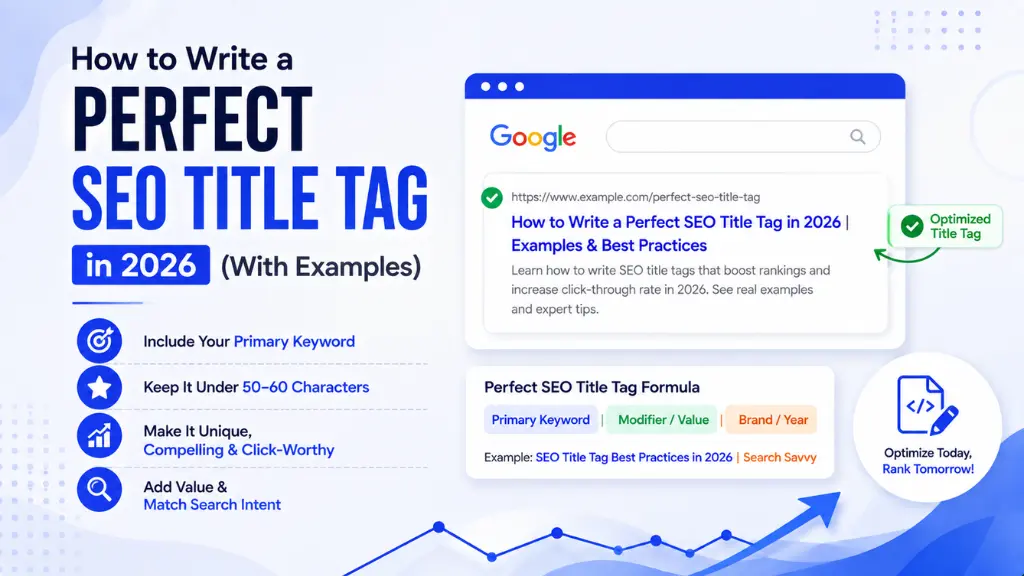
A perfect SEO title tag in 2026 lands consistently in the 50–60 character range across nearly every major analysis, though the real underlying mechanic is pixel width, not character count.
Titles in the 51–60 character range carry the lowest rewrite rate, based on Zyppy’s analysis of over 80,000 title tags, according to Neil Patel’s 2026 report. Google actually measures title length in pixels – roughly 600 pixels, with truncation typically starting between 525 and 535 pixels – rather than a strict character count, according to Scalenut’s 2026 meta title guide and Letter Counter’s 2026 analysis.
This pixel-based system means character count alone can mislead you. A title with many wide characters – capital letters, “M,” “W” – might get truncated at 50 characters, while a title using narrower characters like “i,” “l,” and “t” could display 65 or more characters without truncation, according to TagGenius’ 2026 title length guide. This is exactly why pixel-based preview tools like Zyppy or Conductor have become standard practice in 2026, rather than relying on character counters alone.
People Also Ask: Does Google count title tag length in characters or pixels? Short Answer: Pixels, not characters. Google typically displays around 600 pixels of title width, with truncation starting around 525–535 pixels. Because letter widths vary, two titles with the same character count can display very differently, which is why pixel-preview tools are recommended over character counters alone.
Where Should Keywords Go in a Perfect SEO Title Tag?
A perfect SEO title tag places the primary keyword near the beginning, not buried toward the end, since keyword position carries genuine weight for both ranking signals and user attention.
Placing your primary keyword at the beginning of the title can improve both search rankings and user experience, according to Scalenut’s 2026 guide. Keywords positioned at the start of the title carry more weight for both SEO and immediate user attention, since searchers scanning results tend to focus most heavily on the first few words of each listing, according to TagGenius’ 2026 analysis.
Formatting choices around the keyword matter too. Use hyphens instead of pipes, since pipes can cause display issues and hyphens read more cleanly, and place brand names at the end of the title rather than the beginning, according to Letter Counter’s 2026 guide. Established brands generally benefit from including their name; for newer or lesser-known brands, prioritising keywords over branding is usually the stronger choice when character space is limited, per the same source.
People Also Ask: Should a brand name always be included in a title tag? Short Answer: Not necessarily. For established, recognisable brands, including the name – usually at the end – can improve click-through rate. For newer or smaller brands, prioritising keywords over branding is generally the better use of limited character space.
What Do Real Before-and-After Title Tag Examples Look Like?
A perfect SEO title tag becomes much clearer through direct before-and-after comparison, since the difference between a weak title and a strong one is often more about structure than raw creativity.
- Weak: “Welcome to Our Website | ABC Company” Strong: “Premium Coffee Beans & Equipment | ABC Coffee” According to Letter Counter’s 2026 examples, the fix replaces a generic, meaningless greeting with a specific, keyword-rich description of what the business actually offers.
- Weak: “Running Shoes | Best Running Shoes | Buy Running Shoes Online” Strong: “Running Shoes – Shop Nike, Adidas & More | ShoeStore” This fix eliminates repetitive keyword stuffing and replaces it with specific, genuinely useful information – recognisable brand names – that a searcher actually finds valuable.
- Weak: “SEO Tips” Strong: “SEO Strategy: 2026 AI-First Framework” According to The Ocean Marketing’s 2026 guide, this shift toward “semantic precision” – clearly defining the specific entity or topic rather than a vague, generic phrase – helps both traditional ranking and AI Overview citation.
People Also Ask: What is the most common mistake in a weak title tag? Short Answer: Vague, generic phrasing that fails to describe what the page actually offers – things like “Welcome to Our Website” or repetitive keyword stuffing like listing the same phrase three times. Specific, descriptive titles consistently outperform generic ones.
How Does a Perfect SEO Title Tag Work Inside AI Overviews?
A perfect SEO title tag in 2026 has to function as more than a click magnet – it now serves as a citation anchor, the label an AI system shows a user even when that user never clicks through to the actual page.
Even if a user does not click, appearing as the authoritative source in an AI Overview builds brand trust and mindshare that influences the user’s next search, according to The Ocean Marketing’s 2026 guide. This “citation bonus” carries measurable downstream value: brands cited in AI Overviews see a 35% lift in trust-based direct traffic later in the conversion funnel, per the same source.
This shift changes what a “good” title tag optimises for. Instead of a vague phrase like “SEO Tips,” a title using semantic precision to clearly define the specific entity or topic performs better for AI citation, since AI systems favour titles that state exactly what a page covers without requiring inference, according to The Ocean Marketing’s 2026 analysis.
People Also Ask: Does a title tag still matter if most searches now end without a click? Short Answer: Yes, arguably more than before. A title tag now functions as a citation anchor inside AI Overviews – even without a click, appearing as the cited source builds trust and brand recognition that influences future searches and conversion decisions.
How Should You Test and Improve an Existing Title Tag?
A perfect SEO title tag is rarely achieved on the first attempt – the most reliable path is a structured testing process using your own site’s actual performance data.
Start with Google Search Console’s Performance report, which surfaces click-through rate by URL and provides a reliable baseline, according to Neil Patel’s 2026 guide. Document a page’s average CTR for the 28 days before deploying a new title, then push the change live and compare CTR over the following 28-day window – this length smooths out daily fluctuations and seasonality that a shorter comparison window would distort.
A practical audit and testing sequence:
- Audit existing titles by impressions and click-through rate in Search Console
- Prioritise high-impression, low-CTR pages as your fastest, highest-return wins
- Rewrite using pixel-width tools, not just a character counter, to avoid unexpected truncation
- Document the 28-day baseline CTR before deploying any change
- Compare the following 28-day window against that baseline to judge actual impact
People Also Ask: How long should you wait before judging whether a new title tag worked? Short Answer: A full 28-day window is generally recommended, both before and after the change. This length smooths out daily fluctuations and weekly seasonality that a shorter comparison period would distort, giving a more reliable read on actual performance impact.
How Should You Actually Write a Perfect SEO Title Tag Step by Step?
A perfect SEO title tag comes together through a repeatable process rather than pure creative inspiration – the same structural discipline can be applied consistently across an entire site.
According to Search Savvy’s insights from auditing hundreds of client title tags, the businesses seeing the strongest click-through improvements are the ones treating title tags as a system to maintain, not a one-time task completed at launch and forgotten afterward.
A practical writing framework:
- Identify the page’s primary keyword and search intent before writing anything
- Place the primary keyword near the beginning of the title
- Add a specific differentiator – a number, benefit, or unique detail – rather than a generic description
- Use hyphens instead of pipes, and place brand names at the end when relevant
- Check pixel width, not just character count, using a preview tool
- Write with AI citation in mind, favouring semantic precision over vague, generic phrasing
At Search Savvy, we recommend revisiting title tags at least twice a year for important pages – search intent, competition, and AI citation patterns all shift, and a title that performed well a year ago may already be due for a refresh.
FAQ: Writing a Perfect SEO Title Tag
Q1: What is the ideal character length for an SEO title tag in 2026? A: Roughly 50–60 characters is the widely cited range, though pixel width – around 600 pixels, with truncation starting near 525–535 pixels – is the more technically accurate measure, since letter width varies considerably between characters.
Q2: Why does Google sometimes rewrite my title tag in search results? A: Google rewrites titles to better match the specific search query, improve accuracy, or fix issues like excessive length or keyword stuffing. As of 2025, this happens to roughly 76% of title tags, making well-optimised, accurate titles more likely to be kept as written.
Q3: Should I use pipes or hyphens to separate parts of a title tag? A: Hyphens are generally recommended over pipes in 2026, since pipes can cause display issues in some contexts while hyphens read more cleanly across both search results and other platforms.
Q4: Does including numbers in a title tag actually improve click-through rate? A: Numbers tend to stand out in search results and set clear expectations for the reader, making them a commonly recommended addition where genuinely relevant – for example, a specific year, a step count, or a percentage figure.
Q5: Can a title tag be too long even if it fits within the character limit? A: Yes, potentially. Pixel width, not raw character count, determines truncation, so a title with wide characters can be cut off even at a seemingly safe character count. Always verify with a pixel-based preview tool rather than a character counter alone.
Q6: How often should title tags be reviewed and updated? A: At least twice a year for important, high-traffic pages is a reasonable standard. Search intent, competitive positioning, and how AI systems evaluate titles for citation all continue to shift, meaning a title that performed well previously may need periodic refreshing.
Want your website’s title tags audited for click-through rate and AI citation potential? Visit Search Savvy to speak with an SEO expert who can identify your fastest wins.