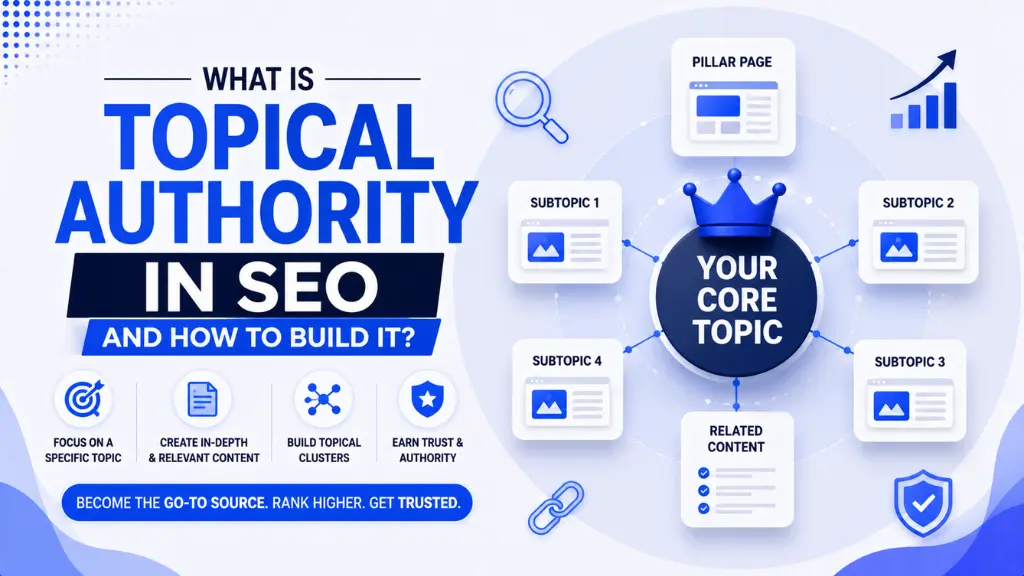
What Is Topical Authority in SEO and How to Build It?

Here is the ranking pattern that confuses most site owners: a niche website with modest backlinks consistently outranks a larger, better-funded competitor for the same queries. The explanation is almost always topical authority in SEO.
In this article14 sections
Topical authority in SEO is the recognition by Google’s systems that a website is a genuine, comprehensive, and reliable source of information on a specific subject. It is not earned by any single piece of content – it is built through the accumulated body of expert coverage across an entire topic domain.
Topical authority in SEO has become the primary content quality signal in 2026, confirmed by Google’s March 2026 Core Update, which made E-E-A-T the explicit top-level ranking factor and identified thin content as a leading cause of ranking suppression. A site with 20 interconnected articles on a specific subject consistently outranks a site with one 5,000-word guide on the same subject – even if the single article is technically superior in isolation.
Topical authority in SEO also determines AI search visibility. When ChatGPT, Perplexity, and Google AI Overviews select sources to cite, they draw from websites their systems recognise as consistently accurate and comprehensive on a given topic. Surface-level content earns zero citations; recognised authorities earn citations across dozens of related queries.
At Search Savvy, we build every content strategy around topical authority as the foundational layer, because it is the mechanism that makes rankings compound rather than plateau. This guide explains exactly what it is and how to build it.
What Is Topical Authority in SEO?#
Topical authority in SEO is Google’s assessment of how comprehensively, accurately, and consistently a website covers a specific subject area. It reflects the depth and breadth of a site’s knowledge on a topic rather than any individual page’s optimisation quality.
Topical authority in SEO is built by covering every meaningful aspect of a topic rather than targeting isolated keywords. When a user searching for anything related to a subject consistently finds helpful, accurate answers on a specific website, Google’s systems learn that website is a trustworthy source. When a new related query appears, that site is treated as a strong candidate to rank – even before individual page factors like backlinks are fully assessed.
People Also Ask: Is topical authority the same as domain authority? Short Answer: No. Domain authority is a third-party metric (used by tools like Moz and Ahrefs) estimating overall link strength based on backlink profiles. Topical authority is Google’s own assessment of how comprehensively a site covers a specific subject – and it directly influences rankings. A site with high domain authority but low topical focus on a subject can be outranked by a smaller site with deep, structured content on that exact topic.
Why Is Topical Authority in SEO Important in 2026?#
Topical authority in SEO has become the defining competitive advantage in 2026 because keyword-by-keyword optimisation no longer determines who wins in search. Google now evaluates entire websites to determine subject matter expertise, not just individual pages.
Topical authority in SEO matters because the results it produces are both measurable and compound. Sites implementing content clusters correctly see an average 40% increase in organic traffic compared to non-clustered content strategies. Businesses transitioning from keyword-focused SEO to topic cluster models report traffic increases ranging from 50% to 300% within 6 to 12 months.
Topical authority in SEO also has a compounding timeline effect that makes early investment disproportionately valuable. The first cluster articles take the longest to build rankings, but as authority grows, new content on the same topic ranks significantly faster than it did at the outset – creating an accelerating competitive advantage over time.
- Sites with topical authority rank for more keywords without needing new backlinks for every page
- New content on an established authority site indexes faster and ranks sooner
- 73% of top-ranking pages now feature detailed author credentials following Google’s March 2026 Core Update
- Brand search volume has a 0.334 correlation with AI citation probability – authority signals SEO and AI visibility simultaneously
People Also Ask: Does topical authority help with AI Overview citations? Short Answer: Yes, directly. AI systems including ChatGPT, Perplexity, and Google AI Overviews default to citing sources recognised as comprehensive and consistently accurate on a subject. A site with deep, structured, frequently updated content on a specific topic becomes the default reference – surface-level content earns zero citations while recognised authorities earn citations across dozens of related queries.
How Does Topical Authority in SEO Work?#
Topical authority in SEO works through three interconnected signals that Google evaluates together to form its picture of a site’s expertise on a subject: content depth, structural organisation, and E-E-A-T evidence.
Content depth means covering every meaningful angle of a topic – not just the obvious head terms, but the follow-up questions, the edge cases, the comparisons, and the practical how-tos that a genuine expert would address without being asked.
Structural organisation means content is connected logically through internal links, clear URL hierarchies, and a pillar-cluster architecture that lets Google’s crawlers map the relationship between pages and identify the topical focus of the site as a whole.
E-E-A-T evidence means the expertise behind the content is demonstrable – through author credentials, original data, case studies, external mentions, and consistent engagement signals that confirm real users find the content genuinely useful.
How Do You Build Topical Authority in SEO Step by Step?#
Topical authority in SEO is built through a sequential process. Trying to build it by publishing more content without structural planning is the most common reason content strategies produce traffic that never compounds.
Step 1: Choose a Focused Topic Area#
Topical authority in SEO requires picking a topic domain narrow enough to cover comprehensively, but broad enough to support 15 to 30 supporting articles. The mistake most sites make is trying to build authority across five broad topics simultaneously – which produces shallow coverage of many areas rather than deep authority in any.
The right starting question is not “what keywords have the highest volume?” but “what topic is this brand genuinely authoritative on, with real expertise and proof to back it up?” Authority that cannot be substantiated does not hold up under Google’s quality evaluation systems.
Step 2: Build a Topical Map#
Topical authority in SEO starts with a topical map – a structured outline of every subtopic, question, and angle that a genuine expert on your chosen subject would need to cover. A topical map is not a keyword list; it is a content architecture that ensures no meaningful question within a topic goes unanswered on your site.
Tools like AlsoAsked, AnswerThePublic, and Semrush’s topic cluster feature help surface the full range of questions users associate with a topic, making sure the map reflects real search behaviour rather than guesswork.
Step 3: Create the Pillar Page#
Topical authority in SEO is anchored by a pillar page – a comprehensive, structured overview of the core topic that covers the full scope at a strategic level while linking out to cluster articles for deeper detail. The pillar page is the central hub; everything else links back to it.
A well-built pillar page typically runs to 2,000 to 5,000 words, uses a clear heading hierarchy (H1 for the main topic, H2s for major subtopics, H3s for specific questions), and includes a FAQ section that directly addresses the most-searched questions about the topic.
Step 4: Publish Cluster Articles Systematically#
Topical authority in SEO is built through cluster articles – individual pieces that each cover one specific subtopic in depth, targeting long-tail keywords and particular user queries that the pillar page addresses only at a high level.
Topical authority in SEO compounds when cluster articles are published systematically over three to six months rather than all at once. Most topically authoritative sites maintain 12 to 48 new or refreshed pages monthly to signal active, ongoing expertise rather than a static content snapshot.
People Also Ask: How many articles do you need to build topical authority? Short Answer: Most well-developed topical authority strategies use 15 to 30 cluster articles per pillar page as a starting target. The exact number depends on topic breadth – a narrow subject like “email subject line optimisation” needs fewer than a broad one like “email marketing strategy.” Quality and structural connection matter more than reaching a specific page count.
Step 5: Build a Strategic Internal Linking Structure#
Topical authority in SEO cannot function without deliberate internal linking. Internal links are the mechanism that connects the pillar page to every cluster article, allows Google to map the relationship between pages, and distributes topical authority signals across the entire content ecosystem.
A well-organised internal linking structure follows a clear hierarchy: cluster articles link up to the pillar page using descriptive, keyword-relevant anchor text; the pillar page links out to every cluster article; and closely related cluster articles cross-link where the connection adds genuine value for the reader.
Links from topically relevant external sources reinforce the signal further – a backlink from an established SEO publication to your SEO content carries far more topical authority weight than a link from a general business directory.
Step 6: Demonstrate E-E-A-T at Every Level#
Topical authority in SEO is inseparable from E-E-A-T in 2026. Google’s March 2026 Core Update made this explicit – 73% of top-ranking pages now feature detailed author credentials, and thin, AI-generated content without genuine expertise is being heavily penalised in the update’s aftermath.
Demonstrating E-E-A-T alongside topical authority means including transparent author bios with verifiable credentials, citing original data and case studies, linking out to authoritative external sources, and building consistent entity mentions across external publications, review sites, and industry directories.
People Also Ask: Can AI-generated content build topical authority? Short Answer: Only with significant human editorial oversight. AI tools accelerate research and drafting, but topical authority requires genuine expertise, original insights, and E-E-A-T signals that purely automated content cannot produce. Thin AI-generated content without human oversight is explicitly penalised by Google’s 2026 systems – it accelerates production of the wrong kind of content at scale rather than building genuine authority.
How Do You Measure Topical Authority in SEO?#
Topical authority in SEO is not a single published metric – it is inferred from the downstream effects it produces on SEO performance over time.
Topical authority in SEO is increasing when: more pages rank simultaneously across a topic cluster; new content on the topic indexes faster than it did previously; organic traffic grows across groups of keywords rather than just individual target terms; and search visibility remains stable through algorithm updates that destabilise less authoritative competitors.
Use Google Search Console to track indexed page count, average position across topic-related queries, and impressions for long-tail cluster keywords – collectively these tell a clearer story than any individual keyword rank.
Key topical authority indicators to track monthly:
- Number of pages ranking in the top 20 for topic-related queries
- Average time for new cluster content to reach the top 10
- Organic traffic growth across the full cluster, not just the pillar page
- Branded search volume growth, which correlates 0.334 with AI citation probability
- AI Overview citation appearances for topic-related queries
How Should Indian Businesses Build Topical Authority in SEO?#
Topical authority in SEO is a particularly powerful strategy for Indian businesses competing in categories where large, well-funded competitors have high domain authority but shallow topic coverage in specific regional or niche subtopics.
Topical authority in SEO for Indian brands benefits from building India-specific content within cluster articles – city-level examples, INR pricing, platform references like Justdial, IndiaMART, and WhatsApp Business, and regulatory context like GST or TRAI guidelines – since this regional depth is exactly the signal that separates a locally authoritative site from a generic one.
According to Search Savvy’s insights from building topical authority for Indian SMB, D2C, and professional service clients, the fastest measurable traction comes from narrowing the initial topic focus more aggressively than feels comfortable. A site building authority specifically in “email marketing for Indian e-commerce” consistently outperforms a site attempting authority in “digital marketing” as a whole, because the narrower focus achieves comprehensive coverage faster.
Conclusion: Authority Is Architecture, Not Output#
Topical authority in SEO is not about publishing more content. It is about organising content into a structure that demonstrates genuine expertise to Google’s evaluation systems, builds the internal relationships that distribute authority across a cluster, and satisfies every meaningful question a user might arrive with.
Search Savvy builds every content strategy around topical authority first – defining the pillar, mapping the cluster, and linking everything together before the first article is written – because this structural clarity is what makes organic rankings compound rather than plateau over time.
FAQ: Topical Authority in SEO – Your Questions Answered#
Q1: How long does it take to build topical authority in SEO? Most topical authority strategies show meaningful traction within 3 to 6 months, with compounding results accelerating over 6 to 12 months as authority builds. The investment pays back cumulatively – the more relevant content a domain publishes in a topic area, the faster new articles on that same topic rank.
Q2: Can a small website build topical authority and outrank large sites? Yes. Topical authority depends on depth and structure, not domain size or backlink volume. A small site that comprehensively covers a narrow topic can and regularly does outrank a large general-purpose competitor that covers the same topic only superficially. This is the mechanism behind many niche site success stories in 2026.
Q3: How is topical authority different from keyword optimisation? Keyword optimisation focuses on individual pages targeting specific search terms. Topical authority focuses on the entire site’s coverage of a subject area. Keywords still matter, but in 2026 they support topical structure rather than defining the entire strategy. A topically authoritative site ranks for thousands of related keywords simultaneously without optimising for each one individually.
Q4: Does topical authority reduce the need for backlinks? Significantly, but not entirely. Strong topical authority allows pages to rank with fewer backlinks than they would need on a less authoritative site. However, external links from topically relevant sources still reinforce the signal, and newly authoritative sites benefit from targeted link building in their topic area to accelerate the process.
Q5: What is the biggest mistake when building topical authority in SEO? Trying to build authority across multiple broad topics simultaneously is the most common mistake. This produces shallow coverage of many areas rather than deep authority in any, and Google’s systems cannot confidently classify the site as an expert on anything. Starting with one narrow topic and achieving comprehensive coverage before expanding consistently produces faster, more durable results.
Q6: How does topical authority affect AI search citations in 2026? Topical authority directly improves AI citation eligibility. AI systems default to sources recognised as consistently accurate and comprehensive on a subject. Brand search volume – which grows as topical authority builds – has a 0.334 correlation with AI citation probability, meaning authority in search and authority in AI tools are built through the same underlying content strategy.
Not sure whether your current content is building genuine topical authority or just producing isolated posts that plateau? Visit Search Savvy for a content architecture audit that maps your existing content against a topical authority framework and shows exactly where the gaps are.