How to Recover from a Google Core Update Penalty
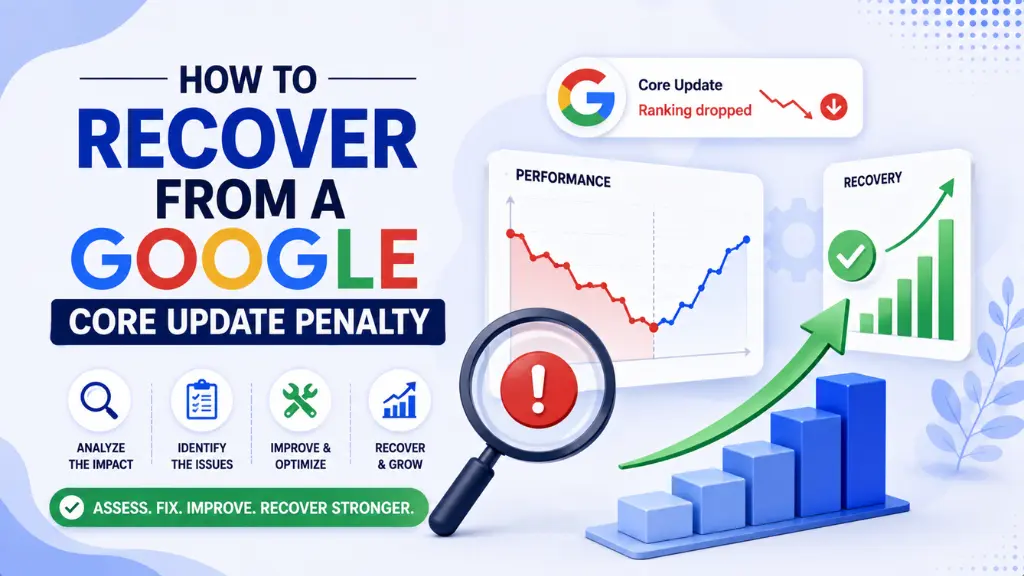

Here is the scene most site owners encounter without warning: traffic looks normal on Monday, and by Wednesday it has dropped 30 to 60 percent with no error in Search Console, no manual action, and nothing obviously wrong.
In this article16 sections
A Google core update penalty – or more accurately, a core update impact – is what most of these sudden, unexplained drops come down to. Google has confirmed two major core updates in 2026 already: the March 2026 core update, which affected 40 to 60 percent of websites and triggered a SERP volatility score of 8.7 out of 10, and the May 2026 core update, which completed on June 2 after an 11-day rollout that practitioners described as bigger than March.
A Google core update is not a manual penalty or a spam action. It is a recalibration of how Google evaluates quality, relevance, and trustworthiness across the entire web – and understanding that distinction changes everything about how you should respond to one.
A Google core update penalty is, in most cases, a signal that competing pages have become a stronger match for the queries your content was serving. One 2026 analysis found that 70% of pages losing rankings during a core update did so because competing pages improved, not because the affected page got objectively worse. That reframe matters: the work ahead is genuine improvement, not damage control for a technical error.
At Search Savvy, recovering from Google core update impacts is some of the most methodical SEO work we do – because the sites that come back fastest are not the ones that publish more content in panic, but the ones that audit deeply, improve honestly, and give the work time to compound. Here is the exact recovery process.
What Is a Google Core Update and How Is It Different from a Penalty?#
A Google core update is a broad, significant change to Google’s ranking algorithm that recalibrates how it evaluates quality, relevance, and user satisfaction across all search results – not a targeted action against a specific website.
A Google core update does not mean Google found something you did wrong in the way that a manual action does. Google’s own documentation is explicit: core updates do not target individual sites or pages. A drop means Google reweighted competing content relative to yours – and the path forward is improvement, not reversal of a specific violation.
People Also Ask: Is a Google core update the same as a manual penalty? Short Answer: No. A manual penalty is a specific action triggered by a human reviewer at Google, visible in Google Search Console under Security and Manual Actions, usually tied to a clear guideline violation. A Google core update is a broad algorithmic shift affecting thousands of sites simultaneously, with no specific violation to “fix” – recovery comes from genuinely improving content quality and relevance to meet the updated evaluation standards.
How Do You Confirm a Google Core Update Penalty Affected Your Site?#
A Google core update impact should be confirmed before any changes are made – and the data needs to come from the right sources and the right timeframe.
Step 1: Date the Impact Precisely#
A Google core update penalty should be matched against a confirmed update timeline. Both the March 2026 core update (which began March 27 and completed April 8) and the May 2026 core update (which ran May 21 to June 2) caused volatility across multiple days, not just at start and end. Comparing traffic one day before and one day after is unreliable; compare two weeks before the rollout against two weeks after it completed.
Use Google Search Console’s Performance report to compare date ranges and check Google’s Search Status Dashboard to confirm which update dates overlap with your traffic drop.
Step 2: Separate Page-Level Drops from Site-Level Drops#
A Google core update penalty can affect specific topic sections rather than an entire domain. Before making sitewide changes, determine whether the drop is isolated to a particular content category, page type, or subject area, or whether it reflects a domain-wide quality signal.
In Search Console, compare clicks and impressions at the page level rather than only the total traffic view – total traffic can hide the real issue. If impressions dropped, Google is showing your pages less. If average position dropped, competitors have replaced your rankings. If impressions are stable but CTR fell, SERP features and AI Overviews absorbing clicks may be the driver rather than ranking position alone.
People Also Ask: How do I check if a Google core update affected my site? Short Answer: Open Google Search Console and compare Performance report data for two weeks before versus two weeks after the core update’s rollout window. Look for drops in clicks, impressions, and average position at the page and query level – not just total traffic. Cross-reference with the Google Search Status Dashboard to confirm the update dates align with your traffic change.
Why Do Google Core Update Penalties Happen in 2026?#
A Google core update in 2026 primarily penalises – more accurately, reweights away from – content that fails to demonstrate genuine helpfulness, expertise, and a clear reason to exist beyond capturing search traffic.
The March 2026 Core Update confirmed E-E-A-T (Experience, Expertise, Authoritativeness, and Trustworthiness) as the explicit top-level quality signal. Sites that lost the most traffic shared common patterns: thin or generic content without original insight, weak or absent author credentials, multiple pages competing for the same query (cannibalisation), and site-wide quality signals dragged down by a large volume of low-value pages.
The May 2026 core update continued in the same direction, targeting content designed for search engines rather than for people – a philosophy first introduced in Google’s 2022 Helpful Content Update, now deeply embedded into every core update’s evaluation criteria.
Common reasons pages drop in a Google core update:
- Content that rephrases what already ranks without adding original data, first-hand experience, or a unique perspective
- Thin articles that fail to satisfy follow-up questions a user would naturally have after reading
- Absent or unverifiable author expertise, particularly on YMYL (Your Money or Your Life) topics
- Multiple pages cannibalising the same query rather than one authoritative page being supported by clear cluster content
- Large volumes of AI-generated content published without meaningful human editorial oversight
- Generic “About Us” pages and missing trust signals that reduce domain-level credibility
How Do You Recover from a Google Core Update Penalty?#
A Google core update penalty recovery follows a specific sequence – and the most important thing to understand upfront is that panic-deleting content, keyword stuffing, or chasing backlinks as a quick fix all make the situation worse, not better.
Step 1: Prioritise Your Highest-Value Pages First#
A Google core update recovery should focus on the top 20 to 30 organic landing pages first, because these pages drove the most traffic and offer the maximum ROI for improvement effort. Trying to fix 50 pages at once produces surface-level changes everywhere rather than meaningful improvements where they matter most.
Step 2: Improve Content Quality Substantively#
A Google core update signals that competing content is currently more helpful than yours – which means the fix is making your content genuinely more helpful, not just longer or more frequently updated.
Specific improvements that move the needle:
- Add original data, first-hand examples, or case studies that competitors cannot replicate
- Update all statistics and dates to reflect 2026-current information (but only change publication dates when substantive content has actually changed – Google can detect date changes without real content updates)
- Expand thin content with genuine depth: real answers to follow-up questions, comparison tables, step-by-step processes, and FAQ sections
- Consolidate multiple thin articles covering the same topic into one comprehensive hub page rather than leaving them to cannibalise each other
- Add direct, structured answers in the first paragraph for key queries, since both AI Overviews and featured snippets prioritise clear immediate answers
People Also Ask: Should I delete content after a Google core update drop? Short Answer: Only as a last resort. Google’s own guidance recommends improving content before deleting it – consolidation of overlapping pages into a single comprehensive resource is almost always more effective than removal. Panic-deleting pages without attempting improvement first can make recovery harder by removing pages that had residual authority signals. Only delete pages that are genuinely irrelevant to your audience and offer no strategic value.
Step 3: Strengthen E-E-A-T Signals Across the Site#
A Google core update recovery is incomplete without addressing E-E-A-T signals, because the 2026 updates specifically reward demonstrable expertise and penalise content that cannot prove its authority.
- Add detailed, credentialed author bios to every piece of content, with links to verifiable external profiles like LinkedIn
- Include professional qualifications, certifications, or real case study references on YMYL pages covering health, finance, or legal topics
- Create a clear, specific About page with team photos, company history, and verifiable information – not generic “dedicated to excellence” filler
- Add prominent trust signals: active HTTPS across all pages, a clear privacy policy, and transparent affiliate or commercial relationships where relevant
- Build consistent brand mentions across external publications, industry directories, and review platforms
Step 4: Fix Technical Issues in Parallel#
A Google core update drop is not usually caused by technical SEO issues alone, but they can compound a content quality problem. Audit for Core Web Vitals failures (particularly INP performance on mobile), pages returning incorrect status codes, internal linking gaps that isolate high-value content, and structured data errors that prevent rich result eligibility.
Use Google PageSpeed Insights for per-page Core Web Vitals diagnostics and Search Console’s Index Coverage report to identify pages not being properly indexed after improvements.
Step 5: Rebuild Internal Linking to Reinforce Priority Pages#
A Google core update recovery accelerates when internal linking is reorganised to concentrate authority on the most important pages. Strengthen internal links pointing to your priority recovery pages using descriptive, keyword-relevant anchor text – and ensure every improved cluster article links back to the relevant pillar page to rebuild topical authority signals.
What Are the Biggest Mistakes to Avoid After a Google Core Update?#
A Google core update penalty recovery fails most often because of reactive mistakes made in the first few days after traffic drops, before a proper diagnosis has been done.
- Panic-deleting content – consolidation is almost always more effective than removal; deleting without improving removes residual authority
- Changing publication dates without substantive content updates – Google can detect cosmetic date changes and may penalise them
- Over-optimising with keyword stuffing – writing for the algorithm rather than the reader is exactly what core updates penalise
- Throwing backlinks at the problem – new links cannot fix a content quality issue that a core update has flagged at domain level
- Making site-wide changes before diagnosing which pages were actually affected – unfocused changes disrupt pages that were unaffected or that actually improved during the update
How Long Does Recovery from a Google Core Update Penalty Take?#
A Google core update recovery typically shows meaningful signals within 4 to 8 weeks of consistent improvement work, but full ranking recovery most often arrives with the next major core update, when Google re-evaluates the site with fresh eyes.
This timeline is not a reason to delay – it is a reason to start immediately, since improvements need to be in place before the next evaluation window arrives. Google also releases continuous minor unannounced updates between major core updates, meaning meaningful partial recovery is possible before the next scheduled event.
A Google core update recovery is also now visible across two surfaces: classic Google Search rankings and AI Overview citations. The same quality improvements that rebuild classic rankings – genuine depth, structured content, clear authority signals – also improve AI Overview eligibility, since Google’s AI features use the same underlying ranking and quality systems.
People Also Ask: How long does it take to recover from a Google core update? Short Answer: Recovery signals typically appear within 4 to 8 weeks of consistent content improvements. Full ranking recovery most often coincides with the next major core update, when Google reassesses the site’s quality signals against the updated evaluation framework. Making substantive improvements quickly is important because you are building credit for the next evaluation cycle.
How Does a Google Core Update Penalty Affect AI Search Visibility?#
A Google core update in 2026 affects not just traditional rankings but AI Overview eligibility simultaneously – because Google’s generative AI features are, as Google’s own AI guidance states, “rooted in our core Search ranking and quality systems.”
A Google core update drop that suppresses traditional rankings also reduces AI Overview citation likelihood, since AI features pull from the same index and apply the same quality signals. The reverse is also true: the content improvements that rebuild rankings – original insight, clear structure, genuine E-E-A-T – also rebuild AI visibility. Recovery work benefits both surfaces at once.
In 2026, this double-surface impact makes a core update drop more consequential than it would have been even two years ago. With AI Overviews absorbing an increasing share of clicks on position-one queries, slipping from the first to the fourth position represents a proportionally larger traffic loss than the same slide did before AI Overviews existed.
According to Search Savvy’s insights from supporting clients through the March and May 2026 core updates, the sites that recovered fastest shared one common trait: they treated the update as honest feedback rather than an external attack. They audited their weakest content honestly, improved their strongest content substantially, and gave the process time to work rather than making reactive changes they later had to reverse.
Conclusion: Recover by Improving, Not by Outmanoeuvring#
A Google core update penalty is not a problem to be solved with a clever workaround. It is Google telling you that your current content does not satisfy its users as well as competing content does – and the path back is closing that gap honestly.
Search Savvy, every core update recovery we oversee follows the same sequence: diagnose precisely, prioritise the highest-value pages, improve substantively, and monitor across both traditional rankings and AI visibility surfaces until the work compounds into recovered positions.
FAQ: Google Core Update Penalty Recovery – Your Questions Answered#
Q1: Is a drop after a Google core update a permanent penalty? No. Core update impacts are not permanent penalties. They reflect Google’s current evaluation of your content relative to competitors, and that evaluation changes with every subsequent core update. Sites that make genuine, substantive improvements consistently see partial or full recovery, though the timeline depends on the scope of the issues and the quality of the improvements made.
Q2: Can I submit a reconsideration request after a core update drop? No. Reconsideration requests are only for sites with confirmed manual actions, visible in Search Console under Security and Manual Actions. A core update impact is an algorithmic shift, not a manual action, and there is no reconsideration process for it – the only path forward is improving content quality to meet the updated evaluation standards.
Q3: Does a core update affect the entire website or just specific pages? Both are possible. Some core updates suppress specific topic sections, page types, or content categories. Others reflect a domain-wide quality signal driven by a large volume of low-value pages pulling down the overall trust assessment. Page-level and section-level diagnosis in Search Console should happen before making site-wide changes.
Q4: Should I keep publishing new content during core update recovery? Only if the new content is genuinely high-quality and topically relevant. Publishing more thin, generic content during a recovery period can make a domain-level quality problem worse. Improving existing content should be the priority over expanding volume, at least until the most-affected pages show signs of stabilisation.
Q5: Does fixing Core Web Vitals help recover from a core update? Indirectly, yes. Core Web Vitals failures do not cause core update drops on their own, but technical performance issues compound content quality problems and should be addressed as part of a comprehensive recovery plan. Pages that are slow, visually unstable, or unresponsive on mobile fail on multiple signals simultaneously.
Q6: How does a Google core update affect AI Overview visibility? A core update drop reduces AI Overview eligibility because Google’s AI features run on the same ranking and quality systems as traditional search. Conversely, the content improvements that rebuild classic rankings – original depth, clear structure, transparent expertise – also rebuild AI citation likelihood. Recovery work benefits both surfaces simultaneously, making it more valuable per hour of effort than traditional SEO improvements alone.
Experienced a traffic drop after the March or May 2026 core update and not sure where to start? Visit Search Savvy for a post-update content and technical audit that identifies exactly which pages were affected, why they dropped, and the specific improvements most likely to rebuild your rankings before the next evaluation window.