White Hat vs Black Hat vs Grey Hat SEO: What’s the Difference?
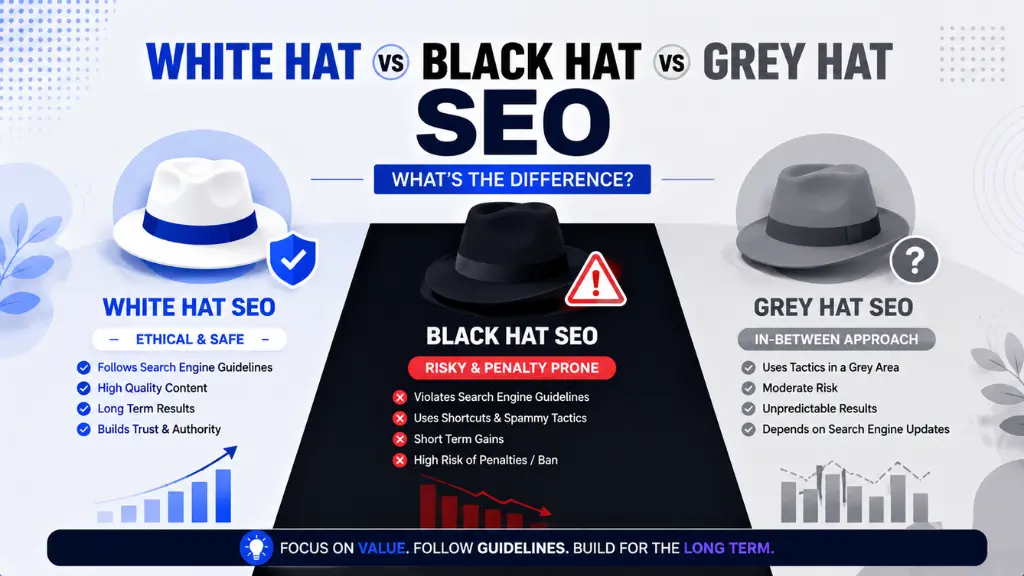

Here is the SEO choice that looks like a strategy decision but is actually a risk management decision: which approach to use when chasing rankings.
In this article9 sections
White Hat vs Black Hat vs Grey Hat SEO describes three fundamentally different philosophies for how a website earns its position in search results. The differences are not just ethical – they are practical, financial, and increasingly existential for any brand that depends on organic search for growth.
White Hat vs Black Hat vs Grey Hat SEO matters in 2026 more than at any earlier point because Google’s detection systems have never been more sophisticated. SpamBrain, Google’s AI-powered spam detection system, now analyses over 40 billion spam pages daily, using pattern recognition, natural language processing, and user engagement data to identify manipulation at a scale and speed that makes older enforcement look primitive.
White Hat vs Black Hat vs Grey Hat SEO also determines AI search visibility, not just Google rankings. ChatGPT, Perplexity, and Google AI Overviews all reward the same signals Google does: genuine editorial authority, structured content, and real trust signals from real publishers. There is no grey zone in AI search.
At Search Savvy, every strategy we build is grounded in white hat principles – not because it is the slower path, but because it is the only one that compounds instead of resets. This guide explains all three approaches clearly, with current 2026 data on what each one actually produces.
What Is White Hat SEO?#
White Hat vs Black Hat vs Grey Hat SEO starts with white hat – the fully compliant approach that earns rankings by genuinely satisfying what Google’s guidelines, and more importantly its users, actually want.
White hat SEO builds rankings through genuine content quality, earned backlinks from real editorial sources, strong technical foundations, and E-E-A-T signals – Experience, Expertise, Authoritativeness, and Trustworthiness – that hold up under algorithmic scrutiny and manual review alike.
White hat SEO is slower in the early months. A recipe website publishing 100 genuinely helpful, well-structured recipes builds authority incrementally over time. That same authority, once built, is also compound – meaning the site earns topical trust that makes each new page rank faster than the last, without the constant risk of losing everything overnight.
White hat SEO delivers 400 to 800% ROI over time, according to 2026 industry benchmarks, because the ranking positions it builds are durable rather than fragile.
White hat SEO includes:
- Creating genuinely helpful, original content that satisfies user intent
- Earning backlinks through real outreach, digital PR, and content worth linking to
- Optimising technical foundations – Core Web Vitals, crawlability, structured data
- Building E-E-A-T through transparent authorship, credentials, and real expertise
- Internal linking and site architecture that helps users and crawlers navigate clearly
People Also Ask: Is white hat SEO still the best approach in 2026? Short Answer: Yes, more definitively than ever. White hat SEO is the only approach that remains effective across both traditional Google rankings and AI search surfaces like ChatGPT and AI Overviews. It takes longer in the first three to six months, but produces compounding, durable results that do not disappear overnight with a penalty or algorithm update.
What Is Black Hat SEO?#
White Hat vs Black Hat vs Grey Hat SEO’s most extreme category – black hat – deliberately violates Google’s guidelines to manipulate rankings artificially, prioritising short-term gains over long-term sustainability or user benefit.
Black hat SEO techniques range from mildly risky to catastrophically penalisable, but all share the same defining characteristic: they work against Google’s stated goal of surfacing the most genuinely useful result for a given query.
Common black hat SEO techniques in 2026:
- Keyword stuffing – unnaturally repeating target keywords throughout content to a density that no real reader would tolerate, creating “robotic” pages that Google now penalises algorithmically
- Cloaking – showing different content to Googlebot than to human visitors, directly deceiving the algorithm about a page’s actual subject matter
- Link schemes and PBN links – buying or building artificial links through private blog networks, link farms, or paid placements that violate Google’s link spam guidelines
- Doorway pages – creating large numbers of thin pages designed solely to capture search traffic and redirect users elsewhere
- Scaled content abuse – mass-producing pages for ranking manipulation through AI, automation, or templated human writing, regardless of actual user value
The consequences of black hat SEO in 2026 are severe and swift. Traffic drops of 50 to 95% can occur within 72 hours of a manual action. Recovery typically takes 6 to 18 months – and 40% of businesses penalised for black hat practices do not recover at all, closing within six months of the penalty.
Google’s March 2024 Core Update demonstrated that brand authority no longer provides immunity: major publishers including Forbes Advisor and CNN Underscored faced penalties, not just unknown spam sites.
People Also Ask: Is black hat SEO illegal? Short Answer: No, black hat SEO is not illegal, but it violates Google’s Webmaster Guidelines and results in severe penalties including ranking drops of 50 to 95%, manual actions, and in serious cases complete deindexing of the website. The financial case against black hat SEO in 2026 is clear – the short-term ranking gains almost never justify the recovery cost and risk of permanent traffic loss.
What Is Grey Hat SEO?#
White Hat vs Black Hat vs Grey Hat SEO’s middle category – grey hat – covers tactics that do not clearly violate Google’s guidelines but push against the spirit of them, walking a line between acceptable optimisation and manipulation.
Grey hat SEO exists because some practices were not explicitly prohibited when they first emerged, creating an ambiguous zone where SEOs once operated with calculated risk. In 2026, that ambiguity has almost entirely collapsed. Google’s SpamBrain and successive algorithm updates have reclassified most classic grey hat techniques as either explicitly black hat or simply ineffective.
Common grey hat SEO techniques in 2026:
- Buying links or niche edits – paying for link placements in existing content, a practice that technically might be done at small scale but that Google’s spam guidelines address directly
- Large-scale link exchanges – reciprocal link agreements that exceed normal editorial patterns and exist primarily to manipulate link signals
- Private Blog Networks (PBNs) – networks of “real-looking” sites built to pass link equity, now caught regularly when Google’s spam team identifies the site footprint
- Purchased reviews – incentivised reviews that inflate trust signals without genuine customer experience behind them
- Expired domain schemes – redirecting old domains with existing authority to new sites without genuine content relevance
- Scaled, unreviewed AI content – publishing large volumes of AI-generated content without genuine human editorial oversight, which Google now classifies as scaled content abuse
The defining risk of grey hat SEO in 2026 is not just that it might be penalised – it is that only 30% of penalised sites recover their rankings within a year. What was considered low-risk in previous years now regularly triggers algorithmic or manual actions, and the boundary continues to tighten with every major update.
People Also Ask: Does grey hat SEO still work in 2026? Short Answer: Rarely, and briefly. Most grey hat tactics either do not work anymore, produce gains that last a few weeks before being devalued, or trigger quiet algorithmic demotion without warning. Google processes 500 to 600 algorithm updates per year, and grey hat tactics that escape one update are increasingly unlikely to survive the next.
How Does Google Detect White Hat vs Black Hat vs Grey Hat SEO?#
White Hat vs Black Hat vs Grey Hat SEO enforcement relies on two distinct mechanisms that work in parallel: algorithmic systems running continuously and human reviewers investigating flagged sites.
Google’s algorithmic enforcement through SpamBrain identifies manipulative patterns at scale – unusual link velocity, suspicious anchor text distributions, cloaking behaviour, and publishing patterns that match content spam. The system has improved six times in effectiveness since 2020 and now processes over 40 billion spam pages daily.
Manual actions are triggered when algorithmic signals flag a site for human review, or when competitor reports prompt investigation. Manual actions are recorded in Google Search Console under the Security and Manual Actions report – meaning site owners can at least see them, even if the recovery process is painful.
Google’s enforcement has intensified dramatically since 2024, with coordinated updates in 2024 and 2025 specifically targeting practices that were once considered grey hat but are now treated as spam.
What Happens When You Get a Google Penalty?#
White Hat vs Black Hat vs Grey Hat SEO decisions become extremely concrete when a penalty lands. The consequences of black and grey hat penalties are not minor ranking fluctuations – they are business-level events.
- 50 to 95% traffic drops within 72 hours for sites hit with a significant manual action
- 6 to 18+ month recovery timelines, even after all violations are addressed and a reconsideration request is submitted
- 40% of penalised businesses close within six months of a significant black hat penalty – the recovery cost and revenue loss combine into an existential problem
- Site reputation abuse penalties have no recovery path – affected content must be removed entirely, with no reconsideration route
Recovering from inherited black hat work – for example, when a previous SEO agency used manipulative tactics without the site owner’s knowledge – requires a full backlink audit using Ahrefs or Semrush, manual outreach to remove harmful links, use of Google’s Disavow Tool for links that cannot be removed, and a formal reconsideration request.
People Also Ask: Can you recover from a Google black hat penalty in 2026? Short Answer: Yes, but it is slow and not guaranteed. Minor manual actions typically resolve in 10 to 30 days after fixes and a reconsideration request. Algorithmic penalties require addressing issues and waiting for re-crawling, typically 4 to 6 months minimum. Site reputation abuse has no recovery path. Only 30% of penalised sites recover rankings within a year, and 40% of penalised businesses close within six months.
White Hat vs Black Hat vs Grey Hat SEO: Side-by-Side Comparison#
White Hat vs Black Hat vs Grey Hat SEO can be evaluated across four dimensions: compliance, timeline, risk, and long-term viability.
| Factor | White Hat | Grey Hat | Black Hat |
| Google compliance | Full compliance | Borderline – shifts with updates | Explicit violation |
| Results timeline | 3–6+ months to compound | Faster initially | Fast but unstable |
| Penalty risk | Very low | Moderate to high | Very high |
| Recovery if penalised | N/A | 30% recover within a year | 6–18+ months; 40% close |
| AI search eligibility | Strong | Weak | None |
| Long-term ROI | 400–800% over time | Resets on detection | Near zero after penalty |
| Recommended for serious brands | Yes | No | No |
Why Does White Hat SEO Win in 2026’s AI Search Landscape?#
White Hat vs Black Hat vs Grey Hat SEO becomes an even clearer choice when AI search visibility is factored in. ChatGPT, Perplexity, and Google AI Overviews reward genuine editorial authority, structured content, and real trust signals from real publishers – exactly what white hat SEO builds.
White Hat vs Black Hat vs Grey Hat SEO cannot be gamed in AI search the way black hat tactics once gamed classic Google. AI citation systems evaluate topical depth, structural clarity, and cross-platform authority signals that black and grey hat practices do not produce. Structured pages with clear H1-H2-H3 hierarchy are 2.8 times more likely to be cited by AI systems than unstructured equivalents, according to 2026 SEO data – a signal built exclusively through white hat content architecture.
According to Search Savvy’s insights from managing SEO strategies across Indian and international clients in 2026, the brands earning the most durable organic growth are consistently the ones who treated white hat SEO as infrastructure from the start, rather than reaching for shortcuts that required rebuilding from scratch after a penalty.
Conclusion: Only One Approach Compounds#
White Hat vs Black Hat vs Grey Hat SEO ultimately comes down to a single question: do you want rankings that compound over time, or rankings that reset on detection?
White hat SEO is slower in the first six months. It requires genuine content investment, real link building, and consistent technical maintenance. But it builds something no algorithm update can destroy: earned authority, genuine user trust, and a site that AI search systems actively want to cite.
Search Savvy builds every client SEO strategy on white hat foundations exclusively – because the risk-adjusted return of ethical SEO, sustained over 12 to 24 months, consistently outperforms every shortcut that requires rebuilding after a penalty.
FAQ: White Hat vs Black Hat vs Grey Hat SEO – Your Questions Answered#
Q1: What is the main difference between white hat and black hat SEO? White hat SEO follows Google’s guidelines, building rankings through genuine content quality, earned backlinks, and technical excellence. Black hat SEO deliberately violates those guidelines through manipulation tactics like cloaking, link schemes, and keyword stuffing. White hat builds durable, compounding results; black hat produces fast, fragile gains that typically end in a penalty and traffic loss of 50 to 95%.
Q2: Is grey hat SEO worth the risk in 2026? No. Google’s SpamBrain and 500 to 600 annual algorithm updates have eliminated most of the grey zone that once made grey hat tactics tempting. Classic grey hat techniques like PBNs, paid links, and scaled AI content now regularly trigger penalties, and only 30% of penalised sites recover within a year. The risk-reward ratio has become decisively unfavourable for any serious brand.
Q3: How does Google detect black hat and grey hat SEO tactics? Google detects manipulation through two parallel systems. SpamBrain’s automated algorithms analyse link velocity, anchor text distributions, cloaking behaviour, and content patterns at scale – processing over 40 billion spam pages daily. Human reviewers then investigate sites algorithmically flagged or reported by competitors, issuing manual actions for severe violations visible in Google Search Console.
Q4: Can I recover if a previous SEO agency used black hat techniques? Yes, but recovery requires systematic effort. Start with a full backlink audit using Ahrefs or Semrush, attempt manual link removal from harmful sources, use Google’s Disavow Tool for links that cannot be removed, and submit a reconsideration request if a manual action is in place. Expect 6 to 18 months of recovery time and understand that only 30% of penalised sites recover fully within a year.
Q5: Does white hat SEO work for AI Overviews and ChatGPT citations? Yes, and it is the only approach that does. AI search systems including ChatGPT, Perplexity, and Google AI Overviews evaluate genuine editorial authority and structured content – exactly what white hat SEO builds. Black and grey hat tactics produce no benefit in AI search and may actively harm AI visibility if they result in a Google penalty.
Q6: How long does white hat SEO take to show results? Most white hat SEO strategies show meaningful traction in organic traffic within three to six months, with more significant compounding results visible at the 9 to 12 month mark. The timeline varies based on domain age, competitive intensity, and publishing consistency, but the results – unlike black or grey hat gains – continue building rather than resetting when the next algorithm update arrives.
Concerned that your site may have inherited black or grey hat practices from a previous agency – or want to make sure your current strategy will hold up through 2026’s next core update? Visit Search Savvy for an SEO audit that checks your backlink profile, content quality, and technical health against white hat standards.