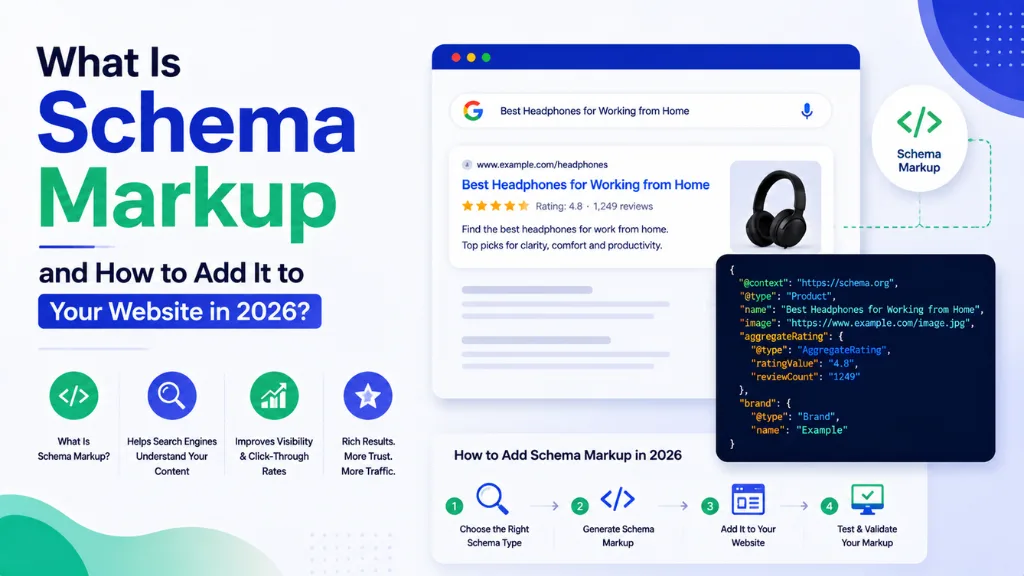
What Is Schema Markup and How to Add It to Your Website in 2026?

Fewer than 33% of websites currently use structured data, despite it being one of the clearest signals a site can give search engines and AI systems about what its content actually means, according to SerpNap’s 2026 schema markup guide. That gap represents genuine, low-effort opportunity for the majority of businesses still not using it at all.
In this article8 sections
Schema markup went through a real reputation shakeup in 2026. For years, the pitch was simple: add a block of code, win a rich snippet, climb the rankings. Then Google retired FAQ rich results, and a major study found that adding schema did little for AI citations on its own, according to Vynce Digital’s 2026 structured data guide. So is it still worth doing? Yes – but for different reasons than most guides admit.
At Search Savvy, schema markup remains a standard part of every technical SEO implementation we run, even after this year’s changes – because the value shifted, it did not disappear. This guide breaks down exactly what schema markup is, what changed in 2026, and how to add it to your website correctly.
What Is Schema Markup, Exactly?#
Schema markup is a standardised format of code added to web pages that helps search engines understand the meaning of your content, not just the words appearing on the page.
It uses a shared vocabulary defined at Schema.org – created collaboratively by Google, Bing, Yahoo, and Yandex – to give explicit clues about what your content actually represents, according to GWContent’s 2026 structured data guide. Google has been consistently clear that structured data is not a direct ranking factor. That remains technically true in 2026 – but what structured data unlocks has expanded considerably: rich result eligibility, Knowledge Graph entity recognition, and increasingly, the entity verification signals that AI systems rely on when generating answers.
Schema markup should be implemented in JSON-LD format specifically. Google explicitly recommends JSON-LD over older formats like Microdata and RDFa, since it lives in a clean script tag entirely separate from your page’s visual HTML, making it easier to implement, maintain, and debug, according to Dominate Tools’ 2026 JSON-LD guide.
People Also Ask: Is schema markup a direct Google ranking factor? Short Answer: No, Google has consistently confirmed structured data is not a direct ranking factor. However, it unlocks rich result eligibility, Knowledge Graph recognition, and AI citation signals – all of which influence visibility even without directly boosting rank.
What Changed With Schema Markup in 2026?#
Schema markup went through its most significant shift since rich snippets first launched, driven largely by Google’s March 2026 core update, which specifically targeted schema types that had been widely abused.
Google’s March 2026 core update reduced rich result display for several schema types, including FAQ, Review, and How-To, on pages where the markup did not genuinely describe the page’s primary content, according to DigitalApplied’s 2026 analysis. FAQ rich result impressions dropped by nearly half across tracked sites, and How-To rich results disappeared entirely from pages where the markup described supplementary rather than primary content.
Sites that had implemented schema aligned to genuine content intent – not as a SERP manipulation tactic – retained, and in many cases improved, their rich result rates through this same update. The distinction Google drew was specifically between schema that accurately reflected a page’s actual purpose versus schema bolted on purely to grab extra search result real estate.
People Also Ask: Did Google’s 2026 update remove FAQ rich results entirely? Short Answer: Largely, yes. Google’s March 2026 core update sharply reduced FAQ rich result display, particularly on pages where FAQ content was supplementary rather than the page’s primary focus. FAQ schema still has value for AI context, but no longer reliably earns extra search listing space.
Does Schema Markup Still Help With AI Search Citations?#
Schema markup’s role in AI search visibility is genuinely more nuanced in 2026 than most guides suggest, with some research showing meaningful benefit and other research finding little direct effect.
Industry research found that pages with thorough schema markup are 36% more likely to appear in AI-generated summaries and citations, and pages combining clean structure with schema markup earn 2.8 times higher AI citation rates than poorly structured pages, according to Tonic Worldwide’s 2026 schema guide. A controlled Search Engine Land experiment in 2025 similarly found that only a page with well-implemented schema appeared in an AI Overview, while an identical page without schema failed to even index, per GWContent’s 2026 analysis.
Other 2026 research complicates this picture. Google says no special schema is needed for AI Overviews specifically, and a separate Ahrefs study found no direct citation lift from adding it on its own – clear, extractable content matters more than schema alone, according to Vynce Digital’s 2026 guide. Google’s own position, per Launchcodex’s I/O 2026 analysis, is that structured data “remains valuable for rich results even though no special markup is required for AI responses specifically” – schema signals trust and structure to AI systems the same way it signals structure to Googlebot, but the effect is correlation, not confirmed causation, according to DigitalApplied’s 2026 I/O analysis.
People Also Ask: Does adding schema markup guarantee an AI Overview citation? Short Answer: No. Schema increases the probability of AI citation by reducing ambiguity and building confidence in your content’s structure, but it does not guarantee selection. Clear, well-organised, genuinely useful content remains the primary factor.
Which Schema Types Actually Matter Most in 2026?#
Schema markup effort is best concentrated on a small handful of types proven to move the needle, rather than spread thin across every schema type Schema.org defines.
The five schema types that consistently earn their place in 2026 are Organisation, Article (or BlogPosting), FAQPage (with caveats), Product, and LocalBusiness, according to GWContent’s 2026 guide. Article and BlogPosting schema are particularly critical for publishers and content-heavy sites, since they establish authorship – feeding directly into E-E-A-T signals – publication dates, and publisher identity, all of which help AI systems attribute content correctly, per Tonic Worldwide’s 2026 analysis.
A practical priority order for most businesses:
- Organization schema – implement site-wide, establishing your business identity clearly
- Article/BlogPosting schema – essential for any content-driven site publishing blog posts or articles
- LocalBusiness schema – critical for any business with a physical location or service area
- Product schema – required for e-commerce pages showing pricing, availability, and reviews
- FAQPage schema – keep for genuine Q&A content, but no longer add it purely to chase rich result space
People Also Ask: Is FAQPage schema still worth implementing after the March 2026 update? Short Answer: Yes, but for different reasons. It no longer reliably earns a FAQ rich result in search listings, but if your page has genuine Q&A content, the markup still helps provide context for AI systems evaluating and citing your content.
How Do You Actually Add Schema Markup to Your Website?#
Schema markup implementation always uses JSON-LD, placed as a script tag in the <head> section of your page’s HTML – a method that does not modify your visible page content at all.
JSON-LD is added as a <script> tag in your page’s head section, making it easy to implement and maintain without touching your page’s actual content or design, according to SerpNap’s 2026 step-by-step guide. Pages with proper schema markup are eligible for rich results – star ratings, FAQ dropdowns, product cards – which can increase click-through rates by 20–35% when those rich results do display, per the same source.
A practical implementation process:
- Choose your implementation method – CMS plugins (RankMath, Yoast, Schema Pro for WordPress), a schema generator tool, or manual JSON-LD for full control
- Start with your highest-priority pages – homepage (Organization), blog posts (Article), and any location or product pages
- Write or generate the JSON-LD code, ensuring every property accurately reflects your actual page content – never markup content that isn’t visibly present on the page
- Place the script tag in the <head> section of your HTML, with each schema type in its own separate block
- Validate before deploying using Google’s Rich Results Test or validator.schema.org
- Monitor performance through Google Search Console’s Enhancements report for ongoing errors
People Also Ask: Do I need a developer to add schema markup, or can I do it myself? Short Answer: Not necessarily. WordPress plugins like RankMath and Yoast can generate schema automatically, and free schema generator tools produce copy-paste JSON-LD code for common types. Manual implementation offers more control but requires basic technical familiarity.
What Mistakes Undermine Schema Markup’s Effectiveness?#
Schema markup fails to deliver value most often through a handful of preventable implementation mistakes, rather than any inherent limitation in the technology itself.
Boilerplate implementation – copying a schema template and filling in only the minimum required fields – produces minimum results. Optional properties like author, image, dateModified, and sameAs are what actually give AI systems the context needed to cite your content confidently, according to Globerunner’s 2026 structured data analysis. Skipping these fields is one of the most common ways businesses undercut their own implementation.
Common mistakes to avoid:
- Marking up content users cannot actually see on the page – this violates Google’s guidelines and risks manual action
- Overstuffing pages with unnecessary schema types rather than using only the schema genuinely relevant to that page’s content
- Filling only required fields and skipping valuable optional properties that strengthen AI context
- Never validating markup before deployment, risking silent errors that go unnoticed for months
- Adding FAQ schema purely to chase rich result space on content where Q&A is not genuinely the primary focus
According to Search Savvy’s insights from auditing client schema implementations, the gap between a boilerplate schema block and a genuinely well-built one usually comes down to those optional properties – the fields most agencies and plugins skip by default.
People Also Ask: What happens if schema markup describes content that isn’t visible on the page? Short Answer: This violates Google’s structured data guidelines and risks manual action or rich result ineligibility. Schema should only describe content genuinely present and visible to users on that specific page.
How Should You Monitor Schema Markup Performance Going Forward?#
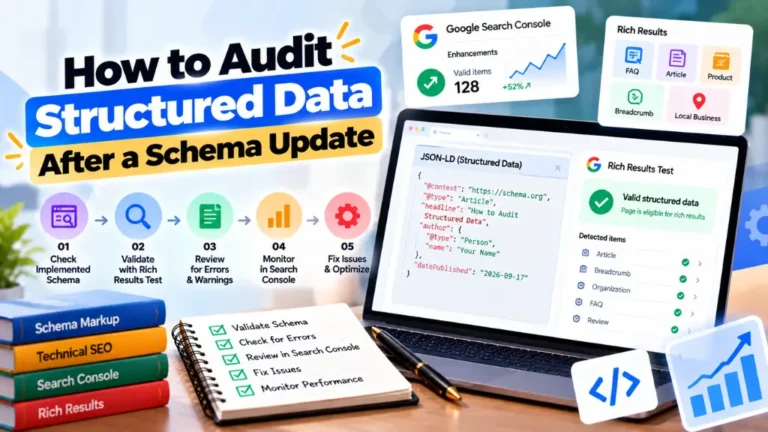
Schema markup requires ongoing monitoring, not a one-time implementation, since content changes, site updates, and evolving Schema.org standards all affect how well existing markup continues to perform.
Google Search Console monitoring provides ongoing oversight of structured data performance, while tools like Screaming Frog and Semrush offer automated schema auditing for larger sites, identifying missing markup and syntax errors at scale, according to We Are TG’s 2026 schema guide. Establishing a regular auditing schedule matters, since content changes and evolving standards require ongoing attention to keep markup effective.
At Search Savvy, we recommend tracking AI Overview impression rates and citation frequency alongside traditional rich result metrics – since a page’s schema quality can influence AI citation even when no visible rich result appears in traditional search listings.
FAQ: Schema Markup#
Q1: Is schema markup still worth implementing after Google’s 2026 changes? A: Yes. While FAQ, Review, and How-To rich results narrowed significantly, Organization, Article, LocalBusiness, and Product schema remain valuable for both traditional rich results and providing structural context to AI systems evaluating your content.
Q2: What is the difference between schema markup and structured data? A: They are closely related terms often used interchangeably. Structured data is the broader concept of standardised, machine-readable content formatting, while schema markup specifically refers to using the Schema.org vocabulary to implement that structured data.
Q3: Can I add multiple schema types to the same page? A: Yes. Multiple schema types can be combined on a single page when genuinely relevant – for example, a blog post might use both Article and Organization schema together, each in its own separate JSON-LD script block.
Q4: Does schema markup improve click-through rates? A: Indirectly, yes, when it earns a rich result. Pages eligible for rich results like star ratings or FAQ dropdowns can see click-through rate increases of 20–35% compared to standard listings, though eligibility for these specific rich results has narrowed since March 2026.
Q5: How do I check if my schema markup is working correctly? A: Use Google’s Rich Results Test or validator.schema.org to check for syntax errors before deployment. After deployment, monitor Google Search Console’s Enhancements report for ongoing validation and rich result eligibility tracking.
Q6: Should small businesses bother with schema markup, or is it only for large sites? A: Small businesses benefit significantly, particularly from Organization and LocalBusiness schema, since fewer than 33% of websites currently implement structured data at all – making it a genuine, low-effort competitive advantage rather than a large-site-only tactic.
Want a schema markup audit for your website? Visit Search Savvy to speak with a technical SEO expert who can identify exactly which structured data would move the needle for your site.