Thought Leadership Measurement: KPIs and Frameworks for Quantifying Personal Brand Equity

Ask most executives how their personal brand is performing, and you’ll get a follower count. Ask a CMO to prove that an executive’s LinkedIn presence actually influenced a closed deal, and the conversation usually stalls. That gap – between “people are watching” and “this moved the business” – is exactly what thought leadership measurement is supposed to close, and most organizations still don’t have a real framework for doing it.
In this article13 sections
Tom Peters saw this coming decades before LinkedIn existed. In his landmark 1997 Fast Company article that essentially invented the modern personal branding movement, he wrote, “We are CEOs of our own companies: Me Inc.” That framing – treating your professional reputation as an asset you actively manage, not something that just happens to you – is exactly the mindset thought leadership measurement requires, and it’s the lens we bring to this work with clients at Search Savvy. You can’t run a company without knowing whether it’s performing. The same is true of a personal brand.
What Is Personal Brand Equity, and Why Is It Hard to Measure?#
Personal brand equity is the accumulated trust, credibility, and differentiation an individual’s professional reputation carries – the value a person’s name and point of view add, independent of the actual content of any single post or article. Unlike product brand equity, which finance teams can partly triangulate through pricing power or market share, personal brand equity lives across dispersed, mostly qualitative signals: how a person is perceived, whether their opinion changes a decision, whether other credible people vouch for them.
Academic research has actually started catching up to this problem. A peer-reviewed study developing a standardized framework for Personal Brand Equity measurement identified three core dimensions – Brand Appeal, Brand Differentiation, and Brand Recognition – built from six measurable attributes: visibility, credibility, differentiation, online presence, professional network, and reputation. That structure is useful because it gives marketers something more rigorous than “engagement is up” to work from, and it maps cleanly onto the KPI layers most thought leadership programs should actually be tracking.
Personal Brand Equity vs. Corporate Thought Leadership: What’s the Difference?#
They overlap heavily but aren’t identical. Corporate thought leadership is content published under a company’s banner meant to build organizational authority. Personal brand equity is specifically about an individual – a founder, executive, or subject-matter expert – whose credibility often travels with them if they change companies. In practice, the most effective B2B thought leadership programs deliberately build both at once: company authority benefits when its executives are individually well-regarded, and an executive’s personal brand grows faster when it’s backed by a company with genuine expertise to draw on.
Why Thought Leadership Measurement Matters More Than It Used To#
For years, thought leadership was treated as a soft, reputation-building exercise that didn’t need hard measurement. That’s changed, largely because the research on how B2B buying actually works has gotten much more specific.
The Edelman-LinkedIn B2B Thought Leadership Impact Report, now in its seventh year and drawing on nearly 2,000 global professionals including both visible decision-makers and so-called “hidden buyers” in finance, legal, and procurement, found that more than 40% of B2B deals stall due to internal misalignment within the buying group – meaning people you’re not directly pitching often have outsized influence on whether a deal closes at all. The same research found that 70% of C-suite leaders say a piece of thought leadership has at least occasionally led them to question whether to keep working with an existing supplier. That’s a striking number: strong thought leadership doesn’t just win new business, it can quietly erode a competitor’s incumbency.
At the same time, the research points to a real quality gap. Widely cited findings from Edelman and LinkedIn’s ongoing research show that while the overwhelming majority of organizations now produce some form of thought leadership, only a small minority of buyers rate what they see as genuinely excellent. That gap is exactly why measurement matters – publishing volume without a way to assess actual resonance and impact is how organizations end up producing a lot of content that moves nothing.
Seth Godin, whose writing on marketing and trust has shaped how a generation of marketers think about audience-building, put the underlying problem in a single line: “The goal isn’t to be liked. The goal is to be trusted.” That distinction matters enormously for measurement, because likes, followers, and impressions measure the former. Almost none of the standard platform metrics measure the latter directly – which is exactly why a proper KPI framework has to look beyond what LinkedIn’s own dashboard shows you.
A Four-Layer KPI Framework for Thought Leadership Measurement#
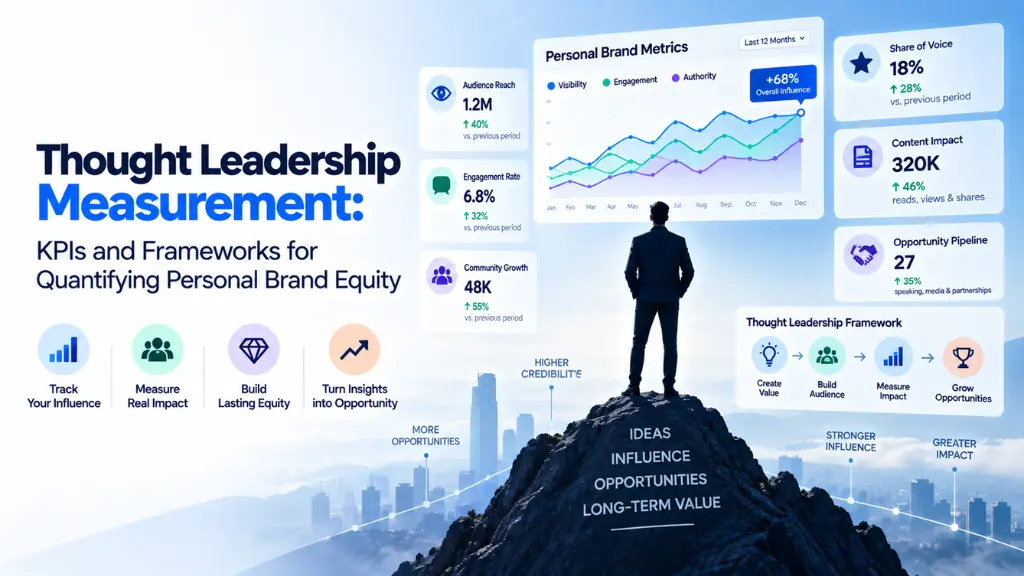
Rather than tracking a scattered list of metrics, it helps to organize thought leadership KPIs into four layers that build on each other – visibility feeds engagement, engagement feeds authority, and authority is what eventually drives business impact.
Layer 1: Visibility and Reach#
This is the foundation, and it’s the layer most programs over-index on. Useful metrics here include follower growth rate on strategic platforms (tracked month over month, not as a raw total), impressions per post, and share of voice relative to named competitors within your industry conversation. These numbers matter, but only as a leading indicator – visibility without the layers below it rarely translates into anything a business can point to.
Layer 2: Engagement and Resonance#
Engagement rate (interactions relative to reach, not raw likes) is a better signal than follower count because it reflects whether people actually find the content valuable enough to respond to. Saves and shares are particularly telling, since they represent someone deciding content is worth returning to or passing along, which is a stronger trust signal than a quick like. Comment quality is worth tracking qualitatively too – thoughtful, substantive comments from relevant industry people indicate real resonance in a way a comment count alone doesn’t capture.
Layer 3: Authority and Credibility Signals#
This is where personal brand equity starts becoming visible outside your own channels. Speaking invitations to conferences, podcasts, or panels are one of the clearest external validation signals, since they reflect other organizations actively seeking out someone as a recognized expert rather than the person promoting themselves. Media mentions and being quoted by journalists or other publications matter for the same reason. Backlinks and citations from third-party sites referencing an executive’s work or point of view are a strong, durable authority signal – and increasingly, being cited by AI tools like AI Overviews or ChatGPT when someone asks about a topic your executive is known for is becoming its own credibility marker, something we track closely at Search Savvy as AI search reshapes how authority gets discovered.
Layer 4: Business Impact#
This is the layer most organizations skip, largely because it requires connecting thought leadership activity to sales and hiring data that often lives outside the marketing team’s dashboards. Worthwhile metrics include changes in meeting acceptance rates after a personal brand campaign launches, inbound opportunities that can be traced back to a specific piece of content or speaking appearance, and – where a CRM allows it – whether accounts exposed to an executive’s content show shorter sales cycles or higher win rates than accounts that weren’t. Given how directly the Edelman-LinkedIn research ties thought leadership to hidden-buyer influence and deal-stalling risk, this layer is worth the extra effort to instrument properly rather than treating it as too hard to measure.
What KPIs Should You Actually Track for Executive Thought Leadership?#
If you’re building a scorecard from scratch, a reasonable starting set spans all four layers rather than clustering around vanity metrics: follower growth rate, engagement rate, share of voice, speaking and media invitations logged over time, third-party citations or backlinks, and – at minimum – a qualitative tracking mechanism for inbound opportunities the sales team believes were influenced by the executive’s visibility. None of these need to be perfect on day one; the goal is having a consistent baseline to improve against.
Common Measurement Mistakes to Avoid#
A few patterns show up repeatedly in programs that struggle to prove value:
- Treating follower count as the finish line. A large following with low engagement and no third-party validation is a weak signal, not a strong one – precisely the “liked, not trusted” trap Godin’s line warns against.
- Measuring only what the platform shows you. LinkedIn’s native analytics won’t tell you about a speaking invitation that came from a post six months ago, or a deal that closed faster because a prospect had already read an executive’s article. Those have to be tracked manually, at least until better attribution tooling exists.
- Ignoring the qualitative layer. Not every valuable signal is a number. Sales team feedback about which prospects mention an executive’s content unprompted is real data, even if it doesn’t fit neatly into a spreadsheet.
- Publishing without a baseline. Without knowing where engagement, share of voice, or inbound interest stood before a thought leadership push began, it’s impossible to credibly claim the program moved anything.
Turning Measurement Into an Ongoing Practice#
The organizations that get real value from thought leadership measurement tend to treat it as a recurring practice rather than a one-time audit – reviewing the four layers quarterly, adjusting which topics and formats an executive leans into based on what’s actually resonating, and feeding authority signals like speaking engagements back into the content plan. This is a discipline we help clients build at Search Savvy, particularly for executives trying to translate LinkedIn visibility into something measurable; our LinkedIn Thought Leadership services page walks through how we typically structure that work, and our Analytics & Performance Reporting services cover the dashboard side of connecting these layers together. If your team is still standardizing shared terminology around this, our analytics and reporting glossary is a useful reference point to align on before you start building scorecards.
FAQ: Thought Leadership Measurement#
What is personal brand equity in simple terms? It’s the accumulated trust, credibility, and differentiation a person’s professional reputation carries – value that exists independent of any single piece of content and often follows the individual even if they change roles or companies.
What KPIs actually prove thought leadership is working? A balanced set across visibility (follower growth, share of voice), engagement (engagement rate, saves, comment quality), authority (speaking invitations, media mentions, third-party citations), and business impact (inbound opportunities, meeting acceptance rates, deal influence) gives a far more complete picture than any single metric alone.
Is follower count a good measure of thought leadership success? No, not on its own. Follower count is a visibility metric with no built-in signal for trust or influence; a smaller, highly engaged audience of relevant decision-makers is typically more valuable than a large, passive one.
How long does it take to see measurable results from thought leadership? Most authority and business-impact signals take months, not weeks, to materialize, since speaking invitations, media pickup, and sales-cycle effects depend on consistent publishing and network effects building over time.
Does thought leadership actually influence B2B buying decisions? Yes. Research from Edelman and LinkedIn’s ongoing B2B Thought Leadership Impact studies has repeatedly found that thought leadership influences vendor vetting, can cause buyers to question an existing supplier relationship, and plays a meaningful role in overcoming internal misalignment within buying groups.
What’s the biggest mistake companies make when measuring thought leadership? Relying entirely on platform-native analytics like impressions and likes while skipping the harder work of tracking authority signals and business outcomes, which are what actually demonstrate impact beyond simple visibility.
The Bottom Line#
Thought leadership measurement doesn’t need to be perfect to be useful – it needs to be consistent, layered, and honest about what a vanity metric can and can’t tell you. Start by establishing a baseline across visibility, engagement, authority, and business impact, and resist the temptation to lead with follower count just because it’s the easiest number to report. Tom Peters was right that you’re the CEO of your own brand; the executives who treat that job with the same rigor they’d apply to running an actual company are the ones who can eventually prove, not just assume, that it’s paying off.