How Long Does SEO Take to Show Results? (Realistic Timeline)

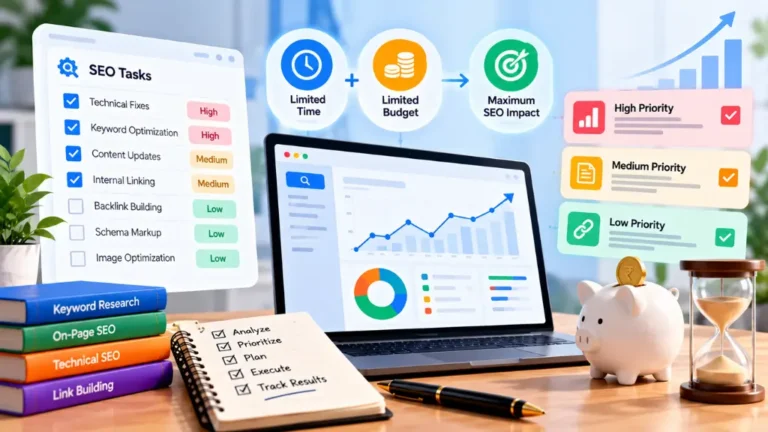
Nobody enjoys hearing “it depends” as an answer, but when it comes to search rankings, the honest answer really does depend on a handful of specific, measurable factors — and once you know what they are, the timeline stops feeling like a mystery.
In this article7 sections
SEO take to show results is one of the most common questions business owners ask before signing off on any SEO investment, and for good reason: unlike paid ads, you cannot simply switch it on and watch traffic appear the next morning. Ahrefs’ study of 2 million randomly sampled pages found that 95% of newly published content never reaches Google’s top 10 within its first year, according to Factory Jet’s 2026 SEO timeline analysis.
At Search Savvy, setting realistic timeline expectations is one of the first conversations we have with every new client, because misaligned expectations are the number one reason businesses abandon SEO before it has a real chance to work. This guide breaks down exactly how long SEO take to show results in 2026, month by month, with current data and India-specific benchmarks.
Why Does SEO Take to Show Results So Long Compared to Paid Ads?#
SEO take to show results measured in months, not days, because Google’s ranking systems are fundamentally built around trust signals that accumulate over time, not instant relevance matching.
Around 80% of SEO professionals agree that consistent results require at least six months of ongoing work before a campaign can be considered genuinely successful, according to NEWMEDIA’s 2026 SEO statistics report. More than 200 ranking factors power Google’s search algorithm, and the most influential ones — particularly your backlink profile and topical authority — build gradually as your site earns a reputation as a trusted resource, per SEO.com’s 2026 timeline guide.
SEO take to show results also has an authority-compounding element that paid channels simply do not. Ahrefs’ analysis of pages currently ranking in the top 10 found the average result is over two years old, underscoring how strongly authority compounds over time rather than appearing suddenly, according to Factory Jet’s 2026 data.
People Also Ask: Why is SEO slower than running paid ads? Short Answer: Paid ads buy immediate visibility, while SEO earns it gradually through trust signals like backlinks, content depth, and site authority — all of which accumulate over months, not days. This makes SEO slower initially but far more durable and cost-effective long-term.
How Long Does SEO Take to Show Results for a Typical Business?#
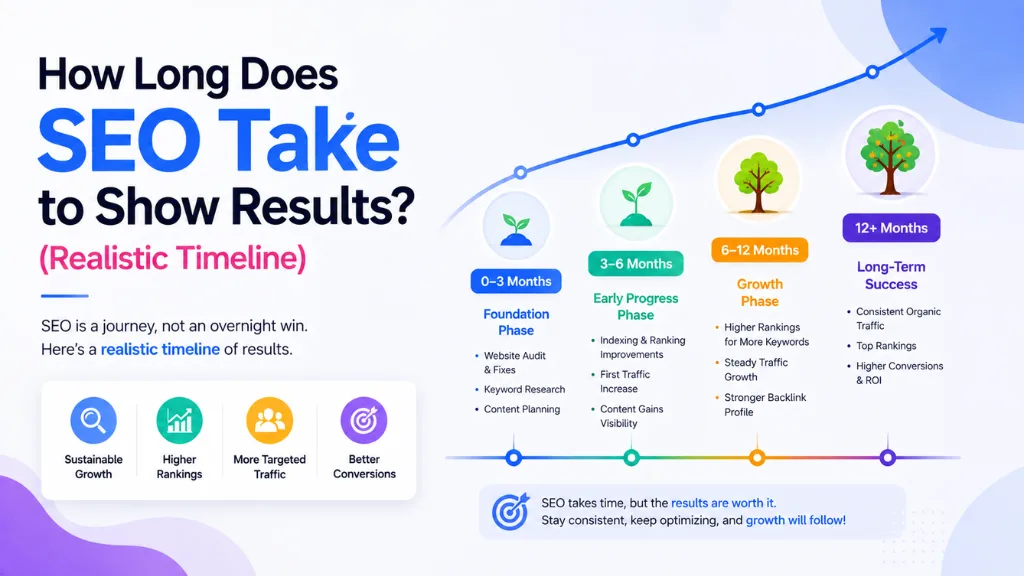
SEO take to show results generally falls into a consistent three-tier pattern across most 2026 industry data, regardless of which research firm or agency you reference.
Semrush’s State of Search reports consistently find that newly created pages take three to six months to generate meaningful impressions, and six to twelve months to reach page-one positions for genuinely competitive keywords, according to Factory Jet’s 2026 analysis of Ahrefs and Semrush data. This range holds up consistently across independent sources — SEO.com’s 2026 guide reports the same three-to-six-month window for initial traction, extending to six to twelve months for sustained competitive rankings.
Here is the realistic tiered timeline most 2026 data supports:
- 0–3 months — technical fixes, keyword research, and foundational content go live; minimal visible ranking movement yet
- 3–6 months — first meaningful traction; long-tail keywords enter positions 10–30; organic impressions grow steadily week over week
- 6–12 months — sustained page-one rankings for moderately competitive keywords; traffic growth becomes noticeable in business terms, not just Search Console
- 12–18 months — for highly competitive national keywords, this is often when consistent first-page results finally appear, according to NEWMEDIA’s 2026 SEO data
People Also Ask: What is a realistic timeframe to expect SEO results? Short Answer: For most small-to-medium businesses, three to six months for early traction, and six to twelve months for meaningful, sustained results. Highly competitive national keywords can take twelve to eighteen months of consistent work.
What Factors Actually Speed Up or Slow Down How Long SEO Takes?#
SEO take to show results depends heavily on a handful of specific, controllable and uncontrollable factors — understanding which ones apply to your site helps set an accurate expectation from day one.
Website age and existing authority play a significant role: older websites with an established backlink profile tend to reach results faster, while brand-new domains typically need four to six months before search engines establish enough trust to rank consistently, according to Lasso Up’s 2026 SEO timeline guide. Publishing consistency compounds this effect — a business that blogs weekly and monitors performance sees steady growth, while one that publishes sporadically often fails to rank at all, per EWR Digital’s 2026 timeline report.
Key factors that influence your specific timeline:
- Website age and authority — newer sites take longer to earn Google’s trust
- Competition level — low-competition, long-tail keywords can rank in three to four months; competitive national terms often take twelve months or more
- Content consistency — regular publishing signals an active, growing site; gaps hurt momentum
- Technical health — crawl errors, broken links, and slow pages create friction that delays everything else
- Content quality over volume — AI-generated content speeds up production but does not meaningfully shorten the timeline if it lacks genuine depth and expertise
People Also Ask: Does a new website take longer to rank than an established one? Short Answer: Yes. New websites typically need four to six months before consistent SEO results appear, since search engines need time to establish trust and authority. Established sites with an existing backlink profile and content history generally see movement sooner.
How Does AI Search Change How Long SEO Takes in 2026?#
SEO take to show results has developed an additional, faster track in 2026 because of how Google’s AI Overviews now surface content — sometimes ahead of traditional ranking movement entirely.
A page can now appear inside an AI Overview before it ranks organically in position one, which means content structured specifically for AI extraction — FAQ schema, answer-first headings, and short, direct paragraphs — can produce visibility faster than waiting for traditional ranking movement alone, according to Factory Jet’s 2026 analysis. This creates a genuinely parallel path to visibility that did not exist in earlier SEO cycles.
At the same time, this shift raises the quality bar rather than lowering the timeline for everyone. Content needs to be extremely clear and data-backed to earn citation within AI summaries, and following Google’s Search Quality Evaluator Guidelines for E-E-A-T signals matters more than ever for building the trust these systems reward, per Ranknality’s 2026 SEO timeline guide.
People Also Ask: Can content appear in Google’s AI Overviews before it ranks organically? Short Answer: Yes. AI Overviews create a parallel visibility track alongside traditional rankings. Content built with clear structure — FAQ schema, answer-first headings, and concise paragraphs — can earn AI citation before reaching a top organic position.
How Long Does SEO Take to Show Results for Indian Businesses Specifically?#
SEO take to show results in India generally tracks close to global benchmarks, though local SEO specifically tends to move faster than broader, competitive national SEO campaigns.
For Indian businesses, a realistic breakdown looks like three to four months for first rankings, six to nine months for meaningful traffic growth, and twelve months for genuinely compounding results, according to Mayank Digital Labs’ 2026 India-specific SEO timeline guide. Getting listed accurately on Indian directories like JustDial, Sulekha, and IndiaMART, matching your Google Business Profile details exactly, provides genuine domain authority that Google trusts, per the same source.
Local SEO specifically moves noticeably faster than broader content-driven SEO. Google Business Profile improvements can show measurable movement within two to six weeks, with local pack visibility improving within 60–90 days and durable multi-keyword local visibility by month six, according to Media Officers’ 2026 local SEO checklist.
According to Search Savvy’s insights from managing SEO campaigns across Indian small and mid-sized businesses, local SEO is consistently the fastest-paying-back investment for service-area businesses, precisely because search intent is already immediate — someone searching “plumber near me” is ready to act now, not researching for later.
People Also Ask: Does local SEO show results faster than regular SEO in India? Short Answer: Yes, significantly. Local SEO can show measurable movement in four to eight weeks through Google Business Profile optimisation, while broader content-driven SEO for competitive national keywords typically takes six to twelve months or longer.
What Can You Actually Do to Speed Up How Long SEO Takes?#
SEO take to show results faster when specific, proven acceleration tactics are applied consistently, rather than treated as one-time fixes.
According to Search Savvy’s insights from managing client SEO campaigns, the businesses that see faster movement combine several of these tactics together, rather than relying on just one:
- Target long-tail, low-competition keywords first to build early domain confidence before attempting broader head terms
- Refresh existing content regularly — updated statistics, better formatting, and added multimedia can outperform publishing something entirely new
- Build topic clusters — interlinked pillar and supporting content demonstrates depth faster than isolated, unconnected articles
- Add schema markup, including FAQ schema, to help both traditional rankings and AI Overview citation
- Fix technical SEO issues early — crawl errors and slow load times create friction that delays every other improvement’s impact
- Strengthen E-E-A-T signals — author bios, case studies, and genuine credentials build the trust signals search engines increasingly prioritise
At Search Savvy, we recommend treating these as a compounding system rather than a checklist — consistency across all six areas produces faster, more durable results than doing any single one exceptionally well in isolation.
FAQ: How Long Does SEO Take to Show Results#
Q1: Can SEO show any results within the first 30 days? A: Small technical wins — fixed crawl errors, improved page speed, resolved indexing issues — can show impact within the first 90 days. However, meaningful traffic and ranking growth typically takes three to six months at minimum.
Q2: Is it possible to speed up SEO results significantly? A: Somewhat. Low-competition, long-tail keywords with high-quality, well-integrated content can sometimes reach page one within three to four months. However, no legitimate tactic delivers SEO results as quickly as paid advertising can.
Q3: Does hiring an SEO agency make results appear faster than DIY SEO? A: Generally, yes, particularly because algorithms change faster than most business owners can track alongside running their business. Agencies with current data and experience across multiple sites often identify faster wins and avoid common timeline-delaying mistakes.
Q4: Why do some businesses never see SEO results at all? A: The most common reasons are expecting overnight success and abandoning the strategy too early, inconsistent publishing, low-quality or AI-generated content lacking genuine depth, and unresolved technical issues that quietly undermine every other improvement.
Q5: Does website age affect how long SEO takes? A: Yes. Older websites with an established backlink profile and content history tend to reach results faster than brand-new domains, since search engines need time to build trust in a newer site regardless of content quality.
Q6: How long should a business commit to SEO before evaluating whether it is working? A: At least six months, based on the consensus across most 2026 industry data. Evaluating results before the three-month mark rarely reflects the strategy’s actual trajectory, since early months are largely foundational work.
Want a realistic SEO timeline tailored to your specific website and industry? Visit Search Savvy to speak with an SEO expert who can set clear, honest expectations from day one.