
Voice Search vs AI Chat Search: Are They the Same Thing in 2026?
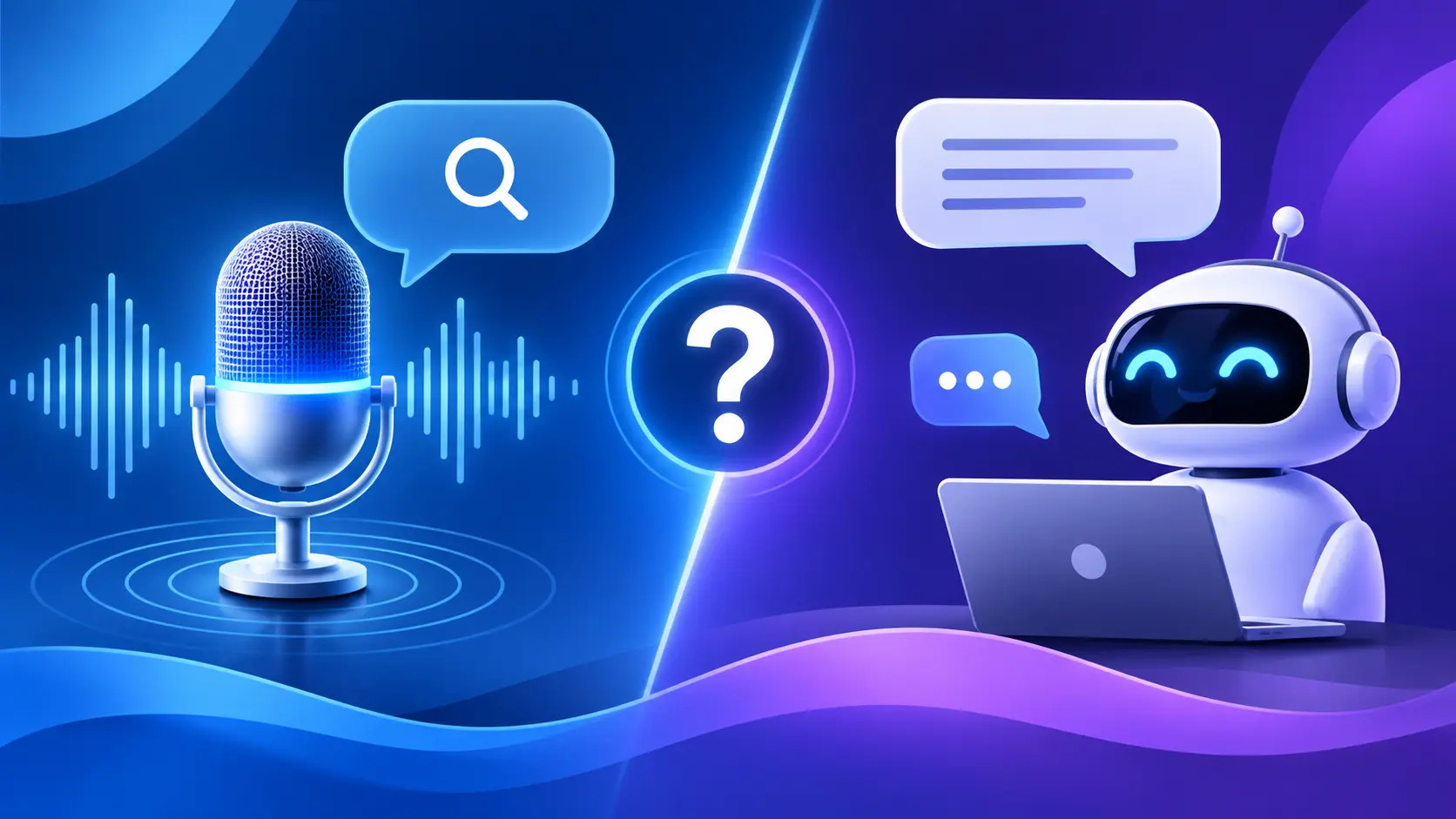

No. Voice search and AI chat search are different things, although in 2026 they overlap more than ever. Voice search describes how you ask: out loud. AI chat search describes how the answer is produced: a language model reads your question in context, runs searches behind the scenes, and writes a response. You can use one without the other, and a growing number of people now use both at once.
In this article20 sections
That overlap is why the question is harder to answer than it looks. When Google’s Search Live, Amazon’s Alexa+ and ChatGPT all let you talk to a model, “voice” no longer means short commands and a single spoken reply. This article shows where the two channels still differ, how query length and conversational structure compare, what the 2026 data says, and what to change in your content.
Voice Search vs AI Chat Search: The Short Answer#
Voice search is a spoken query answered by a voice assistant or a search engine. AI chat search is a typed or spoken conversation with a language model that keeps context, pulls in sources, and writes a synthesized answer. Voice is an input method. AI chat is an answer system. The two can be combined, which is exactly what is happening now.
A quick test helps. Ask three questions about any search. How was the query entered: text, speech or camera? Does the system remember the previous turn? Is the answer retrieved or generated? Voice only answers the first question. AI chat answers the second and third.
What Is Voice Search, and What Is AI Chat Search?#
What is voice search?#
Voice search lets you speak a query to a phone, smart speaker, car or watch instead of typing it. In the classic pipeline, speech recognition converts audio to text, a language-understanding layer works out intent, and the assistant either reads one answer aloud or shows a results page. “What’s the weather tomorrow?” and “Find a pharmacy near me” are typical examples.
What is AI chat search?#
AI chat search means asking a conversational AI system, such as ChatGPT, Gemini, Microsoft Copilot, Perplexity or Google’s AI Mode, to find and explain information. These systems often split one question into several related searches. Google calls this “query fan-out” and says both AI Overviews and AI Mode may use it. Follow-ups build on earlier turns, so a prompt like “what about the cheaper one?” still makes sense.
Voice search vs chatbot search at a glance#
| Factor | Voice search | AI chat search |
| Input | Speech | Text, speech, images or camera |
| Typical turn | One question, one answer | Multi-turn conversation |
| Context memory | Limited in classic assistants | Carries earlier turns |
| Answer type | Short spoken reply or results page | Synthesized answer with source links |
| Where it runs | Phones, smart speakers, cars | Chat apps, AI Mode, LLM-backed assistants |
| Typical need | Quick facts, local info, commands | Research, comparison, planning |
One caveat: the “voice assistant vs chatbot” line is blurring because the assistants themselves are being rebuilt on language models, as the section on 2026 shows below.
How Do Query Length and Conversational Structure Compare?#
Typed Google queries average about four words. Google AI Mode queries average about seven, and Semrush measured ChatGPT prompts at around 23 words. Voice queries sit closer to natural speech than typed ones, but length alone does not separate voice from chat. Structure does.
| Channel | Average length | Source |
| Typed Google Search | 4.0 words | Semrush, US desktop clickstream, 2025 |
| Google AI Mode | 7.22 words | Same Semrush study |
| ChatGPT prompts | About 23 words | Semrush’s earlier ChatGPT analysis, cited in the same study |
| ChatGPT’s own background searches | 5.48 words | Nectiv, via Search Engine Land |
Averages can mislead, though. Two surveys by Stella Rising found that two-thirds of respondents wrote prompts of 15 words or fewer, and an Otterly.AI analysis put the median real-world prompt at 12 words. Long, context-heavy prompts exist, but they cluster around drafting, coding and planning rather than lookups.
The evidence on voice length is older and mixed. Google researchers reported in 2010 that longer queries were more likely to be typed than spoken. A 2016 analysis of a commercial search engine’s mobile logs found that spoken queries were closer to natural language than typed ones. Wharton professor Shiri Melumad ran five studies and found that spoken queries tend to be more specific, for example naming brands. In her words, “When we type, it tends to be more spontaneous”, whereas speaking makes people plan the question first.
What does conversational query structure look like in each channel?#
A voice query is usually one complete question: “What’s a good Italian restaurant near me?” An AI chat conversation layers constraints and builds across turns. An illustrative example: “I need a quiet Italian restaurant in Pune for six people tonight, vegetarian-friendly, under 1,500 rupees each.” Then: “Which of those has parking?” The second message only works because the system remembers the first.
How Do Smart Speaker Search Behavior and Chatbot Behavior Differ?#
Smart speakers are habitual, hands-busy and short. Chatbots are task-oriented and longer. Pew Research Center’s February 2026 survey found that 35% of U.S. adults own a smart speaker, and about a quarter use AI chatbots daily.
Spoken answers have to be compact. In a HubSpot experiment comparing 26 questions across platforms, Siri averaged about nine seconds per answer, Alexa 10 and Google Assistant around 18. Chat answers have no such ceiling. Semrush also found that AI Mode sessions took two to three searches on average, roughly half as many as classic Google sessions, because the system handles refinement internally.
Where Are Voice and AI Chat Search Merging in 2026?#
The two channels are converging fast:
- Google: Search Live expanded globally on March 26, 2026, letting people in more than 200 countries talk to AI Mode by voice or camera and ask follow-ups. A beta redesign of Voice Search groups Search, AI Mode, Live and Song Search in one toolbar, though it was limited to some beta users in August.
- Amazon: Alexa+ became available to all U.S. customers on February 4, 2026, free for Prime members.
- Google Home: Google plans to retire Assistant on speakers and displays on August 2, 2027 in favor of Gemini for Home.
- Apple: At WWDC in June 2026, Apple unveiled Siri AI, a Gemini-based rebuild with a standalone conversational app.
- OpenAI: The company says 250 million people use ChatGPT’s voice input weekly, counting dictation and voice conversations, among 1.2 billion weekly users. These are company-reported figures.
In practice, “voice search” increasingly means “talking to an AI chat system.”
How Does Natural Language Processing Search Work Behind Each?#
Classic voice search chains three steps: speech recognition, intent classification, and answer selection. Errors compound. A misheard brand name at step one sends everything after it in the wrong direction.
AI chat search relies on a language model that reads the whole conversation, then retrieves fresh sources before writing. That pattern is called retrieval-augmented generation. Search engines have been moving this way for years. When Google applied BERT to Search in 2019, it said the change would help with longer, more conversational queries and understand one in 10 U.S. English searches better. Today’s chat systems extend that idea from understanding a query to composing an answer.
How Do You Optimize Content for Both Voice and AI Chat Search?#
You optimize for both with the same habits: answer questions directly, cover the follow-ups, and keep your facts consistent. Here is a practical sequence:
- Start with intent. Decide whether the searcher wants a fact, a comparison or a decision. How search intent works determines the format of your answer.
- Lead with the answer. Put a 40 to 60 word response directly under a question-style heading, then expand. It reads well aloud and extracts cleanly into AI answers.
- Cover the follow-ups. Fan-out systems search for sub-questions: cost, alternatives, who it suits, mistakes. Search Savvy’s walkthrough of question-based keyword research shows how to surface them.
- Keep local facts consistent. Hours, addresses and services should match everywhere. A local SEO checklist covers the basics for “near me” queries.
- Protect the fundamentals. Google states that no additional requirements apply for AI Overviews or AI Mode beyond being indexed and eligible for a snippet, and its generative AI guide says llms.txt and other special markup are unnecessary. Search Savvy’s voice search optimization guide covers the speech-specific tactics in more detail.
- Test in the real interfaces. Ask your key questions aloud to Google, Alexa and ChatGPT every month. Note which sources get cited and which wording gets read back.
What Mistakes Should You Avoid?#
- Treating voice as a separate keyword project. The underlying work is the same as for conversational search generally.
- Assuming voice queries are always long. The research above says otherwise.
- Writing only for the spoken answer. In Semrush’s early sample, 92 to 94% of AI Mode sessions were zero-click, so being cited and remembered matters as much as being read aloud.
- Mass-producing question pages. Google’s guidance warns that generating many pages without adding value may violate its spam policy on scaled content abuse.
FAQ#
Is ChatGPT voice mode the same as voice search?#
No. ChatGPT’s voice mode is a spoken interface to a chatbot that keeps context and can search the web. Classic voice search is a spoken query to an assistant or search engine. They overlap in input but differ in how answers are produced.
Will AI chatbots replace voice assistants?#
They are merging instead. Alexa+, Gemini for Home and Apple’s Siri AI all rebuild existing assistants on language models, and Google is retiring Assistant on home devices in August 2027.
Are voice search queries longer than typed queries?#
Not always. Older research found shorter queries were more likely to be spoken, while other studies found spoken queries closer to natural language. Specificity and phrasing differ more reliably than word count.
Should I optimize for voice search or AI search first?#
Start with answer-first pages that satisfy search intent. That foundation serves both channels, and you can then add speech-specific refinements such as concise definitions and local details.
Do I need FAQ schema or llms.txt for voice and AI search?#
No. Google says AI features have no additional requirements, and its guide says special files like llms.txt are not needed. Structured data can still clarify a page, but it is not a prerequisite.
Can I track voice search traffic?#
Not directly. Google Search Console does not report spoken queries as a separate segment, and AI feature traffic is included in overall search totals. Monthly prompt tests, branded query trends and Business Profile actions are practical proxies.
The Takeaway#
Voice search and AI chat search are not the same thing, but treating them as separate projects wastes effort. One describes how people ask, the other describes how answers are built, and both reward pages that answer clearly, anticipate follow-ups and stay accurate.
Your next step: pick your five most valuable pages, add a 40 to 60 word answer under a question heading, cover the likely follow-ups, then ask those questions aloud in Google, Alexa and ChatGPT. If you want a second opinion on where your content stands, Search Savvy’s AI search optimization services are a reasonable place to start.