SERP Feature Intent Mapping: Targeting Rich Results by Search Behaviour Pattern
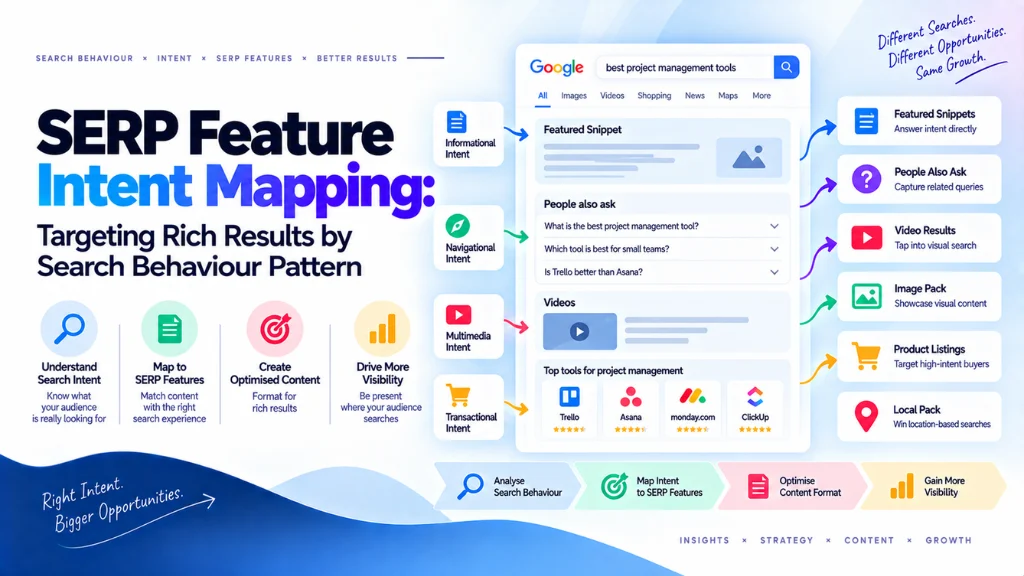

A search results page isn’t just a ranking list anymore – it’s a real-time editorial brief that tells you exactly what Google believes will satisfy a given query. When a search returns a comparison table, a video carousel, and a set of People Also Ask questions, that composition is Google publicly showing its judgment of intent. SERP feature intent mapping is the practice of reading that composition deliberately – identifying which rich results appear for a given query pattern, and building content specifically to earn the features that pattern favors, rather than optimizing for a generic ranking position.
In this article10 sections
This has become more important, not less, as SERPs have fragmented. Rich results now earn a 58% click-through rate compared to 41% for standard listings, and featured snippets alone post the highest CTR of any SERP feature at 42.9%, according to March 2026 research from Reboot and Databox. At the same time, 68.01% of US Google searches ended without any click at all in the first four months of 2026, per Similarweb clickstream data analyzed by SparkToro – a reminder that not every SERP feature is a traffic opportunity, and mapping intent to feature type only works if you also know which features convert to clicks and which simply build visibility.
What Is SERP Feature Intent Mapping?#
SERP feature intent mapping is the process of analyzing which rich results – featured snippets, People Also Ask, local packs, review-rich results, video carousels, AI Overviews – consistently appear for a specific category of search intent, then structuring content to specifically target those features rather than a generic top-10 ranking. It treats the SERP itself as the primary research tool: instead of guessing at intent from the keyword alone, you search the query and observe exactly which features Google has already decided belong there.
This reframes keyword difficulty in a meaningful way. If a keyword triggers multiple attention-grabbing rich results – an AI Overview, a People Also Ask block, and a video carousel all above the first organic listing – that layout is effectively part of the keyword’s real difficulty, even if the traditional ranking-difficulty score looks moderate. A page sitting in position three under three stacked features can be technically strong and commercially weak at the same time, which is exactly the gap many teams feel when rankings improve but sessions don’t follow.
Why the SERP Itself Is the Best Intent Signal#
Academic research analyzing SERP composition found a clear, consistent pattern across intent types: data-rich elements are more prevalent on informational SERPs, navigation-facilitating elements occur more often on navigational SERPs, and commercial or decision-supporting elements are more prominent on transactional SERPs. AI Overviews were found to be especially prevalent on what researchers classified as instrumental SERPs – queries where the user needs a specific, actionable answer – while local and search-refinement features cluster more heavily around navigational intent.
This means the SERP’s own structure functions as a diagnostic: search a target query and observe the features already present before writing a single word of content. If the top results are dominated by comparison tables and review-rich results, that’s Google telling you the query is being evaluated as commercial-investigation intent, regardless of what the keyword’s surface wording might suggest.
How SERP Features Map to Intent Categories#
The mapping is consistent enough to build a working reference from, though real SERPs often blend more than one intent signal simultaneously.
| Intent Category | Common SERP Features | What This Signals |
| Informational | Featured snippets, People Also Ask, video results, AI Overviews | Google favors a direct, extractable answer over a sales pitch |
| Navigational | Sitelinks, local packs, knowledge panels | Users want a specific destination or entity, not general education |
| Commercial investigation | Review-rich results, comparison layouts, product modules | Users are evaluating options before deciding, not ready to buy immediately |
| Transactional | Shopping modules, ads, product rich results | Users are close to a purchase decision and want direct paths to buy |
Do I Need to Target Every Feature That Appears for My Keyword?#
No. A single query can display multiple features simultaneously, but not every one deserves equal content investment. Prioritize the feature that best matches the specific decision-friendliness or answer-directness your content can genuinely deliver – attempting to win every feature on a fragmented SERP usually dilutes the page’s focus rather than strengthening it.
Feature Ownership vs. Ranking: Why Position Isn’t Enough#
Traditional SEO reporting treats ranking position as the primary success metric, but a good position sitting below the most prominent SERP features can still fail to generate meaningful traffic. Feature ownership – actually being the source a rich result draws from – increasingly matters more than the underlying blue-link position, because Google is using these features to express its interpretation of intent directly, rather than relying on ranking order alone to communicate it.
The practical implication is that keyword difficulty assessments built purely on backlink and content-quality metrics are incomplete in 2026. A keyword with moderate traditional difficulty but three stacked rich results above the fold should be scored as functionally harder than the raw difficulty number suggests, because winning the ranking without winning a feature often means winning very little visible real estate at all.
Separating Traffic Features from Visibility Features#
Not every SERP feature should be judged by the same metric. Some features genuinely send traffic; others exist primarily to build visibility and brand presence without a click ever occurring. The broader zero-click trend is real, but it predates generative AI – featured snippets, knowledge panels, maps, and shopping modules were already creating zero-click behavior well before AI Overviews arrived, so a falling click-through rate shouldn’t automatically be attributed to AI search alone.
The more useful approach is segmenting measurement by feature type rather than relying on a single sitewide CTR benchmark, which has become increasingly misleading as SERPs fragment. Track clicks and conversions specifically where a feature sends traffic, and separately track impressions, citations, and branded-demand signals where a feature builds visibility without a visit. Being cited inside an AI Overview, for instance, doesn’t register as a click, but it can materially improve brand recall and downstream branded search – a value that a click-only reporting model misses entirely. Search Savvy’s keyword research services build this feature-level segmentation into keyword scoring, rather than treating every ranking opportunity as equally valuable regardless of the SERP layout surrounding it.
A Practical Framework for Mapping SERP Features to Content Strategy#
- Search the target query and observe the SERP directly before drafting anything – the composition of features present is Google’s own editorial brief for that query.
- Choose one primary intent to serve, based on whichever intent Google appears to prioritize in its feature selection, rather than trying to satisfy every possible interpretation of an ambiguous keyword.
- Address secondary needs through micro-sections, such as a short definition, a criteria list, or an FAQ block, rather than diluting the page’s primary promise by trying to be everything at once.
- Structure content to match the featured format directly. A query dominated by comparison tables needs a genuinely comparative table, not a narrative summary; a query showing People Also Ask needs direct, self-contained answers to those exact questions.
- Split into a satellite page when a secondary need becomes substantial. If a secondary intent requires real depth to answer properly, a dedicated page usually serves users – and SERP feature eligibility – better than cramming it into a page built for a different primary intent.
- Reassess periodically, since SERP composition changes as Google tests new formats; roughly 15% of queries are reported as new each day, and feature presence shifts accordingly.
Search Savvy’s on-page SEO services apply this SERP-first diagnostic approach before content structure decisions are made, treating the SERP’s own composition as the brief rather than a generic content template applied regardless of query type.
Common Mistakes in SERP Feature Intent Mapping#
- Optimizing for a generic top-10 ranking regardless of feature layout. A strong ranking below three stacked rich results often delivers far less traffic than the position alone suggests.
- Treating every SERP feature as equally valuable. Traffic-generating features and visibility-only features need separate measurement, not a single blended CTR benchmark.
- Attempting to win every feature on a fragmented SERP. Spreading content thin across multiple intents usually weakens the page’s ability to win any single feature convincingly.
- Ignoring structured data as an enabler. With 97.3% of SEOs reporting that structured data helps SEO, skipping schema markup – such as a properly configured FAQ schema on a page targeting People Also Ask visibility – leaves eligibility on the table unnecessarily.
- Blaming all zero-click behavior on AI Overviews. Featured snippets, knowledge panels, and maps were producing zero-click searches long before generative AI arrived; attribute click declines to the correct feature before adjusting strategy.
The Bottom Line#
SERP feature intent mapping turns the results page itself into the clearest available signal of what Google – and the searcher – actually wants from a query. Reading that composition before writing a word, structuring content to match the dominant feature type, and separating traffic-generating features from visibility-only ones consistently outperforms optimizing for a generic ranking position without regard to what’s sitting above it.
The practical next step is searching your five highest-priority target queries today and mapping exactly which features currently appear, before assuming your existing content is structured to compete for them. Search Savvy’s keyword scoring and prioritisation work and content strategy and topical authority services build this SERP-first diagnostic into planning from the start, so content is built to win the specific feature the query already favors.
Frequently Asked Questions#
What is SERP feature intent mapping? It’s the process of analyzing which rich results – featured snippets, People Also Ask, local packs, review-rich results, AI Overviews – consistently appear for a specific type of query, then structuring content to specifically target those features rather than a generic ranking position alone.
Why does rich result CTR matter more than overall ranking position? Rich results earn a meaningfully higher click-through rate than standard listings – 58% versus 41% according to 2026 research – meaning a page ranking well but sitting below a rich result it doesn’t own can still underperform a lower-ranked page that actually wins that feature.
Are all SERP features worth optimizing for? No. Some features primarily drive clicks and traffic, while others mainly build visibility, brand recall, or citations without generating a visit. Treating every feature as an equal traffic opportunity leads to misallocated content effort.
How do I know which intent Google has assigned to my target keyword? Search the query directly and observe which features appear. Data-rich elements tend to signal informational intent, comparison and review features signal commercial investigation, and local or navigational elements signal that users want a specific destination rather than general education.
Is the rise in zero-click searches caused by AI Overviews? Not entirely. Featured snippets, knowledge panels, maps, and shopping modules were producing zero-click behavior well before generative AI search features existed. AI Overviews have added to the trend, but they aren’t the sole cause, and segmenting by feature type gives a clearer picture than a single overall zero-click statistic.
Does structured data guarantee a rich result? No. Structured data makes content eligible for a rich result by clearly communicating its type and content to search engines, but eligibility doesn’t guarantee selection. It remains a near-universal best practice regardless, with the vast majority of SEOs reporting it helps overall SEO performance.