Composable MarTech Architecture: Building Agile Stacks That Scale Without Legacy Lock-In

A marketing team wants to test a new personalization engine. On a monolithic platform, that request typically means filing a support ticket, waiting for the vendor’s release roadmap, and hoping the eventual feature fits the actual use case – a process that can take the better part of a year. On a composable MarTech architecture, the same team swaps in a specialist tool, connects it through an API, and is testing it against production data within two weeks. That gap is the entire case for composability, and it’s why organizations project that 61% of their technology stack will be MACH or composable by the start of 2026, with 93% reporting that MACH investments have met or exceeded ROI expectations.
In this article10 sections
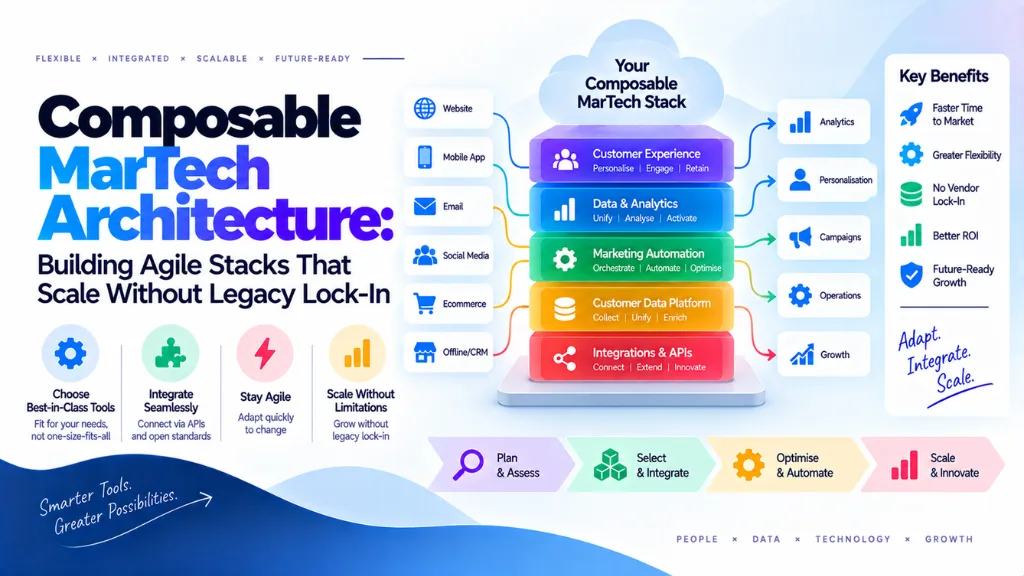
Composable MarTech architecture is the practice of building a marketing technology stack from independent, best-of-breed components connected through APIs, rather than betting the entire operation on a single vendor’s monolithic suite and roadmap. This article breaks down the principles behind it, the real ROI case, and – just as importantly – the orchestration challenge that determines whether a composable stack actually delivers agility or just adds complexity without the payoff.
What Is Composable MarTech Architecture?#
Composable MarTech architecture assembles a marketing stack from modular, independently deployable components – a CDP, a CMS, an email platform, a personalization engine – each connected through open APIs rather than bundled into a single all-in-one suite. Each component can be swapped, upgraded, or replaced individually without redesigning the entire system, which is the core advantage over a monolithic platform where the frontend, backend, business logic, and data layer are tightly coupled and changing one piece risks breaking others.
The analogy that captures this well: a pre-made suite is like buying a sandwich exactly as the shop made it – fixed bread, filling, and sauce. A composable stack is building the same sandwich from individually chosen ingredients, layer by layer, so each component reflects what the business actually needs rather than what one vendor bundled together.
The MACH Principles Behind Composable Stacks#
Most composable MarTech and commerce architecture in 2026 follows the MACH framework, which defines four interconnected principles.
| Principle | What It Means | Why It Matters for Lock-In |
| Microservices | Applications broken into independent, individually deployable services | A single service can be replaced without touching the rest of the stack |
| API-first | All functionality accessible programmatically through open APIs | Components integrate on their own terms rather than a vendor’s proprietary format |
| Cloud-native | Deployed on cloud infrastructure with elastic scaling | Scales with demand without capacity planning tied to a single vendor’s infrastructure |
| Headless | Presentation layer decoupled from backend logic | Frontend experiences can change independently of backend commerce or content logic |
MACH has moved from an emerging concept to the standard reference architecture for modern digital experiences between 2024 and 2026. The early conversation was almost entirely about breaking monolithic systems into modular services – that problem is now largely solved for organizations that have made the shift. The harder, current challenge is orchestration: getting genuinely composable outcomes from MACH-aligned tools, rather than simply running microservices under an operating model that’s still fundamentally monolithic.
Why Legacy Monolithic Stacks Create Lock-In#
Legacy platforms weren’t built to be replaceable. Traditional CMS, ERP, and commerce suites bundled the frontend, backend, business logic, and data layer together by design, which meant customization often required forking the core product – making every future upgrade harder and more expensive than the last. Enterprises hosted entirely by a single vendor faced a structural trap: migrations became multi-year projects, upgrade costs compounded over time, and a marketing team wanting something as simple as a new landing page had to wait for a backend release cycle it had no control over.
This is what’s referred to as the vendor lock-in trap, and it’s the specific problem composable architecture was designed to solve. Rather than accepting one vendor’s pace of innovation across the entire stack, composability lets an organization upgrade or replace individual capabilities – search, personalization, content management – on its own timeline, independent of what any single vendor chooses to prioritize next.
The Real ROI Case for Composability#
The adoption numbers reflect more than hype. Ninety-two percent of retail executives report having implemented composable solutions in some form, and organizations using unified customer data platforms report ROI as high as 418% – a figure that underscores how much value sits specifically in the customer-data layer of a composable stack, not just the presentation or commerce layers most conversations focus on.
The practical case is equally compelling at the team level: pre-built components with open APIs mean less time spent on custom development and integration busywork, and more time actually delivering value to the business. Swapping a personalization engine in two weeks instead of six months isn’t a marginal efficiency gain – it’s the difference between testing three approaches to a problem in a quarter versus testing one.
The Orchestration Challenge: Why Composable Tools Alone Aren’t Enough#
Adopting MACH-aligned tools doesn’t automatically produce composable outcomes. A well-documented failure pattern involves teams adopting individually composable components while keeping the coordinated release cycles, shared deployment windows, and centralized approval chains of their old monolithic operating model fully intact. The tools change; the organizational bottleneck that made the monolith slow in the first place doesn’t.
This is also where “MACH-washing” has become a real procurement risk – vendors claiming MACH compliance without genuinely adhering to the underlying principles, bundling proprietary lock-in mechanisms back into what’s marketed as an open, composable product. Evaluating a vendor’s actual API openness and deployment independence matters more than checking a MACH compliance box on a sales sheet.
Does Composable Always Mean Fully Headless and Fragmented?#
Not necessarily. A pattern that gained significant traction through 2026 is partial composability – keeping a unified commerce or CMS backend while pulling specific capabilities like search, personalization, or content into specialist services. This balances the flexibility composability offers against the operational complexity of managing many fully independent vendors, and it’s often the more realistic starting point for organizations not ready for a full MACH rebuild.
A Practical Framework for Building a Composable MarTech Stack#
- Audit the current stack for lock-in risk, not just feature gaps. Identify which components are hardest to replace today, and why – proprietary data formats, custom integrations, or contractual terms are all forms of lock-in worth mapping before choosing what to replace first.
- Build a warehouse-native data foundation before adding more tools. A composable stack without a unified data layer just distributes fragmentation across more vendors instead of consolidating it in one; this is the same analytics and reporting discipline Search Savvy applies before recommending any new tool in a client’s stack – the data foundation should come before the personalization engine, not after.
- Separate experimentation from production systems explicitly. Composability’s speed advantage depends on being able to test a new component against real data without risking the production stack – a distinction that needs deliberate infrastructure, not just good intentions.
- Start with partial composability if a full rebuild isn’t realistic. Replacing the highest-friction component first – often search, personalization, or content management – delivers measurable agility without the operational complexity of a complete MACH migration on day one.
- Measure revenue outcomes, not architecture purity. Composability is a means to faster iteration and better customer experience, not an end in itself; organizations that succeed use the flexibility to execute a clearer strategy, not to accumulate more vendors.
Search Savvy’s website design and development services work directly with this kind of composable, API-first architecture when building or restructuring a client’s digital presence, prioritizing which components actually need replacing rather than recommending a full rebuild by default.
Common Mistakes in Composable MarTech Architecture#
- Adopting composable tools without changing the operating model. Coordinated release cycles and centralized approval chains carried over from a monolithic setup neutralize most of composability’s speed advantage.
- Falling for MACH-washing. Vendor claims of MACH compliance don’t always reflect genuine API openness or deployment independence – verify before committing.
- Skipping the data foundation. Adding specialist tools without a unified, warehouse-native data layer underneath just spreads fragmentation across more systems.
- Attempting a full rebuild before proving value. Partial composability, replacing the single highest-friction component first, typically delivers faster, more measurable wins than a complete architectural overhaul.
- Underestimating integration as a permanent responsibility. Composability trades vendor lock-in for ongoing integration maintenance, which requires dedicated engineering resources rather than a one-time setup project.
The Bottom Line#
Composable MarTech architecture solves a real and expensive problem – the vendor lock-in and glacial release cycles that define legacy monolithic stacks – but the tools alone don’t deliver the agility unless the operating model changes alongside them. The organizations seeing genuine ROI are the ones treating the data foundation, governance, and orchestration as seriously as the individual component choices, not the ones simply swapping a monolith for a collection of disconnected MACH-labeled tools.
The practical next step is auditing your current stack for genuine lock-in risk and choosing one high-friction component to replace first, rather than committing to a full architectural rebuild before proving the model works. Search Savvy’s API-first architecture consulting helps teams evaluate exactly this kind of phased, API-first transition, so composability delivers the agility it promises without adding integration complexity nobody planned for.
Frequently Asked Questions#
What is composable MarTech architecture? It’s the practice of building a marketing technology stack from independent, best-of-breed components connected through open APIs, following MACH principles, rather than relying on a single monolithic platform for every marketing function.
What does MACH stand for in composable architecture? MACH stands for Microservices, API-first, Cloud-native, and Headless – four interconnected principles that define modern composable and commerce architecture, allowing individual components to be replaced or scaled independently.
Is composable architecture only relevant for ecommerce companies? No. While much of the early MACH adoption happened in ecommerce and commerce platforms, the same principles apply to content management, customer data platforms, personalization engines, and broader marketing technology stacks across industries.
What is MACH-washing? MACH-washing refers to vendors claiming MACH or composable compliance without genuinely adhering to the underlying principles, often bundling proprietary lock-in mechanisms back into a product marketed as open and API-first. Verifying actual API openness before committing avoids this trap.
Why do some organizations struggle to get value from composable tools? A common failure pattern is adopting individually composable, MACH-aligned tools while keeping the coordinated release cycles and centralized approval chains of a legacy monolithic operating model intact, which neutralizes most of the speed advantage composability is supposed to provide.
Should a company go fully headless and composable immediately? Not necessarily. Partial composability – keeping a unified backend while pulling specific high-friction capabilities like search or personalization into specialist services – is often a more realistic and lower-risk starting point than a complete MACH rebuild.