
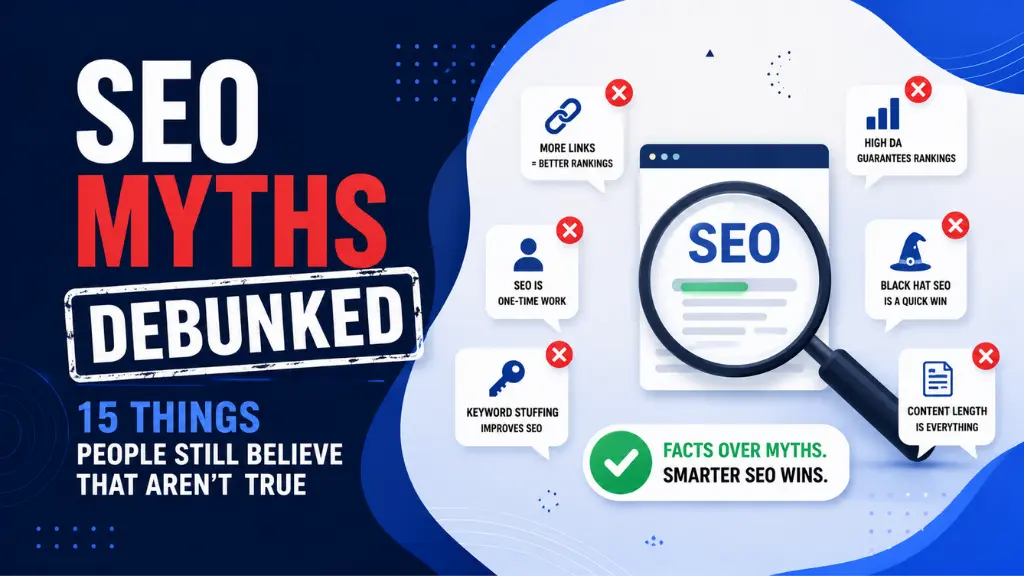

Here is the uncomfortable truth about SEO advice on the internet: a significant amount of it is outdated, never true, or actively harmful – and it keeps circulating because it sounds plausible enough that nobody questions it.
SEO myths debunked properly makes a real difference to how you invest time and budget, because myths do not just waste resources – they create the wrong priorities. A business obsessing over keyword density while ignoring Core Web Vitals, or chasing backlink quantity while producing thin content, is investing in things that do not move the needle while the levers that do go untouched.
SEO myths debunked in 2026 are particularly important because the search landscape has changed faster in the past two years than in the preceding decade. AI Overviews now appear on over 55% of search results. Google’s March and May 2026 core updates have explicitly changed what the algorithm prioritises. Beliefs formed in 2019 or 2022 are increasingly likely to be not just outdated but counterproductive.
At Search Savvy, we encounter these myths in audits and client conversations consistently – and the same fifteen misconceptions come up again and again across businesses of every size and category. Here they are, debunked with current evidence.
Why Do SEO Myths Persist in 2026?
SEO myths debunked through evidence tend to resurface because search engine optimisation is not fully transparent. Google does not publish its complete algorithm, which creates space for speculation that gets published, shared, and treated as fact. Additionally, some myths were true at one point and survived long after the underlying reality changed.
The result is an ecosystem where businesses confidently invest in things that have not mattered for years, while the mechanisms that do matter – E-E-A-T, Core Web Vitals, topical authority – are underinvested because they are less understood.
People Also Ask: Why do so many SEO myths keep circulating? Short Answer: SEO myths persist because Google’s algorithm is not fully transparent, creating space for speculation and folklore. Some myths were true in earlier algorithm versions and simply never got updated as the algorithm evolved. Others spread from low-quality content farms that publish plausible- sounding advice without verification. The safest practice is to check beliefs against Google’s own documentation, confirmed statements from Google Search Liaisons, and independent research on actual ranking data.
Myth 1: Keyword Density Matters and Has an Ideal Percentage
SEO myths debunked start here because keyword density is one of the oldest and most persistent. There is no confirmed ideal keyword density percentage – not 1%, not 2%, not any specific number. Google has stated this directly, and John Mueller has confirmed it repeatedly.
Keyword density as a ranking factor is a concept from the early 2000s. Modern Google uses semantic understanding and natural language processing to evaluate content relevance. Using a keyword in every paragraph helps nobody – using it naturally in context, alongside topically related terms, signals relevance far more effectively.
Myth 2: Meta Keywords Still Influence Rankings
SEO myths debunked in every technical audit include meta keywords. Google stopped reading the meta keywords tag as a ranking signal in 2009 and confirmed publicly that it does not use it. Adding keywords to the meta keywords field does nothing for Google rankings. Bing made a similar statement years ago.
This myth persists because the meta keywords field still exists in most CMS systems, which makes it look like it should matter. It does not. Spend that time on the meta description instead – which, while not a direct ranking factor, directly affects click-through rate from search results.
Myth 3: More Backlinks Always Means Higher Rankings
SEO myths debunked most dramatically by Google’s own spam policies include the idea that backlink quantity determines rankings. Google’s 2024 SpamBrain updates and subsequent 2025 and 2026 refinements have specifically targeted sites building large numbers of low-quality or irrelevant links.
One topically relevant, editorially placed backlink from a respected publication in your industry consistently outperforms fifty links from unrelated, low- authority directories. In 2026, backlink quality and relevance are the operative metrics – not volume.
Myth 4: Social Media Shares Directly Improve Rankings
SEO myths debunked by Google representatives themselves include the belief that social media likes, shares, and follower counts are ranking factors. Gary Illyes confirmed in 2016 that Google does not use social signals directly, and no credible evidence has emerged since to contradict this.
Social media affects SEO indirectly – through content discovery, backlink acquisition, and branded search volume – but the social signal itself does not enter Google’s ranking algorithm. Optimise social for its genuine indirect effects rather than expecting a direct rankings lift.
Myth 5: Exact-Match Domains Guarantee Better Rankings
SEO myths debunked for e-commerce and service businesses especially include the belief that owning exactmatchkeyword.com automatically produces higher rankings for that keyword. Google’s Exact Match Domain (EMD) algorithm update in 2012 specifically reduced the advantage of keyword-stuffed domain names.
In 2026, domain name is a minimal ranking signal at best. Brand authority, content quality, and technical performance matter enormously more than whether the keyword appears in the domain. Choosing a domain that supports brand building consistently outperforms chasing an exact-match string.
People Also Ask: Do exact match domains still help SEO in 2026? Short Answer: Not meaningfully. Google’s EMD algorithm update (2012) reduced the ranking advantage of exact-match domains. In 2026, domain name carries minimal ranking weight compared to content quality, backlink authority, and technical performance. A strong, memorable brand domain consistently outperforms a keyword-stuffed domain over any significant time horizon.
Myth 6: You Need to Submit Your Sitemap Every Week
SEO myths debunked around sitemaps include the idea of frequent, repeated sitemap submissions accelerating indexation. Google crawls and updates its index continuously. Submitting the same sitemap fifty times does not improve crawl frequency or indexation speed.
Submit your XML sitemap once through Google Search Console and update it when you publish significant new content. The actual levers for faster indexation are strong internal linking, fast server response times, and consistent publication of genuinely useful content – not repeated sitemap pings.
Myth 7: HTTPS Is Not Necessary for Small Websites
SEO myths debunked across all site sizes include the belief that HTTPS only matters for e-commerce or large organisations. Google confirmed HTTPS as a ranking signal in 2014, and Chrome has marked all HTTP sites as “Not Secure” since 2018. In 2026, any HTTP site is visibly flagged in browser address bars across Chrome, Firefox, and Safari – directly damaging user trust before a visitor reads a single word.
HTTPS is now a baseline technical requirement for every website of any size. Free SSL certificates are available through providers like Let’s Encrypt and are typically bundled with hosting packages. There is no budget or complexity justification for remaining on HTTP.
Myth 8: Google Ads Spending Boosts Organic Rankings
SEO myths debunked most consistently by Google’s own team include the idea that spending money on Google Ads improves organic search positions. Google Ads and Google organic search are operated by entirely separate teams with structural walls between them.
Spending on Google Ads generates paid impressions and clicks from the ad auction. It produces no organic ranking lift. Google’s own documentation explicitly states that participation in Google Ads does not influence organic rankings in any way. If you have seen this claim from an agency, it is either a misunderstanding or misinformation worth investigating.
Myth 9: All AI Content Automatically Gets Penalised
SEO myths debunked with the most current 2026 evidence include the growing belief that any use of AI for content creation leads to Google penalties. Google’s official position, reaffirmed through 2025 and 2026, is that it focuses on content quality and helpfulness, not production method.
Ahrefs’ analysis of 600,000 pages found that 81.9% of top-ranking pages include some form of AI assistance, with a correlation of 0.011 between AI content percentage and ranking position – statistically meaningless. What Google penalises is thin, unedited content published at scale to manipulate rankings – not AI as a writing tool used with genuine human editorial oversight.
People Also Ask: Does using AI to write content hurt your Google rankings? Short Answer: No, not inherently. Google evaluates content quality and helpfulness, not whether AI was involved in its creation. 81.9% of top-ranking pages include AI assistance according to Ahrefs’ 600,000-page analysis. What Google penalises is scaled content abuse – thin, low-value content published at mass volume to manipulate rankings – which can be produced with or without AI.
Myth 10: Longer Content Always Ranks Better
SEO myths debunked with the most nuance include the belief that word count directly determines rankings. Longer content tends to rank better because it more thoroughly covers a topic – not because Google rewards word count as a metric. John Mueller has stated explicitly: “We don’t have a ranking factor that counts words on a page.”
A 500-word article that completely satisfies a simple query outperforms a padded 3,000-word article targeting the same query. The correct principle is: write enough to comprehensively cover the topic better than competing results. Test what “enough” means by checking the actual word count of top-ranking pages for your specific target keyword.
Myth 11: Bounce Rate Is a Direct Google Ranking Factor
SEO myths debunked by Google’s most frequent public statements include bounce rate as a confirmed ranking signal. Google has repeatedly said it does not use Google Analytics data, including bounce rate, in its ranking algorithm.
What Google does use are engagement signals from Chrome user data – measured through NavBoost and similar systems – which track satisfaction signals like return visits and time before returning to search results. These correlate with what Analytics calls bounce rate but are measured differently and through a separate data source entirely.
Myth 12: You Only Need to Optimise a Page Once
SEO myths debunked for maintenance-averse content teams include the set-it-and- forget-it approach to on-page optimisation. Google continuously re-evaluates content as new competing pages are published, as user behaviour signals change, and as algorithm updates shift what the system rewards.
Pages that once ranked well can lose ground to competitors who update their content with newer data, better structure, or more comprehensive coverage. Quarterly content refreshes on top-performing pages – updating statistics, improving structure, and expanding coverage of emerging angles – are a standard practice for maintaining rankings long-term.
Myth 13: Ranking Position One Always Produces the Most Clicks
SEO myths debunked by 2026’s evolving SERP data include the assumption that position one automatically produces maximum click-through rate. Google AI Overviews now appear above position one for over 55% of queries globally. Featured snippets, knowledge panels, Google Shopping carousels, and “People Also Ask” boxes further interrupt the path from a user’s query to a position- one organic click.
Research tracking real-world click behaviour in 2026 finds click-through rates from position one ranging from 2% to 40% depending on query type, SERP features present, and whether an AI Overview absorbs the query without any clicks. Position one is still the strongest organic position – but it does not deliver the same predictable click volume it did three or five years ago.
People Also Ask: Is ranking #1 on Google still worth pursuing in 2026? Short Answer: Yes, but with adjusted expectations. Position one still drives the highest organic click volume for most queries, but AI Overviews and SERP features mean position-one CTR is highly variable by query type – ranging from 2% to 40% depending on what else appears on the page. Being cited in AI Overviews is now a parallel goal that can deliver impressions at scale even for pages that rank below position three.
Myth 14: Local SEO Is Only Relevant for Physical Store Locations
SEO myths debunked for service businesses operating without a public storefront include the belief that local SEO only applies to physical retail locations. Any business serving a specific geographic area – consultants, freelancers, agencies, home-service providers – benefits from local SEO through Google Business Profile, location-specific landing pages, and local citation building.
A law firm with no walk-in office but a city-specific service area can benefit from local SEO just as much as a restaurant – and in many service categories, local SEO produces the fastest initial results available for any SEO investment.
Myth 15: SEO Is Dead Because of AI Search
SEO myths debunked most urgently in 2026 include the widely circulating claim that AI search has killed SEO. It has not. What AI search has done is change the definition of SEO success – adding AI Overview citation and LLM mention tracking to the measurement framework that used to contain only keyword rankings and traffic.
The same signals that generate traditional rankings – genuine expertise, structured content, topical authority, technical performance – are exactly what AI systems use to select citation sources. SEO and AI visibility are the same strategy at their core, not competing alternatives.
The Truth Under Every Myth
SEO myths debunked in aggregate all reveal the same pattern: they focus on simple, easily measurable variables (keyword density, backlink count, word count) rather than the genuinely complex, quality-driven factors that actually determine rankings (content depth, topical authority, user engagement, technical performance, E-E-A-T). Simple is easier to talk about. Complex is what moves rankings.
According to Search Savvy’s insights from auditing and correcting SEO strategies for Indian and international clients throughout 2025 and 2026, the businesses generating the strongest organic results are almost always the ones who stopped chasing the myths early and focused on the fundamentals that Google has been consistent about for years: be helpful, be technically sound, be genuinely authoritative, and be patient.
Search Savvy builds every strategy around confirmed signals rather than folklore – because in SEO, acting on a myth is not just wasted effort, it is often an opportunity cost that leaves real performance gains sitting uncaptured while resources go elsewhere.
FAQ: SEO Myths Debunked – Your Questions Answered
Q1: How do I know if a piece of SEO advice is based on fact or myth? Cross-reference against three sources: Google’s own documentation at developers.google.com/search, confirmed statements from Google Search Liaisons and representatives like John Mueller and Gary Illyes in official channels, and independent research using real ranking data from large page samples. If advice cannot be supported by at least one of these, treat it as unverified regardless of how confidently it is presented.
Q2: Is keyword research still relevant if keyword density doesn’t matter? Yes – keyword research is more important than ever, but for different reasons than keyword density. Research identifies what topics and queries your audience actively searches for, how competitive a given term is, and how to structure content to cover an entire subject area comprehensively. It informs strategy and topic selection; keyword density as a content-writing metric is the myth.
Q3: If social signals don’t directly affect rankings, why bother with social media? Because social media drives the indirect mechanisms that do affect rankings: content discovery and backlink acquisition, branded search volume growth, content indexation speed, and referral traffic quality. Social media is the distribution layer that amplifies SEO investment – not through social signals directly, but through the downstream effects of genuine social engagement.
Q4: Does Google’s helpful content system make all the earlier ranking factors irrelevant? No. The Helpful Content system is an additional quality signal layered on top of existing ranking factors, not a replacement for them. Backlinks, technical performance, E-E-A-T, and keyword relevance all remain active signals. Helpful Content adds a holistic assessment of whether a site serves humans or search engines – sites that pass this test still need all other signals to rank.
Q5: Is there any scenario where HTTPS doesn’t matter for rankings? Very few. Google has confirmed HTTPS as a ranking signal since 2014. Chrome marks HTTP sites as Not Secure across all page types, which generates direct trust and conversion problems even before rankings are considered. For any website where user trust and conversion matter, HTTPS is non-negotiable. The cost of implementation is essentially zero with modern hosting.
Q6: Why do agencies sometimes repeat SEO myths? Some do so out of genuine misinformation – the agency itself was not trained on current evidence. Others simplify deliberately for client communication purposes, which can produce myth-adjacent messaging. A small number repeat myths that serve their interests (such as overselling the value of low-quality link building). Evaluating an agency’s claims against Google’s own documentation is the most reliable filter.
Still operating an SEO strategy based on advice you are not sure is current – or want a second opinion on whether your current approach reflects 2026 best practice rather than 2016 folklore? Visit Search Savvy for an SEO audit that evaluates your strategy against confirmed signals and identifies where effort is going into myths rather than mechanisms.