

Here is the most honest answer to the question every business owner asks before starting SEO: it depends on your starting point. But that answer is only useful if you know exactly what it depends on and what to look for at each stage.
SEO takes time to show results because Google is in the business of trust. It needs to crawl your pages, index them, evaluate your content against millions of competing pages, check user engagement data, and test your rankings at different positions before settling on where you belong. In 2026, Google’s AI-driven ranking systems are more sophisticated than at any prior point – which means the evaluation process is more thorough, not less.
SEO takes time to show results for a reason that is actually reassuring once you understand it: if rankings could be achieved overnight, spammers and manipulators would always win. The delay exists to protect the user experience Google is trying to deliver – and the brands that benefit most from SEO are exactly the ones willing to build genuine authority over a realistic timeline.
SEO takes time to show results, but “results” in 2026 looks different from what it used to mean. You can appear in Google AI Overviews before reaching position one. You can generate brand citations in AI tools without a single click. You can influence purchase decisions through knowledge panel visibility while your keyword rankings are still climbing. The 2026 definition of SEO results includes this expanded visibility, not just position tracking.
At Search Savvy, setting honest expectations is one of the most important things we do at the start of every engagement – because unrealistic timelines lead to abandonment right before the compounding phase begins. This guide gives you the most current, honest answer to the SEO timeline question for 2026.
What Is the Realistic SEO Timeline in 2026?
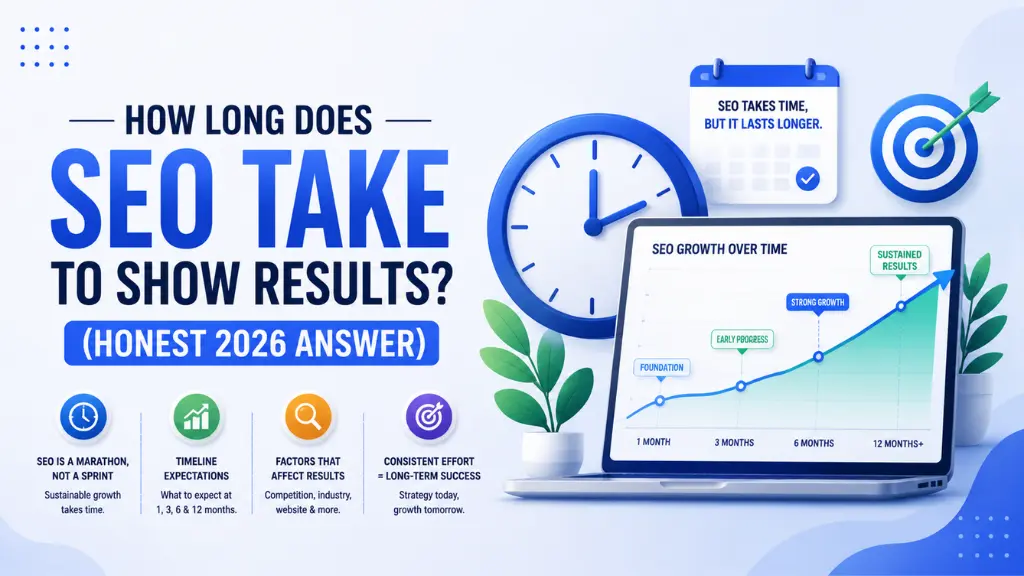
SEO takes time to show results across a range that depends heavily on your site’s current state, competition level, and resource investment. The consensus across 2026 industry data from multiple independent sources is:
- Small improvements – visible within 3 to 4 months of consistent work
- Meaningful organic growth – typically appears between 4 and 6 months
- Strong, stable results – usually require 6 to 12 months
- Full compounding effect – builds through months 12 to 24 and beyond
SEO takes time to show results partly because Google “tests” pages at different ranking positions before settling on stable placements. It is common to see a new or improved page appear briefly in position 5, drop to position 25, climb back to position 8, and gradually stabilise over several weeks – a behaviour that is entirely normal and not a sign that something is wrong.
By site type, the timeline breaks down as follows:
| Site Type | Typical First Results | Meaningful Traffic |
| Established site, some SEO history | 3–4 months | 4–6 months |
| New website, no domain history | 4–6 months | 9–12 months |
| Local business + Google Business Profile | 4–8 weeks | 3–6 months |
| E-commerce, competitive keywords | 6–8 months | 8–12 months |
| Niche / low-competition topic | 2–4 months | 4–6 months |
| Highly competitive industry (health, finance) | 9–12 months | 12–18 months |
People Also Ask: How long does SEO take for a brand new website? Short Answer: New websites with no domain history typically need 9 to 12 months before seeing significant organic traffic growth. This is because Google needs time to crawl, index, and establish trust signals for a site with no historical performance data. Starting with local SEO, targeting low-competition long-tail keywords, and publishing at a consistent frequency can meaningfully shorten this window – but the foundational trust-building phase cannot be bypassed entirely.
What Does a Realistic Month-by-Month SEO Timeline Look Like?
SEO takes time to show results across a predictable sequence of phases. Understanding what each phase delivers prevents abandonment at exactly the wrong moment.
Months 1 to 2: Foundation Phase (No Visible Results Yet)
SEO takes time to show results partly because the first two months are almost entirely invisible to external analytics. This phase covers the work that makes everything else possible:
- Comprehensive technical SEO audit and critical issue fixes
- Crawl error resolution, Core Web Vitals assessment, and sitemap submission
- Keyword research, competitor analysis, and content strategy development
- On-page optimisation of existing priority pages
- Google Analytics 4 and Search Console setup and baseline tracking
SEO takes longer when this phase is skipped or rushed. Sites that begin publishing content before fixing technical blockers – crawl errors, poor Core Web Vitals, broken internal linking – spend months producing content that Google cannot efficiently discover or evaluate.
Months 3 to 4: Early Signals Phase
SEO takes time to show results, but months three and four typically deliver the first visible signals. Pages begin showing movement in Search Console impressions even before clicks follow. Low-competition, long-tail keywords may surface on page two or three. Indexation improves as Googlebot recognises the site’s improved structure.
Technical SEO fixes specifically tend to produce the fastest early results. Resolving crawl errors and improving Core Web Vitals can trigger ranking improvements faster than any other category of change, because they remove friction that was blocking Google’s ability to evaluate the content at all.
The most dangerous phase for abandonment: most businesses who quit SEO early do so in month four, right before measurable organic growth begins arriving in month five or six.
Months 5 to 6: First Meaningful Growth
SEO takes time to show results, and months five and six are typically where the first meaningful evidence of compounding arrives. Organic traffic shows consistent upward momentum as pages gain authority. Target pages begin ranking on page one for less competitive terms. Content published in months one and two starts attracting backlinks as it has had time to be discovered and evaluated.
This is also the phase where conversion-relevant rankings – transactional and commercial keywords rather than purely informational ones – start producing actual enquiries and revenue, not just impressions.
Months 7 to 12: Authority Building and Stabilisation
SEO takes time to show results at scale, and the 7 to 12 month window is where strategies begin compounding meaningfully. Multiple pages ranking simultaneously, strong positions stabilising rather than fluctuating, and organic traffic becoming a reliable, predictable channel rather than an unpredictable one.
Sites that have published consistently, earned quality backlinks, and maintained technical health through this window typically achieve their first top-10 rankings by month 8 to 9 and begin seeing genuine revenue impact from organic search.
People Also Ask: When should I start seeing results from SEO? Short Answer: Expect first visible signals – Search Console impressions increasing, low-competition keywords surfacing on page two or three – between months three and four. Expect meaningful organic traffic growth between months four and six. Expect stable, compounding results from month six through twelve. Sites that have done prior SEO work, or target low-competition niches, often see early signals sooner; brand-new sites in competitive industries often see them later.
What Factors Control How Quickly SEO Shows Results?
SEO takes time to show results at different speeds for different sites, and five specific factors determine which end of the timeline you are on.
Factor 1: Domain Age and Historical Authority
SEO takes longer for brand-new websites because Google has no historical data on which to evaluate their trustworthiness. An established website that has been active for three or more years typically begins responding to new SEO work within weeks rather than months – because it has already passed Google’s baseline trust evaluation. A domain purchased last month starts from zero.
Factor 2: Technical Health at Baseline
SEO takes longer when a site has significant technical problems – crawl errors, slow load times, mobile usability failures, duplicate content, and broken internal links. Every month spent fixing these issues is a month of delay before content and backlinks can produce their full effect. Google’s March 2026 Core Update specifically increased the weight of Core Web Vitals performance signals – making technical health a direct timeline variable, not just background work.
Factor 3: Competition Level for Target Keywords
SEO takes time to show results in direct proportion to how much competition exists for the target keywords. Ranking for “best SEO agency in India” requires competing against established, authoritative sites that have been building signals for years. Ranking for “technical SEO audit for Pune e-commerce brands” faces far less competition and can produce results significantly faster.
Starting with low-competition, long-tail keywords is the most reliable way to accelerate early results while building the authority needed to compete for higher-volume terms over time.
Factor 4: Content Quality and Publication Frequency
SEO takes longer when content is thin, generic, or published sporadically. Sites that publish two to four high-quality, well-structured posts per month consistently see faster results than those that publish a batch every few months. Google’s Helpful Content systems in 2026 are specifically designed to identify and deprioritise content that lacks genuine depth, original insight, and demonstrable expertise – making content quality a direct speed variable.
Factor 5: Backlink Earning Rate
SEO takes time to show results partly because backlinks remain one of Google’s strongest ranking signals in 2026, and they are earned, not installed. Sites that earn high-quality, editorially placed backlinks from relevant sources consistently climb faster than those relying on content alone. Digital PR, original research, guest contributions to relevant publications, and genuinely shareable content are the most reliable backlink-earning strategies.
People Also Ask: Can you speed up how long SEO takes to show results? Short Answer: Yes, within limits. You can accelerate the timeline by fixing technical issues immediately before investing in content, targeting low-competition long-tail keywords for early wins, publishing consistently at a higher frequency, and earning quality backlinks proactively through digital PR and original research. You cannot force Google’s trust-building timeline, but you can remove every friction point that extends it unnecessarily.
What Does “SEO Results” Actually Mean in 2026?
SEO takes time to show results, but the definition of “results” has expanded significantly in 2026. Measuring SEO purely by keyword rankings and organic click counts misses a growing portion of how SEO investment is actually delivering value.
Up to 55% of Google searches now display an AI Overview above traditional results. Up to 58% of searches end without a click. This means a page can be influencing thousands of buying decisions per month – through AI citation, knowledge panel visibility, and brand recognition – without those decisions appearing in click-count analytics.
SEO results in 2026 should be measured across:
- Search Console impressions – brand exposure even without clicks
- AI Overview citations – tracked through tools like Semrush Visibility Overview or SE Ranking
- Branded search volume growth – the most reliable signal of accumulated authority
- Keyword ranking movement – tracked across groups of terms, not just one or two head keywords
- Organic conversion rate – how efficiently organic traffic converts relative to paid
Why Do Businesses Quit SEO Before Results Arrive?
SEO takes time to show results, and the abandonment pattern is consistent across industries and team sizes. The most common abandonment point is months three to four – precisely the phase where the first meaningful results are two to six weeks away.
The reasons are predictable:
- Expecting paid-ad-style instant results from an organic, compounding channel
- Measuring SEO by traffic alone rather than Search Console impressions, indexing progress, and keyword movement during the foundation phase
- Leadership pressure when visible traffic metrics are flat despite significant behind-the-scenes progress
- Switching strategies mid-process and resetting the compounding momentum that had been building
The businesses that benefit most from SEO are those that understand the compounding timeline from the start and measure early phases by leading indicators – indexation progress, impression growth, crawl frequency – rather than waiting for traffic as the only acceptable signal of progress.
How Should Indian Businesses Approach the SEO Timeline?
SEO takes time to show results for Indian businesses in exactly the same timeframe as anywhere globally, but local SEO specifically can produce meaningful visibility significantly faster. Google Business Profile optimisation for Indian local businesses – reviews, category selection, service-area pages – can show improved map visibility within 4 to 8 weeks, making local SEO the fastest first win available for any business serving a specific city or region.
Indian businesses in competitive verticals – real estate, education, healthcare, financial services – should plan for the longer end of the timeline and ensure that leadership expectations are set against the 6 to 12 month window from the outset, since these categories are among the most competitive in Indian search.
According to Search Savvy’s insights from managing SEO for Indian SMB and D2C clients through 2025 and 2026, the single most common timeline extension is not competition or content – it is technical issues discovered after the content investment has already begun. Starting with a thorough technical audit before any content or link work dramatically shortens the overall path to results.
Conclusion: Patience Is a Strategy, Not a Weakness
SEO takes time to show results. This is not a limitation or a failure of the approach – it is the mechanism that makes the results durable, compounding, and genuinely competitive when they arrive. Paid ads stop the moment the budget runs out. SEO results continue delivering returns long after the investment that generated them.
Search Savvy, we would rather set an honest 12-month expectation and overdeliver than promise three-month results and abandon a client relationship that was weeks away from breakthrough. The businesses that get the most from SEO are the ones who treat it as infrastructure, not a campaign.
FAQ: How Long Does SEO Take to Show Results – Your Questions Answered
Q1: How long does SEO take for a completely new website? New websites typically need 9 to 12 months to see significant organic traffic growth, since Google needs time to evaluate a domain with no historical trust signals. Starting with local SEO, targeting long-tail low-competition keywords, publishing consistently, and building a small number of high-quality backlinks can shorten this window – but the foundational trust phase cannot be fully compressed.
Q2: What is the fastest type of SEO to show results? Local SEO combined with Google Business Profile optimisation is the fastest pathway to visible results in most markets. Improved map visibility for local keywords can appear within 4 to 8 weeks of consistent GBP management. Technical SEO fixes – resolving crawl errors and improving Core Web Vitals – can also trigger early ranking movement within weeks for established sites.
Q3: Is 3 months enough time to see SEO results? Early signals – Search Console impressions increasing, low-competition keywords appearing on page two or three – are often visible within 3 months of consistent work. Meaningful traffic growth typically requires 4 to 6 months. Expecting significant revenue impact within 3 months on a competitive keyword strategy sets an unrealistic standard that almost no legitimate SEO programme meets.
Q4: How is the SEO timeline affected by the 2026 Google updates? Google’s March and May 2026 core updates increased the weight of Core Web Vitals performance signals and further penalised thin or AI-generated content without genuine editorial oversight. Sites with strong technical foundations and genuine content depth are responding faster to SEO investment than those needing significant quality remediation first. The timeline for quality-first sites has not extended; the timeline for low-quality content sites has.
Q5: Should I pause SEO and run paid ads while waiting for results? Running both simultaneously is the most efficient strategy. PPC delivers immediate traffic and conversion data while SEO builds the organic foundation. The data from paid ads – which keywords convert, which pages perform, which audience segments respond – directly informs and accelerates the SEO strategy, making the two channels genuinely complementary rather than competing for the same budget.
Q6: How do I know if my SEO is working before traffic increases? Track leading indicators in Google Search Console from the outset: indexation rate (are priority pages being indexed?), total impressions (is Google showing pages more often?), average position movement (are target keywords climbing?), and crawl frequency (is Googlebot visiting the site more often?). All four of these metrics move before organic traffic does – making them the correct early-phase success indicators when it is too soon to expect traffic growth.
Starting SEO and wondering what to actually expect in the first six months – or have you been running SEO for a year without seeing the results you expected? Visit Search Savvy for an SEO audit that assesses where you are in the timeline, what is blocking progress, and what realistic results look like for your specific site, category, and competition level.