Marketing Mix Modelling (MMM): Measuring Channel Contribution Without Third-Party Cookies

If your attribution reports have started adding up to more than 100% of actual revenue – your last-click dashboard claims one thing, your Meta reporting claims another, and neither number survives contact with your finance team – you’re not imagining the problem. Multi-touch attribution was built on identity tracking that’s been quietly eroding for years, and Marketing Mix Modelling (MMM) has re-emerged as the measurement method that doesn’t depend on any of it. It’s a decades-old statistical technique, and in 2026 it’s genuinely back at the center of how serious marketing teams measure channel contribution – not out of nostalgia, but because it was built for exactly this problem from the start.
In this article11 sections
This guide, shaped by the measurement work we do for clients at Search Savvy, explains what MMM actually is, why the identity data that used to power attribution has degraded even faster than most marketers realize, and how to build a practical, current measurement approach around it.
What Is Marketing Mix Modelling, and Why Is It Suddenly Everywhere Again?#
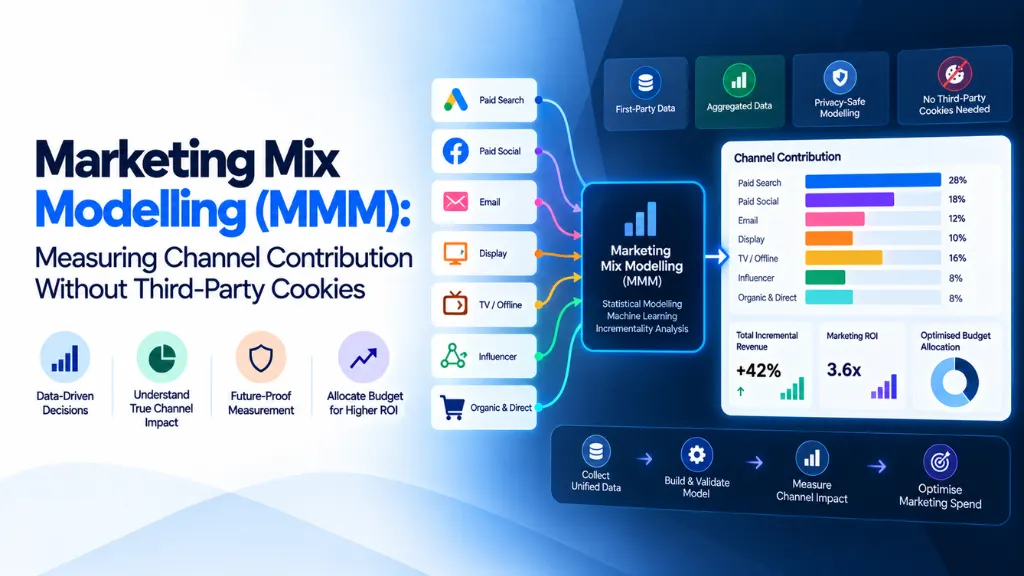
Marketing Mix Modelling is a statistical technique, typically built on regression or Bayesian methods, that uses aggregated historical data – weekly or monthly spend by channel, alongside sales and external factors like seasonality, pricing, and even weather – to estimate how much each channel actually contributed to business outcomes. Critically, it requires no user-level tracking, no device IDs, and no cookies, because it works entirely on aggregate patterns rather than following individual people across browsing sessions.
The discipline’s roots go back further than most digital marketers realize. Simon Broadbent, a Cambridge-trained mathematician who moved into advertising in the 1960s, was among the first to apply rigorous econometric modelling to isolate advertising’s effect on sales from the noise of pricing and distribution changes – a problem many at the time doubted could be solved at all. He coined the concept of “adstock” in the 1970s, capturing the idea that advertising’s effect builds and decays over time rather than happening all at once, a concept still embedded in nearly every modern MMM tool. In an obituary tribute after Broadbent’s death, his son Tim Broadbent, himself an advertising executive, described his father’s approach as combining “the rigour of a mathematician and the clarity of a poet” – a fitting description for a discipline that turns messy real-world marketing data into something a CFO can actually act on.
What’s the Difference Between MMM and Multi-Touch Attribution?#
Multi-touch attribution (MTA) tracks individual users across touchpoints – typically via cookies or device identifiers – and assigns fractional credit to each ad along the path to a conversion. It requires identity resolution to work, which is precisely what’s become unreliable. MMM works at a completely different level: it analyzes aggregate trends across an entire market or account, without needing to know anything about any single user’s journey. The trade-off is real – MMM can’t tell you which specific ad a specific customer clicked before converting, but it doesn’t need that information to estimate whether your total YouTube spend is driving incremental sales, which is a question MTA increasingly can’t answer reliably either.
Why Did Third-Party Cookies Stop Being a Reliable Foundation?#
The popular narrative was that Chrome’s planned deprecation of third-party cookies would be the event that broke attribution. That’s not quite what happened, and the actual story is more instructive. Google ultimately backed away from a full, forced deprecation in Chrome, opting instead for a user-choice model rather than eliminating cookies outright. But that reversal didn’t rescue identity-based tracking, because Chrome was never the only source of signal loss. Safari’s Intelligent Tracking Prevention and Firefox already block third-party cookies by default, and Apple’s App Tracking Transparency framework, in place since 2021, had already gutted mobile attribution well before Chrome’s decision was finalized.
The cumulative effect shows up clearly in practitioner estimates: usable identity coverage for multi-touch attribution has fallen to roughly 30% to 60% by 2026, down from the 90%-plus coverage teams could rely on during the cookie era. More than 60% of the web is now effectively cookieless in practice, regardless of what Chrome ultimately decided.
Did Google Ever Actually Deprecate Third-Party Cookies in Chrome?#
No – Google canceled its plan for full deprecation and moved to a user-choice approach instead, letting individuals opt in or out rather than removing third-party cookies from Chrome entirely. This is a common point of confusion, since so much measurement strategy over the past few years was built around an assumption of full deprecation that never actually arrived in Chrome specifically. The practical reality for marketers is that the underlying signal-loss problem persists regardless, driven by other browsers and platform-level privacy controls that were never contingent on Chrome’s decision in the first place.
How MMM Actually Works, Without Any User-Level Data#
A typical MMM regresses aggregate sales against spend levels across each channel, alongside control variables like seasonality, pricing changes, competitor activity, and broader economic conditions, to statistically isolate how much each input actually moved the outcome. Two concepts do most of the heavy lifting in a well-built model:
Adstock, Broadbent’s original contribution, models the fact that advertising’s effect doesn’t happen instantly and doesn’t disappear immediately – a TV ad or a YouTube campaign can keep influencing purchase behavior for weeks after it stops running, and a model that ignores this will systematically undervalue channels with strong long-term brand effects.
Saturation curves capture diminishing returns: the first dollars of spend on a channel typically generate more incremental impact than the marginal dollar spent once a channel is already heavily saturated, which is why pouring more budget into a channel that tested well at a lower spend level often disappoints.
Modern tools have moved from simple linear regression toward Bayesian methods, which let a model incorporate prior knowledge and produce more stable estimates even with a moderate amount of historical data – a meaningful improvement over older approaches that needed years of clean data to be reliable.
Google Meridian and Meta Robyn: The Open-Source Shift#
For most of MMM’s history, building one meant hiring a specialist agency, waiting months, and paying a six-figure fee for a slide deck at the end. That barrier has largely collapsed – a shift we’ve watched change what’s realistic for clients at Search Savvy over the past two years. Google launched Meridian, an open-source Bayesian MMM, in March 2024, reaching general availability in January 2025, backed by a partner program of more than 20 certified implementation agencies. Meridian pulls in Google’s own media and search query volume data directly, which helps control for organic demand when isolating the effect of paid search – a persistent challenge in MMM going back decades. In its own announcement, Google was candid about where the discipline still stands, noting plainly that “MMMs today are not perfect, but are evolving.”
Google cited Kantar research showing 60% of US advertisers were already using MMM at Meridian’s launch, with 58% of non-users actively considering it. Separately, Deloitte measurement research found that C-level leaders who placed high importance on MMM were more than twice as likely to exceed revenue goals by 10% or more – a signal this isn’t just a measurement preference but a genuine business advantage. Meta’s own open-source alternative, Robyn, uses a different underlying regression approach, giving teams a real choice depending on media mix and existing data science capacity.
MMM’s Real Limitations, and Why 2026 Best Practice Is Triangulation#
MMM isn’t a silver bullet, and treating it as one creates the same false confidence that hurt attribution. It typically needs at least a couple of years of clean weekly data to produce reliable estimates, works at an aggregate level unsuited to real-time tactical optimization, and can struggle to cleanly separate the effects of channels whose spend tends to move together. Most importantly, an MMM output is a modeled estimate, not a record of what actually happened – the same honest framing Google applies to its own attribution products.
That’s why the emerging 2026 consensus isn’t “MMM instead of attribution” – it’s triangulation: using MMM for strategic, longer-term budget allocation, incrementality testing to validate the model’s estimates on your largest channels, and attribution for tactical, in-flight, week-to-week signal. A January 2026 survey of 500 senior US decision-makers found that independent incrementality testing – geo-holdout experiments that withhold spend in specific markets to observe what happens without it – earned more trust than either marketing mix modelling or standard in-platform attribution reporting, precisely because it requires no modeling assumptions at all, just a controlled real-world test.
Is MMM More Accurate Than Multi-Touch Attribution?#
Not automatically, and it’s more useful to think of them as answering different questions rather than competing on accuracy. MMM is generally more durable and less biased than attribution in a privacy-constrained environment, since it doesn’t depend on identity coverage that keeps shrinking. But the same 2026 research showing growing distrust of both models also shows that decision-makers place the most confidence in incrementality testing specifically, which is why the strongest measurement stacks in 2026 use MMM for strategy, incrementality tests for validation, and attribution as a supplementary, clearly-labeled directional signal rather than a single source of truth.
Getting Started with MMM: A Practical Path#
- Assess your data readiness first. Ideally two to three years of clean, weekly channel spend and outcome data, since a rushed model built on thin history produces unstable, unreliable estimates.
- Choose an open-source foundation that fits your media mix. Meridian integrates naturally if your spend leans heavily on Google’s own channels; Robyn or a vendor solution may fit better for a more fragmented media mix or limited in-house data science capacity.
- Build in adstock and saturation curves from the start rather than assuming a simple linear relationship between spend and outcome – this is where naive, quickly-built models go wrong most often.
- Validate the model’s biggest estimates with incrementality tests on your largest channels, since a geo-holdout experiment can confirm or challenge what the model is telling you with real-world evidence rather than another layer of assumptions.
- Treat the output as a living, refreshable estimate, not a one-time report – refresh the model as new data comes in and market conditions shift, rather than treating a single MMM exercise as a permanent budget allocation.
- Keep attribution in the stack for tactical, short-term signal, clearly labeled as a directional estimate rather than ground truth, since it still has real value for in-flight optimization even as its long-term reliability has declined.
This kind of layered measurement approach – MMM, incrementality, and attribution working together rather than competing – is exactly the framework we help clients build at Search Savvy as identity-based tracking keeps eroding. Our Performance Marketing Services page covers how we typically structure this kind of measurement work, and our Analytics and Reporting glossary is a useful shared reference if some of this terminology is new to parts of your team.
FAQ: Marketing Mix Modelling#
What is Marketing Mix Modelling in simple terms? It’s a statistical technique that uses aggregated historical data on spend, sales, and external factors to estimate how much each marketing channel contributed to business outcomes, without tracking any individual user.
Why is MMM becoming popular again in 2026? Because identity-based tracking that multi-touch attribution depends on has degraded significantly due to browser privacy changes and mobile tracking restrictions, while MMM requires no user-level data at all, making it naturally resilient to those same changes.
Is Marketing Mix Modelling free to use? Open-source tools like Google’s Meridian and Meta’s Robyn have eliminated the licensing cost that once made MMM enterprise-only, though building a reliable model still requires meaningful data science expertise and clean historical data.
How much historical data does MMM need to work well? Most practitioners recommend at least two to three years of clean, weekly spend and outcome data, since thinner history produces less stable and less reliable estimates.
Should I use MMM instead of attribution? No. The strongest 2026 measurement approaches combine MMM for strategic budget allocation, incrementality testing to validate the model’s biggest estimates, and attribution for tactical, short-term optimization signal, rather than relying on any single method alone.
Did Chrome ever actually remove third-party cookies? No. Google canceled its plan for full third-party cookie deprecation in Chrome and moved to a user-choice model instead, but Safari, Firefox, and mobile app tracking restrictions had already caused significant identity signal loss regardless of Chrome’s decision.
The Bottom Line#
Marketing Mix Modelling isn’t a retro throwback to pre-digital measurement – it’s a genuinely well-suited answer to a privacy-constrained marketing environment that isn’t going back to the identity-rich tracking of the 2010s. Build it on clean historical data, respect the adstock and saturation effects that shape how advertising actually works, and pair it with incrementality testing rather than treating either method as a complete answer on its own. The teams getting real value from measurement in 2026 aren’t the ones who found the one perfect model – they’re the ones who stopped expecting any single number to be ground truth.